
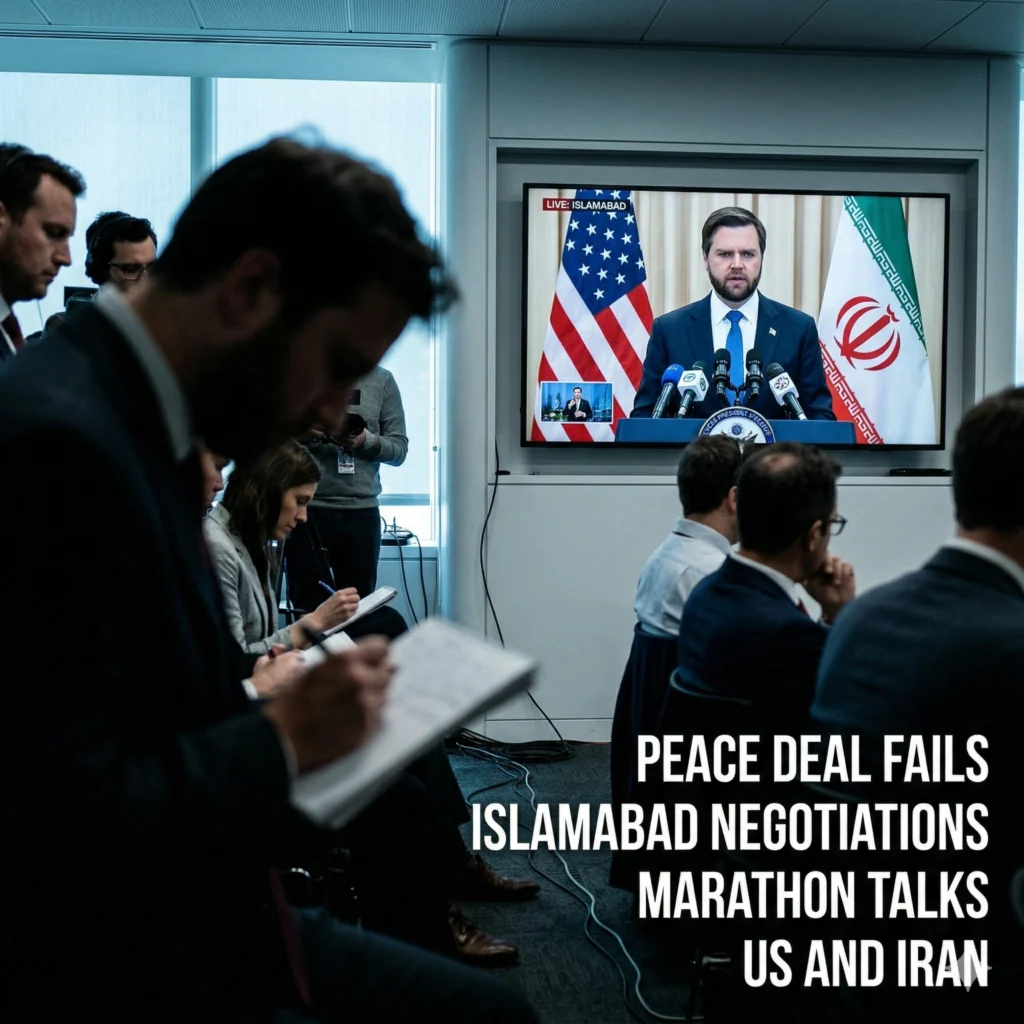
The high-stakes US-Iran peace deal failed to materialize this Sunday after a grueling 21-hour marathon of negotiations in Islamabad, Pakistan. US Vice President JD Vance announced that despite flexible efforts and “substantive agreements” on minor points, the core differences regarding nuclear guarantees and regional security remained insurmountable. The world watched with bated breath as the highest-level direct engagement since 1979 ended without a signature, leaving a fragile two-week ceasefire in a state of high-pressure uncertainty.
The failure to secure a US-Iran peace deal has immediate ramifications for global energy markets, particularly as the Strait of Hormuz remains a contested chokepoint. While Pakistani mediators like Foreign Minister Ishaq Dar characterized the discussions as “intense and constructive,” the departure of both delegations from Nur Khan air base without a framework suggests a significant setback. This article explores the intricate details of these failed negotiations and what they mean for the future of global stability and the ongoing regional military crisis.
The Core Obstacle to a US-Iran Peace Deal
The primary reason a US-Iran peace deal could not be finalized centered on the American demand for an “affirmative commitment” from Tehran regarding its nuclear program. Vice President JD Vance explicitly stated that the United States required a guarantee that Iran would not seek nuclear weapons or the tools to develop them rapidly. This “red line” proved too restrictive for the Iranian delegation, which maintains its right to peaceful nuclear technology under international law.
During the overnight sessions, technical papers were exchanged, but the gap between “nuclear rights” and “nuclear restrictions” was too wide to bridge. The American team described their proposal as a “final and best offer,” yet the Iranian Ministry of Foreign Affairs countered that the demands were excessive and unlawful. Without a compromise on this fundamental core principle, the path to a US-Iran peace deal remains blocked by deep-seated mistrust that has spanned decades.
Impact on the Strait of Hormuz and Energy Markets
A secondary but equally critical sticking point in the US-Iran peace deal negotiations was the management of the Strait of Hormuz. Iran has recently exerted control over this strategic waterway, mining sections and demanding tolls from passing vessels. The failure to reach an agreement means that Tehran is likely to maintain its grip on this corridor, which is vital for one-fifth of the world’s oil supply.
- Global oil prices are expected to face renewed upward pressure as the “war premium” remains.
- Shipping insurance rates for tankers transiting the Persian Gulf are likely to stay at record highs.
- The US Navy’s presence in the region will continue to be a point of military friction.
The lack of a US-Iran peace deal ensures that the “mine-sweeping” operations mentioned by President Trump will continue to be a necessity. Iranian Revolutionary Guards have already threatened to deal severely with any military vessels transiting the strait without their explicit permission. This ongoing tension makes the prospect of a stabilized global energy market seem like a distant dream.
Pakistan’s Role as a Mediator in the Peace Process
Pakistan’s Foreign Minister Ishaq Dar and Chief of Army Staff Field Marshal Asim Munir played pivotal roles in bringing the two superpowers to the table. The Islamabad negotiations were a testament to Pakistan’s unique diplomatic position, acting as a bridge in an “atmosphere of mistrust.” Even though a US-Iran peace deal was not signed, the fact that both parties engaged in face-to-face dialogue for 21 hours is seen by some as a procedural victory.
Minister Dar urged both nations to uphold the existing ceasefire, emphasizing that regional prosperity depends on the avoidance of a return to open warfare. Islamabad has offered to remain a permanent venue for future discussions, should both sides decide to return to the table. However, the departure of JD Vance on Air Force Two without a follow-up date suggests that the “facilitation” role of Pakistan has reached its current limit.
Why the US-Iran Peace Deal Failed to Meet Expectations
Many analysts believe the expectations for a comprehensive US-Iran peace deal were perhaps too high for a single summit. Iranian officials noted that it was “natural” not to reach a deal in one session, especially given the historical baggage involved. The US delegation, however, appeared to be looking for a definitive “yes or no” on their specific terms, which Tehran viewed as an attempt at “capitulation” rather than negotiation.
The “mood swings” reported by officials during the overnight sessions reflected the volatility of the discussions. At times, a breakthrough seemed near as minor agreements were reached, but the conversation inevitably stalled when it returned to sanctions relief and war reparations. The failure of the US-Iran peace deal in this instance highlights that while the parties are talking, they are not yet speaking the same language of compromise.
The Future of the Ceasefire Without a Signed Agreement
The most immediate concern following the failed US-Iran peace deal is the status of the current ceasefire. While the truce remains in effect for now, it is describe as “shaky” and “uncertain.” Without a formal peace framework, any small skirmish or misunderstanding in the Persian Gulf could escalate into a full-scale resumption of hostilities.
- Military commanders on both sides are reportedly on high alert following the summit’s end.
- Domestic pressure in both Washington and Tehran may limit the room for future diplomatic flexibility.
- International allies are calling for an immediate return to “indirect” channels to prevent a total collapse.
The US-Iran peace deal was meant to be the “off-ramp” for a six-week-old military crisis that has already claimed thousands of lives. Now, the absence of an agreement forces the international community to brace for a prolonged period of “no peace, no war.” This gray zone is notoriously difficult to manage and requires constant diplomatic maintenance to prevent a catastrophic breakdown.
US-Iran Peace Deal
The quest for a US-Iran peace deal continues to be the most pressing challenge for the Trump administration’s foreign policy in 2026. Vice President Vance’s departure from Islamabad marks the end of a historic chapter, but the book on this conflict is far from closed. The American proposal remains on the table, and the world is now waiting to see if Tehran will eventually find the terms acceptable or if a new cycle of escalation is inevitable.
In the coming weeks, the focus will shift back to the United Nations and the Strait of Hormuz. If the US-Iran peace deal remains elusive, the “maximum pressure” tactics of the past may return with even greater intensity. For now, the people of the region can only hope that the “spirit of Islamabad” eventually leads to a more durable and lasting resolution than what was achieved this Sunday morning.
Key Points of Contention in the Failed Peace Treaty
To understand why the US-Iran peace deal was not signed, one must look at the specific technical disagreements. Iran sought the immediate lifting of all primary and secondary sanctions, which the US was only willing to do in phases tied to verification. Furthermore, Iran demanded recognition of its authority to collect transit fees in the Strait of Hormuz—a point the US delegation flatly rejected as a violation of international maritime law.
These specific details are what ultimately sank the US-Iran peace deal during the final hours of the marathon. As technical experts from both sides packed their bags, the realization dawned that the “best and final offer” from Washington was simply not enough to satisfy Tehran’s requirements for “nuclear rights.” This deadlock ensures that the shadow of war will continue to hang over the Middle East for the foreseeable future.
Summary of the Islamabad Summit Results
The attempt to forge a US-Iran peace deal in 2026 will go down in history as a moment of missed opportunity. While the face-to-face engagement was a milestone, the results were a reminder of the deep ideological and strategic canyons that divide the two nations. As the sun rose over Islamabad on Sunday, the only thing clear was that the search for peace remains as complicated as ever.
The US-Iran peace deal remains the ultimate prize for regional stability, yet it remains just out of reach. For the millions of people affected by the war and the global economic tremors it causes, the failure in Pakistan is a sobering reality check. The path forward is narrow, and the stakes for the next round of diplomacy—if there ever is one—have never been higher.
For more details & sources visit: CNN
For the latest updates from the United States, visit our U.S. news page.