
US-Iran Negotiations Crisis has reached a boiling point after high-stakes diplomatic discussions in Islamabad ended without a formal resolution. The failure of these marathon talks places the fragile regional ceasefire under immense pressure while global energy markets remain in a state of extreme volatility.
Following twenty-one hours of intense deliberation, Vice President JD Vance confirmed that the American delegation is departing Pakistan after presenting their final proposal. This high-level engagement was intended to provide a roadmap for peace, yet the US-Iran Negotiations Crisis deepened as both sides remained firm on non-negotiable security demands.
The primary obstacle during the summit involved Iran’s refusal to provide affirmative commitments regarding its nuclear program’s future trajectory. While the United States demanded a total guarantee against nuclear armament, the Iranian delegation focused heavily on the removal of economic sanctions and war reparations.
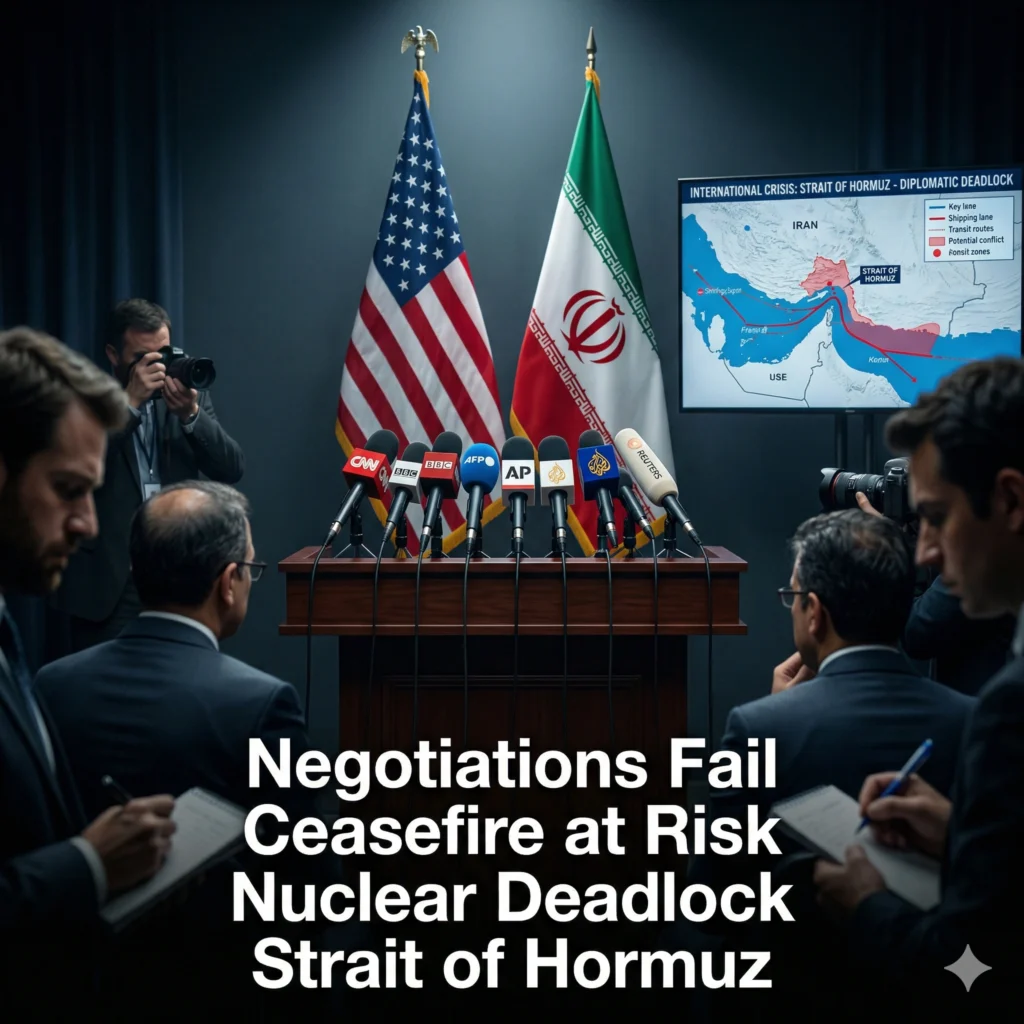
US-Iran Negotiations Crisis
The US-Iran Negotiations Crisis represents the most significant diplomatic hurdle the two nations have faced since the 1979 Islamic Revolution. For two days, Islamabad became the center of the world’s attention as mediators attempted to bridge a decades-old chasm of distrust.
Despite the gravity of the situation, the parties could not find common ground on the sequencing of sanctions relief versus nuclear inspections. This stalemate suggests that the US-Iran Negotiations Crisis will continue to dictate the geopolitical climate of the Middle East for the foreseeable future.
Experts suggest that the failure of these talks may lead to an immediate escalation in maritime tensions, as the strategic Strait of Hormuz remains blocked. Without a clear path forward, the US-Iran Negotiations Crisis threatens to undo months of back-channel diplomacy aimed at preventing a full-scale regional war.
Strategic Importance of the Strait of Hormuz
The closure of the Strait of Hormuz remains the most pressing economic consequence of the ongoing US-Iran Negotiations Crisis. As a primary chokepoint for global oil supplies, the continued blockade has sent shockwaves through international stock exchanges and energy markets.
During the discussions, Iranian officials linked the reopening of the waterway directly to the total lifting of Western economic restrictions. However, the American team viewed this as a secondary issue that could only be addressed after nuclear security was firmly established.
Consequently, the US-Iran Negotiations Crisis has left global shipping companies in a state of high alert, with many rerouting vessels at massive expense. The economic toll of this diplomatic failure is expected to manifest in higher fuel prices across the United States and Europe.
Role of Pakistan as a Regional Mediator
Pakistan played a pivotal role in hosting this historic summit, placing Islamabad under a total security lockdown to ensure the safety of the delegations. The Pakistani government acted as a neutral bridge, facilitating communication during the most heated moments of the US-Iran Negotiations Crisis.
- Pakistan provided a secure, neutral venue for direct high-level engagement.
- Local officials coordinated logistics for over twenty hours of continuous talks.
- The mediation team attempted to find a compromise on the issue of war reparations.
- Security forces maintained a strict perimeter to prevent any external interference.
While the outcome was not a signed agreement, the logistical success of the meeting showcased Pakistan’s growing influence in Middle Eastern diplomacy. Nevertheless, the underlying US-Iran Negotiations Crisis proved too complex for a single round of mediation to resolve.
Impact on Global Energy Markets
The immediate reaction to the US-Iran Negotiations Crisis was a sharp spike in crude oil futures as traders realized no deal was imminent. Markets had optimistically priced in a potential easing of tensions, but those gains were erased within minutes of the US departure announcement.
Global energy security is now at its most vulnerable point in years, with no clear timeline for when the maritime blockade might end. Analysts warn that the US-Iran Negotiations Crisis could lead to a sustained period of triple-digit oil prices if the ceasefire collapses.
Furthermore, the lack of a diplomatic breakthrough means that energy-dependent nations in Asia must look for alternative suppliers. This shift in the global supply chain is a direct byproduct of the unresolved US-Iran Negotiations Crisis and its impact on trade routes.
Nuclear Commitments and National Security
At the heart of the US-Iran Negotiations Crisis is the fundamental disagreement over Iran’s sovereign right to a nuclear program. The United States maintains that any deal must include “breakout time” safeguards that are verifiable by international inspectors.
Iran, however, views these demands as an infringement on its national sovereignty and a violation of previous understandings. This ideological clash has fueled the US-Iran Negotiations Crisis, making it nearly impossible to draft a document that satisfies both domestic audiences.
Vice President Vance emphasized that the American people require a guarantee that Iran will never possess the tools to create a nuclear weapon. Until this condition is met, the US-Iran Negotiations Crisis is likely to persist as a defining feature of American foreign policy.
US-Iran Negotiations Crisis
The Iranian delegation arrived in Islamabad wearing mourning attire, a symbolic gesture to honor the late Supreme Leader Ayatollah Ali Khamenei. This visual reminder of the internal Iranian political landscape added a layer of complexity to the US-Iran Negotiations Crisis.
For the Iranian leadership, the talks were as much about domestic legitimacy as they were about international relations. Any concession made during the US-Iran Negotiations Crisis would have to be framed as a victory for the Islamic Republic’s revolutionary principles.
This domestic pressure on both sides created a rigid environment where neither party felt empowered to make the necessary compromises. As a result, the US-Iran Negotiations Crisis remains a stalemate that endangers the lives of millions in the region.
Future of the Regional Ceasefire
The two-week ceasefire currently in place is now the only thing preventing a return to active hostilities. However, the failure of the talks has made this truce incredibly fragile, as the US-Iran Negotiations Crisis enters a more volatile phase.
Military analysts suggest that both nations may now seek to increase their leverage through proxy actions or increased naval presence. If the US-Iran Negotiations Crisis is not managed carefully, the current silence of the guns could be short-lived.
- Military commanders on both sides are reportedly reviewing their rules of engagement.
- Regional allies are being briefed on the potential for a resumption of conflict.
- Humanitarian organizations are warning of the consequences of a failed peace process.
The international community is now calling for a second round of discussions to prevent a total collapse of the regional order. The US-Iran Negotiations Crisis has proven that while dialogue is possible, true reconciliation remains a distant and difficult goal.
Humanitarian Concerns and Sanctions
The civilian population in Iran continues to bear the brunt of the economic fallout from the US-Iran Negotiations Crisis. Sanctions have limited the availability of certain medical supplies and consumer goods, leading to widespread inflation and hardship.
During the summit, the Iranian delegation presented evidence of the humanitarian impact of these restrictions, urging the US to show flexibility. The American response remained tied to security benchmarks, illustrating the cold logic of the US-Iran Negotiations Crisis.
Without a breakthrough, the prospect of sanctions relief remains slim, which could lead to further social unrest within Iran. The US-Iran Negotiations Crisis is therefore not just a military or political issue, but a profound human rights challenge.
Historical Context of the Conflict
To understand the current US-Iran Negotiations Crisis, one must look back at the nearly five decades of frozen relations between the two powers. Since 1979, the relationship has been defined by mutual suspicion, covert operations, and occasional open hostility.
The Islamabad summit was supposed to be the turning point, the moment where history was finally set aside in favor of a shared future. Unfortunately, the US-Iran Negotiations Crisis proved to be too deeply rooted in past grievances to be solved in twenty-one hours.
The shadow of the late Supreme Leader and the history of American interventionism hung heavy over the negotiating table. This historical weight is a primary reason why the US-Iran Negotiations Crisis is so resistant to standard diplomatic tools.
The Role of Global Superpowers
While the talks were bilateral, other global powers like China and Russia have a vested interest in the outcome of the US-Iran Negotiations Crisis. Their influence in the background often shapes the boundaries of what Iran is willing to accept in a formal agreement.
The United States must also consider its commitments to regional allies like Israel and Saudi Arabia when navigating the US-Iran Negotiations Crisis. These external pressures often limit the flexibility of American negotiators, forcing a more rigid stance on nuclear issues.
As the US-Iran Negotiations Crisis continues, the shift toward a multipolar world becomes more evident, with various nations vying for influence over the outcome. This global competition ensures that the US-Iran Negotiations Crisis will remain a headline issue for years to come.
Conclusion and Next Steps
The departure of the American team from Islamabad marks the end of a hopeful chapter and the beginning of a dangerous one. The US-Iran Negotiations Crisis is now in a state of limbo, with both sides waiting for the other to blink first.
Diplomacy is rarely a straight line, and the failure of this summit does not necessarily mean that war is inevitable. However, the US-Iran Negotiations Crisis requires a new approach if the parties ever hope to reach a sustainable and lasting peace.
For now, the world watches the Strait of Hormuz and the ticker of oil prices, waiting for the next development in the US-Iran Negotiations Crisis. The hope for a peaceful resolution remains, but the path to achieving it has never looked more uncertain.
The US-Iran Negotiations Crisis has shown that high-stakes diplomacy is a marathon, not a sprint, and both sides must be willing to run the distance. Only time will tell if the leaders in Washington and Tehran have the political will to overcome the US-Iran Negotiations Crisis.
The lessons learned in Islamabad will be crucial for any future attempts to resolve the US-Iran Negotiations Crisis through peaceful means. As the delegations return home, the hard work of rethinking strategy begins in the shadow of this missed opportunity.
Ultimately, the US-Iran Negotiations Crisis is a test of the modern international system’s ability to prevent major power conflict. The failure to reach a deal today is a sobering reminder of the work that remains to be done in the US-Iran Negotiations Crisis.
For more details & sources visit: The New Arab
Read more on Iran news: 360 News Orbit – Iran.