
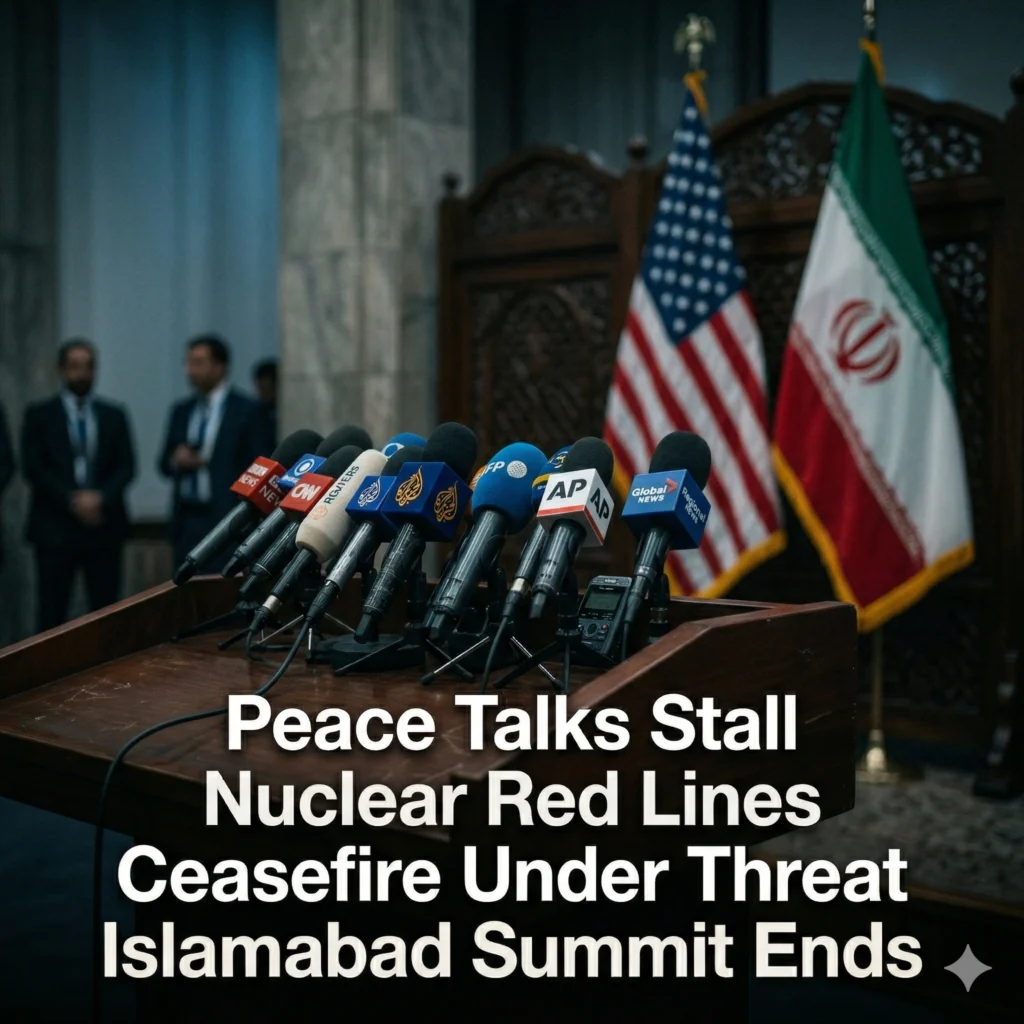
Islamabad Peace Talks Crisis represents a significant setback for global stability as high-level diplomatic efforts in Pakistan concluded without a formal agreement. The atmosphere remained tense throughout the twenty-one hours of intensive discussions between the American and Iranian delegations. While the world watched with bated breath, the inability to bridge fundamental ideological gaps led to a stalemate that now threatens the fragile two-week ceasefire. This failure marks a critical turning point in a conflict that has already claimed thousands of lives and disrupted the global economy.
The failure of the Islamabad Peace Talks Crisis underscores the deep-seated animosity that has defined the relationship between Washington and Tehran for decades. Despite the historic nature of these direct talks, the first of their kind since 1979, the outcomes were disappointingly familiar. Both sides emerged from the summit trading blame, leaving international mediators scrambling to prevent a return to active hostilities. The geopolitical implications are profound, as the collapse of these negotiations could lead to a rapid escalation of regional violence.
Vice President JD Vance Leads American Delegation
Vice President JD Vance arrived in Pakistan carrying the heavy burden of securing a definitive resolution to the ongoing war. His leadership of the United States group signaled the high priority the administration placed on these specific diplomatic proceedings. Throughout the sessions, Vance maintained a firm stance on American security interests while attempting to navigate the complex nuances of Middle Eastern diplomacy. His presence was intended to project strength and commitment to a lasting peace, yet the resulting deadlock suggests a significant gap in expectations.
The American strategy focused heavily on establishing clear red lines regarding Iran’s regional influence and military capabilities. Vance expressed profound disappointment after the talks concluded, noting that a golden opportunity for de-escalation had been missed. The Vice President emphasized that the United States entered the room with a sincere desire for peace, provided that such peace did not compromise the safety of global allies. Unfortunately, the rigidity of the Iranian position proved to be a barrier that the American delegation could not overcome during this round.
Core Conflicts Regarding Nuclear Weapons Program
A primary factor contributing to the Islamabad Peace Talks Crisis was the non-negotiable demand from the United States for a total commitment from Iran. Specifically, the American officials insisted that Iran must completely and verifiably abandon its nuclear weapons program to move forward. This demand has been a cornerstone of American foreign policy for years, but it became the ultimate deal-breaker during the Islamabad sessions. The US delegation argued that any agreement without this provision would be a temporary band-aid on a permanent threat.
Iran viewed these demands as a direct infringement on its national sovereignty and its right to technological advancement. The Iranian negotiators argued that their nuclear program is intended for peaceful energy purposes, a claim that the US continues to dispute with intelligence data. This fundamental disagreement on the nature of Iran’s nuclear ambitions ensured that the talks would hit a wall. Without a middle ground on nuclear transparency, the possibility of a comprehensive peace treaty remains a distant and unlikely prospect for the foreseeable future.
Islamabad Peace Talks Crisis
The Islamabad Peace Talks Crisis has cast a long shadow over the future of international diplomacy in the Middle East. As the delegations packed their bags on Sunday, the realization set in that the window for a peaceful transition might be closing. The failure to produce a signed document means that the rules of engagement remain undefined, leaving military commanders on both sides to interpret the silence. This lack of clarity is precisely what international observers feared most when the summit was first announced last month.
Economic markets have already begun to react to the news of the diplomatic stalemate in Pakistan. Oil prices, which had stabilized during the ceasefire, showed immediate signs of volatility as news of the failed talks broke. Investors are wary that a return to conflict could lead to further disruptions in the Strait of Hormuz, a vital artery for global energy supplies. The crisis in Islamabad is therefore not just a political failure, but a potential economic catastrophe that could affect households across the globe.
Iranian Perspectives on Excessive American Demands
State media in Tehran characterized the demands made by the United States as excessive and counterproductive to the actual peace process. The Iranian delegation argued that the US was not looking for a fair compromise but was instead seeking a total capitulation. This narrative has been amplified across Iranian news outlets, framing the Islamabad Peace Talks Crisis as a result of Western imperialism. By portraying themselves as the aggrieved party, the Iranian leadership is consolidating domestic support even as international pressure mounts.
The Iranian foreign ministry noted that the atmosphere during the talks was hindered by a deep, pervasive sense of mutual mistrust. They pointed to the history of sanctions and previous broken agreements as reasons for their hesitation to accept American terms. According to their spokespeople, the US failed to offer significant sanctions relief in exchange for the heavy concessions they were asking for. This imbalance in the proposed deal made it politically impossible for the Iranian delegation to sign any formal agreement in Islamabad.
Critical Points of Contention in the Middle East
- The status of the Strait of Hormuz remains a primary flashpoint for both nations during the conflict.
- Control over regional proxy forces continues to complicate any long-term security arrangements or peace treaties.
- Sanctions relief for the Iranian economy is a mandatory requirement for Tehran to consider nuclear concessions.
- The role of third-party monitors to oversee a potential ceasefire is still a matter of heated debate.
The Role of Pakistan as a Diplomatic Mediator
Pakistan Foreign Minister Ishaq Dar played a pivotal role in organizing the summit and urging both parties to maintain the ceasefire. As the host nation, Pakistan attempted to provide a neutral ground where two historic enemies could face each other directly. Dar emphasized that while the Islamabad Peace Talks Crisis is a setback, the fact that the two nations met at all is a feat. He urged both Washington and Tehran to keep the lines of communication open to prevent a total collapse of regional security.
Despite the best efforts of Pakistani diplomats, the weight of the historical baggage proved too heavy for a single summit to resolve. The Pakistani government remains committed to facilitating future rounds of talks, though the appetite for such meetings may have diminished. The failure to reach an agreement puts Pakistan in a difficult position, as it shares borders and interests with both sides of the conflict. The regional stability that Pakistan craves is now more precarious than it was before the delegations arrived in the capital.
Humanitarian Impacts of the Continued Stalemate
- Thousands of civilians remain displaced near the conflict zones without access to basic necessities.
- Medical supplies are reaching a critical low in regional hospitals due to the ongoing blockade.
- The breakdown of talks delayed the scheduled exchange of prisoners of war between the two nations.
- International aid organizations are struggling to secure safe corridors for the delivery of food and water.
Global Oil Market Reactions to the Diplomatic Failure
The energy sector has been one of the most visible victims of the Islamabad Peace Talks Crisis. Analysts had hoped that a successful negotiation would lead to a steady decline in crude oil prices, providing relief to global economies. Instead, the uncertainty following the Islamabad meetings has sparked a new wave of panic buying and speculative trading. The possibility of renewed hostilities near major shipping lanes remains the primary concern for energy analysts and global logistics firms alike.
If the ceasefire breaks, the world could see oil prices reach record highs, further fueling inflation in the West. This economic pressure is a tool that Iran has used effectively in the past to gain leverage in negotiations. However, the United States remains committed to its strategy of “maximum pressure” through sanctions, despite the potential for domestic economic blowback. The tug-of-war between energy security and national security goals continues to define the current administration’s approach to the Iranian problem.
Historical Context of US-Iran Diplomatic Relations
These talks represented the first direct high-level meeting between the two nations since the 1979 Islamic Revolution. For nearly five decades, communication has been handled through backchannels or third-party intermediaries like Switzerland or Oman. The decision to meet in person in 2026 was seen as a radical departure from established foreign policy norms. However, the Islamabad Peace Talks Crisis proves that physical proximity does not necessarily translate to ideological alignment or a willingness to compromise.
The legacy of the 1979 hostage crisis and the subsequent decades of economic warfare continue to haunt every negotiation attempt. Generations of leaders in both countries have been raised on a diet of mutual suspicion and hostile rhetoric. Breaking this cycle requires more than just a twenty-one-hour meeting in a neutral capital; it requires a fundamental shift in how both nations perceive their roles in the world. As of now, that shift seems to be nowhere on the immediate horizon for either government.
Future Projections for the Two-Week Ceasefire
The two-week ceasefire was initially established to provide a necessary window for de-escalation and humanitarian relief. With the conclusion of the talks, the clock is now ticking on the expiration of this temporary pause in fighting. Military analysts warn that both sides may be using this time to regroup and resupply their forces for a renewed offensive. The Islamabad Peace Talks Crisis has inadvertently created a period of high tension where any small misunderstanding could trigger a full-scale return to war.
There is a slim hope that the parties might agree to an extension of the ceasefire even without a formal peace treaty. Such an extension would allow for lower-level technical talks to continue behind the scenes. However, the public trading of blame following the Islamabad sessions suggests that the political will for an extension is rapidly evaporating. The international community is now looking to the United Nations Security Council to intervene before the ceasefire officially expires and the region plunges back into chaos.
Final Departure of Delegations from Islamabad
Both delegations departed from Pakistan on Sunday following the official conclusion of the unsuccessful diplomatic sessions. The sight of the motorcades heading to the airport was a somber reminder of the high stakes and the even higher failure. There were no joint statements, no handshakes for the cameras, and no promises of a follow-up meeting in the near future. The silence from both camps as they left the capital spoke volumes about the depth of the disagreement.
The Islamabad Peace Talks Crisis will likely be analyzed by historians as a missed opportunity to change the course of the 21st century. For now, the residents of the conflict zones and the global markets must wait and see what happens next. The diplomatic stage has been cleared, but the theater of war remains prepped and ready for the next act. As the planes took off from Islamabad, the hope for a peaceful 2026 seemed to vanish into the clouds above the Pakistani mountains.
For more details & sources visit: Reuters
Read more about Pakistan news on 360 News Orbit – Pakistan.