
The Ethiopia Fuel Shortage Crisis has emerged as a severe consequence of the ongoing maritime blockades in the Strait of Hormuz and Bab el-Mandeb. The landlocked nation is grappling with a massive oil supply shock that has paralyzed major transport corridors and sent domestic prices soaring to unprecedented levels.
The disruption of critical international shipping lanes has triggered a wave of economic instability across the Horn of Africa, with Ethiopia positioned at the center of the storm. Because more than ninety percent of the nation’s imports flow through the Djibouti corridor, the current energy disruption has become a direct threat to national security and internal stability.
Government officials have been forced to implement emergency measures, including controlled distribution and mandatory leave for non-essential public workers. This proactive yet desperate response highlights the gravity of the national struggle as the country attempts to maintain basic industrial and agricultural productivity amidst a global energy drought.
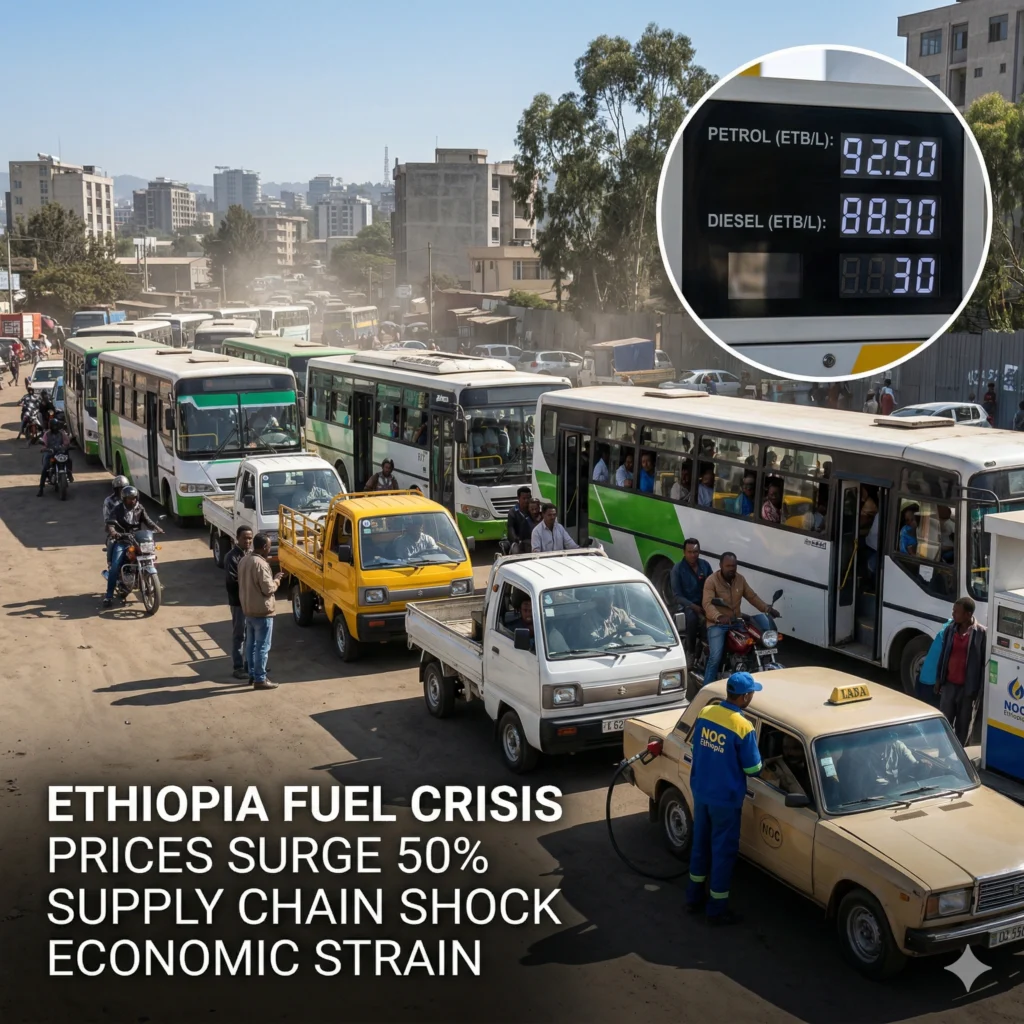
Ethiopia Fuel Shortage Crisis
The Ethiopia Fuel Shortage Crisis represents a perfect storm of geographical vulnerability and geopolitical volatility. Without direct sea access, Ethiopia relies entirely on the stability of neighboring maritime routes to fuel its rapidly growing population and industrial base.
Recent data indicates that the price of gasoline has jumped from eighty-five birr per liter to a staggering one hundred forty-two birr in just a few weeks. This dramatic increase is a hallmark of the current situation, leaving millions of citizens unable to afford basic commuting costs or transport goods.
At local filling stations, the scarcity is visible in the form of mile-long queues where motorists wait overnight in hopes of securing a few liters. This logistical nightmare is stalling the movement of goods and services, effectively slowing the heartbeat of the Ethiopian economy to a crawl.
Rising Diesel Prices and Industrial Impact
Diesel prices have seen an even more alarming surge than gasoline, recently crossing the one hundred sixty-three birr per liter mark. This particular aspect of the energy emergency is devastating for the construction and manufacturing sectors, which rely heavily on diesel-powered machinery.
- Industrial plants are reporting a thirty percent drop in output due to energy rationing.
- Construction projects on major infrastructure have been suspended indefinitely.
- The cost of operating backup generators has become prohibitive for small businesses.
- Logistics companies are raising freight rates to cover the massive fuel overhead.
The ongoing supply disruption is effectively taxing every level of the production chain, leading to a significant slowdown in national GDP growth projections. Economists warn that if these conditions persist through the next quarter, the industrial sector may face a period of deep recession.
Impact on Food Security and Inflation
One of the most dangerous side effects of the Ethiopia Fuel Shortage Crisis is the rapid inflation of food prices. Since the majority of agricultural products are transported via trucks from rural farms to urban centers, the rising cost of transport is passed directly to the consumer.
Basic household goods, including grains and cooking oil, have seen price hikes of over forty percent in some regions. This inflation, driven by transport costs, is putting an unbearable strain on low-income families who already spend a large portion of their earnings on food.
Furthermore, the lack of petroleum is disrupting the distribution of fertilizers and seeds for the upcoming planting season. If farmers cannot access affordable fuel for their equipment, the energy problem could transform from a logistical issue into a full-scale national food security emergency.
Government Emergency Directives
In response to the deepening Ethiopia Fuel Shortage Crisis, the federal government has issued several emergency directives aimed at conservation. By prioritizing essential sectors like healthcare and public transport, authorities hope to prevent a total societal collapse during this supply shock.
Non-essential public workers have been instructed to take leave or work remotely to reduce the overall national demand for gasoline. This measure is a clear indicator of how the fuel scarcity is altering the daily operations of the state and forcing a shift in traditional labor practices.
Additionally, the Ministry of Trade and Regional Integration is strictly monitoring fuel stations to prevent hoarding and black-market activities. Despite these efforts, the lack of supply continues to create opportunities for price gouging, which the government is struggling to contain through regulatory oversight.
Vulnerability of Landlocked Nations
The current Ethiopia Fuel Shortage Crisis serves as a sobering reminder of the interconnectedness of global supply chains. A conflict thousands of miles away in the Strait of Hormuz can effectively shut down the transport system in Addis Ababa within a matter of days.
For landlocked nations, the current dilemma highlights the urgent need for diversified energy sources and improved storage capacity. Currently, the nation’s strategic petroleum reserves are being depleted faster than they can be replenished, worsening the domestic situation significantly.
International partners are being urged to provide emergency assistance, but the global nature of the energy shock means that help is slow to arrive. This isolation during the crisis is forcing the Ethiopian leadership to rethink its long-term energy security strategy and its reliance on fossil fuels.
Social Pressures and Political Tensions
Geopolitical analysts are closely monitoring the social implications of the Ethiopia Fuel Shortage Crisis, as rising living costs often lead to public discontent. The psychological toll of the scarcity, characterized by long waits and uncertainty, is palpable across major cities.
Historically, sharp increases in fuel and food prices have been catalysts for social unrest in the region. The government is acutely aware that the energy deficit could intensify existing internal political tensions if a resolution is not found quickly.
To mitigate this, state media has focused on explaining the external causes of the shortage, emphasizing that the problem originates from international maritime disruptions. However, for the average citizen, the daily reality of the pump prices remains a primary concern that outweighs geopolitical explanations.
Logistical Challenges in the Djibouti Corridor
The Djibouti corridor, the lifeline of the nation, is currently a bottleneck of stranded trucks and delayed shipments due to the Ethiopia Fuel Shortage Crisis. Without a steady flow of refined petroleum from the ports, the entire logistics network is effectively paralyzed.
- Truck drivers are reporting week-long delays in fuel acquisition at the border.
- Port fees in Djibouti are accumulating as cargo remains unmoved.
- Essential medical supplies are being delayed due to the lack of transport fuel.
- Port-to-city rail services are operating at reduced capacity to save energy.
Addressing the national shortage requires more than just domestic policy; it demands a stabilization of the maritime routes leading to Djibouti. Until ships can safely navigate the Bab el-Mandeb, the supply chain will continue to starve the corridor of its most vital resource.
Small Business Vulnerability
Small and medium-sized enterprises (SMEs) are the backbone of the Ethiopian economy, and they are currently the hardest hit by the Ethiopia Fuel Shortage Crisis. Without the capital to absorb sudden cost increases, many small businesses are facing the prospect of permanent closure.
The lack of affordable energy has made it nearly impossible for small delivery services and local manufacturers to operate profitably. As these businesses fail, unemployment rates are expected to rise, creating a secondary economic ripple effect from the initial supply shock.
Entrepreneurs are calling for government-backed credit lines to help them navigate the financial pressure, but the state’s own financial resources are stretched thin. This lack of a safety net makes the current energy shortage a terminal threat for thousands of local businesses.
Long-term Economic Growth Projections
Before the onset of the Ethiopia Fuel Shortage Crisis, Ethiopia was one of the fastest-growing economies in Africa. However, the energy shock has forced economists to drastically revise their growth forecasts for 2026 and beyond.
The current situation has increased the cost of doing business to such an extent that foreign direct investment is beginning to waver. Investors are wary of the risks associated with a nation so heavily impacted by maritime volatility and its reliance on a single import corridor.
Recovery from this economic blow will likely take years, as the economy must not only stabilize but also rebuild its lost momentum. The current crisis is a stark warning that future growth must be built on a more resilient and less fuel-dependent foundation.
Environmental and Alternative Energy Shifts
One unexpected outcome of the Ethiopia Fuel Shortage Crisis could be an accelerated shift toward renewable energy. Ethiopia already possesses significant hydroelectric potential, and the current scarcity is proving that fossil fuel dependence is a strategic liability.
Government officials are now discussing ways to fast-track electric vehicle (EV) adoption to reduce the impact of any future energy disruption. While this is a long-term solution, the current pressure has provided the necessary political momentum to move away from internal combustion engines.
Investment in solar and wind power projects is also being prioritized as part of the post-crisis recovery plan. The goal is to ensure that the nation is never again held hostage by a supply disruption caused by distant maritime conflicts.
Conclusion and National Outlook
The Ethiopia Fuel Shortage Crisis of 2026 is a defining moment for the nation’s economic history. It has exposed deep-seated vulnerabilities while forcing a national conversation about energy independence and logistics security.
While the immediate future remains clouded by the lack of fuel, the resilience of the Ethiopian people is being tested once again. Navigating this period will require a combination of short-term emergency management and long-term strategic planning.
As the government works to secure new supply lines and manage the domestic fallout, the Ethiopia Fuel Shortage Crisis remains the most significant hurdle to national prosperity. The world watches as Ethiopia attempts to emerge from this hardship stronger and more self-reliant than before.
The lessons learned from this year will undoubtedly shape the country’s policy for decades to come. For now, the priority remains surviving the day-to-day challenges of the fuel deficit and ensuring that the most vulnerable citizens are protected from its worst effects.
For more details & sources visit: New Business Ethiopia
Read more on global developments: 360 News Orbit – Extended Orbit