
The Turkey Energy Price Hike has become a central focus of national economic debate, as the government grapples with staggering subsidy costs. With the state currently providing 620 billion liras ($14 billion) in utility support, officials are warning that the current fiscal path is no longer sustainable. President Recep Tayyip Erdoğan is currently reviewing a proposal that could see electricity and natural gas prices rise as early as this month. This potential shift represents a significant departure from the blanket subsidy model that has shielded Turkish households from global market volatility for years.
As the Treasury feels the weight of these massive expenditures, the move toward a more targeted support system seems inevitable. The challenge remains how to implement these changes without derailing the country’s fragile disinflation progress. Global energy markets continue to place immense pressure on Ankara’s budget, forcing a difficult choice between fiscal discipline and social stability.
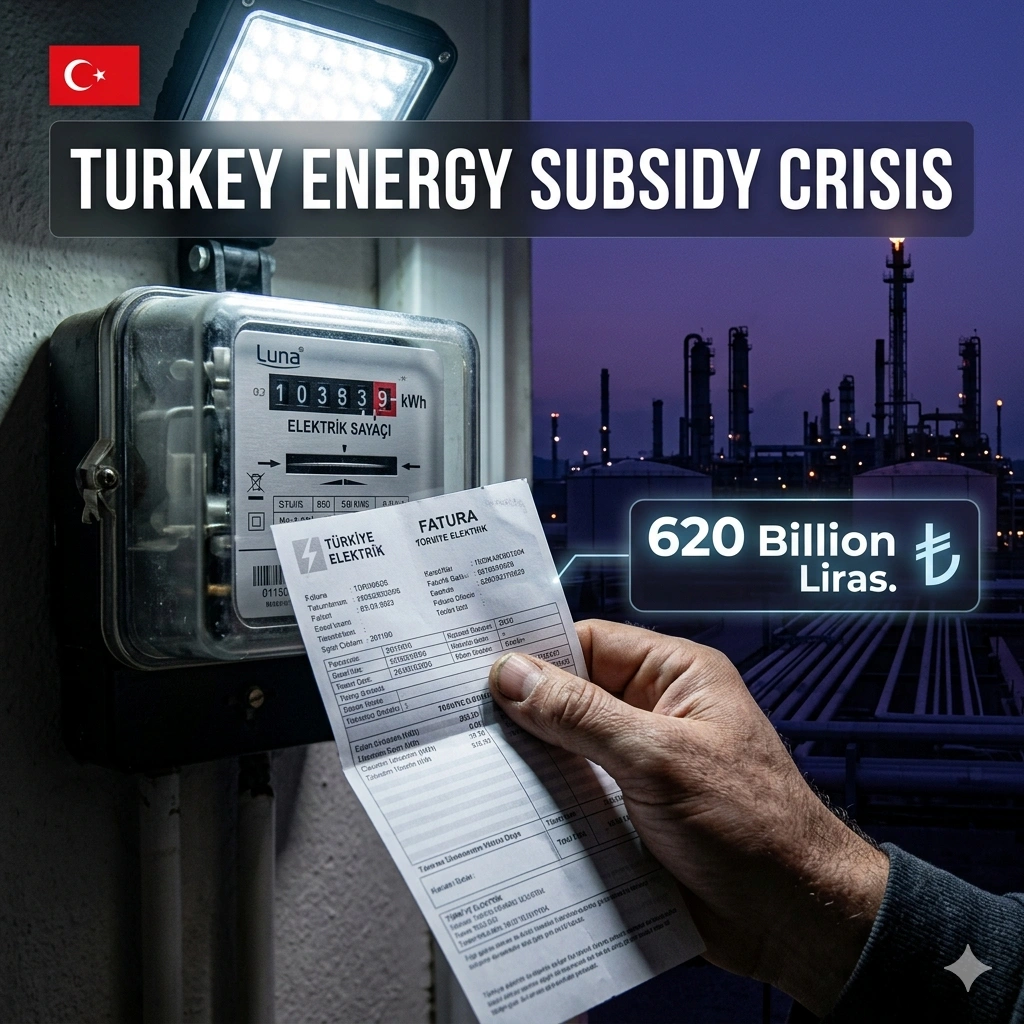
The Fiscal Pressure Behind the Turkey Energy Price Hike
The primary driver of the Turkey Energy Price Hike is the massive 620 billion lira burden currently resting on the national Treasury. Energy Minister Alparslan Bayraktar has noted that maintaining these subsidies at current global oil prices is creating an unsustainable deficit. The government is effectively paying for a large portion of every citizen’s utility bill, a practice that is draining resources from other vital public services.
Furthermore, the Turkish lira’s fluctuations against the dollar have made importing natural gas and oil increasingly expensive for the state energy company, BOTAŞ. These rising import costs are not being fully passed on to consumers, leading to a widening gap that the government must bridge with borrowed funds. This cycle of debt is a major concern for international investors looking at Turkey’s creditworthiness.
Consequently, the move toward a Turkey Energy Price Hike is seen by many economists as a necessary step toward restoring fiscal health. By reducing the subsidy burden, the government can redirect funds toward infrastructure and debt reduction. However, the timing of such a move is critical, as it coincides with a period of significant economic transition for the nation.
Balancing Inflation and Utility Costs in 2026
While annual inflation in Turkey slowed to 30.9% in March 2026, the Turkey Energy Price Hike threatens to reignite price growth. Economists are particularly concerned about “second-round effects,” where businesses pass their increased operating costs directly to the consumer. This could lead to a sudden spike in the cost of everything from bread to manufactured goods.
The central bank’s disinflation program relies on stable expectations, and a sudden jump in energy costs could shatter that confidence. Policymakers are therefore looking for a “middle way” that reduces subsidies without causing a catastrophic shock to the consumer price index. This delicate balancing act is the most significant domestic challenge facing the current administration.
- Manufacturing sectors are expected to be the hardest hit by any industrial energy price increases.
- Small businesses may struggle to absorb higher utility costs without raising their own prices.
- The government is monitoring the impact on lower-income households who spend a higher percentage of their income on heat.
- Targeted support models are being developed to protect the most vulnerable segments of the population.
Turkey Energy Price Hike
The Turkey Energy Price Hike is currently being discussed as a multi-stage process to prevent a sudden economic shock. Rather than a single massive increase, the government may opt for smaller, incremental hikes over the coming months. This would allow businesses and households more time to adjust their consumption habits and budgets to the new reality of energy costs.
To mitigate the impact of the Turkey Energy Price Hike, authorities are exploring a more targeted subsidy model. This would replace the current blanket support with a system that links natural gas subsidies to regional climates and specific household consumption levels. For example, households in the colder eastern provinces might receive more support than those in the more temperate coastal regions.
The sliding-scale tax mechanism on gasoline is also being utilized to shield citizens from the full brunt of global price spikes at the pump. This demonstrates the government’s willingness to use various fiscal tools to manage the transition. However, for natural gas and electricity, the sheer scale of the required subsidy makes such tax-based shielding much more difficult to maintain long-term.
Transitioning to a Targeted Subsidy Model
A cornerstone of the proposed Turkey Energy Price Hike strategy is the shift from universal subsidies to a consumption-based system. Under this new model, a basic “life-line” amount of energy would still be subsidized, but usage beyond that threshold would be charged at market rates. This encourages energy efficiency while still protecting the basic needs of every Turkish citizen.
This targeted approach is seen as a way to fulfill fiscal responsibility while maintaining a social safety net. By focusing support on those who need it most, the government can significantly reduce the overall 620 billion lira price tag. The implementation of such a system requires sophisticated data tracking and regional adjustments, which are currently being finalized by the Energy Ministry.
- Regional climate data will determine the “base” heating needs for different cities.
- Smart meters will play a crucial role in tracking consumption tiers for accurate billing.
- Low-income families may receive direct cash transfers to offset the Turkey Energy Price Hike.
- Industrial users will face different price tiers based on their sector and energy efficiency ratings.
Impact on Turkish Industry and Manufacturing
The Turkey Energy Price Hike will undoubtedly have a profound effect on the nation’s industrial heartland. Turkey’s manufacturing sector, which is a major driver of exports, relies on affordable energy to remain competitive in European markets. An abrupt increase in electricity and gas costs could squeeze profit margins for textile, automotive, and chemical producers.
Industry leaders are calling for a “phased-in” approach to give them time to invest in energy-efficient technologies and on-site renewable generation. Many factories are already exploring solar and wind options to decrease their dependence on the national grid. This transition to self-sufficiency could be an unintended but positive long-term consequence of the price adjustments.
- The textile industry in Bursa and Denizli is particularly sensitive to changes in electricity rates.
- Large-scale steel and cement producers are looking into long-term private energy contracts.
- Government incentives may be offered to companies that achieve specific energy reduction targets.
- Export competitiveness remains a top priority for the Ministry of Trade during these negotiations.
Environmental Implications of Higher Energy Costs
One of the less-discussed aspects of the Turkey Energy Price Hike is its potential impact on the environment. Higher prices naturally lead to decreased consumption and an increased interest in renewable energy sources. As the cost of natural gas rises, many households and businesses will likely turn to heat pumps and solar panels to save money.
Turkey has immense potential for solar and wind power, and the current energy crisis may act as a catalyst for a “green surge.” The government is already supporting several large-scale renewable projects, but higher consumer prices provide the ultimate market signal for decentralization. This shift aligns with Turkey’s long-term goal of reducing energy import dependency and meeting climate targets.
- Household solar panel installations are expected to see record growth in 2026 and 2027.
- Energy efficiency audits for commercial buildings are becoming a standard business practice.
- The Turkey Energy Price Hike may accelerate the decommissioning of older, less efficient power plants.
- Public awareness campaigns are focusing on simple ways to reduce home energy waste.
The Role of Global Oil and Gas Prices
The Turkey Energy Price Hike is inextricably linked to the volatility of global oil and gas markets. As a major energy importer, Turkey is at the mercy of international price swings caused by geopolitical tensions in the Middle East and Eastern Europe. The current conflict in the Persian Gulf has only added to the urgency of Ankara’s fiscal reforms.
Energy Minister Bayraktar has emphasized that Turkey cannot remain an “island of low prices” in a world of high energy costs indefinitely. The Treasury simply does not have the capacity to continue absorbing the difference between global market rates and subsidized domestic prices. The 2026 budget was built on a certain oil price assumption that has since been exceeded, necessitating these urgent discussions.
- The closure of the Strait of Hormuz has direct implications for Turkey’s energy import costs.
- Turkey is diversifying its gas suppliers, looking increasingly toward Azerbaijan and Algeria.
- The Akkuyu nuclear power plant is seen as a long-term solution to the energy price crisis.
- Short-term price spikes in LNG are the primary driver of the current subsidy deficit.
Political Considerations for the Erdoğan Administration
The decision to implement a Turkey Energy Price Hike is fraught with political risk for President Erdoğan. Higher utility bills are a sensitive issue for the Turkish public, especially during a period where the cost of living is already a major concern. The President’s approval is the final hurdle before any price changes can take effect.
To mitigate the political fallout, the administration is likely to couple the price hikes with announcements of new social support programs or minimum wage adjustments. The goal is to frame the price increase as a necessary step for the country’s long-term economic independence and stability. Communication strategy will be just as important as the economic policy itself in the coming weeks.
- The government is working with local municipalities to provide “energy assistance” packages.
- Public discourse is being steered toward the idea of “fair energy pricing” for all.
- The opposition parties are expected to use the price hikes as a point of criticism in upcoming debates.
- Strategic timing of the announcement is being used to minimize public backlash during holidays.
Strategic Energy Reserves and Long-term Security
In the wake of the Turkey Energy Price Hike, the government is also focusing on increasing its domestic energy production and storage capacity. The discovery of natural gas in the Black Sea is a key part of this strategy, though it will take time for this domestic supply to fully impact consumer prices. Increasing storage capacity allows Turkey to buy gas when prices are lower and use it during market peaks.
The long-term goal is to transform Turkey from a mere energy consumer and transit hub into an energy-independent nation. This requires massive capital investment, which the Turkey Energy Price Hike will indirectly help fund by freeing up Treasury resources. Energy security is now being treated with the same level of priority as national defense.
- Expansion of underground gas storage facilities in Silivri and Lake Tuz is ongoing.
- Further exploration in the Eastern Mediterranean and Black Sea remains a top priority.
- New pipelines are being designed to enhance the flexibility of Turkey’s gas network.
- Nuclear energy is expected to provide a stable “base-load” of electricity by the end of the decade.
The Impact on the Digital and Service Economy
The Turkey Energy Price Hike will also be felt in the growing digital and service sectors of the economy. Data centers, which are the backbone of Turkey’s tech industry, are major consumers of electricity. Higher costs could impact the pricing of cloud services and digital infrastructure, affecting the competitiveness of Turkish tech startups.
Similarly, the hospitality and tourism sector, which is a vital source of foreign exchange, must manage its energy costs carefully. Hotels and restaurants, already dealing with higher food prices, will find it challenging to absorb another increase. The government may consider special energy tiers for the tourism sector during peak seasons to protect this essential industry.
- Data center operators are looking at locations with better access to renewable energy.
- The use of energy-efficient lighting and cooling systems is becoming mandatory in new hotels.
- Tech companies are exploring “remote-first” models to reduce the energy footprint of large offices.
- Tourism associations are lobbying for seasonal energy subsidies to maintain international competitiveness.
Analyzing the “Second-Round Effects” on Food Prices
A major concern for the Turkey Energy Price Hike is its impact on food security and pricing. Modern agriculture is highly energy-intensive, requiring fuel for tractors, electricity for irrigation, and gas for the production of fertilizers. Any increase in the cost of energy will eventually find its way to the supermarket shelves.
The government is considering a “green corridor” for agricultural energy, where farmers would receive subsidized rates to keep food prices stable. This would prevent the Turkey Energy Price Hike from directly impacting the most essential goods. Protecting the agricultural supply chain is seen as a way to maintain social harmony during the transition to market prices.
- Fertilizer prices are directly tied to the cost of natural gas, impacting crop yields.
- Cold-chain logistics for fresh produce will face higher operational costs.
- Greenhouse heating in the winter months will become significantly more expensive.
- Strategic grain reserves are being bolstered to hedge against potential food inflation.
Conclusion: Navigating a Difficult Economic Transition
The Turkey Energy Price Hike is a defining moment for the nation’s economic policy in 2026. By addressing the 620 billion lira subsidy deficit, the government is taking a painful but necessary step toward long-term fiscal stability. The transition to a targeted subsidy model represents a modern, data-driven approach to public welfare.
While the short-term impact on inflation and the cost of living will be significant, the move is essential for Turkey’s integration into the global economy. The success of this policy will depend on the government’s ability to protect the most vulnerable while encouraging industrial efficiency. As global energy markets remain volatile, Turkey’s shift toward market-based pricing is a pragmatic survival strategy.
The coming weeks will be a major test of the administration’s ability to balance economic reality with political stability. With the final approval of President Erdoğan pending, the entire nation is watching to see how the Turkey Energy Price Hike will reshape the domestic landscape. The path to a sustainable energy future is difficult, but the first steps are being taken today.
For more details & sources visit: Bloomberg / Rigzone
Read more on Turkey news: 360 News Orbit – Turkey