
The Dutch Offshore Wind Funding package of €3.9 billion represents a monumental leap in Europe’s race toward a sustainable and carbon-neutral future. Announced, by Climate Minister Stientje van Veldhoven, this financial commitment targets the development of a massive 1-gigawatt wind farm in the IJmuiden Ver Gamma-B zone. This ambitious project is designed to power approximately one million Dutch households by the time it reaches full production in 2032.
As the Netherlands faces increasing pressure to decarbonize its heavy industries, this offshore initiative serves as a critical pillar of national energy security. The allocation comes at a volatile time for the global renewable sector, which has been plagued by rising construction costs and supply chain disruptions. By placing such a significant sum behind the Gamma-B zone, the Dutch government is sending a clear signal of confidence to international investors and energy developers.
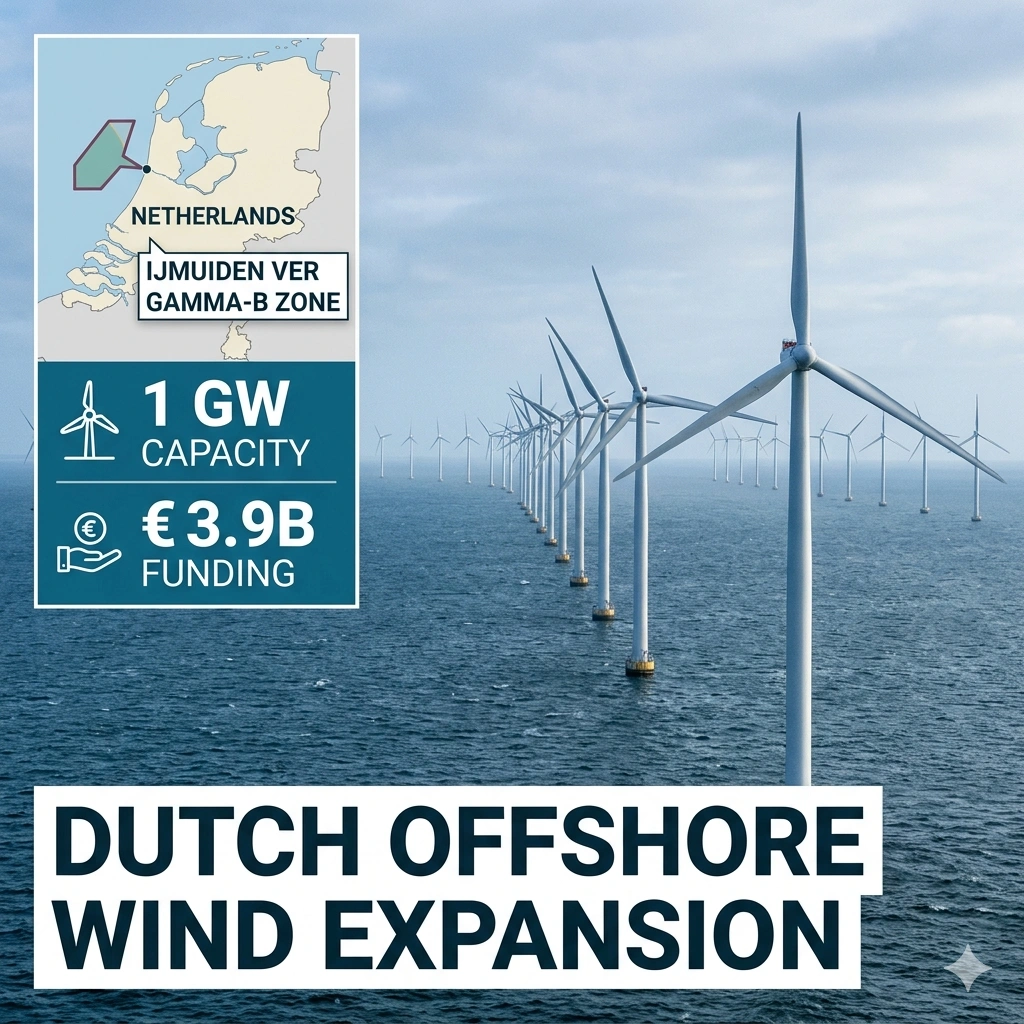
The Strategic Importance of the Dutch Offshore Wind Funding
The Dutch Offshore Wind Funding is not merely a subsidy but a strategic investment in the “engine of the energy transition” for Northern Europe. This 1-gigawatt project is essential for meeting the strict climate targets set for the next decade, ensuring that the Netherlands remains a leader in green technology. The IJmuiden Ver Gamma-B zone is perfectly situated to capture the consistent, powerful winds of the North Sea.
Furthermore, this funding helps mitigate the financial risks that have recently deterred private developers from bidding on similar projects. The global energy market has seen a “deterioration of conditions,” evidenced by the recent failure of the Nederwiek I-A tender. The government’s proactive financial stance is intended to prevent a similar outcome for the IJmuiden Ver expansion.
Consequently, the move is seen as a lifeline for the Dutch offshore industry, which provides thousands of specialized jobs in maritime engineering and maintenance. By securing the domestic energy supply, the government is also protecting its industrial base from future fossil fuel price shocks. This long-term vision is what defines the current Dutch climate policy.
Technical Specifications of the IJmuiden Ver Gamma-B Zone
The project funded by the Dutch Offshore Wind Funding will be located more than 60 kilometers off the Dutch coast, minimizing visual impact while maximizing wind yield. This distance requires advanced subsea cabling and high-voltage direct current (HVDC) technology to transmit power back to the mainland. The engineering challenges are significant, but the rewards in terms of energy output are unparalleled.
The total project cost is estimated at approximately €2.3 billion, though the government has set aside €3.9 billion to account for market fluctuations. This “contract for difference” model ensures that developers are protected if electricity prices drop below a certain threshold. It provides the “bankability” required for such massive capital expenditures.
- The wind farm will utilize the latest Generation IV turbines, standing over 250 meters tall.
- Advanced environmental sensors will monitor the impact on North Sea bird and marine life.
- The project includes a dedicated offshore substation to collect and convert energy for the grid.
- Synergies are expected with the neighboring Gamma-A zone to reduce overall maintenance costs.
Dutch Offshore Wind Funding
The Dutch Offshore Wind Funding serves as a primary driver for the revitalization of the North Sea as a global renewable energy hub. While previous tenders faced setbacks due to rising interest rates and material costs, the Gamma-B package is specifically structured to overcome these hurdles. The government is actively seeking international partners who can bring both technical expertise and financial stability.
Companies interested in the tender are expected to submit their bids in the coming months, with a focus on innovation and environmental sustainability. The concurrent running of the Gamma-A and Gamma-B tenders allows for economies of scale that could further drive down the levelized cost of energy. This efficiency is vital for making green electricity competitive with traditional sources.
Despite the recent zero-bid crisis in the Nederwiek zone, Minister Van Veldhoven remains optimistic that the IJmuiden Ver project will attract top-tier global energy firms. The sheer scale of the 1-gigawatt capacity makes it a “crown jewel” in the European offshore pipeline. This project will eventually define the success of the 2032 energy transition goals.
Overcoming Market Deterioration and Rising Costs
A major challenge for the Dutch Offshore Wind Funding initiative is the current state of the global renewable energy market. Over the past year, the cost of steel and specialized labor has surged, making many previously planned projects economically unviable. The Dutch government’s €3.9 billion allocation is a direct response to these inflationary pressures.
The failure of the Nederwiek I-A zone tender served as a wake-up call for policymakers in The Hague. It became clear that without significant state support, the private sector would not take on the massive risks associated with deep-water wind farms. The new funding structure for Gamma-B is designed to be more flexible and responsive to real-world economic conditions.
- Flexible subsidy amounts that adjust based on the current market price of electricity.
- Government-backed guarantees for the procurement of long-lead items like turbines and cables.
- Streamlined permitting processes to reduce the “time to market” for successful bidders.
- Incentives for using local Dutch suppliers to strengthen the domestic green economy.
Impact on Industrial Decarbonization and Green Hydrogen
The energy produced via the Dutch Offshore Wind Funding is intended to do more than just power homes; it is a vital ingredient for industrial decarbonization. Large-scale factories in the Port of Rotterdam and the North Sea Canal area require massive amounts of green electricity to transition away from coal and gas. This 1-gigawatt farm provides the necessary base load for these transitions.
Furthermore, a portion of the electricity generated at IJmuiden Ver could be used for the production of green hydrogen. This “power-to-gas” technology is essential for decarbonizing heavy transport and chemical processes that cannot be easily electrified. The Dutch government views offshore wind as the primary feedstock for its future hydrogen economy.
By integrating wind power with hydrogen production, the Netherlands can create a more balanced and resilient energy system. This avoids the “curtailment” of wind power during periods of low demand and provides a way to store energy for later use. The Gamma-B project is a test case for this integrated energy future.
Environmental Protection and Marine Biodiversity
While the Dutch Offshore Wind Funding focuses on energy production, it also includes strict mandates for environmental protection. The North Sea is a busy maritime environment and a critical habitat for various species. New wind farms must be designed with “nature-inclusive” features to ensure they do not harm the local ecosystem.
- Artificial reefs at the base of turbine foundations to encourage the growth of mussels and fish.
- “Acoustic curtains” used during the construction phase to protect marine mammals from noise.
- Turbine spacing and blade designs that minimize the risk of bird collisions.
- Long-term ecological monitoring programs funded by a portion of the project budget.
These environmental safeguards are a mandatory part of the bidding process, ensuring that the transition to green energy does not come at the cost of marine biodiversity. The Dutch government is committed to a “nature-positive” approach to offshore development. This sets a high standard for other nations looking to expand their renewable footprints.
The Role of the IJmuiden Ver Gamma-A and Gamma-B Tenders
The decision to run the Gamma-A and Gamma-B tenders concurrently is a tactical move to maximize the impact of the Dutch Offshore Wind Funding. This allows developers to bid on both zones, potentially creating a massive 2-gigawatt complex. Such a scale would provide significant advantages in terms of logistics, procurement, and ongoing operations.
This dual-tender approach is also intended to foster healthy competition among the world’s leading energy consortia. Companies from Denmark, Germany, and the UK are expected to form joint ventures with Dutch firms to bid on these projects. This international collaboration is essential for sharing the high costs and risks of North Sea development.
The success of these tenders will be a bellwether for the entire European offshore wind industry. If the IJmuiden Ver zones receive strong, viable bids, it will signal that the market is beginning to stabilize. If they struggle, it may force a broader rethink of how renewable energy projects are financed across the continent.
Economic Benefits and Job Creation in the Netherlands
The Dutch Offshore Wind Funding is expected to generate a significant return on investment in the form of economic growth and job creation. The construction phase alone will require thousands of technicians, sailors, and engineers. Many of these roles will be filled by the highly skilled Dutch maritime workforce, further cementing the country’s lead in this sector.
Beyond construction, the long-term maintenance of a 1-gigawatt wind farm provides decades of stable employment. Specialized “service operation vessels” will be stationed at the wind farm, providing a constant presence in the North Sea. This creates a new economic ecosystem for port cities like IJmuiden and Den Helder.
- Training programs are being established to transition oil and gas workers to the wind sector.
- Local ports are being upgraded to handle the massive components required for Generation IV turbines.
- The project supports a wide range of secondary industries, from catering to helicopter transport.
- R&D investments in wind technology are expected to stay within the Dutch academic system.
Comparison with Previous Offshore Wind Projects
The current Dutch Offshore Wind Funding package is significantly larger than previous allocations, reflecting the new reality of high construction costs. In the past, some Dutch wind farms were built with “zero-subsidy” bids, but that era has ended due to the changing global economy. The government has had to return to a more supportive role to keep the energy transition on track.
Comparing the IJmuiden Ver project to the earlier Borssele or Hollandse Kust wind farms shows a clear trend toward larger, more distant sites. These newer projects are more technically complex but offer much higher energy densities. The 1-gigawatt capacity of Gamma-B is nearly double that of many earlier Dutch offshore projects.
This evolution in scale and funding is necessary to meet the increasing demand for green electricity. As the Netherlands electrifies its transport and heating systems, the total demand for power will soar. The government’s move to increase funding ensures that the supply of clean energy can keep pace with this growing demand.
Future Projections: 2032 and Beyond
The goal for the project supported by the Dutch Offshore Wind Funding is to begin full commercial production by 2032. This timeline allows for the multi-year process of detailed engineering, environmental impact assessments, and physical construction. It aligns with the Netherlands’ broader goal of having 21 gigawatts of offshore wind capacity by 2030-2032.
Looking even further ahead, the North Sea is envisioned as a vast green power plant for all of Western Europe. Interconnectors will eventually link Dutch wind farms to the grids of neighboring countries, creating a truly integrated European energy market. The IJmuiden Ver project is a foundational piece of this future “Energy Island” concept.
- By 2040, offshore wind could provide up to 70% of the Netherlands’ total electricity needs.
- Advances in floating wind technology may allow for even more distant sites to be developed.
- The integration of offshore solar panels within wind farm zones is being actively researched.
- Long-term costs are expected to decline as the technology and supply chains mature.
Challenges for the Upcoming Tender Process
While the Dutch Offshore Wind Funding provides a strong financial base, the upcoming tender process still faces hurdles. Developers will need to demonstrate not only financial strength but also a robust plan for managing supply chain risks. The limited availability of specialized installation vessels is a global bottleneck that could affect the project’s timeline.
Furthermore, the integration of 1-gigawatt of intermittent wind power into the national grid requires significant upgrades to the onshore high-voltage network. TenneT, the national grid operator, is working in parallel with the wind farm developers to ensure that the power can be safely distributed. This coordination is essential for avoiding “grid congestion” issues.
Bidders will also be evaluated on their circular economy plans, such as how they intend to recycle turbine blades at the end of their 25-year lifespan. This holistic approach to sustainability is a key requirement of the Dutch government. It ensures that the green energy of today does not become the waste problem of tomorrow.
Conclusion: A Green Engine for the Future
The Dutch Offshore Wind Funding for the IJmuiden Ver Gamma-B zone is a bold and necessary step toward a sustainable future. By committing €3.9 billion, the Netherlands is providing the stability and confidence needed to drive the next generation of renewable energy. This 1-gigawatt project will be the “engine” that powers one million homes and decarbonizes Dutch industry.
As the world watches the tender process unfold in the coming months, the success of the IJmuiden Ver project will have global implications. It proves that even in a challenging market, a proactive government can keep the energy transition moving forward. The future of the North Sea is wind-powered, and the Netherlands is leading the way.
The 2032 production target is an ambitious goal that will require the best of Dutch engineering and international cooperation. With the right partners and continued government support, the IJmuiden Ver Gamma-B zone will become a symbol of European climate leadership. The “Kitchenware Mecca” of green energy is being built, one turbine at a time.
For more details & sources visit: NL Times
Read more on Netherland news: 360 News Orbit – Netherland.