
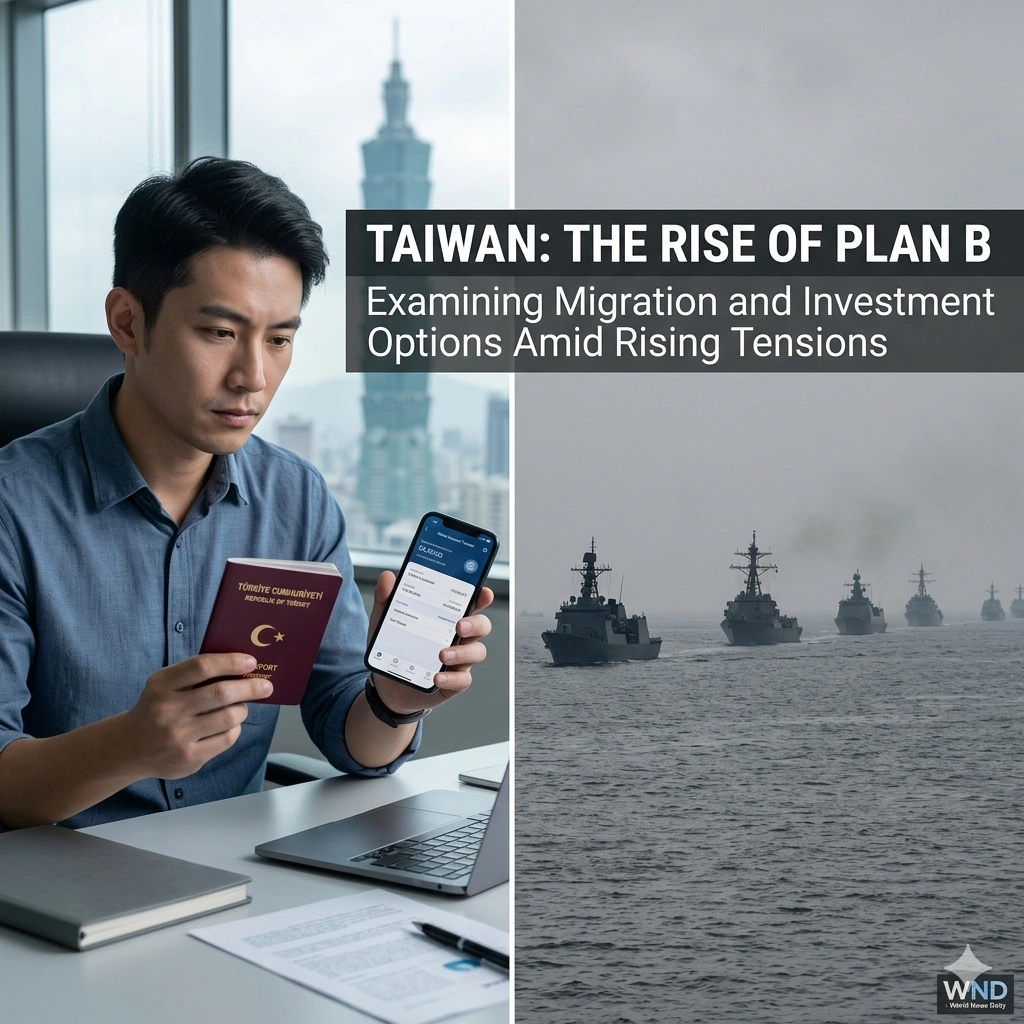
The Taiwan Plan B Strategy has rapidly moved from a niche financial discussion to a mainstream necessity. With military tensions in the Taiwan Strait reaching a critical threshold and global volatility spiking due to Middle Eastern conflicts, citizens are taking personal contingency planning into their own hands. This shift involves a dual-track approach: securing secondary citizenships and moving significant liquid assets into offshore accounts. While the Taiwanese government has bolstered national defense through extended conscription and revamped combat exercises, many high-net-worth individuals feel that state-level preparation must be matched by individual exit strategies.
The search for “Plan B” passports has reached record highs, with immigration consultancies in Taipei reporting a surge in inquiries for programs in Turkey and Southeast Asia. As faith in traditional security guarantees wavers, the motivation to ensure travel mobility and financial access in the event of a blockade has never been higher.
The Motivation Behind the Taiwan Plan B Strategy
The primary driver for the Taiwan Plan B Strategy is the perceived shift in the global order and the increasing frequency of live-fire drills by Beijing. Residents are no longer viewing a cross-strait conflict as a distant possibility but as a scenario that requires immediate, actionable safeguards. This anxiety is further compounded by the ongoing U.S. engagement in Middle Eastern hostilities, which some perceive as a distraction from Indo-Pacific security.
For many families, the “Plan B” is not about a lack of patriotism but about ensuring the survival of their lineage and wealth. The strategy allows individuals to maintain their lives in Taiwan while having a guaranteed “escape hatch” should the domestic situation deteriorate rapidly. This psychological safety net is becoming an essential component of life for the island’s professional and elite classes.
Consequently, the demand for secondary passports is being met by a global market of citizenship-by-investment programs. These programs offer a legal and relatively quick route to a new nationality, providing a level of mobility that a standard Taiwanese passport might lack during a full-scale regional crisis. The choice of destination often depends on the ease of relocation and the stability of the host country’s banking system.
Popular Destinations for Secondary Citizenship
A cornerstone of the Taiwan Plan B Strategy is the acquisition of a Turkish passport through investment. Turkey has emerged as a top choice due to its relatively straightforward process and the strategic geographical link it provides between Europe and Asia. For a specific investment in real estate or capital, Taiwanese citizens can secure a powerful travel document that grants them access to over 110 countries.
Other popular destinations include Southeast Asian nations like Thailand and Malaysia, which offer long-term residency visas that function as a de facto “Plan B.” These locations are attractive due to their proximity to Taiwan and their established expat communities. The goal for many is to find a “neutral” ground that is unlikely to be drawn into a direct conflict between major superpowers.
- Turkey offers a fast-track to citizenship through property investment.
- The “Elite Visa” in Thailand provides long-term residency without the need for full citizenship.
- Caribbean nations like Saint Kitts and Nevis remain popular for their low-tax environments.
- European “Golden Visas” are sought after by those looking for a permanent foothold in the EU.
Taiwan Plan B Strategy
The Taiwan Plan B Strategy is currently manifesting in a massive outflow of capital toward offshore banking hubs, most notably Singapore. Financial professionals in Taipei report that clients are moving significant portions of their wealth to safeguard against a potential collapse of the domestic banking system during a blockade. Singapore is viewed as the “gold standard” for safety due to its strict rule of law and neutral geopolitical stance.
Beyond bank accounts, there is a marked trend toward diversifying assets into physical gold and international equities held in foreign jurisdictions. The idea is to ensure that even if the Taiwanese dollar loses value or domestic exchanges are frozen, the individual’s global purchasing power remains intact. This financial decoupling is a proactive measure against the “total war” scenarios being simulated in recent regional drills.
The immigration consultancy sector in Taiwan is currently experiencing a “gold rush” of its own. Firms that specialize in “exit strategies” are seeing record-high inquiry volumes, often with clients ready to pay premium fees for expedited processing. This sector has become a vital barometer for the underlying anxiety of the Taiwanese populace as the geopolitical clock continues to tick.
Financial Safeguards and Offshore Banking Hubs
As part of the Taiwan Plan B Strategy, Singapore has solidified its role as the preferred offshore vault for Taiwanese wealth. The city-state’s banking sector offers a level of privacy and stability that is increasingly rare in a fragmented global economy. Moving funds to Singapore is seen as a way to “internationalize” one’s assets, making them unreachable by regional geopolitical shocks.
Many high-net-worth individuals are also exploring the use of family offices and international trusts to manage their wealth across multiple jurisdictions. These complex legal structures ensure that assets can be managed and distributed even if the primary owner is unable to communicate during a crisis. This level of sophisticated planning is now a standard requirement for Taipei’s financial elite.
- Multi-currency accounts allow for a quick hedge against a plummeting local currency.
- International brokerage accounts provide access to U.S. and European markets.
- Cryptocurrency is being used by some as a portable, censorship-resistant form of wealth.
- Offshore trusts offer protection against the seizure of assets during a state of emergency.
The Role of Citizenship by Investment (CBI)
The Taiwan Plan B Strategy relies heavily on the efficiency of Citizenship by Investment (CBI) programs. These programs allow individuals to “purchase” a secondary nationality by contributing to the host country’s economy. For Taiwanese citizens, the appeal lies in the speed—some Caribbean programs can grant a passport in as little as three to six months.
Having a secondary passport is not just about travel; it is about having a legal identity that is not tied to a potentially contested territory. In the event of an invasion or a total maritime blockade, a foreign passport could be the difference between being trapped and being able to evacuate on international charter flights. It is the ultimate insurance policy for an uncertain age.
However, the “Plan B” is not without its critics. Some argue that the mass exodus of capital and talent undermines the island’s collective defense. Yet, the reality of 2026 is that individual survival often takes precedence over state-level rhetoric. The CBI market is simply providing a service for which there is a desperate and growing demand.
Military Escalation and Personal Readiness
While the Taiwan Plan B Strategy focuses on the exit, it is often paired with a renewed focus on personal readiness for those who choose to stay. A growing “stay-and-fight” movement has emerged, where citizens are learning first aid, marksmanship, and emergency communication skills. This indicates a bifurcation of the society: those preparing to leave and those preparing to endure.
The Taiwanese government has supported this dual readiness by revamping its reserve forces and encouraging civilian defense training. The military exercises are now more realistic, simulating urban combat and the defense of critical infrastructure. For the citizen with a “Plan B,” these exercises are a reminder of why their contingency plans are so necessary.
- Civilian “kuma academy” style training is seeing increased enrollment.
- Sales of emergency survival kits and long-term food storage have spiked in 2026.
- Private bunkers and “safe rooms” are being integrated into new luxury developments.
- Amateur radio licenses are being pursued as a backup for internet outages.
The Impact of Middle East Volatility on Taiwan
The Taiwan Plan B Strategy has been further fueled by the “crumbling” of the unilateral world order, specifically the instability in the Middle East. Taiwanese observers are closely watching how the U.S. balances its commitments to Israel and Ukraine, fearing that a third front in the Pacific would stretch American resources too thin. This perceived “security vacuum” has shattered the illusion of guaranteed protection.
As U.S. President Trump issues deadlines and threats in the Middle East, Taiwanese citizens are questioning the reliability of the “strategic ambiguity” that has defined U.S.-Taiwan relations for decades. If the world’s superpower is bogged down in regional hostilities elsewhere, the window for a cross-strait move by Beijing is seen as wider. This geopolitical calculation is a direct driver for the current “exit strategy” boom.
The feeling that “no one is coming to save us” is a powerful motivator for personal contingency planning. It transforms the “Plan B” from a luxury for the rich into a survival necessity for the middle class. The instability in the Middle East serves as a constant, real-time warning of how quickly international order can dissolve into chaos.
Navigating the Legal Complexities of Dual Status
Implementing a successful Taiwan Plan B Strategy requires navigating a labyrinth of international and domestic laws. Taiwan allows for dual citizenship, which simplifies the process for its residents. However, the host countries for CBI programs often have their own strict due diligence requirements to prevent money laundering and other illicit activities.
Applicants must undergo rigorous background checks, providing years of financial records and proof of the legal origin of their funds. This process has become more stringent in 2026 as international bodies like the OECD crack down on “golden passport” schemes. Despite these hurdles, the demand from Taiwan remains so high that many firms have opened dedicated “Taiwan desks” to handle the volume.
- Legal experts recommend maintaining clear tax residency in a neutral country.
- Ensuring that secondary passports are renewed and valid at all times is critical.
- Families must coordinate their “Plan B” to ensure all members can move together.
- Power of attorney documents should be filed in both the home and secondary jurisdictions.
The Economic Consequences of Capital Flight
The financial side of the Taiwan Plan B Strategy—the movement of wealth to offshore accounts—is beginning to have a measurable impact on the domestic economy. As billions of dollars flow into Singapore and other hubs, the liquidity available for domestic investment in Taiwan is being squeezed. This “slow-motion bank run” is a major concern for the Central Bank of the Republic of China (Taiwan).
To counter this, the government has introduced incentives for keeping wealth on the island, such as tax breaks for domestic “green” investments. However, for most residents, the “security premium” of an offshore account far outweighs any local tax incentive. The economic cost of geopolitical fear is becoming a significant drag on Taiwan’s 2026 growth projections.
The real estate market in Taipei has also seen a cooling trend as the wealthy shift their investment focus toward overseas property in “Plan B” destinations. Buying an apartment in Istanbul or a villa in Phuket is now seen as a smarter move than acquiring more local real estate. This shift in investment behavior is a clear indicator of long-term sentiment regarding the island’s stability.
Civil Society and the “Stay-and-Fight” Proponents
While the Taiwan Plan B Strategy dominates the headlines, a significant portion of the population remains committed to the “stay-and-fight” philosophy. These citizens argue that the best way to prevent an invasion is to show a unified, determined resistance. They view personal contingency planning as a form of “defeatism” that emboldens the adversary.
This ideological divide is creating a unique social dynamic in 2026. On one hand, you have families quietly preparing their Singaporean accounts and Turkish passports; on the other, you have neighbors training together in weekend urban warfare drills. Both groups are responding to the same threat, but their methods of survival are diametrically opposed.
- “Civilian Defense” clubs are becoming centers of community organization.
- Public debates on the ethics of “Plan B” strategies are frequent in local media.
- The government has praised those who invest in local defense and emergency readiness.
- Social cohesion remains high despite the differing approaches to the current crisis.
Immigration Consultancies and the Record Demand
The boom in the Taiwan Plan B Strategy has turned immigration consultancies into some of the most profitable businesses in Taipei. These firms provide “end-to-end” services, from choosing the right CBI program to setting up the necessary offshore banking infrastructure. They act as the architects of the modern exit strategy, catering to a clientele that ranges from tech billionaires to upper-middle-class families.
The cost of these services has risen in step with the demand, with some “VIP” packages costing upwards of $50,000 in consulting fees alone. For the client, this is seen as a small price to pay for the “peace of mind” that comes with a viable escape route. The consultancy sector is now a vital part of the island’s professional services landscape.
As the conflict in the Middle East continues to distract global attention, these firms are intensifying their marketing efforts. They use slogans that emphasize the “fragility of peace” and the “necessity of a second home.” This marketing resonates deeply with a population that feels increasingly isolated on the global stage.
Conclusion: A Society in Contingency Mode
The Taiwan Plan B Strategy is a profound reflection of a society living on the edge of history. By securing secondary passports and offshore accounts, Taiwanese citizens are making a pragmatic choice to protect their future in an increasingly dangerous world. The combination of regional military pressure and global instability has made the “Plan B” an indispensable part of the national psyche.
Whether through a Turkish passport or a Singaporean bank account, the goal remains the same: mobility and security. While the government prepares the military for a potential conflict, the people are preparing their families for a global transition. This dual-track survivalism is the defining characteristic of Taiwan in 2026.
As we look toward the remainder of the year, the success of these personal contingency plans will depend on the continued openness of international CBI programs and the stability of global banking hubs. For the people of Taiwan, the “Plan B” is not just a document or a bank account; it is the hope that no matter what happens in the Strait, their future will remain in their own hands.
For more details & sources visit: CNN / Kyodo News
Read more on Taiwan news: 360 News Orbit – Taiwan.