
Qatar intercepts Iranian drone units as the state’s Ministry of Defense confirmed the successful destruction of several unmanned aerial vehicles launched from Iran. This tactical victory occurred over Qatari sovereign airspace, marking a critical moment where the nation’s advanced defensive shield was put to the ultimate test during the month-long regional war.
The Ministry of Defense released an official statement on Saturday evening, detailing how national air defense systems identified and neutralized multiple threats originating from across the Persian Gulf. Fortunately, no casualties or material damage were reported following the high-altitude engagements, ensuring that the civilian population remained safe throughout the brief but intense military operation.
While Qatar has historically maintained a more nuanced diplomatic relationship with Tehran compared to its neighbors, this latest provocation proves that no GCC member is immune to the expanding conflict. The successful interception has prompted Qatari officials to maintain a state of maximum alert as they monitor the increasingly volatile borders of the peninsula.
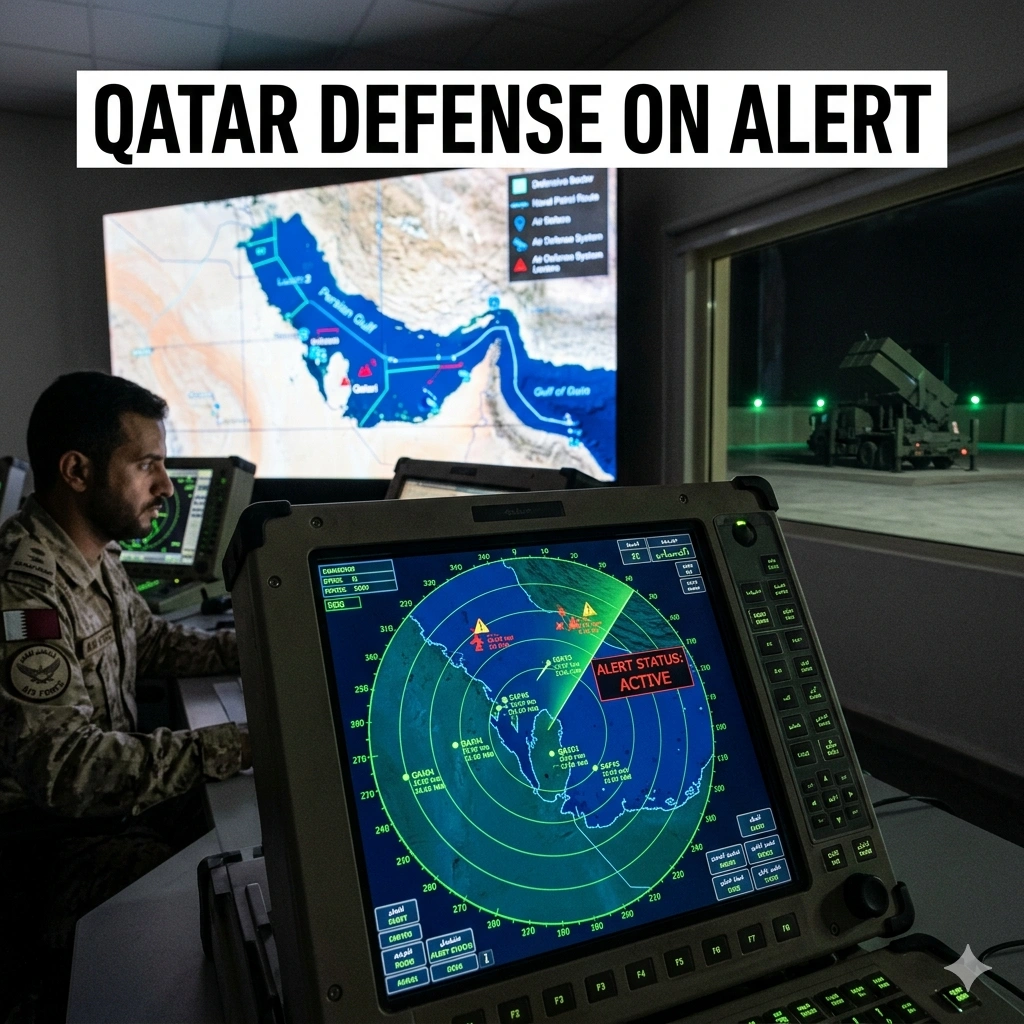
National Defense Systems Prove Effective in Doha
The primary takeaway from the Saturday engagement is the high level of readiness displayed by the Qatari military. As Qatar intercepts Iranian drone swarms, the integration of American-made Patriot batteries and local radar arrays functioned seamlessly to provide a protective dome over the capital and vital liquid natural gas facilities.
Military analysts suggest that the drones used in this specific attack were likely “Shahed-series” loitering munitions, designed to fly at low altitudes to evade traditional radar detection. However, the Qatari early warning systems picked up the thermal signatures of the incoming craft well before they reached the mainland, allowing for a clean intercept over the water.
This performance has boosted confidence in the nation’s ability to protect its critical infrastructure, which is essential for global energy stability. The precision of the defense response indicates that Qatari operators have been training extensively for this exact scenario since the regional conflict began four weeks ago.
Qatar Intercepts Iranian Drone
The news that Qatar intercepts Iranian drone units has shifted the strategic conversation regarding the safety of the world’s largest LNG exporters. While the frequency of strikes against Doha remains lower than those hitting the UAE, the intent behind this specific launch remains a subject of intense intelligence gathering.
Some experts believe the drones were meant as a “warning shot” to discourage Qatar from allowing its bases to be used for offensive coalition sorties. Others argue that the drones may have drifted off course from a larger strike package intended for Saudi targets, though the flight path suggests a deliberate heading toward Qatari territory.
The fact that Qatar intercepts Iranian drone threats without any “leakers” reaching their targets is a testament to the layered defense strategy adopted by the Ministry of Defense. By maintaining a 100% interception rate, Qatar is signaling to Tehran that any further attempts at intimidation will result in nothing more than expensive scrap metal at the bottom of the Gulf.
Strategic Significance of the North Field Protection
Protecting the North Field, the world’s largest non-associated gas field, is the top priority for Qatari security forces. Any successful strike on this facility would not only devastate the local economy but would also cause an immediate global energy crisis that could last for years.
- The field provides a significant portion of the natural gas consumed by Europe and Asia.
- Security vessels are patrolling the maritime borders 24/7 to detect surface-launched threats.
- Hardened shelters have been constructed for essential workers at the processing plants.
- Electronic jamming equipment has been deployed to disrupt drone GPS signals.
As Qatar intercepts Iranian drone launches, the message to global energy markets is one of cautious resilience. The Qatari government is fully aware of its responsibility as a global energy guarantor and is sparing no expense to ensure that the “blue flame” continues to flow despite the surrounding geopolitical firestorm.
Impact on Regional GCC Defense Cooperation
The latest incident has led to an unprecedented level of intelligence sharing between Qatar, Saudi Arabia, and the United Arab Emirates. Despite past diplomatic rifts, the shared threat of Iranian drone swarms has unified the GCC in a way that many thought was impossible just a few years ago.
Common radar pictures are now being shared in real-time across the regional command centers, allowing for a collective response to incoming missiles. This “Al-Udeid” hub model has been instrumental in the recent successes where Qatar intercepts Iranian drone units before they can threaten civilian flight paths or commercial shipping lanes.
This unity is a nightmare for Iranian planners, who had hoped to exploit the historical divisions within the Arab world. Instead, the persistent security risks have forged a “Gulf Shield” that is proving remarkably difficult to penetrate, even with the sophisticated UAV technology currently being deployed by the Islamic Revolutionary Guard Corps.
Diplomatic Tensions Reach a Breaking Point
Qatar has long prided itself on being a mediator in the Middle East, often hosting talks between the U.S. and various regional actors. However, the direct targeting of its airspace makes this middle-ground position increasingly difficult to maintain as the war enters its second month.
The Qatari Foreign Ministry has issued a formal protest to Tehran, demanding an explanation for the violated sovereignty. While Doha has not yet joined the more hawkish military rhetoric of the UAE, the successful event where Qatar intercepts Iranian drone threats marks a clear shift toward a more defensive military posture.
If these attacks continue, Qatar may be forced to formally align with the U.S.-Israeli coalition’s offensive operations. This would be a significant loss for Tehran, as Qatar was one of the few remaining channels for back-channel communication with the Western powers.
Technical Analysis of Intercepted Drone Technology
The wreckage recovered from the Gulf waters is currently being analyzed by Qatari and international experts to determine the exact capabilities of the neutralized craft. Preliminary reports suggest that these drones were equipped with advanced anti-jamming software and optical sensors.
- The airframes appear to be made of composite materials to reduce radar cross-section.
- Engines were muffled to decrease the acoustic signature during nighttime flight.
- Onboard navigation utilized a mix of satellite and inertial guidance systems.
- Warheads were designed for precision strikes on industrial valve stations.
As Qatar intercepts Iranian drone hardware, the data gathered from these “kills” is being fed back into the defensive algorithms of the Patriot and THAAD systems. This “combat learning” is essential for staying one step ahead of Iranian engineers who are constantly modifying their drone designs to find weaknesses in the coalition’s armor.
Psychological Resilience of the Qatari Population
Despite the looming threat of war, the atmosphere in Doha remains one of calm determination. The government has been transparent about the security situation, providing regular updates that have prevented the spread of misinformation or panic among the expatriate and local populations.
Citizens are being encouraged to go about their daily lives while remaining observant of any official emergency instructions. The fact that Qatar intercepts Iranian drone attacks so effectively has provided a sense of security that allows the nation’s financial and commercial sectors to continue operating with minimal disruption.
Education programs regarding civil defense and emergency preparedness have been integrated into schools and workplaces. This proactive approach ensures that the “home front” is just as prepared as the military front, creating a resilient society that refuses to be intimidated by regional aggression.
Future Projections for Drone Warfare in the Gulf
The use of UAVs as a primary tool of aggression is a trend that is only expected to accelerate. As Qatar intercepts Iranian drone units today, they are preparing for a future where hundreds of drones might be launched in a single, coordinated “swarm” designed to overwhelm any possible defense.
To counter this, Qatar is investing heavily in “directed energy” weapons, such as high-powered lasers and microwave emitters. These technologies offer a lower “cost-per-kill” than traditional missiles and can engage multiple targets simultaneously, making them ideal for the next generation of drone defense.
The evolution of this conflict is essentially an arms race between autonomous offensive systems and automated defensive shields. The successful engagement on March 28 proves that, for now, the defensive technology has the upper hand, but the margin for error is becoming razor-thin.
Role of U.S. Forces at Al-Udeid Air Base
Al-Udeid Air Base, located in Qatar, remains the most important strategic asset for the U.S. military in the region. The security of this base is inextricably linked to the security of Qatar itself, and the two nations work in total tandem to monitor the skies.
When Qatar intercepts Iranian drone threats, it is often done with the technical assistance and satellite data provided by the U.S. Space Force and Central Command. This partnership is the backbone of the regional air defense network and serves as the primary deterrent against a full-scale Iranian invasion of the southern Gulf.
The base also serves as a coordination center for humanitarian aid and search-and-rescue operations across the theater of war. Maintaining the operational integrity of Al-Udeid is paramount, and the recent interceptions prove that the combined Qatari-American defense is up to the task of protecting this vital facility.
Iran’s Widening Target List and the GCC
The inclusion of Qatar in the target list suggests that Iran is becoming increasingly desperate to find a “weak link” in the GCC chain. By attacking every member state, Tehran is attempting to prove that no amount of Western protection can guarantee safety in the Persian Gulf.
However, as Qatar intercepts Iranian drone units with such efficiency, this strategy appears to be backfiring. Instead of causing fear and fragmentation, the attacks are reinforcing the necessity of the U.S. security umbrella and the importance of regional military integration.
The persistent security risks are now a daily reality for millions of people. While the frequency of strikes may vary, the underlying tension remains a constant pressure that is reshaping the political and economic landscape of the Middle East for the foreseeable future.
Environmental Risks of Conflict in the Persian Gulf
An often-overlooked aspect of the drone war is the potential for environmental catastrophe. The Persian Gulf is a shallow, enclosed body of water with a fragile ecosystem that could be devastated by a large-scale oil spill or chemical leak resulting from a missile strike.
- Desalination plants, which provide the majority of Qatar’s drinking water, are vulnerable to pollution.
- Coral reefs and seagrass beds could be destroyed by sunken vessels or leaked fuel.
- The local fishing industry would be decimated by a major environmental incident.
When Qatar intercepts Iranian drone craft over the water, they are also protecting their precious marine environment. The Ministry of Environment is working closely with the military to ensure that any debris from intercepted drones is quickly recovered to prevent contamination of the coastal waters.
Strengthening the Legal Framework for Airspace Defense
The Qatari government is also working on the diplomatic and legal front to condemn the violations of its sovereign airspace. By documenting every time Qatar intercepts Iranian drone incursions, the state is building a comprehensive case to present before the United Nations and other international bodies.
These records include radar tracks, wreckage photographs, and satellite imagery that prove the drones originated from Iranian territory. This legal “paper trail” is essential for justifying any future retaliatory measures or for seeking international sanctions against the Iranian regime’s military industry.
The clear violation of international law represented by these unprovoked attacks is a point that Qatari diplomats are emphasizing in every global forum. They are calling for a collective international response to hold the aggressors accountable for threatening the safety of international civil aviation and regional peace.
Conclusion: A Shield That Holds Firm
The events of March 28, 2026, serve as a powerful reminder of the high stakes involved in the current Middle Eastern conflict. As Qatar intercepts Iranian drone units with precision and poise, the nation demonstrates its commitment to sovereignty and its capacity to withstand the pressures of a regional war.
The successful defense of Doha’s skies is a victory for technology, training, and international cooperation. While the persistent security risks remain a significant concern, the resilience shown by the Qatari military and people provides a glimmer of hope in an otherwise dark chapter of regional history.
For more details & sources visit: The Wall Street Journal (WSJ)
Read more about Qatar news on 360 News Orbit – Qatar.