
India Hospitality Market Growth is currently at a historic peak as domestic travel emerges as the primary engine of the nation’s tourism economy. According to a landmark report presented by Global Asset Solutions at the HICSA 2026 conference, local travelers have officially replaced international arrivals as the sustainable foundation of the market. This massive shift is being driven by rising disposable incomes and a cultural transformation where travel is now a common lifestyle choice.
The sector is experiencing a significant pivot toward regional destinations and non-metro cities, moving beyond traditional hubs like Mumbai and Delhi. Digital access and a growing appetite for discovering local heritage are the primary catalysts for this fundamental market evolution. Consequently, industry experts believe that this focus on internal demand makes the Indian hospitality market uniquely resilient compared to other major global economies.
Flexible work arrangements have further accelerated this trend, effectively transforming leisure trips from an occasional luxury into a standard routine for millions of citizens. National hotel occupancy reached a healthy 64% in 2025, fueled by improved air and road connectivity across previously underserved travel corridors. As a result, the hospitality landscape is being permanently reshaped by the strength of the domestic consumer.
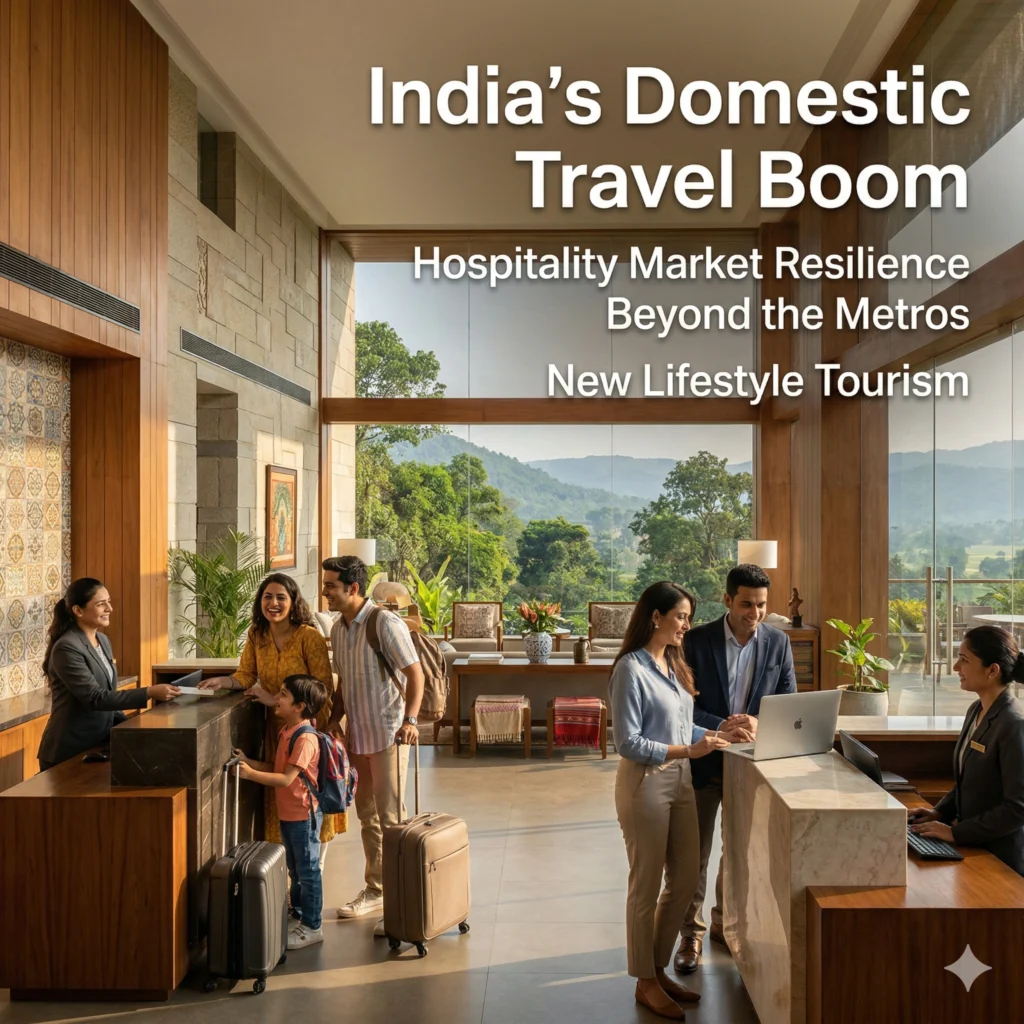
India Hospitality Market Growth
The current surge in India Hospitality Market Growth is anchored in the fact that over 60% of Indian travelers now prioritize domestic destinations. This preference provides a level of stability and repeatability that volatile international demand often lacks during times of global geopolitical uncertainty. By focusing on the local base, the hospitality industry has built a more predictable and scalable growth framework for the coming decade.
National hotel chains and boutique resorts are rapidly expanding their footprints into Tier-2 and Tier-3 cities to capture this growing demand. These non-metro locations are seeing higher growth rates in occupancy compared to traditional business districts, signaling a change in traveler behavior. The report highlights that local discovery is no longer just a trend but the new operational standard for developers.
Furthermore, the rise of “workations” has extended the average length of stay for domestic visitors, boosting total revenue per available room. Hotel operators are now redesigning their spaces to accommodate long-term stays with better connectivity and co-working facilities. This adaptation to the modern traveler’s needs is a key factor sustaining the India Hospitality Market Growth through 2026.
Strategic Shift to Regional Hubs
A significant portion of India Hospitality Market Growth is manifesting in regional development outside of metropolitan centers. More than half of all new hotel signings in the last three years have occurred in underserved regional corridors. This decentralization of the hospitality sector is bringing economic development and infrastructure improvements to previously overlooked parts of the country.
Investors are increasingly looking toward spiritual tourism circuits and nature-based retreats as high-yield opportunities. These locations offer a unique blend of cultural heritage and scenic beauty that appeals to the modern Indian traveler’s desire for authentic experiences. The diversification of the destination portfolio is a major driver of long-term India Hospitality Market Growth.
- Religious pilgrimage routes have seen a 40% increase in premium hotel investments.
- Hill stations and coastal towns are becoming year-round destinations rather than seasonal ones.
- Improved road infrastructure under national programs has made road trips a viable travel option.
- Regional airports are connecting distant towns directly to major economic centers.
This infrastructure-led growth ensures that the hospitality sector can reach its full potential across the entire geographical expanse of the nation. By making travel more accessible, the government and private sector are working together to maintain the momentum of India Hospitality Market Growth. The result is a more balanced and robust tourism ecosystem.
Resilience Through Domestic Stability
The inherent resilience of India Hospitality Market Growth stems from its ability to thrive independently of international arrivals. While other countries struggle with fluctuating foreign tourism numbers, India’s internal market provides a constant stream of revenue. This stability allows hotel owners to better manage their operational costs and plan for future capital expenditures with confidence.
Domestic travel is less susceptible to global currency fluctuations or international travel restrictions, making it a “safer” bet for large-scale institutional investors. The Global Asset Solutions report emphasizes that the repeatability of domestic leisure trips creates a loyal customer base. This loyalty is the “secret sauce” that keeps occupancy rates high even during the traditional off-seasons.
Regional festivals and long holiday weekends have become the primary triggers for short-term leisure breaks, creating predictable peaks in demand throughout the year. Hotel marketing strategies are now tailored specifically to capture these domestic segments with customized family and group packages. This focus on the local calendar is a strategic pillar supporting India Hospitality Market Growth.
The Rise of Destination Weddings
One of the most lucrative segments contributing to India Hospitality Market Growth is the exponential rise of destination weddings. No longer restricted to international locations like Thailand or Italy, Indian couples are increasingly choosing domestic palaces and resorts. This trend keeps billions of dollars within the Indian economy and provides a massive boost to local service providers.
Hotels are investing heavily in massive banquet halls and specialized wedding planning teams to tap into this multi-billion dollar industry. A single destination wedding can generate more revenue for a resort than a month of standard room bookings. This high-value segment is a critical component of the overall India Hospitality Market Growth strategy for premium brands.
- Popular wedding hubs include Jaipur, Udaipur, Goa, and increasingly, the backwaters of Kerala.
- Traditional heritage properties are being converted into luxury wedding venues.
- The “big fat Indian wedding” has evolved into a multi-day residential experience at luxury resorts.
- Auxiliary industries like catering, photography, and decor are flourishing alongside hotel growth.
This synergy between traditional customs and modern hospitality services creates a unique market dynamic found nowhere else in the world. As the middle class grows, the number of families opting for destination weddings continues to rise, providing a long-term runway for India Hospitality Market Growth. This segment is expected to grow by 15% annually through 2030.
Digital Catalysts for Tourism
The role of digital technology in driving India Hospitality Market Growth cannot be underestimated. With the world’s cheapest data and widespread smartphone penetration, Indian travelers are more informed and empowered than ever before. Social media platforms act as a virtual travel brochure, inspiring millions to visit offbeat locations they might otherwise have ignored.
Online Travel Agencies (OTAs) have simplified the booking process, making it easier for travelers to compare prices and read reviews in real-time. This transparency has forced hotels to maintain higher standards of service and cleanliness to stay competitive. The digital revolution has effectively democratized travel, contributing directly to the India Hospitality Market Growth by lowering the barrier to entry.
- Travel influencers are playing a major role in promoting Tier-2 destinations to Gen Z.
- Virtual reality tours are becoming a standard feature for high-end resort websites.
- Contactless check-in and digital room keys are improving the guest experience.
- Data analytics allow hotels to offer personalized promotions to returning domestic guests.
By leveraging these digital tools, the hospitality sector is able to reach a much wider audience with surgical precision. This efficiency in marketing and operations is a significant factor in the sustained India Hospitality Market Growth observed in the 2026 data. The industry is now a digital-first sector that is constantly evolving to meet tech-savvy demands.
Pilgrimage Circuits and Spiritual Tourism
A major, often overlooked, driver of India Hospitality Market Growth is the formalization of spiritual tourism. Millions of Indians travel annually to religious sites, and their expectations for accommodation have shifted toward comfort and hygiene. This has led to the entry of organized hotel brands into towns that were previously served only by informal guesthouses.
The government’s focus on the “Swadesh Darshan” and “PRASHAD” schemes has improved the infrastructure around major pilgrimage centers. These improvements make it easier for elderly travelers and families to visit these sites, leading to longer stays and higher spending. Spiritual tourism is now a core part of the India Hospitality Market Growth narrative.
- The Ayodhya development has triggered a massive influx of luxury hotel signings.
- The Varanasi riverfront redevelopment has boosted premium room demand significantly.
- South Indian temple circuits are seeing a rise in high-end spiritual retreats.
- Combined “spiritual and wellness” packages are becoming a popular niche for urban travelers.
As the quality of infrastructure improves, these sites are attracting a younger demographic that seeks both spirituality and a luxury travel experience. This “spiritual luxury” segment is a fast-growing niche that adds a layer of cultural depth to the India Hospitality Market Growth. It ensures that the sector’s growth is grounded in the country’s deep-rooted traditions.
Sustainable Practices and Local Sourcing
As India Hospitality Market Growth continues, there is an increasing focus on sustainability and eco-friendly operations. Domestic travelers are becoming more conscious of their environmental footprint, prompting hotels to adopt green building standards and zero-plastic policies. This shift is not just ethical but also an operational necessity to attract the modern, conscious consumer.
Local sourcing of food and materials is another trend that is helping hotels manage costs while supporting regional economies. Many resorts now offer “farm-to-table” dining experiences that showcase local flavors, which is a major draw for domestic tourists looking for authenticity. This connection with the local community is a hallmark of the new India Hospitality Market Growth model.
- Renewable energy installations, such as solar panels, are becoming common in new resorts.
- Water conservation and recycling systems are being prioritized in water-stressed regions.
- Skill development programs for local villagers are creating a sustainable workforce for the industry.
- Reduction in food waste is being monitored through advanced AI-driven systems.
By integrating these practices, the Indian hospitality sector is ensuring that its growth is sustainable for the future. The 2026 report indicates that “green credentials” are now a significant factor in hotel selection for more than 30% of domestic travelers. Sustainability is thus a competitive advantage in the race for India Hospitality Market Growth.
Future Outlook: Beyond 2026
The long-term outlook for India Hospitality Market Growth remains overwhelmingly positive as the country moves toward its goal of becoming a top global tourism destination. The focus on the domestic consumer has built a solid foundation that can now be used to attract more high-spending international visitors. The internal economic strength of India is the engine that will drive this transformation.
By 2030, analysts predict that India will have one of the most diverse and resilient hospitality markets in the world. The continued investment in infrastructure, combined with the innovative spirit of Indian hoteliers, will ensure that the country remains at the forefront of global travel trends. India Hospitality Market Growth is a success story of local resilience and global ambition.
- Ongoing expansion of the Vande Bharat express trains will further boost short-haul travel.
- The growth of the middle class will create an additional 100 million travelers by the end of the decade.
- India is expected to become the world’s third-largest aviation market, supporting hotel occupancy.
- Innovation in “staycation” and “daycation” models will continue to diversify revenue streams.
The sector has reached a pivotal inflection point, and there is no looking back. As India continues to urbanize and its citizens become more mobile, the demand for high-quality hospitality will only increase. The India Hospitality Market Growth journey is a testament to the power of a booming domestic economy in shaping a world-class industry.
Conclusion: The New Era of Indian Travel
In conclusion, India Hospitality Market Growth is currently being defined by the unprecedented rise of the domestic traveler. The shift from international to internal demand has provided the sector with a level of resilience that is the envy of many other nations. From destination weddings to pilgrimage circuits, every segment of the market is contributing to a robust and scalable growth story.
The 2026 findings from Global Asset Solutions and HICSA underscore the fact that regional discovery and digital innovation are the future. As hotel development moves into non-metro cities, the benefits of tourism are being spread more equitably across the country. India Hospitality Market Growth is not just about increasing room counts; it is about building a sustainable and inclusive economic ecosystem.
As we look toward the future, the lessons learned from this period of domestic-led growth will be invaluable. The Indian hospitality sector has proven that it can adapt to changing circumstances and emerge stronger. The era of the Indian domestic traveler has truly arrived, and it is here to stay, ensuring the continued success of India Hospitality Market Growth for generations to come.
For more details & sources visit: Travel Weekly Asia
Read more about India news on 360 News Orbit – India.