
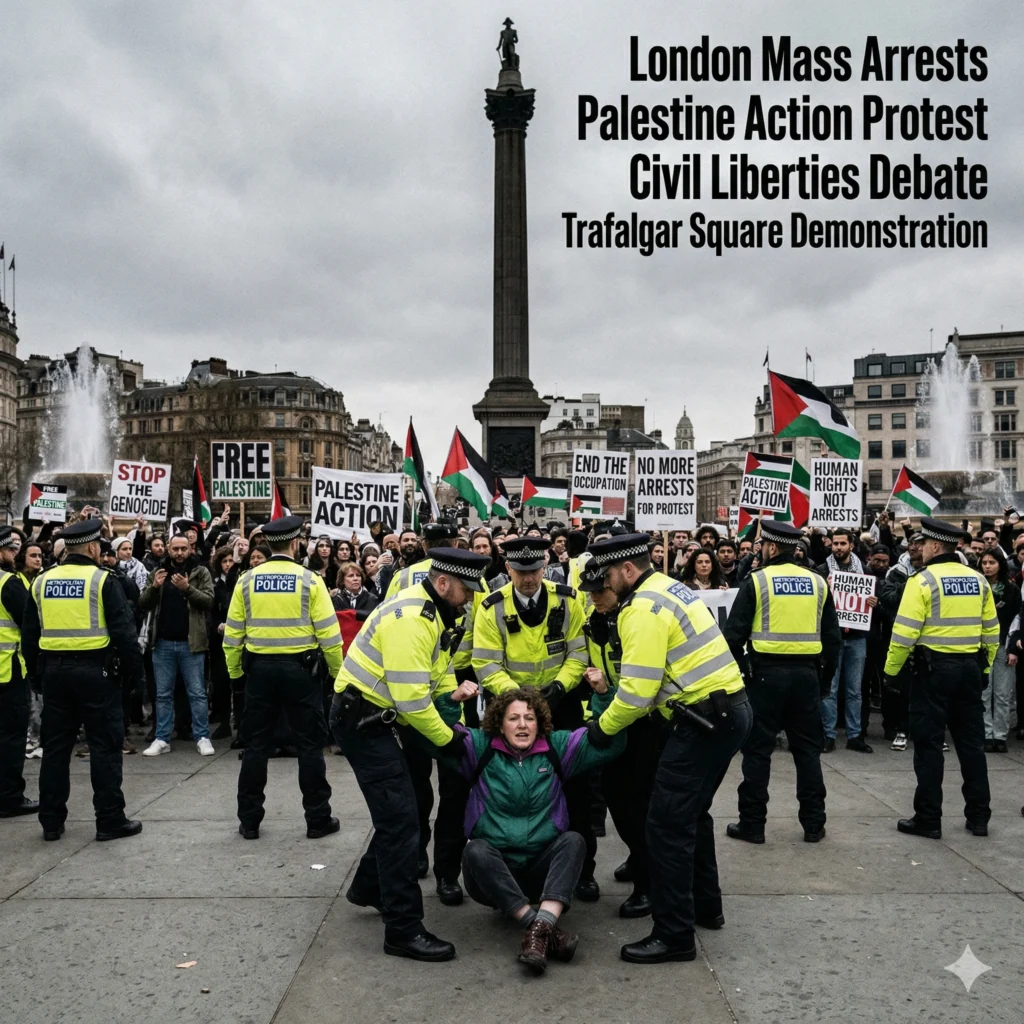
London Protest Civil Liberties are currently the subject of intense national debate following a massive police operation in the heart of the capital. Over the weekend, Metropolitan Police detained 523 demonstrators in Trafalgar Square for holding placards in support of Palestine Action. This group was officially proscribed by the United Kingdom government last July, making any public display of support a potentially criminal act.
The arrests have sparked immediate backlash from legal experts and human rights organizations who argue the police actions are disproportionate. These mass detentions occurred despite a previous High Court ruling that challenged the legality of the ban on freedom of speech grounds. Consequently, the intersection of national security legislation and individual rights has created a significant legal crisis in 2026.
According to official police reports, the ages of those detained range from 18 to 87 years old, reflecting a wide demographic of dissent. Protesters were arrested under counter-terrorism laws that carry prison sentences of up to 14 years for supporting proscribed organizations. As a result, London Protest Civil Liberties have become a focal point for those concerned about the erosion of democratic norms.
London Protest Civil Liberties
The current state of London Protest Civil Liberties reflects a tightening of public order laws that many activists describe as draconian. Saturday’s sit-down protest was intended as a peaceful response to the ongoing conflict in Gaza and domestic crackdowns on dissent. However, the presence of banned imagery and slogans prompted the Metropolitan Police to move in and clear the square.
This police intervention marks one of the largest mass arrest events in London’s recent history, surpassing several previous climate and social justice protests. Amnesty UK has formally condemned the action as a significant blow to civil liberties within the country. They argue that the government is using proscription powers to silence political movements that challenge foreign policy.
The resumption of arrests in late March follows a brief pause after the initial High Court ruling in February. While the court found the ban on Palestine Action to be a potential violation of speech rights, government officials were granted leave to appeal. Until a final verdict is reached, the police maintain that the group remains legally proscribed, leading to further clashes over London Protest Civil Liberties.
The High Court and Legal Uncertainty
The legal battle over London Protest Civil Liberties hinges on whether a group can be banned for direct action tactics that do not involve violence against persons. Palestine Action has historically targeted the factories of arms manufacturers, leading the government to label them as a threat to national security. The High Court, however, initially suggested that banning the expression of support for such a group may be overreaching.
Lawyers representing the detainees argue that making arrests while the ban is being legally challenged is a violation of due process. They warn that if the ban is eventually overturned, the government could face thousands of claims for unlawful imprisonment. This uncertainty has created a precarious situation for both the police and the public regarding London Protest Civil Liberties.
- The February ruling cited the European Convention on Human Rights regarding freedom of assembly.
- Government lawyers argue that the group’s “sabotage” tactics fall outside protected speech.
- Nearly 3,000 total arrests have been recorded since the ban was first imposed in 2025.
- The Supreme Court is expected to take up the case if the Court of Appeal cannot reach a resolution.
This legal tug-of-war ensures that every demonstration remains a high-stakes encounter for participants. Many of those arrested on Saturday were reportedly aware of the risk but chose to proceed as a matter of principle. The ongoing saga continues to redefine the boundaries of London Protest Civil Liberties in the post-pandemic era.
Impact on Public Trust and Policing
The scale of the Trafalgar Square arrests has put a significant strain on the relationship between the Metropolitan Police and the communities they serve. Critics suggest that the force is being used as a political tool to enforce controversial government mandates. This perception of “political policing” is deeply damaging to the concept of policing by consent, a cornerstone of London Protest Civil Liberties.
Police commanders, however, maintain that they are simply enforcing the law as it currently stands on the books. They argue that allowing support for a proscribed group to go unchecked would undermine the entire framework of UK counter-terrorism efforts. Balancing these operational requirements with the protection of London Protest Civil Liberties remains an almost impossible task for the Met.
The resource drain of processing 523 individuals in a single weekend is also a major concern for city officials. Temporary holding centers had to be established as local police stations reached capacity within hours of the protest starting. This logistical nightmare highlights the immense cost—both financial and social—of the ongoing crackdown on London Protest Civil Liberties.
Amnesty UK and International Reactions
Amnesty UK’s formal condemnation of the arrests has brought international attention to the situation in Trafalgar Square. The organization has called for an immediate review of the proscription process, which they claim lacks sufficient parliamentary oversight. This international scrutiny is a major factor in the evolving narrative surrounding London Protest Civil Liberties.
Other human rights monitors have noted that the UK is increasingly being cited in reports on the global decline of protest rights. The use of long-term prison sentences for carrying placards is seen by some as a move toward more authoritarian methods of social control. These concerns are shared by many of the 87-year-old protesters who remember a more permissive era of British dissent.
- International observers have compared the UK’s new protest laws to those in more restrictive regimes.
- The UN Special Rapporteur on freedom of assembly has requested a formal briefing from the Home Office.
- Civil liberties groups in the US and EU are coordinating to support the London legal challenges.
- The “chilling effect” of these arrests is reportedly reducing attendance at smaller, localized rallies.
By framing the issue as a human rights crisis, advocates hope to pressure the government into a more moderate stance. However, the current administration has shown little sign of backing down, viewing the ban as a necessary measure for public safety. The future of London Protest Civil Liberties may ultimately depend on the outcome of the government’s appeal.
Domestic Political Consequences
The debate over London Protest Civil Liberties is also playing out in the halls of Westminster, with opposition parties divided on the issue. Some MPs have called for the immediate de-proscription of Palestine Action to avoid further mass arrests and legal costs. Others support the government’s position, arguing that “extremist” groups must be curtailed to prevent industrial sabotage.
This political polarization means that the rules governing protest are unlikely to be relaxed through legislative means anytime soon. Instead, the focus remains on the judiciary to provide a check on executive power. The Trafalgar Square incident has forced every major party to clarify their position on the current state of London Protest Civil Liberties.
- Cross-party committees are currently reviewing the impact of the 2023 Public Order Act.
- Public opinion polls show a sharp divide between those prioritizing security and those favoring rights.
- Protests are becoming a central issue for the upcoming 2026 local elections in London.
- The Home Secretary has defended the police, stating that “no one is above the law.”
As the political temperature rises, the frequency of these mass arrests could increase. Organizers of the Saturday protest have already signaled their intent to return to the streets, setting the stage for more confrontations. The struggle for London Protest Civil Liberties is far from over and will likely intensify as the court dates approach.
Freedom of Speech vs. National Security
At the heart of the London Protest Civil Liberties crisis is the fundamental tension between freedom of speech and national security. The government argues that by banning Palestine Action, they are protecting critical infrastructure and the workers employed there. Protesters, conversely, believe they are exercising a core democratic right to oppose what they see as complicity in war crimes.
The placards in question often contained messages that were both political and defiant, explicitly naming the banned organization. For the police, this constitutes a clear breach of the proscription order. For the demonstrators, it is a necessary act of civil disobedience to test the limits of London Protest Civil Liberties.
This conflict of values is what makes the current situation so difficult to resolve. Unlike simple public order offenses, these arrests are tied to the ideological identity of the participants. This ensures that the defense of London Protest Civil Liberties is seen by many as a moral crusade rather than a mere legal dispute.
The Role of Social Media and Live Streaming
Modern technology has played a transformative role in the documentation of the London Protest Civil Liberties struggle. Saturday’s arrests were captured by hundreds of smartphone cameras and broadcast live to a global audience. This real-time visibility prevents the police from controlling the narrative and allows for immediate scrutiny of their tactics.
Live streams showed elderly protesters being carried away by multiple officers, images that quickly went viral and fueled public outrage. This digital record serves as a vital tool for legal defense teams who use the footage to challenge police accounts in court. The transparency provided by social media is now an inseparable part of the fight for London Protest Civil Liberties.
- “Citizen journalists” provided a continuous feed of the events from multiple angles.
- Encryption tools are being used by organizers to coordinate despite government surveillance.
- Crowdfunding campaigns for legal fees reached their targets within hours of the first arrests.
- The Met Police have responded by deploying their own body-worn cameras to record “aggressive” protesters.
This technological arms race between the state and the public is a new chapter in the history of British protest. It ensures that the fight for London Protest Civil Liberties is not just happening on the streets, but in the digital town square. The global reach of these images has made the situation in London a symbol for protest movements everywhere.
Projections for Future Demonstrations
Looking forward to the summer of 2026, the outlook for London Protest Civil Liberties remains grim. Organizers have vowed to hold a “million-person march” if the High Court ruling is successfully appealed by the government. This potential for even larger-scale conflict has put city authorities on high alert.
The Metropolitan Police are reportedly reviewing their tactics to deal with even larger crowds without resorting to mass arrests that overwhelm the system. However, as long as the proscription remains in place, the mandate to arrest those supporting the group will persist. This ensures that the cycle of protest and detention will continue to dominate the news regarding London Protest Civil Liberties.
- Police are considering more “surgical” arrests of organizers rather than mass detentions.
- Legal defense groups are training protesters on how to remain silent and request a solicitor.
- Neighborhood watch groups are becoming more active in monitoring police behavior at rallies.
- New legislation may be introduced to further restrict “nuisance” protests in central London.
The resilience of the protest movement suggests that the threat of prison is not acting as a total deterrent. For many, the defense of London Protest Civil Liberties has become as important as the original cause of their protest. The 2026 Trafalgar Square arrests will likely be seen as a pivotal moment in this ongoing struggle for the right to dissent.
Conclusion: The Fragile State of Dissent
In conclusion, the arrest of over 500 individuals in Trafalgar Square highlights the fragile state of London Protest Civil Liberties in 2026. The collision between counter-terrorism laws and traditional rights of assembly has created a legal and social impasse. As the government seeks to appeal the High Court’s decision, the streets of London remain a frontline for the future of British democracy.
The massive scale of the detentions and the involvement of elderly citizens suggest a movement that is deeply committed to its goals. Whether the courts will ultimately protect London Protest Civil Liberties or uphold the state’s right to proscribe political groups remains the most pressing question of the year. For now, the square is empty, but the voices of the 523 arrested continue to echo through the halls of justice.
Ultimately, the battle for London Protest Civil Liberties is about more than a single organization. It is about the right to speak, to assemble, and to challenge the state without fear of a 14-year prison sentence. As the 2026 crisis unfolds, the world will be watching to see if the UK remains a bastion of free speech or moves toward a more restrictive future.
For more details & sources visit: Dawn
Read more about Palestine news on 360 News Orbit – Palestine.