
Macron Peace Mission Strategy is now the centerpiece of European foreign policy as France takes a bold stand against military escalation in the Middle East. President Emmanuel Macron officially announced on April 13, 2026, that France will not participate in the United States-led naval blockade of Iranian ports. Instead, the Élysée Palace is spearheading an independent, strictly defensive multinational mission designed to reopen the Strait of Hormuz and restore freedom of navigation.
The French government seeks to de-escalate tensions following the recent failure of ceasefire negotiations between Washington and Tehran in Islamabad. President Macron emphasized that this French initiative will remain entirely separate from American naval operations to avoid being drawn into a broader confrontation. By leading this effort, France intends to reinforce its historical role as a stabilizing diplomatic force committed to international maritime law.
France and the United Kingdom are already organizing a high-level summit in Paris to coordinate with nations willing to contribute to this maritime presence. Macron described the proposed operation as a diplomatic alternative to unilateral military measures that could devastate the global economy. The mission’s primary objective is to protect global energy supply lines and international shipping rights through a lawful, non-hostile framework.
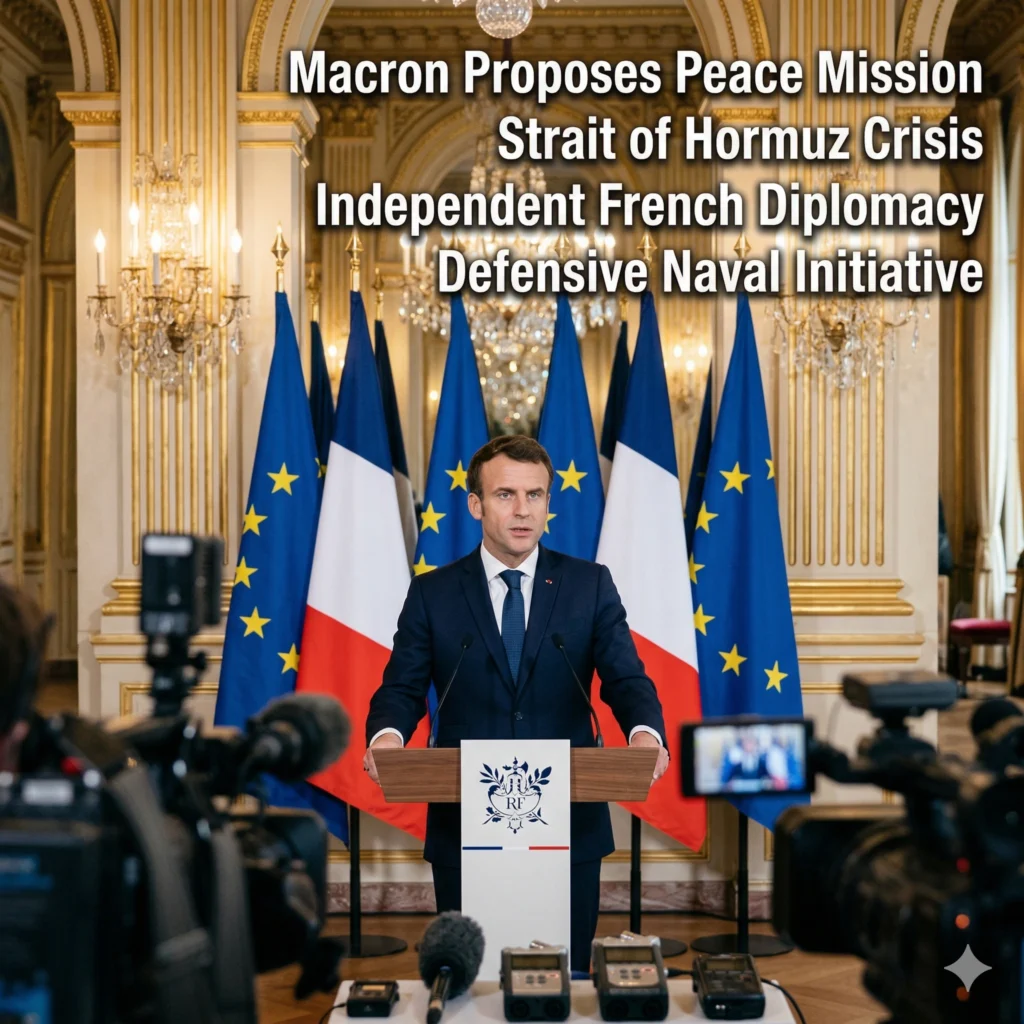
Macron Peace Mission Strategy
The Macron Peace Mission Strategy represents a significant shift in European security autonomy, signaling a departure from traditional alignment with Washington’s regional tactics. By refusing to join the blockade, Macron is prioritizing a “third way” that emphasizes de-escalation over maximum pressure. This strategy is rooted in the belief that a peaceful multinational presence can secure the Strait of Hormuz without triggering a kinetic war.
French officials in Paris have highlighted that the mission is intended to serve as a buffer between the primary warring parties. The President rejected the idea of France being drawn into what he previously termed a foreign war of choice by outside powers. Consequently, the Macron Peace Mission Strategy is framed as a protective shield for neutral commercial vessels caught in the crossfire of the U.S.-Iran dispute.
The success of this strategy hinges on the upcoming Paris conference, which aims to draft a clear framework for safeguarding the strategic waterway. France is currently reaching out to middle powers and maritime nations to build a coalition that is technically capable but politically neutral. This balanced approach is designed to gain the trust of regional actors who are wary of the intensifying American naval presence.
The Strait of Hormuz Crisis
The urgency behind the Macron Peace Mission Strategy is driven by the critical importance of the Strait of Hormuz to the global energy market. As a chokepoint for a significant portion of the world’s oil and liquefied natural gas, any prolonged closure would result in a global economic shock. France recognizes that the current naval blockade risks making the waterway a permanent battleground.
Recent reports indicate that shipping insurance premiums have skyrocketed, effectively halting commercial traffic even before the blockade officially began. The Macron Peace Mission Strategy seeks to provide the security guarantees necessary for shipping companies to resume operations. Without such a mission, the international community faces a supply chain crisis that could trigger a worldwide recession.
- More than 20% of the world’s total petroleum liquids consumption passes through the Strait.
- The waterway is only 21 miles wide at its narrowest point, making it highly vulnerable.
- Alternative pipelines are currently insufficient to handle the total volume of diverted oil.
- Global gas prices have already surged by 15% in anticipation of the Monday blockade.
By deploying a strictly defensive force, France hopes to lower the “temperature” of the conflict. The Macron Peace Mission Strategy involves the use of frigates and surveillance aircraft primarily for monitoring and escort duties. This presence is intended to deter local harassment of tankers without engaging in offensive strikes against Iranian coastal infrastructure.
Diplomatic Coordination with the United Kingdom
A key component of the Macron Peace Mission Strategy is the close coordination between Paris and London. Despite various post-Brexit differences, the two nations have found common ground in the need to prevent a full-scale war in the Middle East. The co-hosted summit will serve as a platform for European and Asian allies to harmonize their maritime rules of engagement.
The British government has expressed support for the French focus on a “defensive-only” mandate. This collaboration strengthens the legitimacy of the mission, moving it beyond a purely French initiative to a broader international effort. The Macron Peace Mission Strategy benefits from British naval expertise and their long-standing historical presence in the Gulf region.
Together, France and the UK are reaching out to nations like India, Japan, and South Korea, which are heavily dependent on Middle Eastern energy. These nations have a vested interest in the success of the Macron Peace Mission Strategy as a way to protect their national interests without choosing sides in the geopolitical rivalry. The goal is to create a truly global maritime safety net that operates independently of the U.S. Navy.
De-escalation and the Islamabad Failure
The collapse of the Islamabad Talks served as the catalyst for the Macron Peace Mission Strategy. When the United States and Iran failed to reach a formal agreement, Paris realized that a military vacuum was being filled by aggressive rhetoric. Macron’s move is a direct response to the lack of diplomatic progress, providing a “safety valve” to prevent accidental escalation.
French diplomats argue that the Macron Peace Mission Strategy creates space for diplomacy to resume. By securing the Strait, the mission removes one of the most immediate “triggers” for war—the threat to global energy. This allows negotiators to return to the table without the immediate pressure of a total economic collapse hanging over their heads.
The initiative is framed as a lawful alternative to the unilateral measures announced by the American administration. France remains deeply concerned about the long-term stability of the Middle East and the potential for a wider regional confrontation involving multiple nuclear-armed powers. The Macron Peace Mission Strategy is the practical application of France’s commitment to “strategic autonomy” in its most urgent form.
Legal Framework and International Maritime Law
To ensure the mission’s legitimacy, the Macron Peace Mission Strategy is being built upon the foundation of the United Nations Convention on the Law of the Sea (UNCLOS). The French government is working with legal experts to ensure that the mission’s activities are strictly compliant with international norms. This legal clarity is essential for attracting a broad range of contributing nations.
The upcoming Paris conference will focus on drafting the specific “Rules of Engagement” that will govern the multinational fleet. Unlike the U.S. blockade, which is a proactive military measure, the French-led mission will be reactive and protective. This distinction is vital for maintaining the “strictly defensive” label that President Macron has emphasized.
- The mission will prioritize the safety of civilian crews and commercial cargo.
- All participating vessels will operate under a unified command structure based in Toulon.
- The legal framework will include protocols for addressing maritime accidents and oil spills.
- Transparency measures will be implemented to keep all regional stakeholders informed.
By adhering to these principles, the Macron Peace Mission Strategy aims to set a new standard for international maritime security. It seeks to prove that freedom of navigation can be upheld through collective, lawful action rather than unilateral force. This approach resonates with many nations that are increasingly wary of the erosion of international legal standards.
Risks and Challenges of an Independent Mission
Despite its noble goals, the Macron Peace Mission Strategy faces significant operational risks. Operating a fleet in close proximity to both the U.S. blockade and Iranian defensive positions requires extraordinary precision. There is a constant danger that the French-led mission could be caught in a “friendly fire” incident or a deliberate provocation by either side.
Furthermore, the mission requires substantial financial and military resources that will test the resolve of the contributing nations. Maintaining a constant presence in the Strait of Hormuz is an expensive endeavor, especially during a time of global economic strain. The Macron Peace Mission Strategy must prove its value quickly by successfully escorting tankers and lowering insurance rates.
President Macron is also facing domestic political pressure regarding the costs and risks of the deployment. Critics argue that France should not be putting its sailors at risk in a conflict that is primarily between two other nations. However, the President maintains that the “cost of inaction” is far higher, as a total closure of the Strait would devastate the French economy through energy price hikes.
Regional Reactions to the French Initiative
The response to the Macron Peace Mission Strategy in the Middle East has been mixed but generally cautious. While some regional powers welcome a de-escalatory force, others are concerned that it might complicate the existing security architecture. Iran has indicated it prefers regional solutions but has not overtly condemned the French proposal for a “defensive” presence.
Washington’s reaction has been one of public skepticism but private observation. While the American administration would prefer a unified front for its blockade, it also recognizes that a European mission might act as a useful back-channel for communication. The Macron Peace Mission Strategy effectively creates a neutral zone that could facilitate future diplomatic openings.
- Saudi Arabia and the UAE are closely monitoring the mission’s impact on regional stability.
- Iraq has expressed interest in any initiative that prevents its oil exports from being cut off.
- Israel remains focused on the effectiveness of the U.S. blockade as a primary security measure.
- Smaller Gulf states see the French mission as a way to maintain their neutrality.
As the mission moves from planning to deployment, the Macron Peace Mission Strategy will require constant adjustment based on these regional dynamics. France must navigate a complex web of rivalries and interests to ensure its mission is seen as a solution rather than a new problem. The success of the Paris summit will be the first major indicator of the mission’s regional viability.
Impact on Global Energy Markets
The primary measure of success for the Macron Peace Mission Strategy will be the stability of global oil and gas prices. Since the announcement of the independent mission, market volatility has slightly decreased as traders factor in a potential “safe passage” for tankers. If the French-led fleet can demonstrate its effectiveness, it could prevent a catastrophic spike in energy costs.
Economic analysts suggest that even a partial reopening of the Strait would be enough to calm the markets. The Macron Peace Mission Strategy provides a psychological boost to the industry, signaling that the international community will not allow the energy supply to be completely held hostage. This confidence is essential for preventing a wider inflationary spiral in the global economy.
- Energy analysts predict a 5-10% price correction if the mission begins escorts this month.
- Global shipping giants have expressed interest in the “safe corridor” concept.
- The mission could reduce the need for expensive and risky around-Africa shipping routes.
- Stable energy prices are critical for the economic recovery of developing nations.
The Macron Peace Mission Strategy is therefore not just a military or diplomatic endeavor, but a vital economic intervention. By securing the physical flow of energy, France is helping to secure the global financial system. This dual-purpose role is what makes the mission a central pillar of President Macron’s 2026 foreign policy agenda.
Future of the Multinational Mission
Looking beyond the immediate crisis, the Macron Peace Mission Strategy could serve as a model for future maritime security challenges. As global tensions rise in other strategic waterways, such as the South China Sea or the Bab el-Mandeb, the concept of a “defensive multinational mission” could become a standard tool for de-escalation.
The success of the 2026 mission will depend on the sustained commitment of France and its partners. If the mission can maintain its independence and neutrality over several months, it will build the credibility necessary to facilitate a larger diplomatic settlement. The Macron Peace Mission Strategy is the first step in a long process of restoring order to a fractured international landscape.
As the ships of the multinational fleet prepare to set sail, the world watches with a mixture of hope and anxiety. President Macron has taken a massive gamble on the power of independent diplomacy and collective security. The next few weeks in the Strait of Hormuz will determine whether the Macron Peace Mission Strategy can truly pave the way for a lasting and sustainable peace.
Conclusion: France’s Stabilizing Role
In conclusion, the Macron Peace Mission Strategy represents a courageous and necessary effort to prevent a global catastrophe. By choosing a path of independent de-escalation, President Emmanuel Macron has provided the world with a viable alternative to military confrontation. The mission to reopen the Strait of Hormuz is a testament to France’s enduring commitment to international law and global stability.
The upcoming summit in Paris will be a defining moment for European leadership in the 21st century. Through the Macron Peace Mission Strategy, France is demonstrating that it has the vision and the will to act as a bridge between warring powers. The success of this mission is not just a French interest, but a necessity for the entire international community as it navigates the dangers of 2026.
As the first French frigates arrive at their stations, the Macron Peace Mission Strategy moves from theory into reality. The hope is that this presence will provide the calm needed for the “Islamabad Spirit” to be revived and for a permanent diplomatic solution to be found. France stands ready to lead the way toward a more secure and predictable future for all.
For more details & sources visit: Arab News
Read more about France news on 360 News Orbit – France.