
China Economic Growth Pressure has become the central theme of global financial discourse. Recent data indicates that the world’s second-largest economy is struggling to maintain its historic momentum amidst a confluence of structural and demographic hurdles. While the nation managed a 5% expansion in early 2026, the underlying indicators suggest that the era of rapid, double-digit development has officially concluded. Economists are now closely monitoring how Beijing navigates the delicate balance between state intervention and the cooling of domestic consumption.
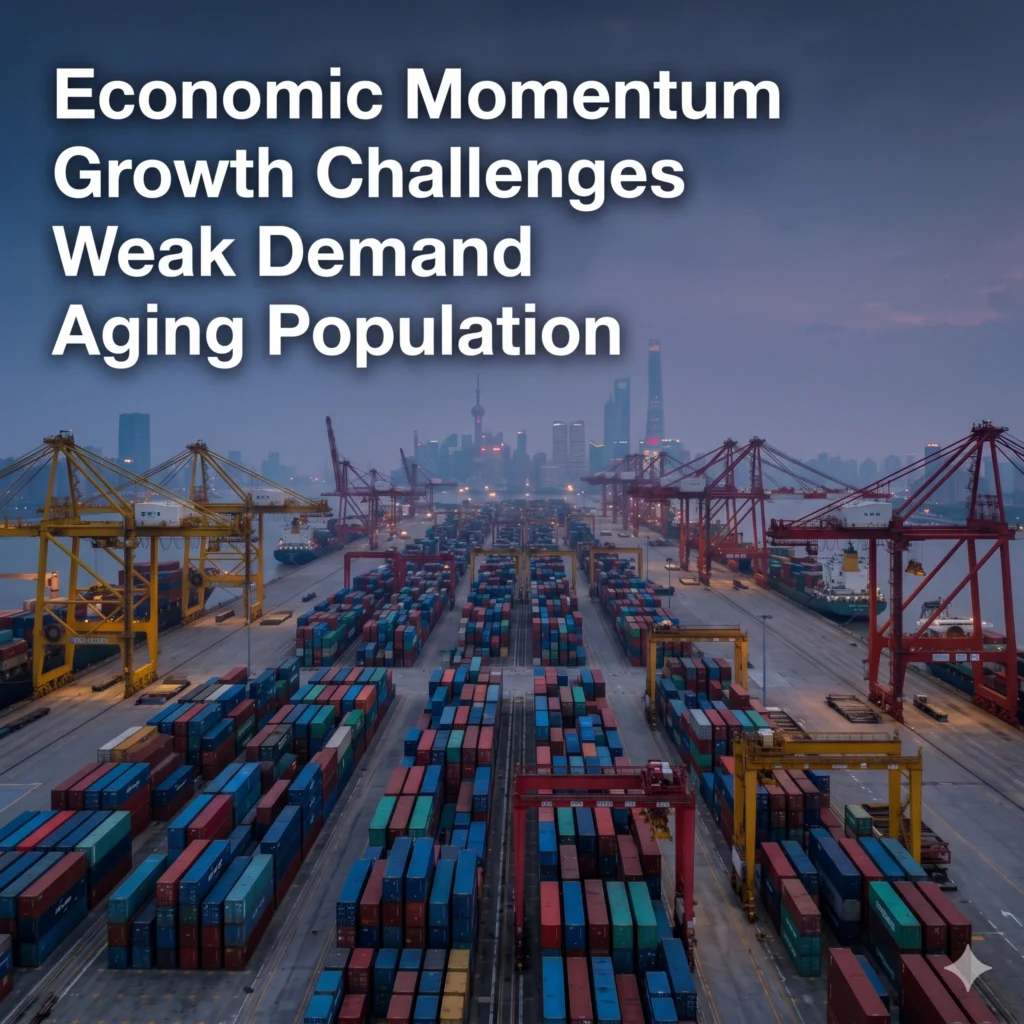
China Economic Growth Pressure and Household Spending
The primary driver behind the current China Economic Growth Pressure is a significant and persistent slump in domestic household spending. For decades, the Chinese model relied heavily on massive infrastructure projects and exports, but the transition toward a consumption-led economy has hit a wall. Consumers are increasingly cautious, choosing to save rather than spend as property market volatility continues to affect personal wealth. This lack of demand creates a deflationary cycle that makes it difficult for businesses to justify new investments or wage increases.
Furthermore, the retail sector has seen a cooling of enthusiasm for luxury goods and high-end electronics, which were previously growth engines. Transitioning the economy to rely on the average citizen’s wallet requires a level of social safety net confidence that has not yet fully materialized. As long as households remain wary of future economic stability, the internal engine of the nation will likely continue to sputter. This hesitation is not just a temporary phase but seems to be a fundamental shift in the psychological landscape of the Chinese middle class.
China Economic Growth Pressure
The reality of China Economic Growth Pressure is most visible when examining the manufacturing sector’s recent performance. Once known as the “world’s factory,” China is seeing a migration of supply chains toward Southeast Asian nations like Vietnam and Thailand. This shift is driven by rising labor costs within China and a strategic desire by global corporations to diversify their production bases. Consequently, the export-led growth that defined the early 2000s is no longer a guaranteed safety net for the national budget.
Investment in fixed assets, which includes everything from factory machinery to new skyscrapers, turned negative in 2025. This contraction is a stark signal that business confidence is at a multi-decade low. When private enterprises stop investing in their own future, it places an enormous burden on the state to fill the gap through fiscal stimulus. However, with local government debt reaching critical levels, the capacity for the state to spend its way out of this slowdown is more limited than it was during the 2008 financial crisis.
The Demographic Crisis and Labor Shrinkage
A major pillar of China Economic Growth Pressure is the undeniable reality of an aging and shrinking population. The working-age demographic peaked years ago, and the nation is now facing the consequences of a rapidly graying society. With fewer young people entering the workforce, labor costs are naturally pushed higher, even as overall productivity gains begin to plateau. This demographic squeeze makes it incredibly difficult to maintain the labor-intensive manufacturing dominance that China enjoyed for the past forty years.
The social implications are equally daunting, as a smaller workforce must now support a vastly larger retired population. This shift diverts capital away from innovation and toward healthcare and pension obligations. Analysts suggest that unless there is a massive leap in robotics and artificial intelligence integration, the shrinking labor pool will remain a permanent drag on the GDP. The government has attempted to incentivize larger families, but the high cost of living in urban centers continues to suppress birth rates across the country.
Trade Barriers and Global Competition
External factors are also intensifying the China Economic Growth Pressure as international trade dynamics shift toward protectionism. Higher tariffs and stringent trade restrictions, particularly from the United States and the European Union, have blunted China’s competitive edge in key markets. These geopolitical tensions have led to “de-risking” strategies by Western nations, which prioritize security over the cost efficiencies previously offered by Chinese manufacturing. This isolation from traditional trading partners forces China to look toward developing markets, which often lack the purchasing power of the West.
Technological competition has also reached a fever pitch, with various export bans on high-end semiconductors and AI hardware. These restrictions hamper China’s ability to upgrade its industrial base and transition into higher-value-added sectors. Without access to the most advanced global technologies, the path to raising productivity becomes significantly steeper. The nation is now forced to invest heavily in domestic research and development, a process that is both expensive and time-consuming with no guarantee of immediate success.
Productivity Hurdles in the Modern Era
To combat China Economic Growth Pressure, the government is banking on a massive surge in industrial productivity. The goal is to produce more with fewer people, leveraging automation and high-tech manufacturing. However, the transition has been uneven, with state-owned enterprises often receiving the lion’s share of funding while more agile private tech firms face increased regulatory scrutiny. This imbalance can stifle the very innovation needed to break through the current economic stagnation.
There is also the challenge of the “middle-income trap,” where a country reaches a certain level of wealth but finds it difficult to transition to a high-income status. Historically, many nations have stalled at this stage when they fail to evolve their economic institutions. For China, the pressure is on to prove that its unique model can overcome the structural deficiencies that have historically slowed down other developing giants. The success or failure of these productivity initiatives will define the nation’s standing in the global order for the remainder of the century.
Real Estate Instability and Financial Risk
No discussion of China Economic Growth Pressure would be complete without mentioning the ongoing instability in the real estate sector. For years, property development accounted for nearly thirty percent of the national GDP. The collapse of major developers and the subsequent halt in construction projects have left a massive hole in the economy. It has also decimated the primary source of wealth for many Chinese families, leading back to the issue of weak household spending.
The financial system is also feeling the strain, as banks deal with non-performing loans tied to stalled real estate ventures. While the central bank has intervened with liquidity injections, the underlying rot in the property market requires a more fundamental restructuring. Until the housing market stabilizes, a significant portion of the nation’s capital remains tied up in unproductive or depreciating assets. This systemic risk keeps global investors on edge and contributes to the general sense of economic malaise.
Shifts in Global Supply Chain Logic
The China Economic Growth Pressure is fundamentally altering how global supply chains are organized in 2026. The “China Plus One” strategy, where companies maintain presence in China but build their next factories elsewhere, has become the standard operating procedure for multinationals. This trend is not just about costs; it is about resilience in the face of potential geopolitical shocks. As a result, China is losing its status as the singular, indispensable hub of global trade.
- Manufacturing is moving toward India and Vietnam to capitalize on younger workforces.
- Automated “near-shoring” is bringing some production back to North America and Europe.
- Critical mineral processing is being diversified to reduce reliance on Chinese refineries.
- Software and service sectors are seeing increased competition from emerging digital economies.
Investment Trends and Market Confidence
The cooling of foreign direct investment is a clear byproduct of the current China Economic Growth Pressure. Investors who once saw China as a “must-have” in their portfolio are now reassessing the risk-to-reward ratio. The combination of slowing growth, regulatory uncertainty, and geopolitical friction has led to a significant capital flight. Regaining this lost confidence will require more than just rhetoric; it will require concrete structural reforms that protect private property and ensure a level playing field.
Domestic investors are also looking elsewhere, with many seeking ways to move capital into more stable international assets. This outflow of wealth further complicates the government’s efforts to stimulate the economy from within. The stock markets in Shanghai and Shenzhen have reflected this pessimism, underperforming compared to other major global indices over the last eighteen months. Turning this sentiment around is perhaps the greatest challenge facing the nation’s financial leadership today.
Infrastructure and the Law of Diminishing Returns
For decades, building roads, bridges, and high-speed rail was the go-to solution for China Economic Growth Pressure. However, the nation has reached a point of diminishing returns where the cost of new infrastructure often exceeds the economic value it generates. Many provinces are now littered with “ghost cities” and underutilized transport links that serve more as debt burdens than as catalysts for trade. This traditional growth lever is essentially broken, requiring a pivot toward “soft” infrastructure like education and healthcare.
The shift toward a digital infrastructure—5G, data centers, and smart cities—is the new frontier. While these investments are necessary, they do not provide the massive, immediate employment boosts that traditional construction once did. Furthermore, the high-tech nature of these projects means they require a highly skilled workforce that is in increasingly short supply due to the aforementioned demographic trends. This mismatch between investment type and labor availability is a recurring theme in the current slowdown.
The Role of State-Owned Enterprises
State-owned enterprises (SOEs) are playing an increasingly dominant role as China Economic Growth Pressure mounts. The government often uses these large entities to stabilize employment and maintain industrial output during lean times. However, SOEs are generally less efficient and less innovative than their private-sector counterparts. Their dominance can crowd out private investment, leading to a misallocation of resources that hampers long-term growth prospects.
Critics argue that the “State Advances, Private Sector Retreats” trend is a primary reason for the slowing productivity gains. While SOEs provide a safety net for the government, they often lack the competitive drive to lead the world in new technologies. Balancing the stability provided by the state with the dynamism of the private market is a tightrope walk that Beijing has yet to perfect. The future of Chinese growth may depend on whether the private sector is allowed to regain its footing and lead the next wave of development.
Environmental Goals vs. Economic Needs
The tension between green energy goals and China Economic Growth Pressure is becoming more apparent. China is a world leader in renewable energy installations, but the immediate need for economic stability often leads to a reliance on coal-power to ensure industrial reliability. Meeting ambitious carbon neutrality targets while trying to stimulate a flagging economy is a massive logistical and financial challenge. The “green transition” requires trillions in investment, which is harder to come by when the general economy is slowing.
However, the green sector is also one of the few areas showing genuine growth. Solar panel manufacturing, electric vehicles, and battery technology are industries where China still maintains a significant global lead. The government is hoping that these “new three” industries can replace the “old three” (real estate, infrastructure, and cheap exports) as the primary engines of the economy. Whether these sectors are large enough to carry the weight of the entire nation remains the multi-trillion-dollar question.
Regional Disparities and Internal Migration
China Economic Growth Pressure is not felt equally across the country. The coastal provinces remain relatively prosperous and innovative, while the inland rust-belt regions face severe stagnation. This widening gap creates social pressures and complicates national policy-making. Efforts to move manufacturing to the interior to save on costs have met with mixed success, as logistics and a lack of skilled talent remain significant barriers.
Internal migration patterns are also changing. The “floating population” of migrant workers is shrinking as many choose to stay in their home provinces rather than face the high costs and uncertain job markets of the mega-cities. This trend reverses decades of urbanization-led growth, forcing cities to rethink their economic models. The reform of the “hukou” (household registration) system is often cited as a necessary step to encourage more permanent urban settlement and consumption, but implementation has been slow and cautious.
Educational Mismatches and Youth Unemployment
A poignant symptom of China Economic Growth Pressure is the high rate of youth unemployment. There is a significant mismatch between the degrees held by recent graduates and the jobs available in the current economy. Many young people are overqualified for factory work but find the “white-collar” job market extremely competitive and stagnant. This “involution”—a term used by Chinese youth to describe a feeling of being stuck in a meaningless, hyper-competitive race—has significant implications for future productivity.
The government has expressed concern over this trend, as a disillusioned youth population can lead to social instability. Programs to encourage vocational training and entrepreneurship have been launched, but the prestige associated with traditional academic paths remains high. Bridging this gap is essential for ensuring that the next generation can contribute effectively to the nation’s economic goals. Without a clear path forward for its youth, the long-term outlook for Chinese innovation remains clouded.
Monetary Policy and the Yuan’s Value
To manage China Economic Growth Pressure, the People’s Bank of China has adopted a cautious monetary policy. Unlike Western central banks that raised rates to fight inflation, China has been lowering rates to encourage borrowing. However, this has put downward pressure on the Yuan, making imports more expensive and complicating the global investment picture. Maintaining currency stability while trying to stimulate growth is a difficult act that requires constant market intervention.
The internationalization of the Yuan is another long-term goal that is being hampered by the current slowdown. A currency’s strength is ultimately a reflection of the underlying economy’s health. As growth falters, the Yuan’s appeal as a global reserve currency diminishes. For Beijing, the challenge is to manage the currency in a way that supports exports without triggering a massive flight of capital. This delicate balance is a central part of the current economic strategy.
Future Projections and Global Impact
Looking ahead, the China Economic Growth Pressure is expected to be a permanent fixture of the global landscape. Most analysts project that growth will settle into a “new normal” of 3% to 4% for the foreseeable future. While this is still positive, it is a far cry from the numbers that fueled the global commodity booms of the past. The world must now adjust to a China that is a steady, rather than explosive, contributor to global GDP.
- Global commodity prices may stabilize or fall as Chinese demand for raw materials wanes.
- Multinational companies will continue to prioritize “resilience” over “efficiency.”
- Geopolitical competition will likely intensify as China seeks to protect its remaining growth engines.
- Innovation in AI and automation will be the primary battlefield for economic supremacy.
Conclusion: A Nation at a Crossroads
In conclusion, the China Economic Growth Pressure observed on May 7, 2026, marks a definitive turning point for the nation. The combination of an aging population, weak domestic demand, and a changing global trade environment has created a complex web of challenges. There are no easy fixes, and the strategies that worked in the past are no longer effective in the modern context. The world is watching to see if China can reinvent itself once again or if it will face a long period of stagnation similar to what other developed Asian economies have experienced.
The resilience of the Chinese people and the vast resources of the state are significant assets, but the structural headwinds are formidable. As the nation navigates this transition, the impact will be felt in every corner of the globe. From the price of consumer electronics to the stability of international financial markets, the health of the Chinese economy remains a vital concern for everyone. The coming years will reveal whether the current slowdown is a temporary setback or the beginning of a new, more challenging era in Chinese history.
For more details & sources visit: Indus Business Journal
Read more about China news on 360 News Orbit – China.