
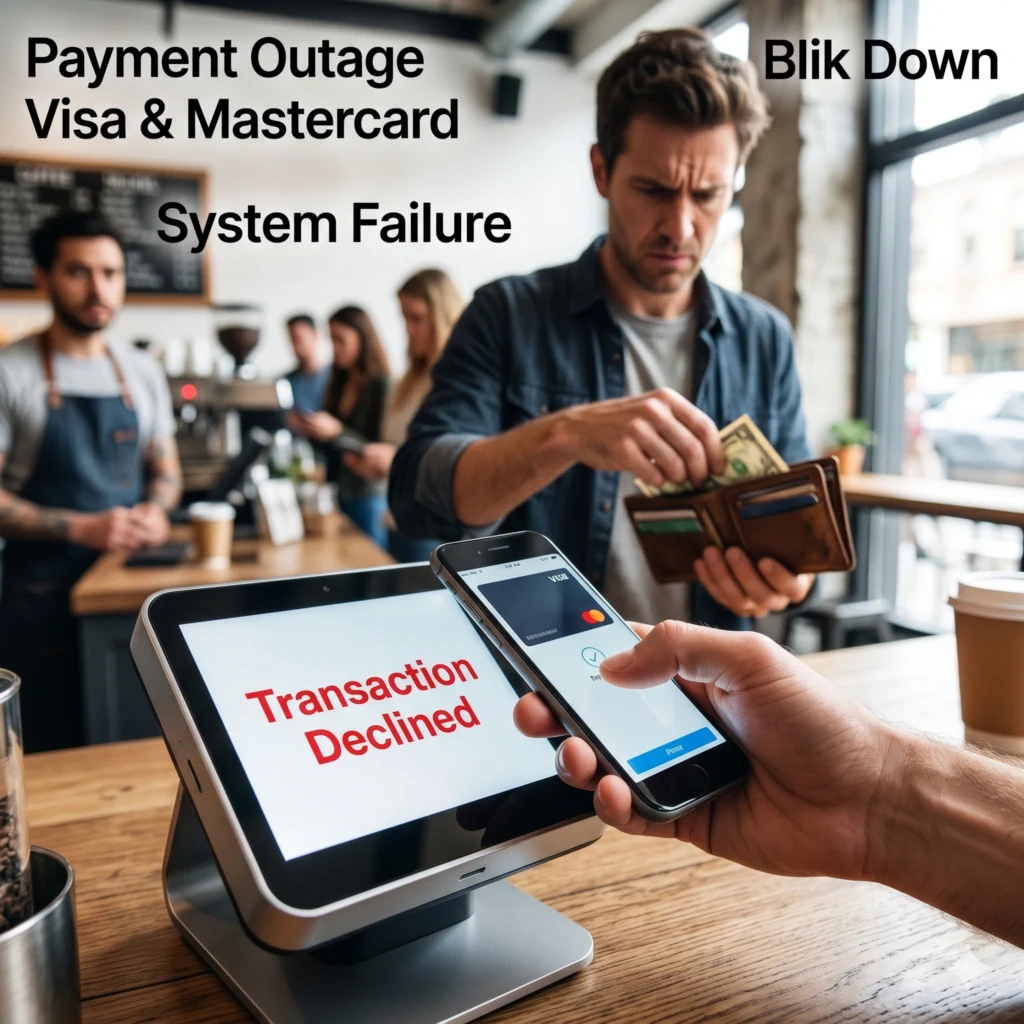
Payment system disruptions have paralyzed retail commerce across Europe this morning, leaving millions of consumers unable to complete basic transactions at the checkout. What began as a series of isolated glitches at seven o’clock in the morning quickly escalated into a full-scale digital blackout affecting the world’s most prominent financial networks. From major supermarkets in Warsaw to high-end boutiques in Paris, the inability to process card or mobile payments has caused unprecedented chaos for both businesses and shoppers.
Technical monitoring services, including Downdetector, confirmed a massive spike in error reports as the morning rush hour intensified across the continent. This synchronized failure marks one of the most significant infrastructure challenges faced by the global financial sector in recent years, highlighting the fragility of our increasingly cashless society.
The Scale of the Digital Blackout
Payment system disruptions on this scale are rarely seen in the modern era, given the high level of redundancy built into international banking architectures. However, data indicates that by eight o’clock, over two hundred individual reports were filed specifically regarding the Visa network alone. These issues are not limited to a single provider, as Mastercard users have also joined the influx of reports citing intermittent connectivity with international gateways.
The economic impact of these failures is already being felt by small businesses that rely exclusively on digital payment terminals for their daily revenue. Without the ability to process transactions, many retailers have been forced to turn customers away or implement manual recording systems that are prone to human error. Experts suggest that the longer these outages persist, the greater the potential for significant losses in the retail and service sectors.
Impact on the Polish Blik Ecosystem
Payment system disruptions have hit the Polish market with particular severity due to the simultaneous failure of the Blik mobile payment system. Blik is deeply integrated into the Polish financial landscape, making it the primary method for ATM withdrawals and peer-to-peer transfers for millions of active users. When the system went down, customers found themselves trapped in a situation where neither their physical cards nor their mobile apps could facilitate a purchase.
- Users reported an total inability to generate the essential six-digit codes required for authentication.
- Many mobile banking applications became unresponsive as they attempted to ping the failing Blik servers.
- ATM networks across major Polish cities saw long queues as people rushed to withdraw physical cash.
- The failure of a domestic favorite alongside global giants suggests a deep-rooted infrastructure issue.
Payment system disruptions
The core of the current crisis is the widespread nature of the payment system disruptions that have crossed the traditional boundaries of card and mobile networks. Usually, if a global card network fails, a mobile payment system acts as a reliable backup, but today’s event has effectively removed all digital safety nets. This rare convergence of failures has forced many citizens to return to traditional cash-based transactions for the first time in years.
Industry insiders suggest that while these platforms are distinct, they often share certain telecommunications backbones or third-party cloud service providers. If a major data center or a high-traffic gateway experiences a critical malfunction, it can create a domino effect across seemingly unrelated payment brands. This is why these outages appear synchronized, despite the companies operating under different corporate structures and technical frameworks.
Global Giants Face Technical Challenges
Payment system disruptions have specifically targeted the core processing architectures of global financial titans like Visa and Mastercard. Mastercard customers have documented intermittent connectivity issues, especially when attempting to use international payment gateways for cross-border transactions. These failures are particularly damaging for travelers and digital nomads who rely on the seamless operation of their cards across different jurisdictions.
- Point-of-sale terminals in various international airports reported a high frequency of declined transactions.
- Online checkouts for major e-commerce platforms saw a dramatic increase in abandoned carts.
- Technical teams are reportedly investigating a potential synchronization error within European data clusters.
- Communication from the companies remains sparse, leading to increased anxiety among the general public.
Disruption at the Point of Sale
Payment system disruptions have directly impacted the physical retail environment, leading to long queues and frustrated staff at supermarkets. Many modern cash registers are programmed to prioritize digital payments, and a system-wide failure often causes the software to freeze or lag significantly. Retail workers have been advised to manually input transaction data where possible, though this is a slow and error-prone process.
The disruption has highlighted the “all eggs in one basket” risk of a cashless society, where a single point of failure can halt commerce across an entire city. Small businesses, which often lack the robust IT support of larger chains, are suffering the most during this period of instability. Until the digital systems stabilize, the advice from financial institutions remains the same: carry physical currency for essential daily tasks.
Analyzing the Infrastructure Failure
Payment system disruptions suggest that the root cause may lie in the middle-layer software that connects banks to the merchant terminals. This software, often referred to as “middleware,” is responsible for the rapid-fire verification of funds and the approval of the transaction code. If this layer is compromised or experiences a high-volume bottleneck, the front-end user experience is one of repeated declines and error messages.
Security experts are also monitoring the situation for signs of a coordinated cyberattack, although there is currently no official evidence to support this theory. Nevertheless, the scale and timing of the outages have put national cybersecurity agencies on high alert as they look for anomalies in traffic patterns. For now, the focus remains on restoration and ensuring that no unauthorized transactions took place during the period of technical instability.
Banking Application Failures and Mobile Woes
Payment system disruptions have extended into the mobile banking applications provided by individual financial institutions. Customers attempting to check their balances or authorize online purchases through their smartphones have encountered persistent loading screens or immediate app crashes. This suggests that the problem is not limited to the physical swipe of a card but involves the entire digital handshake process.
- Several major European banks have acknowledged the issues and issued apologies via their official websites.
- Push notifications intended to verify 3D Secure transactions are failing to reach the users’ devices.
- Internal banking transfers between accounts appear to be less affected than external payments.
- The reliance on mobile apps for two-factor authentication has made the outage feel even more pervasive.
Retailer Response and Alternative Payments
As payment system disruptions continue, large-scale retailers have been forced to implement emergency protocols to keep their doors open. In some cases, stores have had to temporarily close their doors to clear the backlog of customers who are unable to pay. Others have set up “cash-only” signs at their entrances to manage customer expectations before they reach the checkout line.
The shift back to cash has put a temporary strain on local ATM networks, as thousands of people attempt to withdraw physical money at the same time. This has created a secondary wave of technical pressure, as some older ATM units struggle to handle the increased demand for cash disbursements. It is a stark reminder of the importance of maintaining a diverse and resilient payment ecosystem.
Investigating the Technical Root Cause
Payment system disruptions point toward a potential localized infrastructure failure within European payment processing hubs. These hubs act as the central nervous system for millions of transactions every hour, routing data between merchant banks and card issuers. A malfunction at this level can have far-reaching consequences that transcend individual brands, affecting any service that routes through the damaged node.
Technical crews are working around the clock to perform diagnostic tests on the fiber optic links and the server arrays that power these hubs. The goal is to isolate the faulty component and reroute traffic to redundant systems to restore service as quickly as possible. However, rerouting such massive volumes of high-security financial data is a delicate process that requires careful calibration to prevent further data loss.
Resilience in a Digital Economy
Payment system disruptions throughout the morning indicate that this is not a simple “flick of the switch” fix for the providers. The complexity of modern financial networks means that even a minor software update gone wrong can take hours to roll back and verify. Every minute the systems are down adds to the mounting frustration of a public that has become accustomed to near-instantaneous digital transactions.
Governments are also taking note of the situation, with some officials calling for stricter regulations on the uptime and reliability of essential payment infrastructure. If digital payments are to be the primary method of commerce, then the companies providing these services must be held to the highest standards. The current crisis will likely serve as a major case study for future policy discussions regarding financial grid stability.
Potential Cyber Vulnerabilities
Payment system disruptions of this magnitude inevitably raise questions about the security of the underlying network protocols. While technical failures are more common, the possibility of a sophisticated intrusion cannot be entirely ruled out by independent security researchers. If an attacker managed to disrupt the validation servers, it would explain the synchronized nature of the failures across different payment brands.
- Many experts are looking at the Border Gateway Protocol (BGP) for signs of misdirection in internet traffic.
- A failure in the security certificate authority could also lead to widespread handshake failures between devices.
- Companies are conducting deep-packet inspections to rule out malicious traffic aimed at their core databases.
- The recovery process will include a comprehensive security audit to ensure no data was compromised.
Impact on Global Travel and Trade
Payment system disruptions are particularly problematic for the global travel industry, where bookings and services are entirely dependent on digital credit systems. Travelers at international hubs have reported being unable to pay for airport transfers, hotel check-ins, or even basic meals during their journeys. This creates a cascade of logistical issues that can take days to resolve even after the technical systems are restored.
International trade is also affected, as digital payment gateways used for B2B transactions experience similar timeouts and processing errors. When large-scale financial transfers are delayed, it can disrupt supply chains and lead to contract penalties for businesses that are unable to meet their payment deadlines. The global nature of the 2026 economy makes these digital blackouts an international concern for all trading nations.
Lessons for Future Financial Planning
Payment system disruptions serve as a critical warning for nations pushing for a fully cashless society in the near future. While digital payments offer undeniable convenience and efficiency, the total reliance on these systems creates a significant risk profile for the national economy. Diversification of payment methods is not just a matter of convenience; it is a matter of national economic security.
Education on how to handle such outages should become a standard part of financial literacy programs for both consumers and business owners. Knowing how to quickly pivot to alternative payment methods can minimize the personal and professional impact of a sudden digital blackout. As we move forward, the resilience of our financial infrastructure must remain a top priority for the private sector.
Final Updates on System Status
Currently, payment system disruptions continue to be reported across multiple digital channels and social media monitoring tools. If you are currently attempting to make a purchase, it is advisable to check the status of your specific bank’s app before reaching the register. If you encounter a declined transaction, do not repeatedly attempt the payment, as this could lead to multiple temporary holds.
- Check official social media handles of Visa and Mastercard for the most recent updates on the situation.
- Avoid making large online purchases until there is a clear “all-clear” signal from the providers.
- Keep your physical receipts for any transactions made via cash or manual entry during this period.
- Report any suspicious account activity to your bank immediately to prevent unauthorized charges.
Conclusion and Future Outlook
The massive scale on which payment system disruptions have occurred today will likely lead to a thorough industry-wide audit. The goal will be to ensure that such a synchronized failure cannot happen again, or at least to ensure that more robust backup systems are in place. For the time being, the focus remains on the immediate technical fix and getting the wheels of commerce turning smoothly once again.
This event has demonstrated that even the most sophisticated and globally dominant platforms are not immune to critical failure. As technology continues to evolve, the race between innovation and infrastructure resilience will continue to be a defining theme of the financial world. For today’s consumers, the primary takeaway is a renewed appreciation for the tangibility of physical cash in an increasingly ethereal world.
For more details & sources visit: Gazeta
Read more on Poland news: 360 News Orbit – Poland.