
United Airlines Premium Seats represent the core of a massive fleet modernization strategy that is currently reshaping the landscape of American aviation. The Chicago-based carrier officially accelerated its commitment to luxury travel by announcing the integration of over 250 new aircraft by the year 2028. This move is designed to capture a growing market segment that prioritizes comfort over cost, reflecting a structural shift in how people fly.
As the industry evolves, United Airlines Premium Seats are becoming the primary driver of revenue growth for the airline. This strategic pivot comes at a time when demand for high-end travel experiences is outpacing the growth of standard economy options by nearly three to one. By investing heavily in wide-body jets and advanced narrow-body aircraft, United is positioning itself as a dominant force in the luxury market.
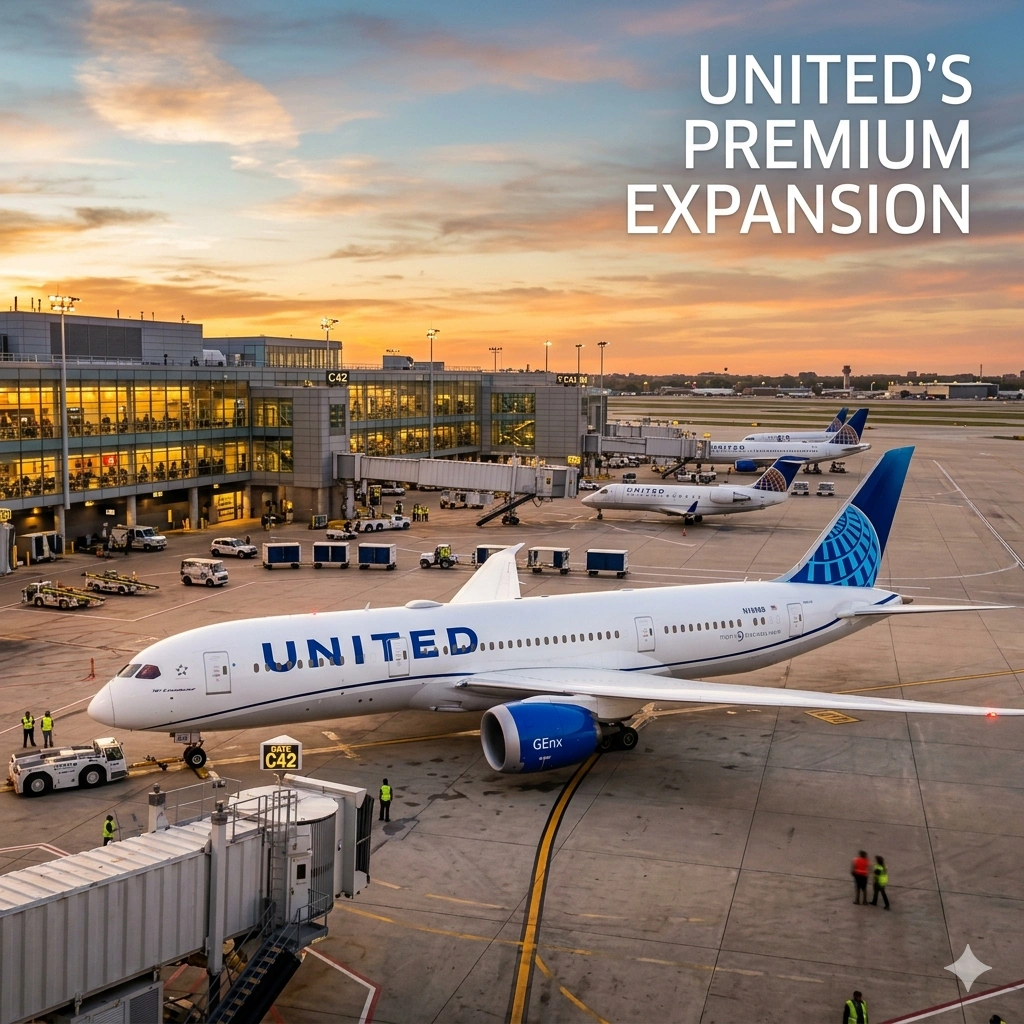
United Airlines Premium Seats
The expansion of United Airlines Premium Seats is not merely a fleet update but a comprehensive overhaul of the passenger experience. Each new aircraft entering the fleet will be equipped with the latest signature interiors, featuring larger overhead bins and high-definition seatback entertainment. This commitment ensures that the premium product remains competitive against international rivals who have long set the gold standard for luxury.
Furthermore, the introduction of these seats allows United to optimize its route network more effectively. By offering more United Airlines Premium Seats on long-haul international flights, the carrier can maximize yield per passenger. This strategy is particularly effective on high-demand corridors where corporate travelers and wealthy vacationers seek the seamless comfort provided by modern business-class configurations.
To support this growth, United is also investing in its ground infrastructure, including revamped Polaris lounges and exclusive check-in areas. The synergy between the ground experience and the United Airlines Premium Seats in the sky creates a cohesive ecosystem of luxury. This holistic approach is what separates United from low-cost competitors that are currently struggling to maintain market share.
Strategic Shift Toward Luxury Aviation
The decision to prioritize United Airlines Premium Seats reflects a broader trend across the global aviation sector. While budget carriers are facing increased operational pressure and shrinking margins, legacy carriers are finding success by moving upmarket. United is leading this charge by ensuring that a higher percentage of its total seat capacity is dedicated to those who value extra legroom and personalized attention.
Currently, the percentage of United Airlines Premium Seats within the carrier’s total scheduled capacity is reaching historic highs. This shift is a direct response to data showing that high-yield passengers are less sensitive to price fluctuations compared to budget travelers. By securing this demographic, United builds a more resilient business model that can withstand economic volatility while maintaining high profitability.
The competitive landscape also plays a role in this modernization push, as Delta and American Airlines are making similar moves. However, the sheer scale of the investment in United Airlines Premium Seats puts the carrier in a unique position. With 250 aircraft on the way, the sheer volume of high-end inventory will give United a significant advantage in terms of availability and global reach.
Modernizing the Long Haul Fleet
A significant portion of the new United Airlines Premium Seats will be featured on the Boeing 787-9 Dreamliner, an aircraft known for its efficiency and passenger comfort. These jets allow United to fly thinner, long-range routes that were previously unprofitable. The advanced cabin pressurization and humidity controls on these planes further enhance the appeal of the premium seating options.
In addition to the wide-body fleet, the Airbus A321neo will play a crucial role in delivering United Airlines Premium Seats on transcontinental and mid-range routes. These narrow-body aircraft provide a wide-body feel, offering lie-flat seats in a single-aisle configuration. This flexibility allows the airline to maintain a consistent luxury product across its entire domestic and international network.
The integration of these new jets also helps United meet its sustainability goals, as modern engines are significantly more fuel-efficient. Passengers choosing United Airlines Premium Seats can feel better about their travel footprint while enjoying the latest in aviation technology. This combination of environmental responsibility and luxury is a key selling point for the modern, conscious traveler.
Impact on Domestic Market Dynamics
The rise of United Airlines Premium Seats is fundamentally changing how domestic flights are marketed and sold in the United States. As more business-class and premium economy options become available, the gap between legacy carriers and ultra-low-cost carriers continues to widen. This divergence is creating a two-tiered market where United excels at the top end of the spectrum.
As low-cost carriers like Spirit Airlines restructure their operations, United is moving in to capture the displaced demand. The availability of United Airlines Premium Seats provides an attractive alternative for travelers who are tired of the “no-frills” model. This shift is particularly evident in major hubs where United is increasing the frequency of flights equipped with its latest seating products.
- Increased availability of lie-flat seats on transcontinental routes.
- Enhanced dining and beverage options for premium passengers.
- Priority boarding and baggage handling for all high-tier bookings.
- Access to exclusive airport lounges for Polaris and United First customers.
These enhancements are designed to build brand loyalty among frequent flyers. When a traveler knows they can rely on the quality of United Airlines Premium Seats, they are more likely to stay within the United ecosystem. This loyalty is a powerful asset that drives recurring revenue and strengthens the airline’s market position against domestic competitors.
Technological Advancements in Cabin Design
Innovation is at the heart of the new United Airlines Premium Seats, with a focus on ergonomics and digital connectivity. Each seat is designed to provide maximum privacy, featuring sliding doors or high partitions in the business class cabin. This focus on personal space is a direct response to passenger feedback requesting more seclusion during long-haul flights.
The digital experience within the United Airlines Premium Seats environment is also seeing a major upgrade. High-speed Wi-Fi, wireless charging ports, and Bluetooth-enabled entertainment systems are becoming standard features. These technological touches ensure that passengers can remain productive or entertained throughout their journey, making the travel time more valuable.
- Wireless charging pads integrated into the side consoles.
- Bluetooth audio connectivity for personal noise-canceling headphones.
- Larger, 4K resolution seatback screens for a cinematic experience.
- Customizable lighting profiles to help reduce jet lag during flight.
By focusing on these details, United is ensuring that its United Airlines Premium Seats are not just comfortable but also highly functional. The goal is to provide a seamless transition from the office or home to the aircraft cabin. This level of detail is what defines the next generation of premium travel and keeps United at the forefront of the industry.
Economic Implications of Fleet Investment
The multi-billion dollar investment in United Airlines Premium Seats has significant economic implications for the carrier and its stakeholders. While the upfront costs are substantial, the long-term revenue potential of high-margin seating is far greater than that of economy seating. This financial strategy is centered on increasing the average revenue per available seat mile (RASM).
Investors are closely watching the rollout of the United Airlines Premium Seats as a primary indicator of the airline’s future health. By shifting away from the price-war mentality of the low-cost market, United is protecting its margins. The ability to command higher fares through superior product offerings is a proven way to achieve sustainable growth in the capital-intensive airline business.
Furthermore, the expansion of United Airlines Premium Seats creates a ripple effect throughout the supply chain. From aerospace manufacturers to luxury catering companies, various sectors benefit from United’s move upmarket. This investment signals confidence in the long-term viability of the travel industry and the enduring demand for high-quality air travel services.
Future Outlook for Premium Travel
Looking ahead to 2028, the presence of United Airlines Premium Seats will be a defining characteristic of the carrier’s brand identity. As the 250 new aircraft are fully integrated into the fleet, the airline will have one of the youngest and most premium-heavy fleets in the world. This transformation will allow United to set the pace for the rest of the industry to follow.
The evolution of United Airlines Premium Seats is also likely to include more personalized services driven by artificial intelligence. From customized meal recommendations to predictive service based on passenger preferences, the future of luxury travel is becoming increasingly data-driven. United is already laying the groundwork for these innovations through its current fleet modernization program.
- Personalized in-flight service based on MileagePlus profiles.
- Expansion of premium economy to more domestic markets.
- Integration of sustainable aviation fuel on premium-heavy routes.
- New partnerships with luxury brands for onboard amenities and bedding.
The journey toward 2028 is paved with high expectations and significant capital. However, the early success of the United Airlines Premium Seats suggests that the carrier is on the right track. By focusing on the needs of the modern traveler and investing in the best possible hardware, United is securing its place as a leader in the global aviation market.
Capturing the Global Business Traveler
The international market remains a vital area where United Airlines Premium Seats provide a competitive edge. As global trade continues to recover and expand, the demand for reliable and comfortable business travel is at an all-time high. United’s extensive network of international routes is perfectly suited to leverage the benefits of its new, high-end seating configurations.
Business travelers often choose their airline based on the quality of the sleep they can get on overnight flights. The United Airlines Premium Seats, specifically the Polaris business class, are designed with this in mind, offering a bedding suite from Saks Fifth Avenue. This focus on sleep quality is a major selling point for those who need to arrive at their destination ready to work.
Moreover, the consistency of the United Airlines Premium Seats across the fleet is a key factor for corporate travel departments. When companies negotiate contracts with airlines, they look for a reliable product that their employees will appreciate. United’s commitment to modernizing its entire fleet ensures that a premium experience is guaranteed, regardless of the specific aircraft assigned to a route.
The Growing Premium Economy Segment
While much focus is on business class, the expansion of United Airlines Premium Seats also includes a significant boost to the Premium Plus (premium economy) cabin. This middle-tier product offers a substantial upgrade over standard economy without the full price tag of business class. It is becoming an increasingly popular choice for leisure travelers looking to treat themselves.
The United Airlines Premium Seats in the Premium Plus cabin offer more recline, more legroom, and an upgraded dining experience. This segment is growing rapidly as more travelers recognize the value proposition of a better seat for a moderate price increase. By offering a tiered premium experience, United can capture a wider range of budgets while still maintaining high margins.
- Dedicated check-in lanes for Premium Plus passengers.
- Two free checked bags included in the ticket price.
- Upgraded noise-reducing headphones provided for the flight.
- Enhanced seat padding and adjustable footrests for better comfort.
This multi-layered approach to United Airlines Premium Seats ensures that the airline is not just catering to the ultra-wealthy, but also to the aspirational traveler. This inclusivity within the luxury segment is a smart move that broadens the market base and fills more seats with high-paying customers.
Operational Excellence and Fleet Reliability
Beyond the comfort of the United Airlines Premium Seats, the fleet modernization program is also about operational excellence. New aircraft are less prone to mechanical delays, which is a critical factor for premium passengers who often have tight schedules. The reliability of the new Boeing and Airbus jets ensures that the premium experience is not marred by technical issues.
The maintenance costs for the new aircraft featuring United Airlines Premium Seats are also significantly lower than those of the aging planes they replace. This allows the airline to reinvest those savings back into the passenger experience. It is a virtuous cycle where better hardware leads to better service and higher profitability, further funding future innovations.
Training programs for flight attendants are also being updated to complement the new United Airlines Premium Seats. The “United Next” initiative includes specialized training on the new cabin features and a focus on elevated hospitality. This ensures that the human element of the flight matches the high quality of the physical seat, creating a truly premium environment.
Conclusion and Market Leadership
United Airlines is clearly making a bold statement with its investment in United Airlines Premium Seats. By 2028, the airline will have transformed its fleet into a modern, luxury-oriented powerhouse capable of competing on any global stage. This strategic focus on the high-end market is a proactive response to changing consumer behaviors and economic realities.
The success of the United Airlines Premium Seats program will likely be the benchmark by which other carriers measure their own modernization efforts. As the 250 new planes take to the skies, the message is clear: United is no longer just a way to get from point A to point B; it is a destination in itself. The commitment to quality, technology, and passenger comfort is setting a new standard for the industry.
As we look toward the future of aviation, the role of United Airlines Premium Seats will only grow in importance. The carrier has shown that it is willing to bet big on the luxury market, and so far, that bet appears to be paying off. Travelers can look forward to a new era of air travel where comfort and elegance are at the forefront of every journey.
For more details & sources visit: Forbes
Read more about USA news on 360 News Orbit – United States of America.