
UK Social Media Trends are shifting rapidly as millions of users move away from public broadcasting toward more private, curated digital experiences. According to the latest data released, the landscape of digital interaction in the United Kingdom has reached a significant turning point. While active posting was once the primary driver of engagement, the majority of adults now prefer to consume content silently or within the confines of encrypted group chats. This transition marks a fundamental change in how we perceive our digital footprints and the permanence of our online actions.
The surge in artificial intelligence adoption has complicated this landscape further by providing new ways to interact without the need for traditional social validation. As the average daily online time remains high, the nature of that time is becoming increasingly passive and observant rather than participatory. Understanding these UK Social Media Trends is essential for brands, creators, and policymakers who are navigating this era of digital self-preservation and algorithmic dominance.
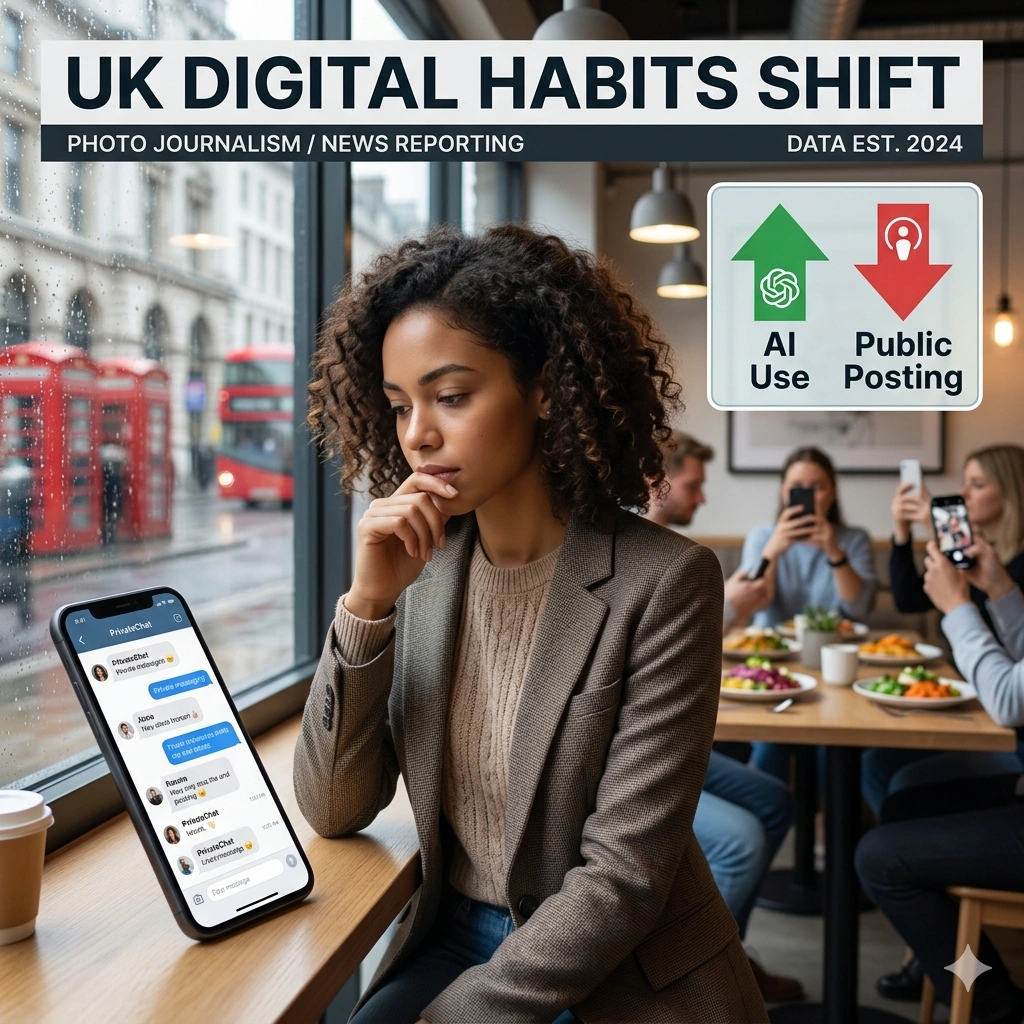
UK Social Media Trends
The decline in active sharing represents a massive cultural shift across the British digital population over the last twelve months. Statistics indicate that public posting among adults has dropped from 61% to just 49%, a statistic that would have seemed unthinkable during the height of the influencer era. Users are increasingly wary of the long-term consequences associated with public digital records, leading to a rise in “ghosting” behavior on major platforms.
As individuals move away from the feed, they are gravitating toward private messaging apps like WhatsApp and Signal to maintain their social circles. This migration suggests that while the desire for connection remains strong, the desire for a public audience is fading fast. UK Social Media Trends now prioritize intimacy and privacy over the broad, performative reach that defined the previous decade of internet culture.
The Massive Rise of Artificial Intelligence Adoption
Perhaps the most shocking revelation in the recent Ofcom report is the meteoric rise of generative AI tools among the general public. Usage has jumped from a modest 31% in 2024 to an impressive 54% in 2025, showing that these tools are no longer niche technologies. Younger demographics are leading this charge, using AI for everything from creative writing to organizing their daily schedules and professional tasks.
This rapid adoption is fundamentally altering how people generate and interact with information online today. Instead of searching through social feeds for inspiration, many users are now turning to personalized AI interfaces to find the answers they need. The integration of AI into daily life is a core component of the current UK Social Media Trends, as it offers a more streamlined, private alternative to public search and social discovery.
Digital Self-Preservation and Public Liability
One of the primary drivers behind the shift in UK Social Media Trends is a growing sense of digital liability among all age groups. Many users now view their historical posts as potential threats to their future careers or personal reputations. This fear of “cancel culture” or future scrutiny has created a chilling effect on the type of content people are willing to share publicly.
The concept of digital self-preservation involves a conscious effort to minimize one’s public footprint while still enjoying the benefits of internet connectivity. By reducing the frequency of their updates, users feel they are reclaiming control over their personal narratives and protecting themselves from future misunderstanding. This trend highlights a maturing audience that is finally beginning to grasp the permanence of the digital world.
The Transformation of Entertainment Hubs
Platforms like TikTok and Instagram have successfully pivoted from being purely social networks to becoming algorithmic entertainment powerhouses. This evolution has encouraged users to act more like television viewers than active contributors to a community. The feed is now dominated by high-quality video content from professional creators rather than updates from personal friends or family members.
Because the bar for content quality has been raised so high, many casual users feel intimidated or uninspired to share their own mundane updates. These UK Social Media Trends suggest that the “social” element of social media is being replaced by a sophisticated distribution model for short-form video. Users are happy to scroll through endless streams of content, but they are increasingly hesitant to add their own voices to the noise.
Impact of Screen Time on Mental Health
Despite the move toward passive consumption, the total amount of time spent online continues to climb for the average UK resident. With a daily average of four hours and 30 minutes spent on devices, the physical and mental toll of constant connectivity is becoming a major public concern. Approximately 67% of adults now admit that they spend more time on their phones than they would actually like.
This paradox of “digital fatigue” means that while people are using their phones more, they are enjoying the experience less than they did in previous years. The cycle of passive scrolling often leads to feelings of burnout and a lack of genuine fulfillment from digital interactions. Addressing these UK Social Media Trends will require a concerted effort from both technology companies and individual users to find a healthier balance.
Strategies for Navigating New Digital Habitats
- Prioritize private community building over public follower counts to ensure more meaningful and protected engagement with your audience.
- Embrace AI tools to streamline content creation and information gathering, allowing for a more efficient use of limited digital time.
- Conduct regular audits of your public social profiles to remove outdated information and maintain a positive, controlled digital presence.
- Set strict boundaries for daily screen time to combat the effects of digital fatigue and improve overall well-being in a connected world.
Future Projections for British Internet Users
Looking ahead, the trajectory of UK Social Media Trends points toward even more fragmentation and a deeper reliance on private digital enclaves. We can expect to see a further decline in the popularity of the “centralized feed” in favor of hyper-niche communities and AI-driven personal assistants. The era of the mass-market social post may be drawing to a close as users seek more tailored and secure experiences.
Technology will likely continue to evolve to meet these demands for privacy and efficiency, with more platforms offering ephemeral content options. As the digital landscape becomes more complex, the ability to navigate it with intention and caution will become a vital skill for every citizen. The shift we are seeing today is just the beginning of a long-term recalibration of our relationship with the internet.
The Role of Algorithmic Curation in User Behavior
Algorithms are now the primary gatekeepers of information, deciding what millions of people see and interact with every single hour. This shift has removed the burden of discovery from the user but has also led to a more homogenized online experience. People are no longer seeking out new perspectives as often as they are being fed content that reinforces their existing preferences.
This curation is a significant factor in the current UK Social Media Trends because it rewards passive consumption over active exploration. When the content comes to you, there is less incentive to go out and create your own or engage in a meaningful dialogue with others. The result is a highly efficient but often isolating digital environment that prioritizes engagement metrics over human connection.
Youth Perspectives on AI and Social Interaction
The younger generation is serving as a bellwether for the future of UK Social Media Trends, specifically regarding the integration of artificial intelligence. For teenagers and young adults, AI is not a frightening new technology but a standard utility that enhances their creative and academic lives. They are much more likely to experiment with AI-generated avatars and conversational agents than older generations.
This comfort level with automation suggests that the next phase of social media will be deeply intertwined with synthetic media and automated interaction. Young people are also leading the move away from large public platforms in favor of smaller, more exclusive digital spaces where they feel safer. Their behavior today provides a clear roadmap for how the broader population will likely behave in the coming decade.
Challenges for Digital Marketers and Brands
- Develop content that feels like authentic entertainment rather than traditional advertising to capture the attention of passive viewers.
- Focus on building trust through transparent data practices to alleviate the growing concerns regarding digital liability and privacy.
- Utilize AI-driven analytics to understand the shifting preferences of a population that is increasingly hiding its behavior from public view.
- Invest in “dark social” channels like messaging apps where the most influential conversations are now taking place away from public feeds.
Redefining Online Community in a Passive Era
The definition of a community is changing as users move away from public interactions toward more secluded digital spaces. In the past, a community was defined by a shared public forum where everyone could contribute their thoughts openly. Today, communities are becoming more like private clubs where entry is restricted and conversations are kept strictly confidential.
This change in UK Social Media Trends presents both challenges and opportunities for those looking to foster genuine human connection. While it is harder to reach a large audience, the connections made within these private groups are often much deeper and more resilient. The focus is shifting from the quantity of connections to the quality and security of those interactions in an increasingly public world.
Balancing Technological Growth and Human Needs
As AI adoption continues to double and digital habits evolve, the need for a human-centric approach to technology has never been more urgent. We must ensure that the tools we create serve to enhance our lives rather than just fill our time with mindless consumption. The data from Ofcom serves as a reminder that we are still learning how to live in this highly connected environment.
Finding the right balance between the benefits of AI and the necessity of human privacy will be the defining challenge of the next few years. UK Social Media Trends will continue to fluctuate as we test new boundaries and discover what truly makes us feel connected and secure. Ultimately, the goal is to create a digital world that respects our humanity while offering the best that modern technology has to offer.
Digital Literacy and the New Information Age
With the rise of AI and the decline of public sharing, digital literacy has become a fundamental survival skill for the 21st century. Users must be able to distinguish between human-generated and synthetic content while navigating a landscape that is increasingly opaque. Understanding how algorithms work and how data is collected is no longer just for tech experts; it is essential for everyone.
Educational initiatives must keep pace with these UK Social Media Trends to ensure that the public is prepared for the changes ahead. By empowering individuals with the knowledge they need to protect their privacy and use AI responsibly, we can build a more resilient society. The shift toward passive participation is not necessarily a negative development, but it does require a more informed and cautious approach to digital life.
The Long-Term Effects of Digital Fatigue
The persistent feeling of digital fatigue is likely to have long-term consequences for how we design and use technology in the future. We may see a move toward “minimalist” platforms that intentionally limit the amount of time users can spend on them or the type of content they can consume. This would be a radical departure from the current engagement-at-all-costs model that dominates the industry today.
If the trends of 2026 continue, the desire for digital detoxes and simplified interfaces will only grow stronger among the general population. UK Social Media Trends are already showing signs of this rebellion against the constant noise of the internet. A future where we are more intentional about our digital interactions is not only possible but increasingly likely as we reach the limits of our cognitive capacity.
Adapting to a Curation-First World
In a world where curation is king, the value of high-quality, reliable information has never been higher. As people share less about their own lives, they are looking for expert voices and trustworthy sources to guide them through the complexities of the modern world. This shift is a golden opportunity for journalists, researchers, and educators to reclaim their place as the primary providers of digital value.
The transition toward UK Social Media Trends that favor passive consumption means that the content we do consume must be worth our limited time and attention. By focusing on depth over breadth, creators can build a loyal following even in an environment where active engagement is declining. The future belongs to those who can provide clarity and meaning in an increasingly crowded and automated digital landscape.
Privacy Settings and Data Protection
- Review and update the privacy settings on all your active social media accounts at least once every quarter to stay ahead of platform changes.
- Use two-factor authentication and strong, unique passwords to protect your digital identity from unauthorized access and potential leaks.
- Be mindful of the permissions you grant to third-party AI tools and applications that may have access to your personal data.
Conclusion on the Shift in British Habits
The findings from the Ofcom report provide a clear picture of a nation in transition, moving from a culture of public disclosure to one of private consumption. These UK Social Media Trends are a natural response to the pressures of modern digital life and the rapid advancement of artificial intelligence. While the way we interact is changing, the fundamental human need for connection and information remains as strong as ever.
As we move forward into 2026 and beyond, we must remain adaptable and informed about the technologies that shape our lives. By understanding the motivations behind these shifts, we can better navigate the digital world and ensure it serves our interests. The evolution of our online habits is a testament to our ability to adapt to a changing environment and find new ways to thrive in a complex, connected world.
For more details & sources visit: BBC News / Ofcom
Read more about UK news on 360 News Orbit – UK.