
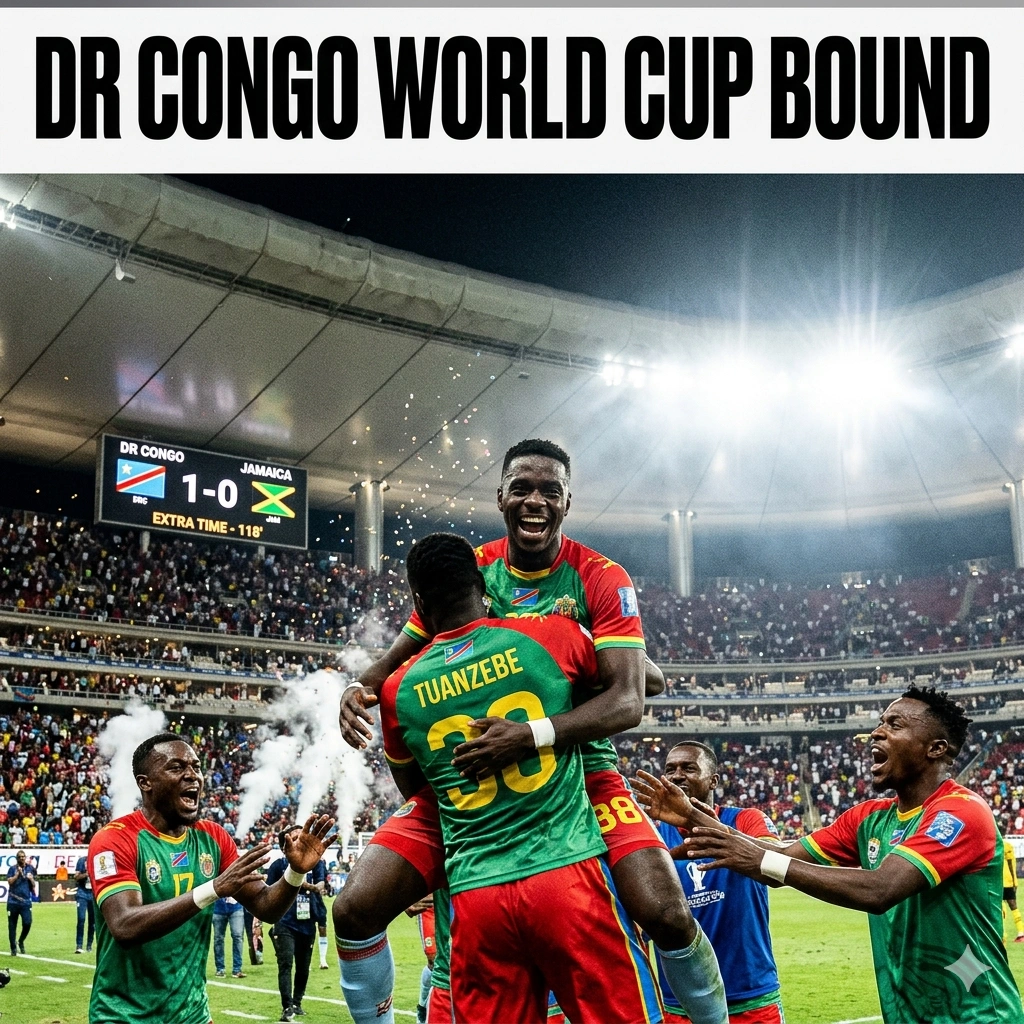
Congo World Cup qualification has ignited a wave of national pride and global sporting interest as the Democratic Republic of the Congo secures its place in the 2026 FIFA World Cup. The Leopards officially entered the elite ranks of international football following a historic 1-0 victory over Jamaica in a high-stakes intercontinental playoff. This achievement marks only the second time in history that the nation has reached the global showpiece, with their previous appearance dating back to 1974. The decisive moment came in the 100th minute of extra time, when defender Axel Tuanzebe converted a crucial goal at the Estadio Guadalajara.
Congo World Cup qualification is particularly significant this year as it brings the total number of African representatives to a record-breaking ten teams. As millions of fans in Kinshasa and beyond erupt in celebration, the DRC prepares to showcase its footballing talent on the world’s most prestigious stage in North America. This win validates years of structural reform within the Congolese football federation and sets the stage for a new era of sporting excellence for the Central African giant.
The Strategic Path to Congo World Cup qualification
The journey toward Congo World Cup qualification was defined by a series of tactical masterclasses and a resilient defensive structure that stifled some of the best attackers in the world. After navigating a grueling CAF qualification phase, the Leopards faced a do-or-die encounter against a highly athletic Jamaican side. Throughout the ninety minutes of regulation time, the DRC maintained superior possession and tempo, though they struggled to find the clinical final touch. The coaching staff’s emphasis on physical conditioning proved to be the difference-maker as the match moved into the exhausting periods of extra time.
Securing Congo World Cup qualification required the team to overcome the immense psychological pressure of an intercontinental playoff final played thousands of miles from home. The players remained composed, adhering to a disciplined game plan that prioritized defensive stability while waiting for a set-piece opportunity. This strategic patience eventually paid off, proving that the Congolese squad has matured significantly since their previous qualifying campaigns. The victory is a testament to the collective belief of the players and the vision of a technical team that refused to settle for anything less than a trip to the finals.
Axel Tuanzebe: The Hero of the Playoff Final
The defining moment of the Congo World Cup qualification campaign was undoubtedly the 100th-minute goal scored by Burnley defender Axel Tuanzebe. In a crowded penalty area during a corner kick, Tuanzebe showed immense strength and awareness to bundle the ball over the line. The stadium fell silent during a tense minute-long VAR check for a potential handball, but the goal was ultimately confirmed, triggering scenes of pure joy. Tuanzebe’s contribution highlights the importance of the Congolese diaspora in the national team’s recent success.
His defensive leadership throughout the qualifying rounds was just as vital as his historic goal in the playoff final. By organizing the backline and winning crucial aerial duels, he provided the foundation that allowed the Leopards to remain competitive against higher-ranked opponents. Congo World Cup qualification was built on these individual acts of heroism within a well-functioning team unit. Tuanzebe has now cemented his status as a national icon, joining the pantheon of Congolese football legends who have represented the country at the highest level.
Historical Context of the Leopards Return
To understand the weight of Congo World Cup qualification, one must look back at the nation’s long absence from the tournament since 1974. For over fifty years, the DRC—formerly known as Zaire—struggled to replicate the success of that golden generation that first put Central African football on the map. This modern qualification serves as a bridge between the pioneers of the past and the superstars of today. It represents the culmination of decades of dreaming and several near-misses in previous qualifying cycles.
The 2026 tournament will be the first time the current generation of fans sees their flag raised at a FIFA World Cup. Congo World Cup qualification has effectively erased years of sporting frustration, replacing it with a sense of immense possibility. The legacy of the 1974 team provided the inspiration, but the 2026 squad has carved out its own unique identity through grit and modern tactical sophistication. This return to the world stage is a powerful reminder of the deep footballing heritage that exists within the Democratic Republic of the Congo.
Africa’s Record-Breaking Contingent in 2026
Congo World Cup qualification is a major milestone not just for the DRC, but for the entire African continent as it prepares for the expanded tournament. With the Leopards securing their spot, Africa will send a record ten teams to the 2026 finals, showcasing the rapid growth of the sport across the region. This increased representation is the result of years of advocacy and the consistently high performance of African teams in previous international competitions. The DRC joins a formidable group of African powerhouses, including Nigeria and Senegal, who are all capable of causing major upsets.
The path for the DRC included a massive victory over Nigeria in the CAF playoffs, a result that signaled their readiness for the global stage. Congo World Cup qualification proves that the traditional hierarchy of African football is shifting, with new contenders emerging to challenge the established order. This ten-team contingent represents a diverse range of footballing styles and cultures, all united by a desire to bring the World Cup trophy to African soil for the first time. The global football community is eagerly anticipating the unique flair and passion that the Leopards will bring to the competition.
Impact on National Unity and Development
Beyond the pitch, Congo World Cup qualification has provided a rare and much-needed point of unity for a nation that has faced significant internal challenges. Football has always been the heartbeat of the DRC, and this victory has brought together people from all provinces and backgrounds in a shared celebration. The sight of the national team succeeding on the world stage fosters a sense of collective identity and hope. Government officials have recognized that Congo World Cup qualification can be a catalyst for broader social and economic development.
There are already plans to invest more heavily in local football infrastructure and youth academies to ensure that this success is not a one-off event. The visibility gained from a World Cup appearance attracts international sponsors and promotes the country’s image on a global scale. Congo World Cup qualification is being viewed as a national project that transcends sports, providing a platform to showcase the resilience and talent of the Congolese people. The positive energy generated by this win is expected to influence everything from tourism to local business investments in the coming years.
Tactical Breakdown of the Intercontinental Playoff
The match against Jamaica was a tactical battle of styles, with Congo World Cup qualification hanging in the balance for over 120 minutes. Jamaica relied on their explosive speed on the wings, while the DRC utilized a compact midfield to control the rhythm of the game. The Congolese coaching staff correctly identified that the Jamaican defense was vulnerable to set-pieces, which became the focus of their attacking drills leading up to the final. This preparation was perfectly executed during the decisive corner kick in extra time.
Defensively, the Leopards were nearly flawless, maintaining a high line that caught the Jamaican strikers offside on multiple occasions. Congo World Cup qualification was secured because the team refused to break under pressure, even when the match seemed destined for a penalty shootout. The integration of European-based professionals with local talents allowed for a blend of tactical discipline and raw physical power. This balance will be essential when the team faces even more varied playing styles during the group stages of the finals.
- The DRC held 58% possession throughout the 120 minutes.
- Axel Tuanzebe made 7 successful clearances during the match.
- The team committed only 9 fouls, showing great discipline.
- Congolese fans occupied nearly 30% of the stadium in Guadalajara.
Group Stage Expectations for the Leopards
Now that Congo World Cup qualification is a reality, the focus shifts to the upcoming group stage draw and the challenges that lie ahead. The Leopards are expected to be placed in a competitive group where they will likely face at least one European or South American giant. However, the team’s recent performances against top-tier African opposition suggest they are ready to compete with anyone. Fans are optimistic that this squad can advance past the group stage and make a deep run into the knockout rounds.
The technical staff is already scouting potential opponents and planning training camps to ensure the players are in peak physical condition. Congo World Cup qualification has raised the bar for what is expected from the national team, and the players are eager to prove they belong among the world’s best. The goal is to not just participate, but to leave a lasting impression through an entertaining and effective brand of football. With a mix of experienced veterans and hungry young talents, the DRC is well-positioned to be the “surprise package” of the 2026 tournament.
The Role of the Congolese Diaspora
The successful Congo World Cup qualification campaign highlights the vital role played by players of Congolese descent who are active in the major European leagues. Athletes like Axel Tuanzebe have brought a level of professional experience and tactical awareness that has elevated the entire squad. This “diaspora connection” has been carefully nurtured by the federation, creating a unified environment where every player feels a deep pride in representing the DRC. This inclusivity has been a key factor in the team’s improved consistency over the last two years.
Many of these players grew up in different footballing cultures but have chosen to return to their roots to help secure Congo World Cup qualification. This trend is likely to continue as more young talents see the success of the current national team and the global platform it provides. The blend of different footballing educations has created a versatile team that can adapt to various match scenarios. This diversity is the strength of the Leopards, making them a difficult opponent for any team to analyze and defend against.
Global Reactions to the DRC’s Victory
The news of Congo World Cup qualification has been met with widespread acclaim from football legends and analysts across the globe. Pundits have praised the team’s mental fortitude and the tactical evolution that allowed them to navigate a difficult playoff path. Social media platforms were flooded with congratulatory messages from international stars, many of whom noted the incredible passion of the Congolese fans. The story of the DRC’s return to the World Cup is being hailed as one of the most heartwarming narratives of the 2026 qualifying cycle.
International media outlets are already producing documentaries and features on the history of Congolese football, building anticipation for their appearance in North America. Congo World Cup qualification has put the spotlight back on Central Africa, reminding the world of the region’s immense contribution to the sport. The global audience is particularly excited to see the vibrant celebrations and cultural expressions that the Congolese supporters are famous for. This qualification is a win for football romanticism and the enduring power of the underdog story.
- FIFA officials praised the organization of the intercontinental playoffs.
- Global viewership for the playoff final reached an estimated 50 million.
- Sports apparel brands are reporting a surge in demand for the Leopards’ jersey.
- International friendlies are being scheduled to prepare for the June opener.
Infrastructure and Future Prospects
Achieving Congo World Cup qualification is expected to trigger a massive influx of funding for the development of football facilities within the DRC. New stadiums in Kinshasa and Lubumbashi are already under discussion, aiming to provide a professional environment for the next generation of players. This success proves that with the right investment and management, the Democratic Republic of the Congo can become a consistent powerhouse in global football. The momentum from 2026 must be used to build a sustainable system that produces talent for decades to come.
The federation is also looking to enhance its domestic league, the Linafoot, to ensure a steady pipeline of talent for the national team. Congo World Cup qualification has shown that local players can compete at the highest level when given the opportunity. By improving coaching standards and youth scouting, the DRC can ensure that Congo World Cup qualification becomes a regular occurrence rather than a rare event. The future of Congolese football has never looked brighter, and the 2026 tournament is just the beginning of this exciting journey.
Coaching Mastery and Tactical Flexibility
The credit for Congo World Cup qualification must also go to the technical staff who managed to mold a diverse group of players into a cohesive unit. Their ability to switch between offensive and defensive systems depending on the opponent was a hallmark of the qualifying campaign. They fostered a locker room culture built on mutual respect and a shared commitment to the national cause. This psychological stability allowed the players to perform at their best even during the high-pressure moments of the intercontinental playoff.
Throughout the qualifiers, the coach’s substitutions were often decisive, showing a deep understanding of the game’s flow and the players’ individual strengths. Congo World Cup qualification was as much a victory for the minds on the touchline as it was for the feet on the pitch. The staff’s meticulous analysis of Jamaica’s weaknesses allowed the DRC to dominate the match and eventually find the winning goal. Their focus now remains on maintaining this level of excellence as they prepare for the tactical challenges of the World Cup finals.
The Significance of the 2026 World Cup
The 2026 FIFA World Cup represents a new era for the sport, with more teams and a wider geographical reach than ever before. For the DRC, participating in this expanded tournament is a chance to define their place in the modern footballing landscape. Congo World Cup qualification allows the nation to be part of a historic event that will be watched by billions. It is a stage where the Leopards can prove that African football is no longer just a “promise” but a realized power.
The tournament’s host nations—the USA, Canada, and Mexico—provide a diverse and exciting backdrop for this monumental return. Congolese communities living in North America are already preparing to welcome their team, ensuring a “home-away-from-home” atmosphere in the stadiums. Congo World Cup qualification is the ticket to a global festival where the DRC will finally take its rightful place. The excitement is palpable, and the preparation is intense as the world counts down to the opening whistle.
Conclusion: A New Chapter for the Leopards
The confirmation of Congo World Cup qualification on April 3, 2026, marks the most important day in the history of the nation’s modern sports era. By defeating Jamaica in a grueling playoff, the Leopards have proven their worth and earned the right to represent the African continent on the global stage. This victory is the result of years of hard work, tactical discipline, and an unwavering belief in the potential of Congolese football. Congo World Cup qualification is more than just a sporting win; it is a symbol of national resilience and the beginning of a promising new chapter.
As the team prepares for the finals, they carry with them the hopes and dreams of 100 million Congolese citizens. The legacy of the 1974 team has been honored, and a new generation of legends has been born. The world is waiting to see the energy, skill, and passion of the Leopards in North America. Congo World Cup qualification is a historic milestone that will be celebrated for years to come, serving as an inspiration for all those who believe in the power of the beautiful game.
For more details & sources visit: Al Jazeera
Read more on global developments: 360 News Orbit – Extended Orbit