
Turkey Accuses Israel of a calculated political shift as Foreign Minister Hakan Fidan announced that the Israeli administration is actively seeking to designate Ankara as its new primary adversary. This diplomatic bombshell follows months of deteriorating relations and suggests a fundamental change in the Middle East’s geopolitical architecture. Fidan asserted that the current Israeli leadership requires a “designated enemy” to maintain domestic political stability, especially following the recent regional ceasefire with Iran. The Turkish government views this development not as a temporary dispute but as a long-term state strategy emerging from within Jerusalem’s military and political establishment.
The escalating rhetoric between the two nations has reached a fever pitch, with President Recep Tayyip Erdogan issuing stern warnings regarding regional security. Turkey Accuses Israel of potentially sabotaging fragile peace agreements to justify further military expansionism. This atmosphere of mutual distrust is further complicated by legal battles and historical comparisons that have effectively dismantled years of normalization efforts. As both nations trade accusations of war crimes and regional destabilization, the international community is watching closely to see if this verbal warfare transitions into a more direct strategic confrontation that could reshape Mediterranean security.
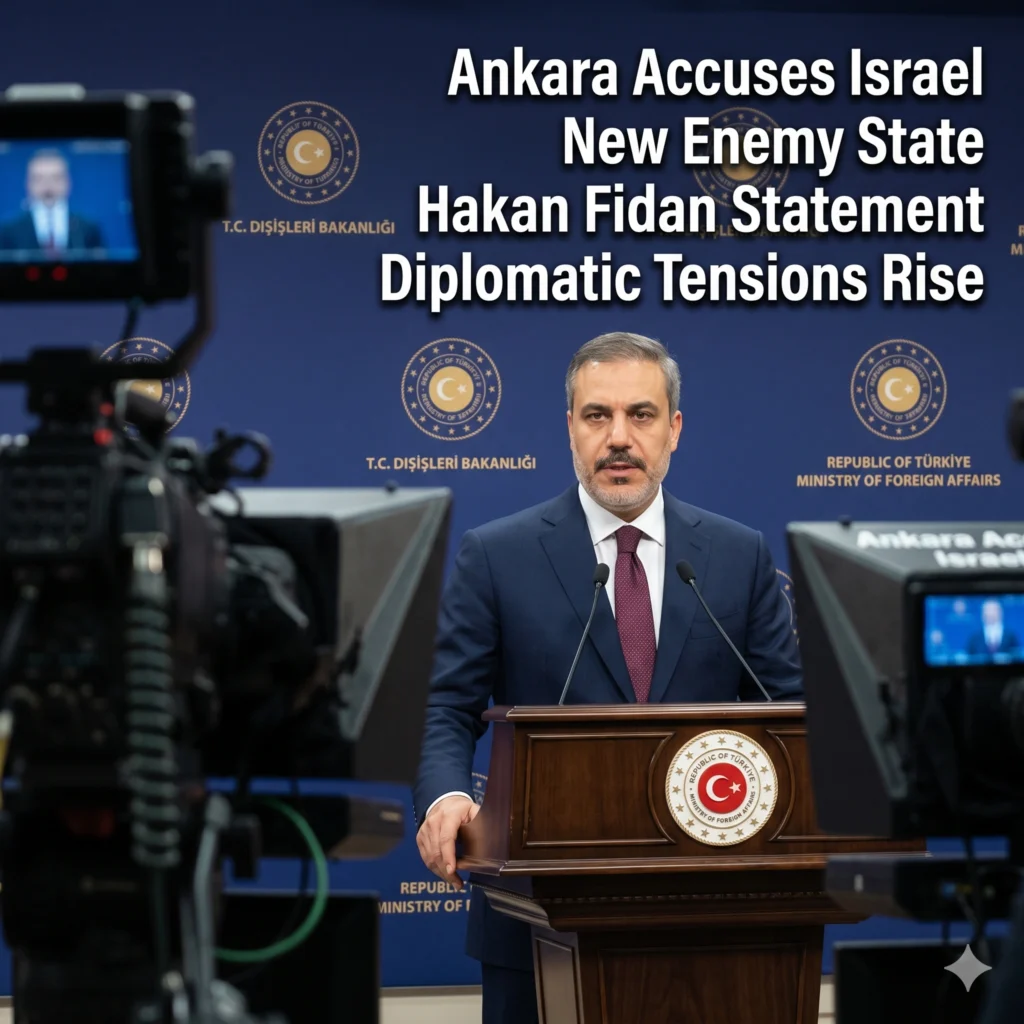
Turkey Accuses Israel
The core of the recent diplomatic fallout centers on the claim that Turkey Accuses Israel of fabricating a new threat profile to replace the cooling tensions with Tehran. Minister Hakan Fidan highlighted that both the Israeli governing coalition and elements of the opposition appear united in their effort to frame Turkey as a hostile actor. This shift is reportedly a response to Turkey’s vocal support for Palestinian rights and its refusal to categorize certain regional groups as terrorist organizations. Ankara maintains that Israel’s internal political survival is now being tied to a narrative of Turkish aggression, which Fidan describes as a dangerous and unfounded provocation.
Furthermore, Turkey Accuses Israel of harboring territorial ambitions that could eventually threaten Turkish sovereignty. President Erdogan has gone on record stating that if Israeli military operations in the Levant continue unchecked, the ultimate target could be the Anatolian heartland. This perspective has fueled a massive propaganda war, where Turkish media outlets are increasingly portraying the current Israeli government as a messianic expansionist power. The strategic move to declare Turkey an “enemy state” is seen by Ankara as a precursor to more aggressive naval and intelligence maneuvers in the Eastern Mediterranean.
The administrative breakdown has also led to a total cessation of intelligence sharing and military cooperation, which were once the hallmarks of the bilateral relationship. Turkey Accuses Israel of ignoring international law and human rights standards, leading to the filing of massive indictments by Turkish prosecutors. These legal actions seek thousands of years in prison for top Israeli officials, a move that Jerusalem has dismissed as a theatrical political stunt. However, for the Turkish public, these indictments serve as a formal documentation of the grievances that have led to the current state of “enemy” status between the two countries.
Erdogan Warnings and the Sabotage of Peace
President Erdogan has taken his concerns directly to the global stage, specifically warning U.S. President Donald Trump about the fragility of the current Middle East ceasefire. Turkey Accuses Israel of planning “sabotage” operations that could reignite the conflict with Iran, thereby drawing Turkey into a regional quagmire. Erdogan’s communication with the White House emphasizes that any disruption to the ceasefire would have catastrophic consequences for the USMCA-level trade stability and energy corridors. The Turkish leader believes that a permanent state of war serves the interests of the current Israeli cabinet.
The warnings also extend to the maritime domain, where Turkey Accuses Israel of infringing upon shared economic zones. Erdogan has reinforced the “Blue Homeland” doctrine, signaling that any attempt to designate Turkey as an enemy will be met with a significant naval presence. The rhetoric suggests that Ankara is preparing for a period of prolonged tension where diplomatic channels are replaced by military posturing. This stance is meant to deter what Turkey perceives as an Israeli attempt to isolate Ankara from regional energy projects and security alliances.
In addition to military warnings, Erdogan has utilized the “Turkey Accuses Israel” narrative to consolidate domestic support. By framing the dispute as a defense of national integrity and Islamic solidarity, the Turkish presidency has effectively sidelined domestic critics of its foreign policy. This internal alignment makes it difficult for future administrations to quickly repair the damage, as the “enemy” label becomes embedded in the national consciousness. The President’s warnings are therefore directed both at international leaders and at the Turkish electorate, preparing them for a “new era” of defensive foreign policy.
- Erdogan warns that Israeli expansionism could eventually reach Turkish borders.
- Ankara views the targeting of Turkey as a diversion from Israel’s internal political crises.
- Potential sabotage of the Iran ceasefire is seen as a key Israeli strategic goal.
- Turkish maritime interests are being reinforced to counter perceived Israeli threats.
Legal Warfare and War Crime Indictments
The conflict has moved from the battlefield of words to the halls of justice, as Turkey Accuses Israel of systemic war crimes. Turkish prosecutors have recently finalized indictments against 35 high-ranking Israeli officials, including members of the security cabinet and military commanders. These legal documents allege that the Israeli military participated in genocide and the deliberate targeting of civilian infrastructure. By seeking life sentences, the Turkish legal system is attempting to create a “no-fly zone” for Israeli officials, who might now face arrest if they travel to countries with extradition treaties with Ankara.
In response to these legal maneuvers, Turkey Accuses Israel of using retaliatory rhetoric to deflect from the evidence. Prime Minister Netanyahu has countered by accusing the Turkish government of its own human rights violations, specifically regarding the Kurdish population. This “tit-for-tat” legal and moral warfare has made it impossible for international mediators to find a middle ground. The Turkish Ministry of Foreign Affairs responded to Netanyahu’s claims by comparing him to the 20th century’s most notorious dictators, further cementing the “enemy” status between the two capitals.
The indictments are not just symbolic; they represent a major shift in how Turkey Accuses Israel within the international legal framework. Ankara is actively lobbying the International Criminal Court (ICC) to take up these cases, offering Turkish evidence as a primary source for the prosecution. This legal offensive is designed to delegitimize the Israeli government on the global stage, making it harder for Western allies to provide unconditional support. The strategy is to turn the “enemy state” label back on Jerusalem, portraying it as a rogue actor that defies the rules-based international order.
Historical Comparisons and Diplomatic Retaliation
The diplomatic language used by the Turkish Foreign Ministry has reached a level of severity not seen in decades. Turkey Accuses Israel of adopting policies reminiscent of historical colonial powers that sought to dominate the Middle East through division and conflict. By using terms like “genocidal” and “dictatorial,” Ankara is signaling that it no longer views the Israeli government as a legitimate partner for peace. This rhetorical shift is backed by a series of diplomatic downgrades, including the withdrawal of key staff and the suspension of high-level summits.
Minister Hakan Fidan’s statements suggest that Turkey Accuses Israel of losing its strategic compass. He argues that by making an enemy of Turkey—a major regional power and NATO member—Israel is isolating itself in a way that will have long-term negative consequences. The Turkish perspective is that Israel’s short-term political gains from “enemy creation” will lead to a long-term security deficit. This analysis is being shared with regional partners in the Arab world, as Turkey seeks to lead a new coalition of states that oppose the current Israeli administration’s trajectory.
The retaliation also includes the cancellation of significant economic agreements. Turkey Accuses Israel of violating the spirit of previous trade deals, leading to a halt in the export of critical materials and energy cooperation. For years, the two nations were bound by lucrative trade in construction, technology, and agriculture. Those days appear to be over, as the Turkish government prioritizes its “enemy state” narrative over economic gain. The message from Ankara is clear: there will be no “business as usual” while Turkey is being targeted by Israeli state strategy.
- Turkish Foreign Ministry compares Netanyahu to historical dictators.
- Diplomatic relations have been downgraded to the lowest level in 50 years.
- Economic trade in critical minerals and construction has been officially suspended.
- Ankara is building a regional coalition to isolate the current Israeli cabinet.
Impact on Regional Alliances and NATO
The tension where Turkey Accuses Israel has significant implications for the NATO alliance. As a key member of the North Atlantic Treaty Organization, Turkey’s designation as an “enemy” by a major U.S. ally like Israel creates a massive friction point for Washington. Turkey has hinted that its security concerns regarding Israel should be taken as seriously as any other threat to the alliance’s southern flank. This creates a diplomatic puzzle for other NATO members, who must balance their traditional support for Israel with the strategic necessity of keeping Turkey integrated into the Western security umbrella.
Furthermore, Turkey Accuses Israel of trying to drive a wedge between Ankara and its neighbors. By portraying Turkey as an aggressor, the Israeli strategy aims to make Arab nations wary of Turkish influence in the Levant. However, Erdogan’s administration has doubled down on its role as a protector of regional stability, arguing that it is the Israeli government, not Turkey, that is the source of chaos. This competition for “regional leadership” is the subtext of every accusation being traded between the two nations in 2026.
The shift also affects energy security in the Mediterranean. Turkey Accuses Israel of attempting to bypass Turkish territory for gas pipelines, a move that Ankara views as a direct economic assault. The “enemy state” designation provides the justification for Turkey to use its naval power to intercept or block energy projects that it deems unfavorable. As the Eastern Mediterranean becomes a crowded space for naval drills and drilling rigs, the risk of a miscalculation or a direct military encounter between the two former allies continues to grow.
The Role of Hamas and Palestinian Advocacy
A major point of contention where Turkey Accuses Israel involves the status of Hamas. While much of the Western world and Israel designate the group as a terrorist organization, Turkey views them as a legitimate political entity and a “liberation group.” This fundamental disagreement is the bedrock of the “enemy” label. Turkey Accuses Israel of using the Gaza war as a pretext to ethnically cleanse the Palestinian territories, a charge that the Turkish government has repeated at every international forum, including the United Nations.
Turkey’s advocacy for Palestine has moved beyond rhetoric into material support. Turkey Accuses Israel of blocking humanitarian aid, leading Ankara to organize its own relief flotillas and airlifts, often in defiance of Israeli blockades. This direct intervention is seen by Jerusalem as a violation of its sovereignty and security, while Ankara sees it as a moral obligation. The clash of these two worldviews is what Fidan refers to when he says Israel is “declaring Turkey a new foe.”
The Turkish public’s support for this stance is nearly unanimous, creating a powerful political mandate for Erdogan. By championing the Palestinian cause, Turkey Accuses Israel of moral bankruptcy, which resonates deeply within the wider Islamic world. This soft power strategy allows Turkey to position itself as the “conscience of the Ummah,” further alienating the Israeli government. The 2026 tensions are thus a mix of hard-power military posturing and soft-power ideological warfare that leaves little room for compromise.
- Turkey continues to recognize Hamas as a legitimate political liberation movement.
- Ankara provides significant humanitarian and diplomatic support to Gaza.
- Israeli blockades are viewed by Turkey as a “genocidal strategy.”
- The Palestinian issue is the primary driver of the “enemy” designation.
Future Outlook: A Permanent State of Friction?
As we look toward the remainder of 2026, the question remains whether the situation where Turkey Accuses Israel can ever be reversed. Most analysts believe that as long as the current leadership remains in place in both countries, the “enemy state” narrative will persist. The damage to the institutional trust between the two governments is so extensive that even a change in leadership might not be enough to restore the previous status quo. The “Turkey Accuses Israel” headlines are likely to become a permanent fixture of Middle Eastern news cycles for the foreseeable future.
The strategic shift described by Hakan Fidan suggests that we are entering a “Cold War” phase in the Eastern Mediterranean. Turkey Accuses Israel of preparing for a long-term containment strategy, and in response, Ankara is diversifying its alliances, moving closer to players like Russia and certain Gulf states that share its concerns about Israeli regional dominance. This realignment could lead to a more polarized Middle East, where nations are forced to choose between the Turkish and Israeli security spheres.
In the final analysis, the “Turkey Accuses Israel” crisis is a symptom of a world in transition. The old alliances of the 20th century are being replaced by new, more volatile identities based on national interests and religious solidarity. While the threat of a full-scale war remains low due to the presence of global powers, the “shadow war” of indictments, cyberattacks, and diplomatic insults will continue to escalate. The year 2026 may be remembered as the year the bridge between Ankara and Jerusalem finally collapsed, leaving a void that will take decades to fill.
The international community’s role will be critical in preventing this friction from sparking a broader fire. However, with Turkey Accuses Israel of being the “new primary adversary,” the path to mediation is blocked by a wall of mutual resentment. For the citizens of both nations, this means a future characterized by travel restrictions, economic boycotts, and the constant hum of military readiness. The “Tulip Fever” of the North might be a beautiful sight, but the “Enemy Fever” of the Mediterranean is a much more somber and dangerous reality.
For more details & sources visit: The Times of Israel
Read more on Turkey news: 360 News Orbit – Turkey