
The Strait of Hormuz blockade has triggered an unprecedented diplomatic and economic crisis as a coalition of 35 nations issues a formal condemnation of Iran’s recent maritime actions. This unified stance, led by major global powers including the United Kingdom, France, and Japan, highlights a growing international consensus against the disruption of one of the world’s most vital energy corridors.
The geopolitical landscape has shifted dramatically following weeks of drone attacks and sea mining that have effectively halted commercial traffic. The coalition emphasizes that the freedom of navigation is a non-negotiable principle of international law that must be upheld to prevent a total collapse of global energy markets. This high-stakes confrontation is not merely a regional dispute but a direct threat to the stability of the global economy and the security of energy supplies for billions of people.
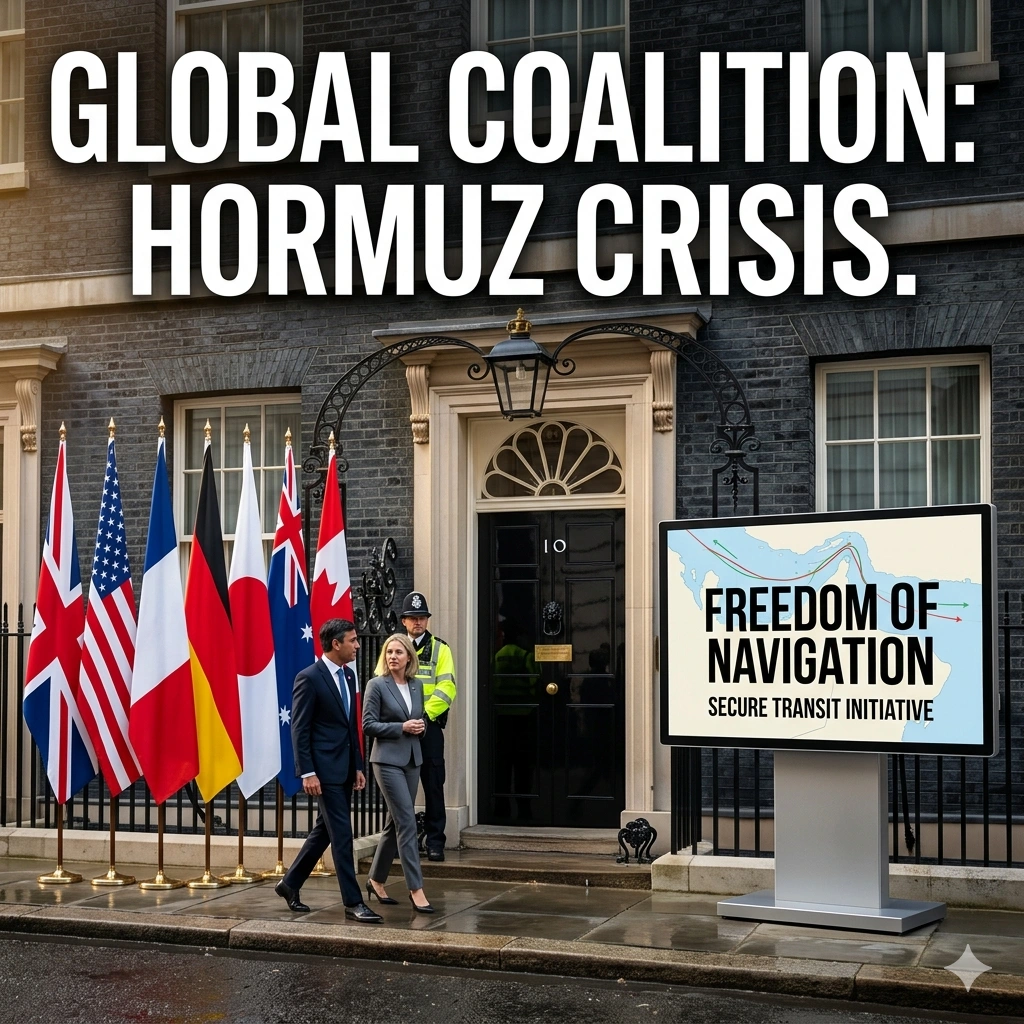
Global Coalition Demands Freedom of Navigation
The joint statement released by 10 Downing Street marks a significant escalation in the diplomatic pressure being applied to Tehran. By invoking the United Nations Convention on the Law of the Sea, the coalition of 35 nations has made it clear that the current Strait of Hormuz blockade is a violation of international norms. The group, which includes Germany, Canada, South Korea, and Australia, expressed deep concern over the targeting of unarmed commercial vessels and civilian infrastructure. They are demanding that Iran immediately comply with UN Security Council Resolution 2817 to restore safe passage for all ships.
The impact of this blockade is being felt far beyond the Middle East, as the waterway typically handles approximately 20% of the world’s oil supply. The disruption has caused a sharp spike in energy prices, with Brent crude reaching heights not seen in years. This economic shock is particularly damaging to vulnerable populations who are already struggling with inflation and supply chain disruptions. The coalition’s unified message serves as a stern warning that continued interference with maritime trade will result in coordinated international responses to protect global interests.
Strait of Hormuz blockade
The Strait of Hormuz blockade represents a critical failure in regional security that has forced the International Energy Agency to take drastic measures. To mitigate the immediate economic fallout, the IEA has authorized the release of record amounts from strategic petroleum reserves across its member states. This coordinated effort aims to stabilize prices and ensure that energy remains available to essential services while the blockade persists. The coalition is also working closely with other oil-producing nations to increase their output and fill the gap left by the closure of the strait.
In addition to economic measures, the coalition is discussing preparatory planning for enhanced maritime security efforts in the region. This could involve the deployment of naval assets to escort commercial vessels and deter further attacks. The goal is to create a secure environment where the freedom of navigation is guaranteed for all nations, regardless of their political alignment. The current situation in the Strait of Hormuz blockade area remains volatile, but the international community is showing a rare level of unity in its resolve to end the crisis.
Economic Consequences of Maritime Instability
The financial markets have reacted with extreme volatility to the ongoing Strait of Hormuz blockade, reflecting fears of a long-term energy shortage. Many industries that rely heavily on petroleum products are facing soaring costs, which are being passed on to consumers at an alarming rate. Global shipping lanes are being rerouted, adding significant time and expense to the transport of goods between Asia and Europe. This shift is placing immense pressure on logistics networks that were already operating at near-capacity.
- Global oil prices have surged by over 40% since the start of the maritime crisis.
- Shipping insurance premiums for vessels in the region have increased tenfold.
- Major airlines have announced fuel surcharges to offset the rising cost of jet fuel.
- Supply chains for critical minerals and food staples are facing unprecedented delays.
The coalition of 35 nations is aware that a prolonged Strait of Hormuz blockade could lead to a global recession if not addressed swiftly. Their joint statement highlights the need for a multilateral approach to resolve the underlying tensions that led to this impasse. By coordinating their diplomatic and economic strategies, these countries hope to convince Tehran that the costs of maintaining the blockade far outweigh any perceived strategic benefits.
Legal Implications of International Waterway Interference
International law experts are closely monitoring the developments surrounding the Strait of Hormuz blockade, as it raises fundamental questions about the rights of coastal states. Under the United Nations Convention on the Law of the Sea, straits used for international navigation enjoy a special status that guarantees the right of transit passage. The coalition argues that Iran’s actions constitute a de facto closure of an international waterway, which is a clear breach of its legal obligations. This legal framework provides the basis for the international community to demand the restoration of the status quo.
The invocation of UNSC Resolution 2817 is a key component of the coalition’s strategy, as it provides a clear mandate for action. This resolution condemns the attacks on civilian shipping and calls for the immediate cessation of hostile acts in the waterway. By aligning their actions with UN mandates, the coalition of 35 nations seeks to legitimate any further steps they may take to ensure maritime security. The Strait of Hormuz blockade is seen as a test case for the international community’s ability to enforce the rules-based order in a increasingly fragmented geopolitical environment.
Strategic Energy Reserves and Global Stability
The decision by the IEA to release strategic petroleum reserves is a historic move that underscores the severity of the Strait of Hormuz blockade. These reserves are intended for use only in the most extreme circumstances, and their deployment signals that the current disruption qualifies as a major energy emergency. The coalition is working to ensure that these supplies are distributed efficiently to prevent regional shortages and maintain the flow of essential goods. This effort is being supported by a diverse group of nations that recognize the interconnected nature of the global energy grid.
- The United States has committed to releasing an additional 50 million barrels from its reserves.
- Japan and South Korea are coordinating their stock releases to stabilize the Asian market.
- European nations are focusing on maintaining natural gas supplies as the crisis affects LNG shipments.
- The coalition is providing technical assistance to developing countries to help them manage energy volatility.
While the release of reserves provides a temporary buffer, the coalition acknowledges that it is not a permanent solution to the Strait of Hormuz blockade. The long-term goal remains the diplomatic resolution of the conflict and the permanent reopening of the waterway. Leaders from the 35 nations are engaged in continuous dialogue to identify potential off-ramps that could lead to a de-escalation of tensions.
Future Outlook for Middle Eastern Maritime Security
The current Strait of Hormuz blockade has fundamentally changed how the international community views maritime security in the Middle East. There is now a clear recognition that existing security arrangements were insufficient to prevent such a large-scale disruption. Moving forward, the coalition of 35 nations is likely to push for a more robust and permanent maritime presence in the region. This could involve new treaties or security frameworks designed to protect international shipping lanes from asymmetric threats.
The 2026 crisis has also accelerated the global transition toward alternative energy sources, as nations seek to reduce their dependence on the Strait of Hormuz. Investment in renewable energy and nuclear power is expected to see a significant boost in the coming years as a direct result of the blockade. However, for the immediate future, the world remains heavily dependent on the oil and gas that flows through the strait. The outcome of the current standoff will therefore have profound implications for global energy security for years to come.
Diplomacy as the Primary Path Forward
Despite the talk of maritime security planning, the coalition of 35 nations remains focused on a diplomatic solution to the Strait of Hormuz blockade. They believe that a negotiated settlement is the only way to ensure long-term stability and prevent a wider conflict. Several neutral nations have offered to mediate between the coalition and Tehran, providing a potential channel for meaningful dialogue. The joint statement from 10 Downing Street emphasizes that the door to diplomacy remains open, provided that Iran takes concrete steps to restore the freedom of navigation.
The Strait of Hormuz blockade is a complex challenge that requires a nuanced and patient approach. The international community’s unity is its greatest strength in this crisis, as it presents a common front that is difficult for any single nation to ignore. By combining diplomatic pressure with economic stabilization measures, the coalition hopes to create the conditions necessary for a peaceful resolution. As the situation continues to evolve, the world will be watching closely to see if the 35 nations can successfully navigate this unprecedented maritime crisis.
Global Resilience in the Face of Energy Shocks
The resilience of the global economy is being put to the test by the Strait of Hormuz blockade, and the results have been mixed. While some sectors have struggled to adapt, others have shown remarkable ingenuity in finding ways to minimize the impact. The shift toward digital and remote work has reduced some of the demand for transportation fuels, providing a small but significant cushion. Meanwhile, the coalition’s efforts to increase output from non-OPEC+ producers are starting to show results, helping to ease some of the supply-side pressures.
- Technological innovations in energy efficiency are being adopted at a record pace.
- Regional energy grids are becoming more interconnected to share resources during local shortages.
- Public awareness campaigns are encouraging energy conservation in many coalition member states.
The Strait of Hormuz blockade has highlighted the importance of global cooperation in maintaining the systems that underpin modern life. Without the coordinated action of the 35 nations, the economic consequences would likely have been much more severe. This crisis serves as a reminder that in an interconnected world, the security of one region is the security of all. The lessons learned during this period will undoubtedly shape international policy for decades to come.
Conclusion and Next Steps for the Coalition
As the calendar turns to April 2026, the Strait of Hormuz blockade remains the central focus of global geopolitical and economic news. The coalition of 35 nations has laid out a clear set of demands and is prepared to take further action if they are not met. The next few weeks will be critical in determining whether a diplomatic breakthrough is possible or if the crisis will enter a new and more dangerous phase. The international community’s commitment to the freedom of navigation remains steadfast, and they will continue to work tirelessly to ensure that global energy chains are protected.
The resolution of the Strait of Hormuz blockade is essential for the continued prosperity and security of the global community. The unified stance of the coalition represents a powerful rejection of the use of maritime disruptions as a tool of political leverage. By standing together, these 35 nations are sending a message that the international order will not be easily undermined. The path ahead is difficult, but the resolve of the coalition suggests that a solution can be found through strength and unity.
For more details & sources visit: GOV.UK
Read more on global developments: 360 News Orbit – Extended Orbit