
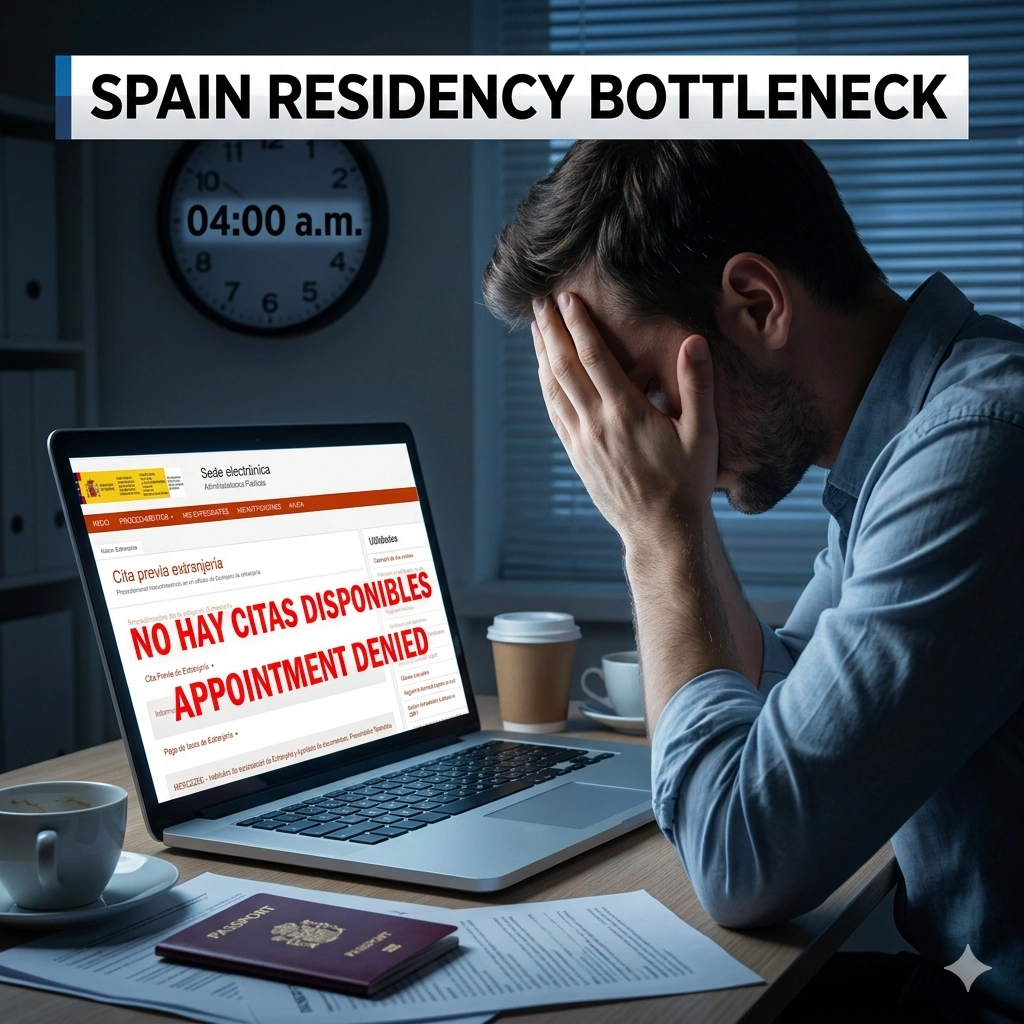
The Spanish Residency Appointment Crisis has reached a breaking point as thousands of foreign nationals find themselves locked out of the official “cita previa” system. Following the Easter break, a massive surge in applications from British and Latin American citizens has completely exhausted available slots in major hubs like Madrid and Valencia. This administrative paralysis has birthed a lucrative black market where automated bots snatch up every new appointment the moment it is released.
For many expats and international students, the inability to secure a legal slot is no longer just an inconvenience but a threat to their legal status. The Ministry of Inclusion and Migration is now under immense pressure to reform a system that has fundamentally failed to keep pace with modern demand. As wait times triple, the desperation of the foreign community is being exploited by illegal intermediaries charging hundreds of euros for a single booking.
The Roots of the Spanish Residency Appointment Crisis
The Spanish Residency Appointment Crisis is the result of a “perfect storm” involving changing visa regulations and seasonal migration patterns. A significant driver is the influx of British citizens who are now transitioning to non-lucrative visas to maintain their Mediterranean lifestyles post-Brexit. These applicants are competing for the same limited resources as thousands of Latin American students rushing to secure residency before planned tuition hikes.
Furthermore, the post-Easter period traditionally sees a spike in administrative filings as people return from holidays to handle their legal affairs. This year, however, the volume has overwhelmed the aging digital infrastructure used by Spanish immigration offices. The system simply was not designed to handle the simultaneous demand of such diverse and large migrant groups.
Consequently, the lack of available appointments has created a vacuum that is being filled by unscrupulous actors. Without a functional official channel, the foreign population is left with few choices but to wait months or risk their savings on the black market. This situation has tarnished Spain’s reputation as a welcoming destination for global talent and investment.
The Rise of the Bot-Driven Black Market
A disturbing hallmark of the Spanish Residency Appointment Crisis is the professionalization of appointment “scalping” via sophisticated software. These bots monitor the government website 24/7, refreshing the page every millisecond to claim slots the instant they are loaded into the database. This makes it virtually impossible for a human being to secure an appointment through standard manual browsing.
These captured slots are then resold on messaging apps and social media for prices ranging from €100 to €200. This illegal trade targets the most vulnerable, including those whose visas are about to expire and who face deportation if they do not complete their fingerprinting. The Ministry has struggled to implement effective CAPTCHA or bot-blocking measures to stop this drain on public resources.
Legal experts have warned that purchasing these appointments carries significant risks beyond the financial loss. If an immigration office detects that an appointment was secured through an unauthorized intermediary, they have the power to annul the entire residency application. This leaves the applicant in a legal limbo that can take years to resolve in the Spanish court system.
Spanish Residency Appointment Crisis
The Spanish Residency Appointment Crisis is currently centered in high-demand provinces like Málaga, Alicante, and Barcelona, where the foreign population is densest. In these areas, the wait time for a simple “toma de huellas” (fingerprinting) has tripled since the start of the year. This bottleneck is causing a ripple effect throughout the entire Spanish economy, affecting everything from housing rentals to tax collection.
Multinational corporations are particularly hard-hit, as their newly hired executives cannot begin work without a valid TIE (Foreigner Identity Card). Some human resources departments have resorted to “appointment tourism,” flying their employees to tiny, remote provinces where the offices are less congested. This is a costly and inefficient workaround for a systemic failure in the national immigration framework.
The Ministry of Inclusion and Migration has acknowledged the severity of the situation and promised a new queue-management algorithm by mid-April. This update is expected to prioritize urgent cases and implement stricter identity verification to prevent bot interference. However, many skeptics believe that without more physical staff in the offices, a digital fix will only provide marginal relief.
Impact on British and Latin American Migrants
Within the context of the Spanish Residency Appointment Crisis, British citizens face unique challenges related to their non-lucrative visa requirements. These visas often require strict adherence to timelines for physical presence and document submission. Missing an appointment due to the system crash can lead to the denial of a visa extension, forcing families to uproot their lives.
Latin American students are also caught in the crosshairs as they attempt to settle their status before new educational surcharges take effect. For many of these students, the cost of an illegal appointment represents a significant portion of their monthly budget. The crisis is effectively creating a two-tiered immigration system where those with extra cash can buy their way to the front of the line.
- British expats are reporting high levels of anxiety over potential “overstay” penalties.
- Students in Madrid have organized protests calling for a more transparent booking process.
- The “Digital Nomad” community is increasingly looking at Portugal or Greece as alternatives.
- Families seeking reunification are being separated for months due to the processing delays.
The emotional toll of this administrative failure cannot be overstated, as it leaves thousands of residents feeling unwelcome and insecure. The Spanish government must act quickly to restore trust in its immigration processes before the summer tourism season adds even more strain to the system.
Corporate Fallout and Economic Disruptions
The Spanish Residency Appointment Crisis is no longer just a social issue; it has become a significant economic drag on the corporate sector. Highly skilled workers, recruited from outside the EU, are finding themselves unable to open bank accounts or sign mobile phone contracts without their residency cards. This prevents them from fully integrating into the local economy and starting their professional duties.
Major tech hubs in Málaga and Valencia are reporting that key projects are being delayed because lead engineers are stuck in the “cita previa” bottleneck. When highly paid professionals spend their first weeks in a country chasing ghost appointments, it sends a negative signal to future investors. Spain’s “Digital Nomad Visa,” which was intended to attract global talent, is being undermined by this lack of basic administrative support.
- HR teams are spending up to 20% of their time just trying to book appointments for staff.
- Relocation agencies are charging premium fees to navigate the broken system.
- Some companies are delaying the start dates of international hires by up to three months.
- The uncertainty is causing some talent to decline offers in favor of more efficient jurisdictions.
To mitigate these losses, some business associations are calling for a “fast-track” lane for corporate hires. However, this is met with criticism from those who believe that the system should be improved for everyone, not just those with corporate backing. The debate highlights the deep-seated frustrations across all levels of the expat community.
Proposed Solutions: The Mid-April Algorithm Update
In response to the Spanish Residency Appointment Crisis, the government’s primary solution is a new queue-management algorithm. This software is designed to detect and block the IP addresses associated with known bot farms that dominate the current system. It is also intended to introduce a “waiting list” feature, where applicants are notified of cancellations in real-time based on their priority.
While the mid-April rollout is highly anticipated, technical experts warn that bot developers are already finding ways to mimic human behavior more accurately. The battle between the government and the black-market touts is an ongoing technological arms race. A more sustainable solution would involve moving routine renewals and updates to an entirely online, e-ID-based system.
By allowing foreigners with a digital certificate or Cl@ve to complete their renewals without a physical visit, the Ministry could free up thousands of slots for first-time applicants. This would alleviate the burden on physical offices and reduce the incentive for bot operators to target the system. The crisis has served as a wake-up call for the need for comprehensive digital transformation in the public sector.
Legal Risks of Using “Cita Previa” Touts
A critical warning during the Spanish Residency Appointment Crisis is the danger of using third-party services to buy slots. While it may seem like a quick fix, the National Police have increased their surveillance of appointment logs. If an applicant’s data is linked to a batch of appointments booked by a single bot, the appointment is often canceled without notice at the door of the office.
More severely, using these services can be classified as “administrative fraud,” which carries penalties beyond just losing your slot. It can lead to a permanent black mark on an immigrant’s record, making it much harder to obtain permanent residency or citizenship in the future. Legal stay can be annulled if the authorities believe the applicant knowingly circumvented the official process.
- Only use registered lawyers or “gestores” who are authorized to use the professional booking portal.
- Avoid any service that “guarantees” an appointment within 24 hours for a cash fee.
- Report any solicitations for illegal appointment sales to the local authorities.
- Keep evidence of your attempts to book through the official site as proof of “good faith.”
The safest path, although frustrating, remains persistence through official channels or seeking professional legal representation. Licensed professionals have access to a different booking system that, while also crowded, does not rely on the same public-facing bots. This protects the applicant from the risks associated with the black market.
The Role of E-ID and Digital Certificates
Many advocates for reform believe the Spanish Residency Appointment Crisis can only be solved by a full shift toward integrated e-ID verification. Spain already has a robust digital certificate system, but it is underutilized in the immigration process. Moving routine tasks like address changes and card renewals online would drastically reduce the need for physical “citas.”
Integrated e-ID would allow the government to verify an applicant’s identity instantly, removing the need for a physical “toma de huellas” in many renewal cases. This would not only make the process faster but also make it much harder for bots to interfere. A digital-first approach would align Spain with other modern European administrations that have successfully digitized their migration services.
- Digital certificates allow for secure, encrypted communication between citizens and the state.
- The “Cl@ve” system provides an easy way for residents to access their records via smartphone.
- Online verification reduces the carbon footprint associated with millions of physical trips to offices.
- Increased automation would allow human staff to focus on complex cases that require personal judgment.
The current crisis has highlighted that the “cita previa” system is a 20th-century solution to a 21st-century reality. Transitioning to a fully digital environment is no longer an option but a necessity for the survival of Spain’s administrative efficiency. The Ministry’s upcoming algorithm is a step in the right direction, but it is only the beginning of a much larger journey.
Navigating the Crisis as an International Student
For students, the Spanish Residency Appointment Crisis is particularly stressful because their right to stay is tied to their enrollment dates. If they cannot secure a TIE, they may have trouble receiving their grades or renewing their health insurance. Universities in Madrid and Barcelona have started providing dedicated support desks to help students navigate the “cita previa” nightmare.
Some students have found success by checking the booking site at specific times, such as 8:00 AM or midnight, when new slots are occasionally released. Others have formed online communities to share tips and alert each other when an office in a nearby town has availability. This grassroots coordination is a testament to the resilience of the student community.
- Students should start their renewal process at least 90 days before their current card expires.
- It is essential to have all documents, including insurance and bank statements, ready for the moment a slot opens.
- If a card expires while waiting for an appointment, the student should carry a copy of their “solicitud” (application) as proof of legal stay.
- Contact the university’s international office immediately if the lack of a card is affecting academic progress.
By staying organized and informed, students can minimize the impact of the crisis on their studies. However, the systemic issues remain a significant barrier that requires government intervention. The hope is that the April reforms will provide the necessary relief before the next academic cycle begins.
The Outlook for Spain’s Immigration System in 2026
As we look toward the second half of 2026, the resolution of the Spanish Residency Appointment Crisis will depend on the government’s ability to modernize. If the new algorithm and the push toward digital renewals are successful, the bottleneck could begin to clear by the summer. However, if these measures fail, the black market will only grow in strength and sophistication.
The pressure from both the corporate sector and foreign governments will likely force the Ministry of Inclusion to allocate more budget to the immigration offices. Hiring more “funcionarios” to process the backlogs is a simple but effective solution that has been largely overlooked in favor of digital fixes. A balanced approach of more staff and better technology is the only long-term fix.
Spain remains one of the most attractive countries in the world for expats, but its administrative hurdles are a major deterrent. Solving the “cita previa” crisis is essential for maintaining the country’s economic vitality and its reputation as a modern, efficient European state. The world is watching to see if Spain can rise to the challenge.
Conclusion: A System in Need of Urgent Repair
The Spanish Residency Appointment Crisis of 2026 is a stark reminder of the consequences of failing to update public infrastructure. The tripling of wait times and the rise of a bot-driven black market have created a state of emergency for the foreign community. While the government’s promise of new technology is welcome, it must be accompanied by a fundamental shift in how residency is managed.
For the thousands of residents currently stuck in the system, the coming weeks are critical. The success of the mid-April algorithm update will be the first test of the Ministry’s ability to regain control from the black-market touts. Until then, persistence and legal caution are the only tools available to those seeking to call Spain home.
The journey toward a transparent and efficient immigration system is long, but the current crisis has provided the necessary impetus for change. By embracing digitalization and increasing office capacity, Spain can turn this “perfect storm” into an opportunity for administrative excellence. The “Kitchenware Mecca” of efficient bureaucracy is still a long way off, but the first steps are finally being taken.
For more details & sources visit: Euro Weekly News / VisaHQ
Read more on Spain news: 360 News Orbit – Spain.