
Meloni Rebukes President Trump represents a seismic shift in European geopolitics as the Italian Prime Minister officially distances herself from the White House following a direct verbal assault on the papacy. This unprecedented diplomatic friction has ignited a firestorm across the Italian peninsula, forcing far-right leaders to choose between their ideological alliances in Washington and the deep-seated religious traditions of their homeland. The fallout from this confrontation is expected to reshape Italy’s foreign policy for years to come.
The controversy began when the U.S. President launched a lengthy tirade against Pope Leo, labeling the leader of the Catholic Church as “terrible” during a public address. This rhetorical escalation, coupled with the provocative use of AI-generated imagery by the Trump campaign, has unified a normally fractured Italian political landscape. From the halls of parliament in Rome to the small parishes in the countryside, the reaction has been one of swift and severe condemnation.
Meloni’s decision to issue a formal rebuke was not without internal struggle, as her administration has spent years cultivating a close relationship with the American executive branch. However, the domestic pressure and the sacred status of the Vatican in Italian life left her with little choice. This article examines the details of the rebuke, the public reaction in Italy, and what this means for the future of the U.S.-Italy alliance under the current leadership.
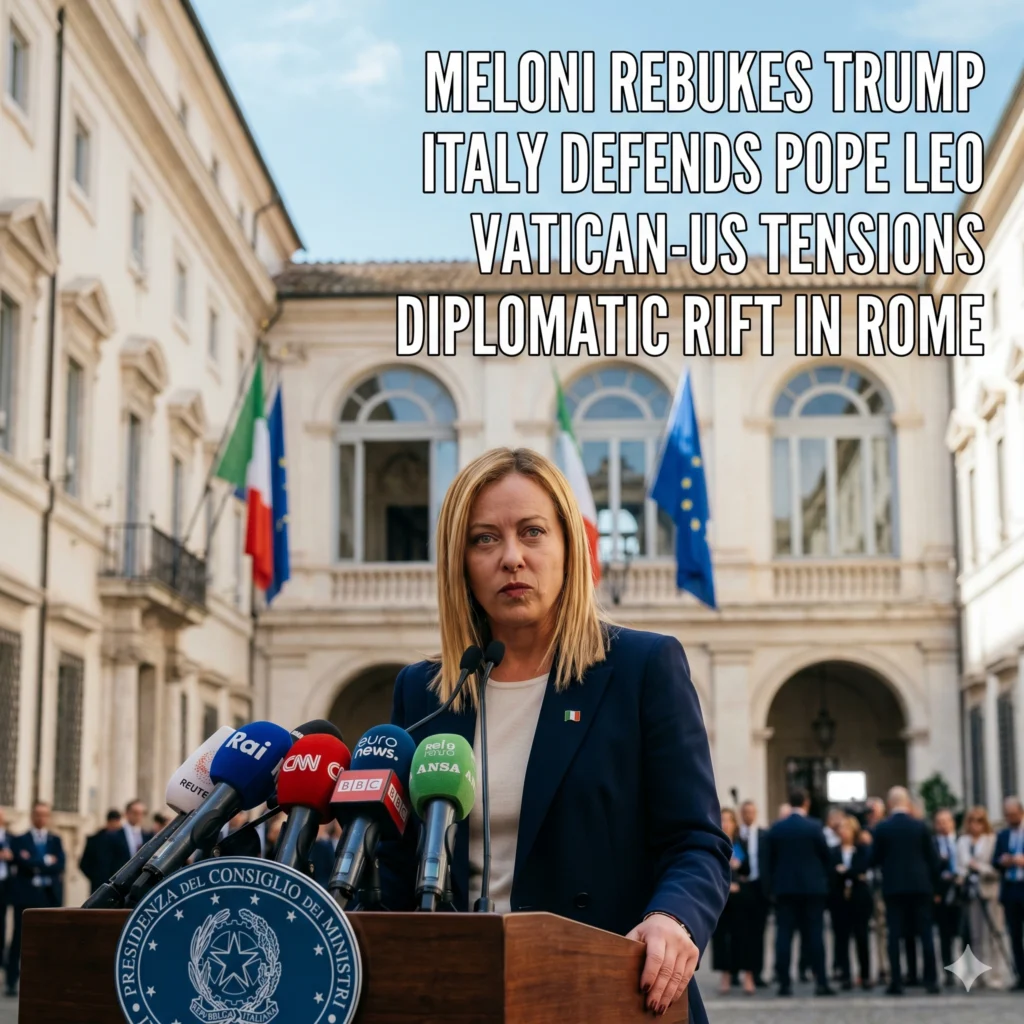
Meloni Rebukes President Trump
Meloni Rebukes President Trump through an official statement that describes the American leader’s remarks as “unacceptable” and “deeply disrespectful.” While the Prime Minister initially faced criticism for her hesitation to name the President directly, her second, more aggressive clarification has left no doubt about her stance. This move is seen by many analysts as a necessary act of political survival following a significant decline in her domestic polling numbers.
The Prime Minister emphasized that the Pope’s right to call for global peace and condemn international conflicts is a fundamental pillar of moral leadership. By standing with Pope Leo, Meloni is attempting to reclaim the support of the Catholic base that felt alienated by her perceived “political cowardice” earlier in the week. The Meloni Rebukes President Trump narrative has now become a central theme in the Italian media, dominating headlines and evening talk shows.
Furthermore, the rebuke highlights a growing rift within the coalition government itself. Even Deputy Prime Minister Matteo Salvini, traditionally one of the strongest proponents of the Trump administration’s “America First” strategy, has joined the chorus of disapproval. This collective distancing from Washington suggests that the ideological bond between the European far-right and the current U.S. administration may have reached a breaking point over the issue of religious respect.
The Viral AI Image and Public Outrage
A significant catalyst for the current diplomatic crisis was the dissemination of an AI-generated image by the Trump team. The image, which depicted the U.S. President in a messianic, Jesus-like pose, was viewed as a direct blasphemous challenge to the Vatican’s authority. In a country where the Catholic Church still holds immense cultural and political sway, this move was perceived as a step too far in modern political branding.
Public outrage reached a fever pitch on Sunday night, leading to spontaneous protests in several major Italian cities. Demonstrators gathered outside the U.S. Embassy in Rome, waving banners that supported Pope Leo and criticized the American President’s lack of decorum. The Meloni Rebukes President Trump movement gained momentum as these images of public anger flooded social media, making it impossible for the government to remain silent.
- Protests in Rome, Milan, and Naples.
- Widespread condemnation from Catholic organizations.
- Social media campaigns defending the dignity of the papacy.
- Calls for a formal review of Italy-U.S. diplomatic treaties.
Recent polling data suggests that approximately 66% of Italian citizens now hold a negative view of the American leader, a sharp increase from previous months. This shift in sentiment is largely attributed to the perception that the U.S. administration is no longer a stable partner but an unpredictable force that actively undermines European values. The Meloni Rebukes President Trump statement is a reflection of this widespread public discontent.
Pope Leo’s Defiant Response
Pope Leo has not remained passive in the face of these attacks, issuing a firm statement from the Vatican. The pontiff clarified that he has “no fear” of the current U.S. administration or its controversial foreign policies. This display of spiritual and political strength has further endeared him to the Italian public, portraying him as a David standing against a modern-day Goliath in the form of the American presidency.
The Pope’s primary point of contention with Washington revolves around the U.S.-led war with Iran and the treatment of international migrants. Leo has consistently used his platform to advocate for a ceasefire and the protection of human rights, stances that directly conflict with the White House’s current military strategy. The Meloni Rebukes President Trump situation is essentially a proxy battle for these larger global issues that have divided the international community.
Despite the ongoing diplomatic friction, Pope Leo is proceeding with his scheduled four-nation visit to Africa. This commitment to his global duties, even while under verbal fire from the world’s most powerful leader, has sent a clear message of resilience. His refusal to be intimidated has forced Meloni to take a harder line, leading to the headline-making news that Meloni Rebukes President Trump in defense of the Holy See.
Impact on Italian Domestic Politics
The diplomatic rift has had immediate consequences for Meloni’s domestic agenda. Political analysts have pointed out that her close affiliation with the White House was a contributing factor in her recent defeat in a major judicial reform referendum. Voters who were once sympathetic to her platform are now questioning her judgment in aligning Italy so closely with a leader who openly disparages the head of their church.
This “referendum shock” forced the Prime Minister to recalibrate her strategy, leading directly to the moment when Meloni Rebukes President Trump. She must now navigate a narrow path between maintaining essential economic ties with the United States and protecting her standing at home. The opposition parties have been quick to capitalize on this vulnerability, framing the Prime Minister as a leader who prioritizes foreign praise over national dignity.
- Referendum defeat attributed to U.S. ties.
- Opposition accusations of “political cowardice.”
- Internal coalition friction over foreign policy.
- Decline in Meloni’s personal approval ratings.
The Meloni Rebukes President Trump declaration is an attempt to stop the bleeding of her political support. By positioning herself as the defender of the Pope, she is hoping to win back the trust of the conservative voters who form the backbone of her party. However, it remains to be seen if this pivot is enough to repair the damage done by months of perceived subservience to the Trump administration.
Global Consequences of the Rift
The fallout from the Meloni Rebukes President Trump event extends far beyond the borders of Italy. It marks a significant turning point for Europe’s far-right leaders, many of whom have looked to the U.S. President as a source of inspiration and support. If Meloni, once his most vocal European ally, is now willing to issue a public rebuke, it signals a broader isolation of the American executive within the Western alliance.
Brussels has been watching the situation with intense interest, as a weakened Meloni-Trump alliance could lead to a more unified European response to global conflicts. The U.S.-led war with Iran remains a point of deep contention between Washington and its European counterparts. The Meloni Rebukes President Trump incident provides the European Union with more leverage to push for an independent diplomatic path that diverges from American interests.
Furthermore, the diplomatic friction could impact NATO’s internal cohesion at a critical time for global security. Italy is a key member of the alliance, and a breakdown in communication between Rome and Washington could have cascading effects on joint operations. The Meloni Rebukes President Trump story is more than just a clash of personalities; it is a symptom of a crumbling international order where traditional alliances are being tested by unconventional leadership.
The Role of Foreign Policy in 2026
As we move deeper into 2026, foreign policy is becoming the primary driver of domestic stability in Europe. The Meloni Rebukes President Trump controversy highlights how external conflicts, such as the war with Iran, can have immediate and devastating impacts on local politics. The Pope’s vocal opposition to this war has made him a lightning rod for criticism from those who support the military intervention, yet it has also made him a hero to the global peace movement.
Meloni’s clarifying statement defended the Pope’s right to condemn every form of war, a stance that resonates with the majority of the Italian population. The Meloni Rebukes President Trump narrative is ultimately a battle over the moral direction of the West. Should foreign policy be dictated by “might makes right” and nationalistic fervor, or should it be guided by the humanitarian principles championed by the Vatican?
- Conflict between secular power and moral authority.
- The influence of religious leaders on global war efforts.
- The shift toward European strategic autonomy.
- Re-evaluating the “Special Relationship” with the U.S.
The Prime Minister’s rebuke is a clear indication that she believes Italy’s future lies in a more balanced approach. While the U.S. remains an essential partner, the Meloni Rebukes President Trump incident proves that the relationship is no longer unconditional. The “New Italy” under Meloni will likely be more selective in its support of American initiatives, particularly those that conflict with its cultural and religious identity.
Analyzing the U.S. Response
The White House has yet to issue a formal apology for the comments regarding Pope Leo, instead doubling down on the rhetoric. Spokespeople for the administration have suggested that the Pope is “playing politics” and interfering in U.S. national security matters. This refusal to back down has only fueled the Meloni Rebukes President Trump fire, making a diplomatic reconciliation seem unlikely in the near future.
The use of AI-generated imagery continues to be a point of pride for the Trump campaign, which views it as a way to bypass traditional media and connect directly with supporters. However, this strategy has clearly backfired in the international arena. The Meloni Rebukes President Trump event serves as a warning to other global leaders about the dangers of using provocative technology to mock sacred institutions.
Political observers in Washington are concerned that the President’s behavior is pushing away America’s most loyal allies. Italy has historically been one of the most pro-American nations in Europe, but the Meloni Rebukes President Trump incident suggests that this goodwill is being squandered. Without the support of leaders like Meloni, the U.S. administration may find itself increasingly isolated on the world stage, unable to form the coalitions necessary for its ambitious foreign policy.
Conclusion: A Turning Point for Rome
The Meloni Rebukes President Trump incident will be remembered as a defining moment of the 2020s. It represents the point where the personal style of a U.S. President finally clashed with the fundamental identity of a sovereign European ally. For Giorgia Meloni, it was the moment she chose the cross over the crown, or at least the Vatican over the White House.
The repercussions of this rebuke will be felt in the coming elections and in the ongoing discussions about Italy’s role in the world. As the nation rallies around Pope Leo, the message to Washington is clear: respect for the Holy See is a non-negotiable part of the Italian-American friendship. The Meloni Rebukes President Trump headline is not just a news story; it is a historical marker of a changing world.
Whether this rift can be healed remains to be seen, but the damage to the personal relationship between Meloni and the U.S. President appears permanent. As the Pope continues his journey through Africa, he does so with the knowledge that his home country has stood up in his defense. The Meloni Rebukes President Trump saga is a testament to the enduring power of faith and tradition in the face of modern political upheaval.
For more details & sources visit: Reuters
Read more about Italy news on 360 News Orbit – Italy.