
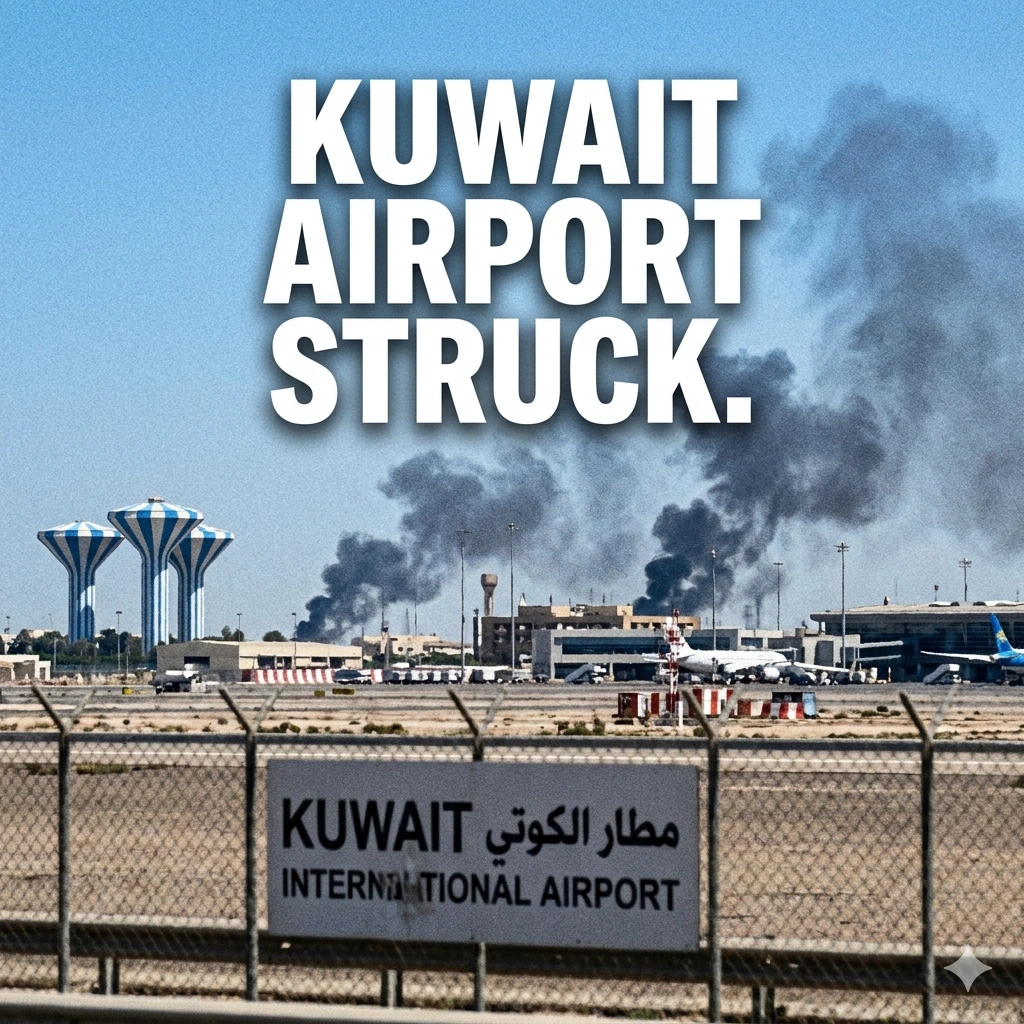
Kuwait International Airport Targeted by suspected Iranian drone strikes has sent ripples of concern throughout the global aviation community as the Middle Eastern conflict expands. Early Saturday morning, multiple unmanned aerial vehicles successfully bypassed local defense systems to strike critical infrastructure within the facility. This deliberate assault has resulted in significant damage to the airport’s sophisticated radar installations and vital fuel storage reservoirs, according to state media reports. Emergency responders were deployed immediately to the scene, battling thick plumes of black smoke that dominated the Kuwaiti skyline for several hours.
Fortunately, officials from the Directorate General of Civil Aviation confirmed that there were no fatalities or serious injuries reported among the airport staff or travelers. The Kuwait International Airport Targeted incident marks a sharp escalation in regional hostilities that have increasingly bled into civilian transport hubs over the past month. As the war between major regional powers enters its second month, the vulnerability of non-military infrastructure has become a primary concern for international observers. Security forces have now cordoned off the affected zones to conduct a thorough technical assessment of the remaining operational systems.
Impact on Global Aviation and Regional Travel
The disruption caused by the latest strike is expected to have a long-lasting impact on flight schedules across the entire Persian Gulf region. Kuwait International Airport Targeted once again means that hundreds of commercial flights must be rerouted or canceled, affecting thousands of passengers and critical cargo shipments. Aviation experts suggest that the damage to the radar systems might take weeks to fully repair, necessitating the use of manual air traffic control protocols. This slowdown is likely to create a bottleneck in one of the world’s most congested and important flight corridors.
Airlines operating in the region are currently evaluating the safety of their routes, with many choosing to bypass Kuwaiti airspace altogether until further notice. The Kuwait International Airport Targeted attack has forced regional neighbors to put their own aviation hubs on high alert, fearing similar strikes. Insurance premiums for flights operating in the Middle East are also expected to rise sharply in response to the increased risk of collateral damage. Travelers are being advised to check their flight status frequently and prepare for significant delays as the situation remains highly volatile.
Tactical Analysis of the Drone Strike
Military analysts believe the drones used in the attack were highly advanced, capable of precision targeting even in the presence of electronic countermeasures. The Kuwait International Airport Targeted operation shows a clear intent to cripple the logistics and communication capabilities of the nation without causing mass casualties. By hitting the fuel storage tanks, the attackers have also created a significant environmental and economic burden for the Kuwaiti government to manage. This specific choice of targets suggests a calculated strategy to exert maximum pressure on the state’s economy and infrastructure.
- Radar systems are the “eyes” of any modern airport, and their destruction renders the facility nearly blind to incoming traffic.
- Fuel reservoirs are often located near the perimeter, making them accessible targets for low-flying drones that can evade traditional radar.
- The timing of the attack—early morning—was likely chosen to minimize the risk of hitting a fully loaded passenger jet on the tarmac.
- Analysts suggest the drones may have been launched from a mobile platform, making it difficult for security forces to trace the point of origin.
Kuwait International Airport Targeted
Kuwait International Airport Targeted by these hostile forces represents a clear violation of international norms regarding the safety of civilian aviation. The government of Kuwait has called for an emergency meeting with its GCC partners to discuss a unified defensive response to these persistent threats. While the nation has tried to maintain a neutral stance in the broader conflict, its geographic location and hosting of international assets have made it a target. The international community is being urged to provide technical assistance to help restore the airport’s security and operational integrity.
Security at the airport had already been heightened following previous incidents, yet the persistence of the attackers has exposed gaps in regional air defense networks. The Kuwait International Airport Targeted event has prompted a national debate about the necessity of acquiring more advanced anti-drone technology from global partners. Citizens are being urged to remain calm as the military takes over the perimeter of the airport to prevent any follow-up incursions. The resilience of the Kuwaiti aviation sector is being tested like never before as it navigates this unprecedented security crisis.
Regional Escalation and Geopolitical Consequences
The strike on Kuwait is widely seen as a retaliatory move by Iranian-backed forces following recent military developments elsewhere in the Middle East. Since the conflict began on February 28, Iran has accused several GCC members of facilitating foreign military operations, leading to a series of “warning” strikes. The Kuwait International Airport Targeted narrative is now part of a larger pattern of unconventional warfare where civilian hubs are used as pawns. This strategy aims to deter regional cooperation with Western powers by demonstrating the high cost of such alliances.
Diplomatic efforts to de-escalate the situation have so far yielded little progress, as both sides remain entrenched in their respective positions. The Kuwait International Airport Targeted incident has only added fuel to the fire, making a peaceful resolution seem increasingly out of reach in the short term. Regional leaders are concerned that the continued targeting of civilian infrastructure could lead to a total collapse of trade and travel in the area. The UN has expressed deep concern over the expansion of the conflict into previously stable territories like Kuwait.
Economic Repercussions for the Gulf Region
The economic fallout from the attack is already being felt in the local markets, with oil prices showing sensitivity to the instability near key refineries. Because the Kuwait International Airport Targeted site is a major hub for business travel, the suspension of operations is hindering international trade and investment. Many multinational corporations are considering relocating their staff to safer regions until the security situation stabilizes. This brain drain could have long-term negative effects on the development goals of the Kuwaiti government and its Vision 2035 plan.
- Logistics companies are facing increased costs due to longer transit times and higher security requirements for their shipments.
- The tourism sector, which was just beginning to recover from previous global disruptions, is facing a new wave of cancellations.
- Local businesses surrounding the airport have been forced to close temporarily, leading to a loss of income for hundreds of families.
- Government spending is being diverted from public projects to cover the immense costs of infrastructure repair and military mobilization.
Technical Restoration and Safety Protocols
Engineers are working around the clock to implement temporary radar solutions to restore partial functionality to the airport. The Kuwait International Airport Targeted technical team is collaborating with international aviation experts to ensure that any resumed flights meet the highest safety standards. This involves recalibrating navigation aids and verifying that the fuel supply lines have not been contaminated by the recent fires. The priority is to create a secure corridor for essential flights, such as those carrying medical supplies or returning citizens.
The Civil Aviation Authority is also reviewing its emergency response protocols to better handle the aftermath of future drone incursions. The Kuwait International Airport Targeted incident revealed that while the fire department was efficient, the communication between different security branches could be improved. New training modules are being developed for airport staff to recognize and report suspicious aerial activity more quickly. These measures are essential to rebuilding public trust in the safety of the nation’s primary gateway to the world.
The Role of International Alliances in Defense
Kuwait has historically relied on a mix of domestic capabilities and international defense agreements to safeguard its territory. The Kuwait International Airport Targeted strikes have reignited discussions about the effectiveness of existing surface-to-air missile systems against small, slow-moving drones. Allied nations have offered to deploy additional surveillance assets to help monitor the northern borders more effectively. This increased military presence, while necessary, also raises concerns about further provoking the forces responsible for the initial attacks.
- Coordination with the United States and other Western allies is being intensified to share real-time intelligence on drone movements.
- Regional neighbors like Saudi Arabia and the UAE are sharing their own experiences and technical solutions for drone defense.
- The purchase of electronic jammer systems is being fast-tracked to provide a non-kinetic way to disable hostile unmanned aircraft.
- Public-private partnerships are being explored to develop local anti-drone technologies that are tailored to the specific environment of the Gulf.
Public Reaction and National Unity
The people of Kuwait have responded to the attack with a mixture of defiance and a strong sense of national solidarity. Following the Kuwait International Airport Targeted news, many citizens took to social media to express their support for the security forces and the government. There is a widespread understanding that the nation is being tested by external forces seeking to sow chaos and division. Community leaders are calling for unity and patience as the authorities work to resolve the crisis and restore normalcy.
Despite the fear, the daily life of most Kuwaitis continues with a sense of quiet determination to not let the attackers win. The Kuwait International Airport Targeted strike has, in many ways, brought the diverse segments of the population closer together under a common cause. Schools and businesses are staying open, and public events are proceeding with increased security as a sign of resilience. This psychological strength will be just as important as the physical repairs in the coming months of the conflict.
Future Outlook for Kuwaiti Infrastructure
Looking ahead, the government is planning to build more resilient and redundant systems for its most critical facilities. The lessons learned from the Kuwait International Airport Targeted incident will be integrated into the design of the new Terminal 2 and other upcoming projects. Hardening of fuel depots and the installation of localized air defense bubbles are now high-priority items on the national security agenda. These investments are seen as vital to protecting the nation’s future prosperity in an increasingly unstable geopolitical landscape.
The focus will also shift toward cyber-resilience, as the drones used in the attack were likely guided by sophisticated software that could be vulnerable to hacking. The Kuwait International Airport Targeted case study will be used by security professionals worldwide to understand the evolving nature of modern warfare. As the world watches, Kuwait is determined to emerge from this crisis with a stronger and more secure infrastructure. The opening of a fully restored airport will be a symbolic victory for the nation and its people over the forces of aggression.
Restoring the Gateway to the World
In conclusion, the path to recovery will be long, but the commitment to restoring the airport’s status as a regional leader remains unshaken. The Kuwait International Airport Targeted disaster has shown that while physical structures can be damaged, the spirit of a nation remains intact. International partners continue to pledge their support, ensuring that Kuwait does not have to face these challenges alone. The gradual return of international flights will be the ultimate indicator that the crisis is being managed effectively.
Every technician working on the radar and every soldier guarding the perimeter is a part of this collective effort toward peace and security. The Kuwait International Airport Targeted history will eventually reflect this period as one of great challenge but also of great adaptation and growth. As the smoke clears and the investigations conclude, the focus remains firmly on the future. Kuwait stands ready to welcome the world back through its doors, stronger and more vigilant than ever before.
For more details & sources visit: Al Jazeera
Read more about Kuwait news on 360 News Orbit – Kuwait.