
Japan Mountain Blazes is a critical situation as over 1,500 personnel have been mobilized to fight persistent wildfires threatening the coastal town of Otsuchi in northern Japan. The deployment involves a massive coordinated effort between the Self-Defence Forces and local fire departments to contain a disaster that has been unfolding for five consecutive days. As dry winds continue to fuel the spreading flames, the regional government has prioritized human life by issuing widespread evacuation orders. This escalating crisis highlights the increasing vulnerability of Japan’s forested mountainous regions to prolonged dry spells and shifting climatic patterns.
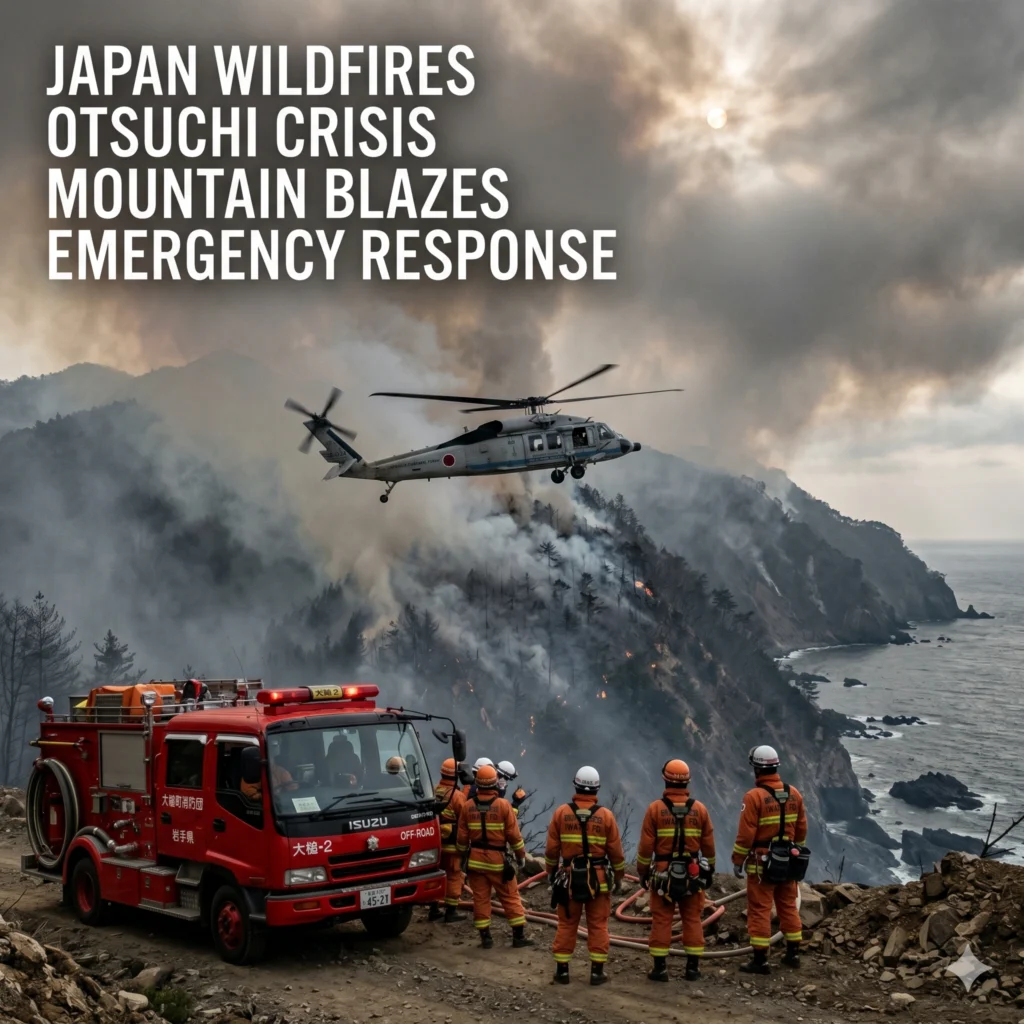
Authorities have confirmed that Japan Mountain Blazes have already consumed approximately 1,373 hectares of land as of Sunday morning. Despite the round-the-clock efforts of 1,400 firefighters and 100 military specialists, the affected area grew by seven percent in a single day. This rapid expansion occurs even with intensive aerial water bombing operations conducted by military helicopters. The scale of the response reflects the severity of the threat posed to residential districts along the Pacific Coast.
Japan Mountain Blazes
The intensity of the Japan Mountain Blazes has forced Otsuchi Mayor Kozo Hirano to issue urgent warnings to all residents within the danger zone. The combination of high-velocity winds and a lack of humidity has created a perfect storm for wildfire propagation across the northern terrain. Currently, evacuation orders remain in effect for 1,541 households, which impacts over 3,000 residents in this coastal community.
Historical trauma weighs heavily on the residents of Otsuchi as they face this new environmental threat. This town was previously devastated by the 2011 earthquake and tsunami, an event that tragically killed a tenth of its population. Seeing smoke rise over the reconstructed neighborhoods has triggered deep emotional distress among the local survivors. Consequently, the government is providing mental health support alongside physical safety measures at various evacuation centers.
Deployment of Self-Defence Forces
The involvement of the Self-Defence Forces is a clear indicator that the situation has surpassed the capacity of local municipal resources. These military personnel are trained for disaster relief and are currently managing the logistics of the aerial assault on the fire lines. Furthermore, they are assisting in the safe transport of elderly residents who are unable to evacuate their homes independently.
Helicopters are playing a pivotal role in the containment strategy by dropping thousands of liters of water on inaccessible ridge lines. Because the terrain is exceptionally steep, ground crews often find it impossible to reach the heart of the fire. Therefore, the coordination between the sky-bound military units and the ground-based firefighters is essential for protecting the town’s perimeter.
Weather Patterns and Fire Risks
Meteorologists have analyzed the current atmospheric conditions and offer a somber outlook for the next forty-eight hours. There is no significant rainfall expected in the northern region until at least Tuesday afternoon. This means that the Japan Mountain Blazes will likely continue to expand unless the wind speed decreases significantly.
The dry season in northern Japan has become increasingly unpredictable over the last decade. While spring usually brings some moisture, this year has been characterized by an unusual deficit in precipitation. As a result, the forest floor is covered in dry organic matter that acts as a potent fuel for any ignition source.
Impact on Coastal Infrastructure
The proximity of the fires to the Pacific Coast has raised concerns regarding the safety of critical infrastructure and local businesses. Transport links, including major coastal roads, have been intermittently closed to allow emergency vehicles unimpeded access to the front lines. Furthermore, smoke inhalation has become a secondary health concern for those living just outside the immediate evacuation zones.
One minor injury has already been reported involving a person who fell at an evacuation center during the initial rush. While this is the only recorded casualty so far, the risk remains high as the fire approaches more densely populated districts. Local authorities are maintaining a strict cordon to prevent residents from returning to their homes prematurely.
Investigation into Ignition Sources
The exact cause of the ignition remains unclear and is currently under official investigation by regional authorities. Investigators are looking into various possibilities, ranging from accidental human activity to potential natural causes. Because the fire started in a remote mountain area, identifying the precise point of origin is a complex task.
Understanding the cause is vital for preventing future occurrences of the Japan Mountain Blazes in other vulnerable prefectures. Preliminary reports suggest that the fire began deep in the forest before being pushed toward the coast by the prevailing winds. Forensic teams will begin their work once the area is deemed safe for entry by the fire marshal.
Environmental Consequences of Wildfires
The environmental toll of the Japan Mountain Blazes extends beyond the immediate destruction of trees and shrubbery. The loss of over 1,300 hectares of forest cover will have long-term implications for local biodiversity and soil stability. Without the root systems of the trees, the area may become prone to landslides during the subsequent rainy season.
Local wildlife has also been displaced, with reports of animals fleeing toward the lower valleys and residential gardens. Environmental groups are monitoring the situation closely and preparing for post-fire restoration projects. Restoring the ecological balance of the northern mountains will likely take several decades of careful management and reforestation.
Community Resilience and Support
Despite the fear and uncertainty, the community spirit in Otsuchi remains remarkably strong and resilient. Volunteers have stepped forward to manage the distribution of food and water at the designated evacuation points. This collective effort is reminiscent of the solidarity shown during the recovery period following the 2011 disaster.
The central government in Tokyo has promised full financial support for the affected region and its residents. Prime Minister’s office representatives have stated that all necessary resources will be deployed until the Japan Mountain Blazes are fully extinguished. This commitment provides a sense of security for a population that has already endured significant hardship.
Advanced Firefighting Technology
In addition to traditional methods, authorities are utilizing satellite data to track the movement of the fire in real-time. This technology allows commanders to predict which way the flames will jump based on current wind patterns. By using these data-driven insights, they can reposition personnel to create more effective firebreaks.
The integration of ground sensors and satellite imagery has transformed how Japan manages large-scale natural disasters. These tools provide a comprehensive view of the Japan Mountain Blazes that would be impossible to achieve through ground observation alone. Consequently, the strategic planning for this operation is more precise than in previous years.
Future Prevention Strategies
Looking ahead, this crisis will likely lead to a total review of wildfire prevention strategies across the country. There is a growing consensus that more permanent firebreaks need to be established around vulnerable coastal towns. Furthermore, the installation of remote early-detection cameras could help identify fires before they reach such a massive scale.
Public education campaigns regarding fire safety during the dry season are also expected to be ramped up. Many residents are now realizing that the risks once associated with other countries are now a reality for Japan. Adapting to this new climate reality is a priority for both the government and the general public.
Health Risks of Smoke Exposure
The persistent smoke from the Japan Mountain Blazes has created a haze that stretches for miles along the coast. Health officials have advised residents to keep windows closed and wear high-filtration masks when outdoors. Children and the elderly are particularly susceptible to respiratory issues caused by the fine particulate matter in the air.
Hospitals in the surrounding areas have seen a slight uptick in patients reporting asthma flare-ups and eye irritation. Although the evacuation has moved people away from the flames, the air quality remains a lingering threat to public health. Monitoring stations are providing hourly updates on the density of the smoke plume.
Economic Impact on Northern Japan
The economic repercussions of the Japan Mountain Blazes are starting to be felt by the local forestry and tourism sectors. Many mountain trails and scenic areas are now scorched earth, which will deter visitors for the foreseeable future. Additionally, the destruction of timber resources represents a significant loss for the regional economy.
Small business owners in Otsuchi, who were still recovering from previous economic downturns, face a new period of uncertainty. The government is considering specialized grants to help these businesses survive the disruption caused by the wildfires. Stabilizing the local economy will be a key component of the long-term recovery plan.
Logistics of the Evacuation Process
Moving over 3,000 people in a short period is a logistical challenge that requires meticulous planning and execution. The local police have been instrumental in managing traffic flow and ensuring that evacuation routes remain clear. Special transport has been arranged for patients in local clinics and residents of nursing homes.
The evacuation centers are equipped with bedding, emergency rations, and basic medical supplies to accommodate the displaced population. Many residents have had to leave behind their pets and personal belongings, adding to the emotional toll of the situation. Staff at the centers are working tirelessly to ensure that everyone is accounted for and safe.
International Observations on the Crisis
International climate scientists are observing the Japan Mountain Blazes as part of a broader study on global wildfire trends. The fact that such a large fire is occurring in a region typically known for its humidity is a cause for concern. These observations help build a better understanding of how forest fires are changing globally.
Japan has received offers of assistance from neighboring countries, although the current deployment of domestic forces is deemed sufficient. This international attention underscores the global nature of environmental challenges and the importance of cross-border cooperation. Information sharing regarding firefighting techniques remains a key part of international disaster management.
Comparison to Previous Wildfires
While Japan does experience seasonal forest fires, the Japan Mountain Blazes are notable for their duration and rapid growth. Compared to historical data, this fire has consumed more land in five days than many previous fires did in a month. This intensity is what prompted the swift mobilization of the military.
Previous fires in the northern region were often extinguished by natural rainfall within a few days. The current lack of rain has forced a shift in tactics, moving from containment to active suppression. This transition highlights the need for more aggressive firefighting capabilities in the future.
Role of Local Volunteers
The bravery of local volunteer fire brigades cannot be overstated during this national emergency. These individuals often work alongside professional crews, providing vital local knowledge of the mountain paths. Their contribution is a testament to the strong tradition of community service in rural Japan.
Volunteer units have been responsible for patrolling the perimeters of the town to spot any spot-fires caused by flying embers. This “watch and act” approach is critical for preventing the fire from jumping into residential zones. Their dedication has undoubtedly saved numerous homes from the encroaching Japan Mountain Blazes.
Forestry Management Challenges
Effective forestry management is a complex task in Japan due to the density of the woods and the steepness of the terrain. Over the years, the buildup of undergrowth has created a significant fire hazard that is now being realized. Addressing this issue will require a massive effort to clear deadwood and manage forest density.
The government is facing pressure to increase funding for forestry departments to conduct controlled burns during the off-season. While this practice is common in other countries, it is less frequent in Japan and would require a cultural shift in land management. Balancing conservation with safety is the primary challenge for policymakers.
Resilience of the Pacific Coast
The Pacific Coast of Japan has a long history of enduring and overcoming natural disasters. From tsunamis to typhoons, the people of this region have built a culture of preparedness. The current response to the Japan Mountain Blazes is another chapter in this ongoing story of resilience.
Infrastructure improvements made after 2011, such as better communication networks, have helped in the current crisis. Residents received evacuation alerts on their smartphones instantly, allowing them to leave before the smoke became too thick. This technological advantage is a direct result of lessons learned from past tragedies.
Summary of the Current Situation
As of today, the Japan Mountain Blazes remain an active threat that requires the full attention of the nation. The deployment of 1,500 personnel shows the seriousness with which the government is treating the situation. While the focus remains on containment, the ultimate goal is the total suppression of all fire lines.
The coming days will be a true test for the firefighters and military personnel on the ground. With the weather remaining dry, the margin for error is incredibly thin. However, the coordinated effort and the bravery of the crews provide hope that the town of Otsuchi will be protected from further destruction.
- The fire has burned for five consecutive days in the northern region.
- Over 1,500 personnel are currently engaged in firefighting operations.
- Evacuation orders affect one-third of Otsuchi’s total population.
- Significant rainfall is not expected until Tuesday at the earliest.
Lessons for Future Generations
The current generation is learning that disaster preparedness must include a wide range of scenarios, including wildfires. Schools in the region are already incorporating fire safety into their curriculum to ensure that children know how to respond. This knowledge is an essential tool for building a safer future for the coastal communities.
The Japan Mountain Blazes serve as a stark reminder of the power of nature and the importance of environmental stewardship. By understanding the factors that led to this crisis, the community can work together to prevent it from happening again. The strength of Otsuchi lies in its people and their ability to stand together in the face of adversity.
Conclusion and Outlook
The fight against the Japan Mountain Blazes is far from over, but the progress made by the deployment of forces is visible. The aerial water bombing and the creation of firebreaks have slowed the advance of the flames toward the town center. Continued vigilance is necessary as the winds remain unpredictable.
The government’s primary focus remains the safety of the 3,000 residents currently in evacuation centers. Once the fires are out, the long process of recovery and investigation will begin. For now, the nation watches and supports the heroes on the front lines as they battle the mountain blazes.
For more details & sources visit: Dawn
Read more about Japan news on 360 News Orbit – Japan.