
The Egyptian government has officially lifted the mandatory 11 p.m. closing time for commercial establishments following a comprehensive crisis management review. Prime Minister Mostafa Madbouly announced that the Egypt Solar Energy Initiative is now the primary focus to bolster the nation’s renewable energy transition and economic stability. This major policy shift aims to revitalize the retail and hospitality sectors which were previously constrained by restrictive operating hours. By transitioning toward sustainable power, the state intends to mitigate the domestic impact of rising global energy costs and regional instability.
As part of a broader strategy, the Central Crisis Management Committee approved the return to standard operating hours for shops, malls, and restaurants nationwide. This decision comes at a critical time when the economic fallout of regional military operations is weighing heavily on local commerce. The Egypt Solar Energy Initiative serves as a cornerstone for future-proofing the economy against such external shocks. Government officials are now preparing multiple economic scenarios to ensure that the nation remains resilient regardless of the duration or scope of the ongoing regional conflict.
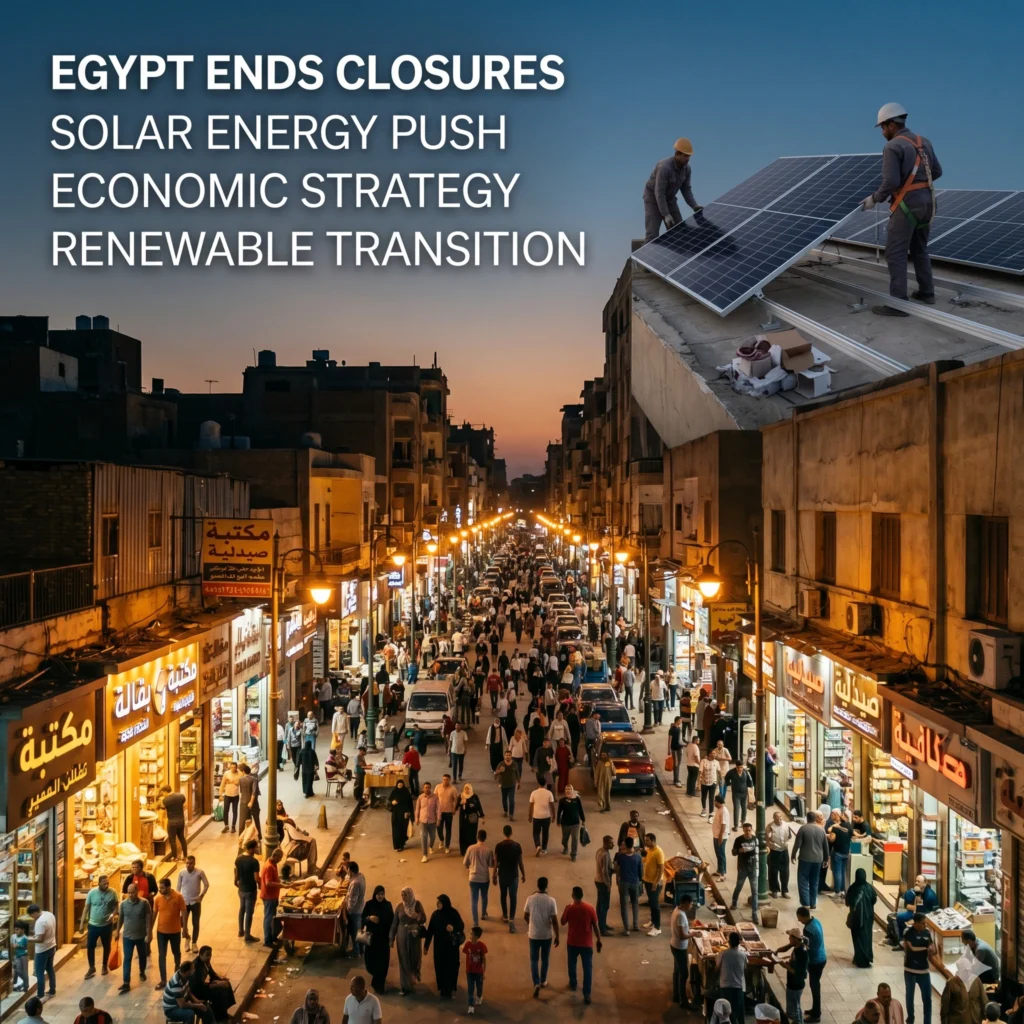
Egypt Solar Energy Initiative
The Egypt Solar Energy Initiative represents a significant leap toward energy independence for both residential and industrial sectors. Prime Minister Madbouly has directed the swift implementation of these solar programs to reduce the national reliance on traditional, expensive power sources. These incentives are specifically designed to make solar panels more accessible for homeowners and large-scale factory owners alike. By diversifying the energy mix, Egypt hopes to secure a more sustainable and predictable economic environment for its citizens and investors.
Securing long-term strategic reserves of essential commodities and petroleum products remains a top priority for the Egyptian state. President Abdel Fattah al-Sisi issued direct orders to ensure that all national consumption and production needs are fully met during this transitional period. The Egypt Solar Energy Initiative acts as a secondary layer of protection, ensuring that the power grid remains stable even if fuel supply chains are disrupted. This proactive approach is essential for maintaining public confidence in the face of fluctuating global trade growth and commodity prices.
Standardized Commercial Operating Hours
The return to standard operating hours is expected to provide an immediate boost to the local retail market. Authorities have been urged to maintain strict oversight of these markets to prevent price manipulation during the transition. While the Egypt Solar Energy Initiative focuses on long-term sustainability, the lifting of shop closures addresses immediate economic concerns. This dual-track strategy ensures that while the future is secured, the present commercial landscape remains vibrant and competitive for all business owners.
Malls and restaurants can now operate without the looming threat of early shutdowns, which had previously hampered evening revenue. Business leaders have welcomed the change, noting that it allows for better employment opportunities and increased consumer spending. However, the government continues to encourage the rationalization of electricity consumption through the Egypt Solar Energy Initiative. Combining longer hours with more efficient energy usage is seen as the most viable path forward for the Egyptian service sector in 2026.
Regional Growth Projections and Risks
The Ministry of Planning recently reported that global economic growth is projected to decline to 3.1 percent during the current fiscal year. Furthermore, regional growth in the Middle East and North Africa is expected to decelerate sharply to 1.1 percent due to rising costs. The Egypt Solar Energy Initiative is a direct response to these sobering statistics, aiming to keep domestic production costs low. By investing in local renewable infrastructure, Egypt can partially decouple its growth from the volatile regional economic climate.
Global trade growth is also forecast to decrease significantly from 5.1 percent in 2025 to just 2.8 percent in 2026. These figures emphasize the importance of domestic resource management and self-sufficiency in key sectors like energy and agriculture. The Egypt Solar Energy Initiative is not just an environmental project but a vital economic defense mechanism. It allows the country to redirect funds that would have been spent on fuel imports toward social programs and infrastructure development.
Strategic Reserves and Commodity Security
Maintaining a robust supply of essential goods is critical for preventing social unrest and ensuring market stability. The government is coordinating efforts across various ministries to ensure that petroleum products and food staples are always in stock. Alongside these efforts, the Egypt Solar Energy Initiative helps reduce the overall demand for petroleum in the electricity sector. This frees up existing fuel reserves for use in heavy transport and industries where solar power is not yet a primary option.
President Sisi’s directives have led to the establishment of new storage facilities and enhanced logistics networks across the country. These measures are designed to withstand the pressures of international power shifts and military operations that threaten trade routes. The Egypt Solar Energy Initiative plays its part by providing decentralized power solutions that are less vulnerable to centralized grid failures. This integrated approach ensures that the basic needs of the Egyptian population are always prioritized by the state.
Market Oversight and Price Control
Authorities are currently on high alert to prevent unscrupulous traders from taking advantage of the changing economic regulations. Strict oversight of local markets is being enforced to ensure that the benefits of the Egypt Solar Energy Initiative reach the end consumer. If energy costs for factories decrease due to solar incentives, the government expects a corresponding stabilization in product prices. Market monitors are conducting daily inspections to ensure compliance with fair pricing standards and goods availability.
Transparency in the supply chain is being enhanced through digital tracking and regular reporting from the Ministry of Supply. This ensures that any bottlenecks in the distribution of essential commodities are identified and resolved immediately. The Egypt Solar Energy Initiative further supports this by providing reliable power to cold storage and distribution centers. Stabilizing the cost of keeping food fresh is a key component of the national strategy to keep inflation under control during the 2026 crisis.
Rationalization of Public Spending
In response to global disruptions, the Egyptian government is implementing strict measures to rationalize public spending. Every ministry has been tasked with reducing waste and focusing resources on high-impact projects like the Egypt Solar Energy Initiative. This fiscal discipline is necessary to maintain a balanced budget while still investing in future growth. By cutting unnecessary expenditures, the state can afford to provide the incentives needed to kickstart a nationwide solar revolution.
Public buildings are also being fitted with energy-efficient lighting and solar arrays to lead by example. The rationalization efforts extend to electricity consumption in government offices, which are now required to meet strict efficiency targets. The Egypt Solar Energy Initiative is the blueprint for this transformation, proving that sustainability and fiscal responsibility go hand in hand. These steps are crucial for maintaining the country’s credit rating and attracting foreign direct investment in a challenging global market.
High-Level Ministerial Cooperation
The recent strategy meetings included high-ranking officials from the Central Bank and the ministries of finance, electricity, and petroleum. This level of cross-departmental cooperation is required to ensure the Egypt Solar Energy Initiative is financially and technically viable. The Central Bank is working on specialized financing packages for small businesses looking to install solar panels. Meanwhile, the Ministry of Electricity is updating the national grid to accommodate the influx of renewable energy from diverse sources.
The Ministry of Finance is playing a critical role by allocating the necessary budget for solar subsidies and tax breaks. By working together, these institutions are creating a unified front against the economic challenges of 2026. The Egypt Solar Energy Initiative is the common thread that binds these various government efforts together. It represents a shared vision of a modern, energy-efficient Egypt that can thrive even during times of international tension and regional crisis.
Impacts on the Industrial Sector
Factories are among the largest consumers of electricity in Egypt and stand to benefit most from the new solar incentives. The Egypt Solar Energy Initiative provides a pathway for manufacturers to reduce their overhead and become more competitive in the global market. Lower energy costs mean that Egyptian exports can remain attractive even as global trade growth slows down. This is vital for maintaining the industrial workforce and preventing layoffs in the manufacturing heartlands.
Many industrial zones are now planning to build dedicated solar farms to power their operations independently. This move toward self-generation is highly encouraged by the government as part of the Egypt Solar Energy Initiative. It reduces the strain on the national grid during peak hours and ensures that production can continue during maintenance windows. The transition to solar is seen as a long-term investment that will pay dividends for decades to come.
Residential Solar Adoption and Incentives
For the average Egyptian household, the Egypt Solar Energy Initiative offers a way to significantly reduce monthly utility bills. The government is introducing easy-payment plans and low-interest loans for the purchase of rooftop solar systems. This makes the technology accessible to a wider range of the population, not just the wealthy. As more homes adopt solar power, the collective impact on national energy demand will be substantial and beneficial.
Education campaigns are being launched to inform citizens about the benefits and technical requirements of home solar installations. The Egypt Solar Energy Initiative aims to create a culture of energy awareness and environmental responsibility among the youth. By starting at the household level, the government hopes to build a foundation for a green economy. Local technicians are also being trained to install and maintain these systems, creating new green jobs in the process.
Global Economic Context of 2026
The year 2026 has been marked by significant volatility in international markets and a general slowdown in growth. With global growth projected at 3.1 percent, every nation is looking for ways to protect its economy. The Egypt Solar Energy Initiative is a proactive step that puts Egypt ahead of the curve in renewable energy adoption. While other nations may struggle with rising fuel costs, Egypt is building an infrastructure that is powered by the sun.
This strategic move is also intended to improve Egypt’s standing in international climate rankings and fulfill its global environmental commitments. The Egypt Solar Energy Initiative proves that even during a regional crisis, the government remains committed to sustainable development. This consistency is attractive to international organizations and green funds looking for reliable partners in the Middle East. It demonstrates a maturity in governance and a long-term perspective on national security and prosperity.
Future of Public Transportation and Solar
The government is also exploring how the Egypt Solar Energy Initiative can be integrated into the public transportation network. Charging stations for electric buses and trains could eventually be powered by large-scale solar arrays. This would further reduce the carbon footprint of the nation’s transport system and lower operational costs for the state. Innovations in battery storage technology are being closely monitored to make this vision a reality.
Experimental solar-powered stations are already being tested in major cities like Cairo and Alexandria. These projects serve as a proof of concept for the wider application of the Egypt Solar Energy Initiative in urban planning. As technology improves and costs continue to fall, the integration of solar into every aspect of public life will become more seamless. The goal is a fully integrated, smart energy system that optimizes usage across all sectors of the economy.
Resilience in the Face of Regional Conflict
The ongoing military operations in the region have created an atmosphere of uncertainty that affects everything from tourism to trade. However, by launching the Egypt Solar Energy Initiative, the government is sending a clear signal of resilience and stability. The state is focused on internal development and ensuring that the lives of its citizens remain uninterrupted by external shocks. This focus on domestic strength is the best defense against regional instability.
The lifting of shop closure rules is another part of this signal, showing that the domestic economy is open for business. While the government monitors the regional situation closely, it is not allowing it to paralyze national progress. The Egypt Solar Energy Initiative is a testament to the fact that Egypt is looking forward, not backward. It is a bold statement of intent for a nation that is determined to chart its own course through a difficult period in history.
Role of International Investment
Foreign investors are being invited to participate in the various projects under the Egypt Solar Energy Initiative. The government is offering streamlined licensing processes and competitive land leases for large solar developments. This influx of foreign capital is expected to accelerate the transition and bring in the latest global technologies. International partnerships are seen as a way to bridge the gap between national goals and technical implementation.
Major energy companies from Europe and Asia have already expressed interest in the new incentives announced by Prime Minister Madbouly. These investments will not only build solar farms but also create local manufacturing hubs for solar components. The Egypt Solar Energy Initiative is thus a catalyst for a new industrial sector that can serve both the domestic and regional markets. It positions Egypt as a regional hub for renewable energy expertise and production.
Monitoring and Evaluation of the Initiative
To ensure the success of the Egypt Solar Energy Initiative, a dedicated monitoring unit has been established. This unit will track the progress of solar adoption and the impact on the national grid in real-time. Regular reports will be issued to the Prime Minister’s office to allow for quick adjustments to policy and incentives. This data-driven approach ensures that public funds are being used effectively and that the initiative is meeting its targets.
Continuous feedback from the private sector and residential users will also be integrated into the evaluation process. The government wants to ensure that the Egypt Solar Energy Initiative remains flexible and responsive to the needs of the people. By maintaining an open dialogue with all stakeholders, the state can overcome any technical or bureaucratic hurdles that may arise. This transparency is key to the long-term success of the national energy transition.
Conclusion and Strategic Outlook
The lifting of mandatory shop closures and the launch of the Egypt Solar Energy Initiative represent a balanced approach to governance in 2026. By addressing immediate economic needs while planning for a sustainable future, the Egyptian government is demonstrating strong leadership. The path ahead may be challenging due to regional and global economic pressures, but the foundation being laid today is solid.
The Egypt Solar Energy Initiative will ultimately define the country’s energy landscape for the next generation. It is a comprehensive plan that touches every part of society, from the smallest shop to the largest factory. As the nation moves forward, the sun will provide the power needed to drive Egypt toward a bright and prosperous future.
For more details & sources visit: Daily News Egypt
Read more about Egypt news on 360 News Orbit – Egypt.