
Israeli military convoy storms Quneitra today as tension reaches a new high in the southern region of Syria. On Wednesday, Israeli forces escalated their presence in the province by entering the village of Al-Asbah. This operation involved a fleet of six armored military vehicles that moved through the residential areas. Residents reported a significant level of intimidation as soldiers conducted unannounced home raids across the village. This latest maneuver follows a series of incursions that have become increasingly common since the collapse of the 1974 Disengagement Agreement.
The presence of the Israeli military convoy storms Quneitra areas without any formal declaration of hostility from the central government in Damascus. Military units have effectively occupied the frontier buffer zone, citing a shift in regional security dynamics. This move has placed thousands of Syrian civilians under direct foreign military oversight. The local population is now dealing with the daily reality of foreign soldiers patrolling their streets and monitoring their homes. These actions have raised serious questions about the long-term status of Syrian sovereignty in the southern countryside.
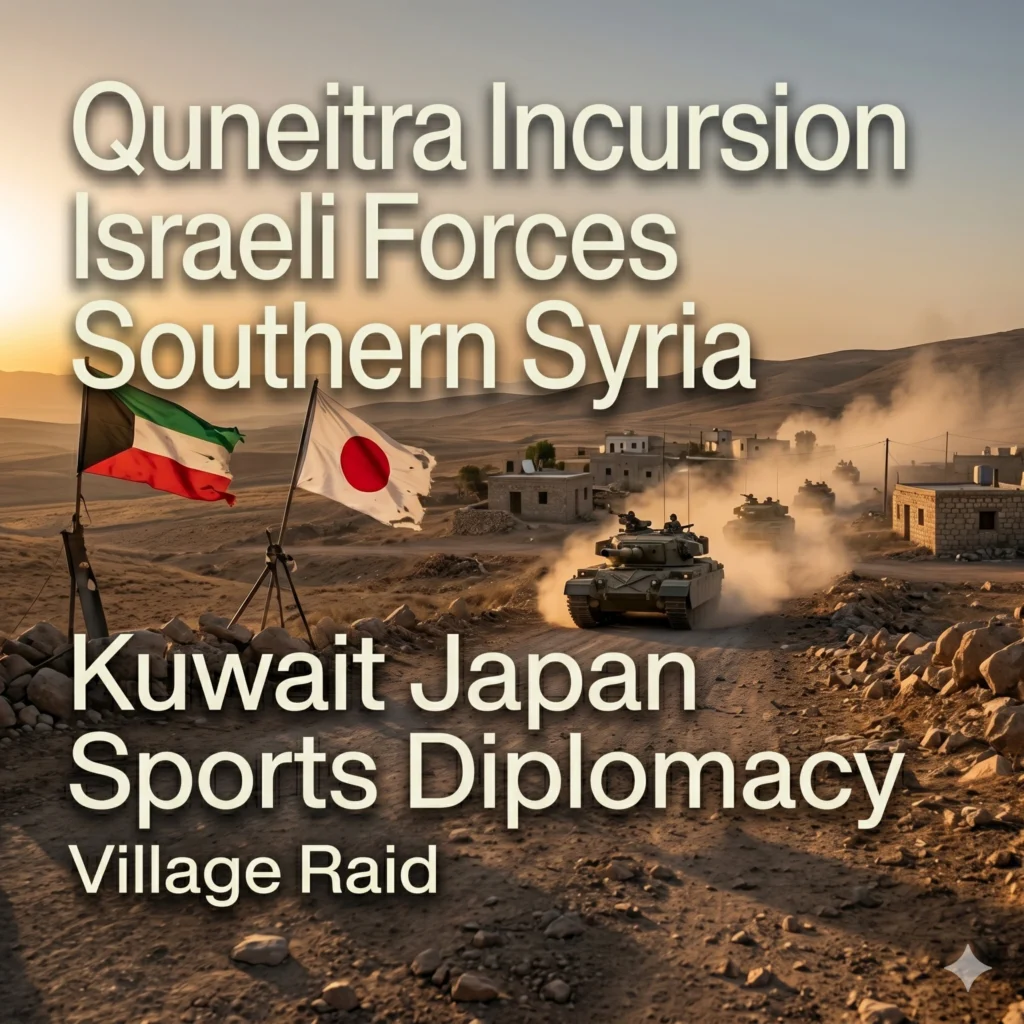
Impacts of the Israeli Military Convoy Storms Quneitra Incident
The tactical move where an Israeli military convoy storms Quneitra villages like Al-Asbah has deep humanitarian consequences. During the home raids, families were reportedly forced out of their residences while soldiers conducted thorough searches of the properties. These tactics are perceived by local monitors as a form of psychological pressure on the civilian population. The sudden nature of these incursions leaves little time for families to prepare or seek safety. Such actions disrupt the already fragile stability of the region’s social and economic life.
Beyond the immediate raids, the Israeli military convoy storms Quneitra sectors to enforce new movement restrictions. Checkpoints have been established on primary roads leading to Al-Asbah, making it difficult for farmers to reach their lands. This economic strangulation is creating a sense of desperation among the rural communities who depend on agriculture. The military presence has turned a once-quiet farming village into a zone of constant surveillance and military friction.
Israeli military convoy storms Quneitra
The frequency with which the Israeli military convoy storms Quneitra has fundamentally changed the geography of southern Syria. Over the past several months, these incursions have transitioned from occasional patrols to a permanent presence within the buffer zone. Soldiers are not just passing through; they are establishing semi-permanent positions and observation posts. This creeping annexation of the frontier is a direct violation of international norms regarding territorial integrity.
The latest report of an Israeli military convoy storms Quneitra signifies a push into deeper residential zones. Al-Asbah is not the only target, but it represents a clear example of the military’s new operational freedom. With the previous Syrian regime’s structures gone, the Israeli military has taken it upon itself to redefine the border. This lack of a formal border agreement has created a “gray zone” where the strongest military force dictates the rules of daily life.
Land Leveling and Expansion Activities
Parallel to the raids, the Israeli military convoy storms Quneitra to provide security for land leveling projects. Massive bulldozers have been spotted clearing large swaths of Syrian territory to create new defensive barriers and trenches. These engineering projects suggest that the military plans to stay in these positions for the foreseeable future. The destruction of local farmland to make way for military infrastructure has sparked outrage among Syrian land owners.
- Bulldozers are creating deep trenches to prevent vehicle movement across the buffer zone.
- Natural vegetation is being cleared to improve lines of sight for Israeli snipers.
- New patrol roads are being paved on Syrian soil to facilitate faster troop movements.
- Existing Syrian infrastructure, including irrigation pipes, is often damaged during leveling.
These expansion activities are effectively moving the border further into Syria every day. The Israeli military convoy storms Quneitra to ensure these construction teams can work without interference from the local population. This systematic restructuring of the landscape is a clear sign of a long-term strategic shift. It demonstrates that the military is no longer satisfied with observing from a distance.
Systematic Intimidation of Local Residents
The methods used when an Israeli military convoy storms Quneitra are specifically designed to discourage local resistance. By entering homes in the early morning or late at night, the military ensures a high level of shock among the inhabitants. Soldiers often use heavy-handed tactics, including shouting commands and detaining young men for questioning. These interactions are meant to show that the military has total control over the village’s physical and social space.
The emotional toll on children in Al-Asbah has been particularly severe, according to local humanitarian reports. Seeing their homes invaded by armed foreign soldiers creates a lasting trauma that will affect the next generation. The Israeli military convoy storms Quneitra with little regard for the long-term social fallout of these encounters. For many residents, the home is no longer a sanctuary but a place of potential confrontation with a foreign power.
Collapse of the 1974 Disengagement Agreement
The legal justification for why an Israeli military convoy storms Quneitra stems from the declared collapse of the 1974 agreement. Following the fall of the previous regime in Damascus, Israel claimed the security guarantees provided by the UN-monitored buffer zone were no longer valid. This allowed the military to cross the “Alpha Line” which had separated the two forces for decades. Without this agreement, there is no formal mechanism to prevent the escalation of military activities.
- The UN Disengagement Observer Force (UNDOF) has seen its role diminished.
- Israeli officials argue that a “power vacuum” necessitated their move into Syria.
- The 1974 lines are no longer respected as a hard border by Israeli command.
- Military incursions are now justified under the guise of “preemptive defense.”
This legal vacuum has turned the Quneitra province into a laboratory for new military doctrines. The Israeli military convoy storms Quneitra because there is no international or domestic force capable of stopping them. This situation poses a significant challenge for the new Syrian administration as it tries to assert control over its national territory.
Movement Restrictions and Civilian Hardship
Every time an Israeli military convoy storms Quneitra, the freedom of movement for local Syrians is further curtailed. New checkpoints often remain in place for days, preventing students from reaching schools and patients from accessing clinics. The military has also imposed “no-go zones” around newly constructed observation posts. This has effectively carved the province into small, isolated pockets of land where movement is strictly regulated by a foreign military.
The inability to move freely has a direct impact on the local economy, which is already struggling after years of national conflict. When an Israeli military convoy storms Quneitra, the local markets often shut down out of fear. This creates a cycle of poverty and dependency that is difficult to break. The residents of Quneitra find themselves caught between the aspirations of a new national government and the boots of a foreign military on their doorsteps.
Frequent Air Strikes and Military Targets
In addition to ground movements, the Israeli military convoy storms Quneitra in coordination with frequent air strikes. These strikes target what the military claims are Iranian-linked assets or weapon caches. However, the proximity of these strikes to civilian areas often results in collateral damage to homes and infrastructure. The combination of ground raids and aerial bombardment has turned southern Syria into a high-intensity conflict zone.
- Air strikes often occur simultaneously with ground incursions to overwhelm defenses.
- Precision munitions are used, but shrapnel often damages civilian dwellings.
- The noise from low-flying jets adds to the general atmosphere of fear and tension.
- Local communication towers are sometimes targeted to disrupt coordination.
These military actions show that the ground raids are only one part of a larger campaign. The Israeli military convoy storms Quneitra as part of a multi-domain strategy to dominate the region. By controlling the ground, the air, and the information flow, the military maintains an absolute advantage over the decentralized local population.
Sovereignty Violations and International Silence
The frequency with which an Israeli military convoy storms Quneitra has been met with relative silence from the international community. Despite the clear violation of Syrian sovereignty, there have been few diplomatic repercussions for the ongoing incursions. This silence is often interpreted as a green light for further military expansion into the Quneitra countryside. Syrian authorities have expressed frustration but currently lack the military means to challenge the occupation of the buffer zone.
The new Syrian administration is struggling to gain international recognition for its territorial claims in the south. Without strong diplomatic support, the Israeli military convoy storms Quneitra with impunity. This situation creates a dangerous precedent where regional powers can unilaterally redraw borders under the pretext of security. The people of Al-Asbah are the ones paying the highest price for this geopolitical shift.
Future Projections for Southern Syria
As the Israeli military convoy storms Quneitra with increasing regularity, the future of the province looks increasingly bleak for its Syrian inhabitants. Many analysts predict that the military will continue to harden its positions, effectively creating a permanent “security belt” inside Syria. This would mirror previous historical occupations and could lead to decades of conflict and displacement. The residents of the southern countryside are braced for a long period of uncertainty and hardship.
- Potential for permanent Israeli settlements within the cleared zones.
- Increased likelihood of direct clashes between Israeli forces and new Syrian units.
- Continued displacement of border communities as “security zones” expand.
- Persistent humanitarian crisis due to movement restrictions and economic blockades.
The resilience of the people in Quneitra is being tested every day. Despite the fear, many families refuse to leave their ancestral lands, even as the Israeli military convoy storms Quneitra villages. Their presence is a quiet form of resistance against the changing map of their country. The story of Al-Asbah is a microcosm of the larger struggle for Syrian identity in the face of overwhelming military force.
Conclusion: The New Reality in Quneitra
The events of April 16, 2026, confirm that the southern border of Syria is no longer a stable line but a moving front. The Israeli military convoy storms Quneitra not as a temporary measure, but as part of a new permanent reality. The raids on Al-Asbah are a stark reminder of the vulnerability of civilians when international agreements fail. As the world watches, the province continues to be reshaped by armored vehicles and bulldozers.
The international community must eventually address the legal and humanitarian implications of these actions. Until then, the Israeli military convoy storms Quneitra at will, leaving a trail of broken homes and terrified residents. The hope for a return to the 1974 status quo is fading, replaced by a much more volatile and unpredictable security environment. For the children of Al-Asbah, the sight of a military convoy has become a normal part of their childhood—a tragic indicator of the times.
The new Syrian administration faces its greatest challenge in the south. Reclaiming sovereignty will require more than just words; it will require a level of national unity and international support that is currently elusive. Meanwhile, the Israeli military convoy storms Quneitra again and again, reinforcing a new border with every kilometer they advance into Syrian land.
For more details & sources visit: TRT World
Read more about Syria news on 360 News Orbit – Syria.