
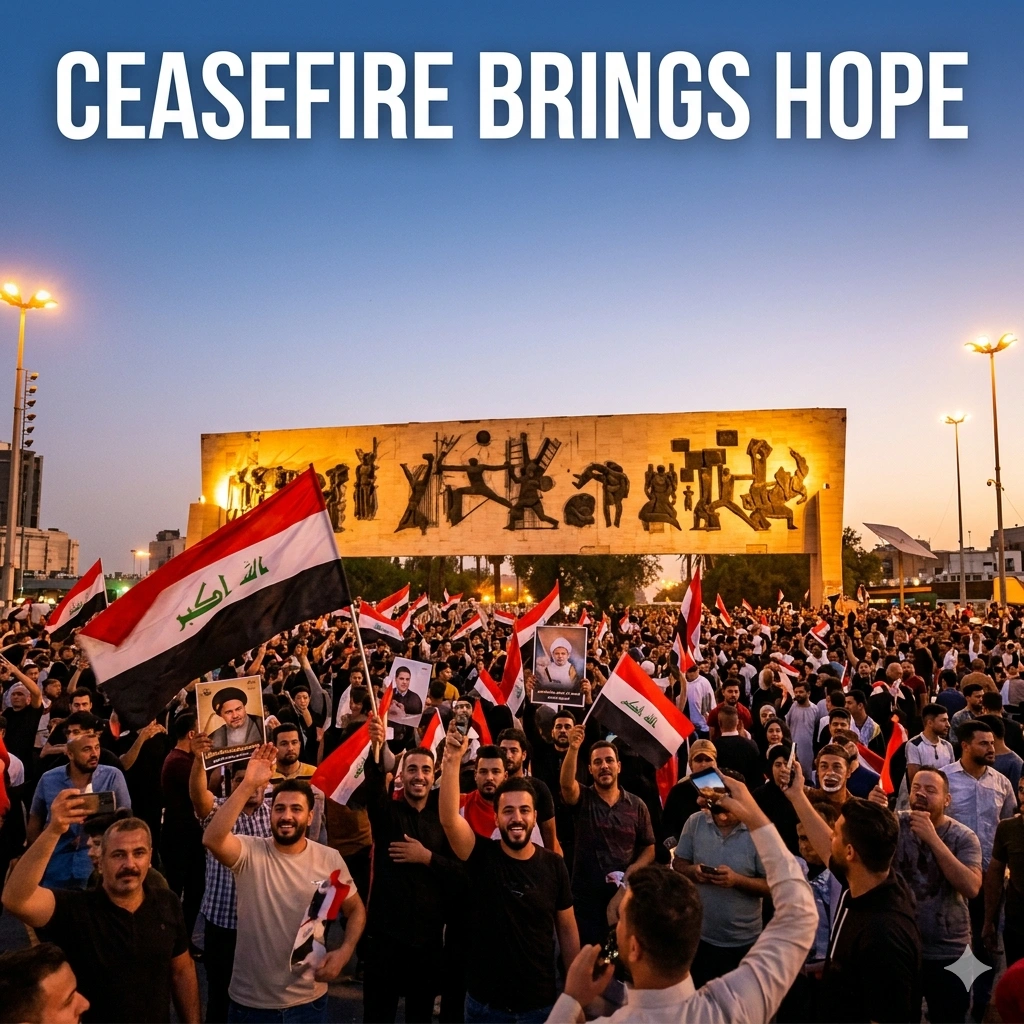
Iraq and US-Iran Ceasefire celebrations have transformed the atmosphere in Baghdad from one of constant anxiety to one of cautious optimism. The streets of the Iraqi capital were filled with citizens marking the start of a 14-day truce between the United States and the Islamic Republic of Iran. For a nation that has frequently served as the primary battlefield for foreign proxy wars, this temporary halt in hostilities represents a vital lifeline.
Iraqis from all walks of life are expressing a profound sense of relief as the immediate threat of retaliatory strikes within their borders recedes. The Iraq and US-Iran Ceasefire is being viewed not just as a pause in military operations, but as a critical window for the Iraqi government to assert its national sovereignty. These joyful scenes in Baghdad reflect a collective hope that the next two weeks will provide enough diplomatic space to transition from a fragile truce to a more permanent and sustainable regional peace agreement.
A Reprieve from the Cycle of Retaliatory Strikes
The Iraq and US-Iran Ceasefire comes after two months of intense military escalation that saw numerous drone attacks and missile strikes on Iraqi soil. Pro-Iranian armed groups and U.S. forces had been locked in a dangerous pattern of action and reaction, often leaving Iraqi civilians to deal with the collateral damage. The announcement of the 14-day truce has effectively silenced the sirens that had become a nightly occurrence in many Baghdad neighborhoods.
Residents are taking advantage of the improved security to return to normal activities, with markets staying open late and families gathering in public parks. The Iraq and US-Iran Ceasefire has provided the first real opportunity in months for the local economy to breathe. While the military commanders remain on high alert, the visible absence of combat aircraft in the skies over Baghdad has significantly boosted public morale. This reprieve is essential for a population that has endured years of conflict and is desperate for a return to a stable and predictable daily life.
Diplomatic Aspirations and National Sovereignty
The Iraq and US-Iran Ceasefire is viewed by many political analysts in the region as a test of diplomatic maturity for all parties involved. Iraq has consistently pushed for its territory to be respected as an independent sovereign state rather than a convenient staging ground for external powers. Prime Minister Mohammed Shia’ al-Sudani has utilized the ceasefire to engage in high-level discussions aimed at making the neutrality of Iraq a permanent fixture of regional policy.
By facilitating communication between Washington and Tehran, Baghdad is positioning itself as a vital mediator rather than a passive victim. The Iraq and US-Iran Ceasefire allows the Iraqi government to refocus its efforts on domestic reforms and infrastructure projects that were sidelined during the height of the hostilities. For the citizens celebrating in the streets, the hope is that this diplomatic momentum will lead to a broader agreement that finally removes the threat of foreign military intervention from their daily reality.
Iraq and US-Iran Ceasefire
The Iraq and US-Iran Ceasefire has officially set a 14-day countdown for diplomats to find a more lasting solution to the regional crisis. This specific timeframe was chosen to allow for immediate humanitarian de-escalation while maintaining pressure on the negotiating teams to reach a breakthrough. In Baghdad, the start of this two-week period was met with spontaneous rallies where protesters called for “Iraq first,” emphasizing their desire for a country free from outside influence.
The success of the Iraq and US-Iran Ceasefire depends heavily on the restraint shown by various armed factions operating within the country. So far, the halt in activities has been respected, leading to a significant drop in reported security incidents across the central and northern provinces. As each day passes under the Iraq and US-Iran Ceasefire, the pressure builds on the United States and Iran to extend the truce. The international community is watching closely, as the stability of the global energy market and regional trade routes hinges on the durability of this fragile agreement.
Economic Impact and Market Recovery in Baghdad
One of the most immediate benefits of the Iraq and US-Iran Ceasefire has been the stabilization of the Iraqi dinar and a surge in local commercial activity. The fear of an all-out war had previously led to capital flight and a sharp increase in the price of essential goods. With the ceasefire in place, consumer confidence has returned, and businesses are beginning to restock their inventories in anticipation of a peaceful month ahead.
Logistics and transport sectors have also seen a revival, as truck drivers can now move goods between major cities with a lower risk of encountering military checkpoints or active conflict zones. The Iraq and US-Iran Ceasefire has proven that even a short-term halt in fighting can have a massive impact on the livelihoods of millions. For the shopkeepers in Baghdad’s Shorja market, the peace is a welcome relief that allows them to plan for the future without the constant threat of destruction looming over their businesses.
The Role of Global Mediation in the Truce
The Iraq and US-Iran Ceasefire was not achieved in a vacuum; it was the result of intense mediation efforts by regional and international actors. Countries like Qatar and Oman played a pivotal role in relaying messages between the U.S. and Iran, using Baghdad as the symbolic and practical location for these exchanges. The ceasefire is a victory for multilateral diplomacy over unilateral military action.
During the celebrations, many Iraqis expressed gratitude to the international organizations and neighboring states that helped facilitate the pause. The Iraq and US-Iran Ceasefire serves as a reminder that the world has a vested interest in a stable Iraq. By supporting this truce, global powers are effectively investing in the security of the entire Middle East. The challenge now is to transform the temporary Iraq and US-Iran Ceasefire into a structured peace process that addresses the underlying grievances of all sides.
Social Cohesion and Public Sentiment
Socially, the Iraq and US-Iran Ceasefire has acted as a unifying force among the diverse segments of Iraqi society. Sunnis, Shiites, and Kurds have all shared in the joy of the halt in violence, proving that the desire for peace is a universal sentiment that transcends sectarian lines. In Baghdad’s Tahrir Square, young people from different backgrounds were seen waving the national flag and singing songs of unity.
The Iraq and US-Iran Ceasefire has provided a rare moment of national pride, where the focus is on the shared future of the country rather than the divisions of the past. Public sentiment is overwhelmingly in favor of an extension of the truce, with many calling on their leaders to reject any attempts to drag the country back into the crossfire. This groundswell of support for the Iraq and US-Iran Ceasefire gives the government a strong mandate to pursue a “neutrality-first” foreign policy that prioritizes the safety of the Iraqi people above all else.
Challenges to Maintaining the 14-Day Truce
Despite the celebrations, the Iraq and US-Iran Ceasefire remains vulnerable to spoilers who may benefit from continued instability. Hardline elements on both sides of the conflict have expressed skepticism about the long-term viability of the deal. Intelligence agencies are monitoring for any signs of rogue actors attempting to provoke a response that would collapse the ceasefire. The Iraq and US-Iran Ceasefire is essentially a high-stakes balancing act where a single misstep could reignite the conflict.
The Iraqi security forces have been placed on high alert to prevent any unauthorized attacks from within their territory that could jeopardize the truce. For the Iraq and US-Iran Ceasefire to survive its full 14-day term, there must be a continuous and transparent exchange of information between all parties. The people of Baghdad are well aware of these risks, which is why their celebrations are tempered with a sense of urgency for the diplomats to move quickly toward a more permanent resolution.
Conclusion: A Turning Point for Regional Peace
The Iraq and US-Iran Ceasefire of April 2026 may be remembered as the moment the region chose a different path. By stepping back from the brink of a larger war, the United States and Iran have given the people of Iraq a chance to reclaim their streets and their future. The 14-day truce is a small but significant victory for those who believe that diplomacy is the only sustainable way to resolve complex geopolitical disputes.
Ultimately, the Iraq and US-Iran Ceasefire is a testament to the resilience of the Iraqi spirit. Even after decades of hardship, the people of Baghdad are still capable of coming together to celebrate the hope of peace. As the clock ticks on the 14-day window, the world watches with bated breath, hoping that the joy seen in Iraq today becomes a permanent feature of the regional landscape. The Iraq and US-Iran Ceasefire is more than just a military order; it is a profound expression of a nation’s desire to finally live in a world without war.
For more details & sources visit: Al Jazeera
Read more about Iraq news on 360 News Orbit – Iraq.