
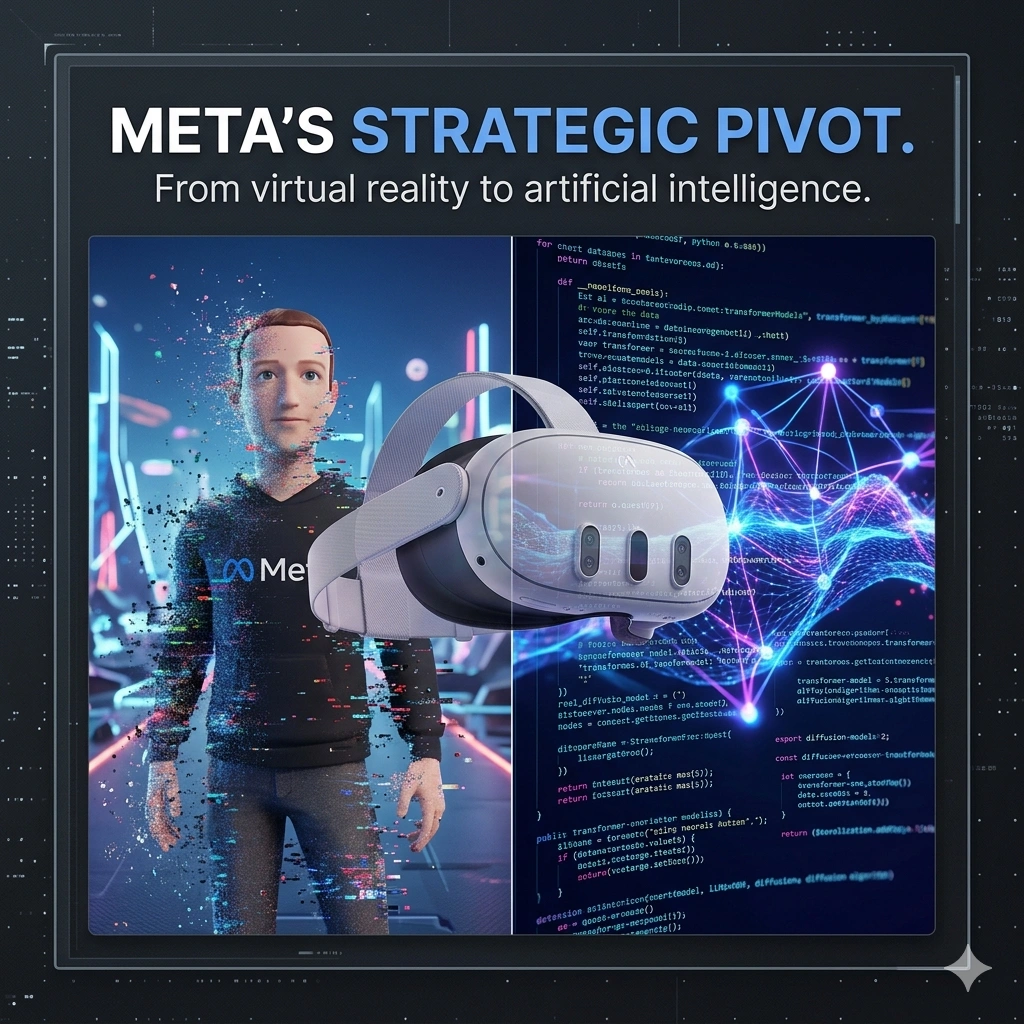
Meta has officially shifted its Horizon Worlds Strategy 2026 following a week of unprecedented digital chaos and intense community backlash. Mark Zuckerberg initially signaled a full retreat from high-end virtual reality headsets to prioritize mobile platforms, but immediate public outcry forced a sudden executive pivot. This dramatic reversal highlights the internal tension at Reality Labs as the company attempts to balance its massive metaverse ambitions with the surging demands of the global generative AI race.
The recent update to the Horizon Worlds Strategy 2026 suggests that while the platform will remain accessible on Quest devices, it is no longer the singular crown jewel of Meta’s future. CTO Andrew Bosworth clarified that the VR version would receive minimal support while developers focus on a fundamental rewrite of the ecosystem’s core architecture. This shift is largely driven by staggering financial losses that have topped $80 billion since 2021, forcing the tech giant to reconsider how it allocates its multi-billion dollar research and development budgets.
The Financial Reality of Horizon Worlds Strategy 2026
The economic foundation of the Horizon Worlds Strategy 2026 is currently under intense scrutiny by Wall Street analysts and tech historians alike. Despite Meta investing billions into the hardware and software required for a seamless digital universe, consumer spending on the platform has remained alarmingly low at just $1.1 million. This disparity between investment and revenue is the primary catalyst for the company’s sudden interest in shifting toward more profitable, AI-driven digital experiences.
Market data reveals that while mobile downloads for the Horizon application reached a record 45 million, the retention rate for VR users continues to dwindle. The Horizon Worlds Strategy 2026 must now address why users are downloading the app but failing to engage with it as a primary social destination. Investors are demanding a clearer path to profitability, which has led to the current “minimal support” model for the traditional virtual reality hardware segment.
Horizon Worlds Strategy 2026
The implementation of the Horizon Worlds Strategy 2026 marks a significant departure from the original vision of a fully immersive, headset-first internet. By pivoting toward a mobile-centric approach, Meta hopes to capture a broader audience that may not be willing to purchase expensive Quest hardware. This tactical adjustment is designed to keep the brand alive while the company’s top engineers are reassigned to build the “superintelligence” infrastructure Mark Zuckerberg now views as the company’s true long-term priority.
Within the framework of the Horizon Worlds Strategy 2026, the VR experience is being treated as a legacy feature rather than a growing frontier. This decision has sparked concerns among early adopters who fear that the quality of virtual environments will stagnate as resources move elsewhere. The company maintains that the VR version will still exist, but the lack of substantial new feature updates indicates a clear cooling of enthusiasm for the medium.
Impact of Generative AI on Metaverse Development
A major pillar of the Horizon Worlds Strategy 2026 involves the integration of advanced generative AI tools to automate world-building and avatar creation. Meta is reportedly offering elite AI researchers compensation packages worth hundreds of millions of dollars to ensure they lead this transition. These researchers are tasked with creating a “superintelligence” that can populate the metaverse with realistic non-player characters and dynamic, AI-generated environments.
The transition toward AI within the Horizon Worlds Strategy 2026 is seen as a necessary survival tactic in an increasingly competitive silicon valley landscape. As companies like Google and OpenAI dominate the headlines, Meta is desperate to prove its AI credentials by embedding these technologies into its existing social platforms. This means the future of Horizon Worlds will likely be defined by how well it can serve as a playground for Meta’s newest large language models.
User Backlash and the Power of Community
The sudden reversal of the shutdown plan proves that the Horizon Worlds Strategy 2026 is still subject to the whims and pressures of its dedicated user base. When news broke that the VR version might be discontinued, creators who had spent thousands of hours building virtual worlds staged digital protests. These users argued that abandoning the Quest platform would be a betrayal of the community that supported Meta’s vision during its most difficult years.
Meta executives realized that the PR damage from a total VR exit would outweigh the savings gained from the Horizon Worlds Strategy 2026 pivot. Consequently, the “minimal support” compromise was born to keep the peace while still allowing the company to move its primary focus elsewhere. This dynamic shows that even the world’s largest tech companies must occasionally bend to the collective will of their most loyal and vocal digital citizens.
Hardware Sales and the Quest Lifecycle
The struggling sales of Meta Quest headsets have played a definitive role in shaping the Horizon Worlds Strategy 2026 for the coming fiscal year. With a 16% drop in headset sales reported in the last quarter, the hardware-first model is becoming increasingly difficult to justify to shareholders. If people are not buying the headsets, Meta cannot expect them to inhabit the virtual worlds that require those specific devices to function at their best.
- Declining interest in bulky VR hardware among casual consumers.
- Competition from more versatile augmented reality glasses and mobile devices.
- High entry costs for premium VR experiences compared to free mobile gaming.
- The lack of a “killer app” that makes VR an essential daily tool for users.
The Role of Reality Labs in 2026
Reality Labs remains the division responsible for executing the Horizon Worlds Strategy 2026, though its mandate has changed significantly. Previously, the goal was hardware dominance, but the new mission involves creating a cross-platform social layer that works across phones, tablets, and headsets. This “platform-agnostic” approach is intended to mitigate the risks associated with slow VR adoption rates while keeping the metaverse dream on life support.
The massive $80 billion loss recorded by Reality Labs has forced a stricter culture of accountability within the Horizon Worlds Strategy 2026 team. Projects that do not show immediate potential for user growth or AI integration are being sidelined in favor of leaner, more efficient operations. This “Year of Efficiency” mentality has finally reached the metaverse division, resulting in a more disciplined but less ambitious roadmap for the virtual world.
Competitive Pressure from Global Tech Giants
Meta is not operating in a vacuum, and the Horizon Worlds Strategy 2026 is a direct response to the moves made by its primary competitors. Apple’s continued refinement of its spatial computing ecosystem and Sony’s dominance in high-end VR gaming have squeezed Meta from both ends of the market. To survive, Meta must differentiate its offering by leaning into the social and AI aspects that its competitors have yet to fully master.
- Apple Vision Pro focusing on high-end productivity and cinema experiences.
- Sony PlayStation VR2 maintaining a stronghold on the hardcore gaming demographic.
- OpenAI developing world-simulation models that could rival Meta’s digital spaces.
Future Outlook for Virtual Social Spaces
As we look toward the end of the decade, the Horizon Worlds Strategy 2026 will likely be remembered as the moment the metaverse became “AI-first” rather than “VR-first.” The move to a mobile app signifies a shift toward accessibility, allowing Meta to gather more data and train its models on a much larger scale. While the dream of a Ready Player One-style oasis remains far off, the groundwork is being laid for a more practical, AI-driven social internet.
The Horizon Worlds Strategy 2026 suggests that the virtual reality community must prepare for a period of transition where the boundaries between reality and simulation are blurred by software rather than hardware. Meta’s pivot is a gamble that the intelligence of the platform matters more than the goggles used to view it. Whether users will embrace this AI-centric version of the metaverse remains the most significant question for the company’s long-term survival.
Strategic Infrastructure and Data Privacy
A critical but often overlooked component of the Horizon Worlds Strategy 2026 is the underlying data infrastructure required to support millions of simultaneous users. As Meta shifts toward a mobile and AI-heavy model, the way it handles user interactions and biometric data within the metaverse is evolving. Protecting user privacy while training massive AI models is a tightrope walk that the company must navigate to avoid further regulatory intervention from global authorities.
- Implementation of advanced encryption for cross-platform voice and text data.
- New transparency reports regarding how AI avatars learn from human behavior.
- Localized data processing to comply with stricter European and Asian privacy laws.
Redefining Success in the Virtual Economy
Under the new Horizon Worlds Strategy 2026, success is no longer measured solely by the number of active VR headsets in the wild. Instead, Meta is tracking engagement across multiple touchpoints, including how many people interact with AI NPCs on their mobile phones. This broader metric allows the company to present a more successful narrative to investors, even if the traditional VR metrics remain somewhat stagnant in the short term.
The Horizon Worlds Strategy 2026 also emphasizes the creation of a “creator economy” that can finally generate significant revenue for the platform. By simplifying the tools needed to build worlds, Meta hopes to attract professional developers who can create high-quality, monetizable content. If the platform can transition from a series of empty rooms to a thriving marketplace, the financial bleeding at Reality Labs might finally begin to slow down.
Final Thoughts on Meta’s Pivot
The evolution of the Horizon Worlds Strategy 2026 reflects a company that is learning to be more agile in the face of technological disruption. While the initial announcement of a VR shutdown was a misstep, the rapid course correction shows that Meta is still listening to its core audience. The road ahead is fraught with financial and technical challenges, but the shift toward generative AI provides a new spark of life for a platform that many had already written off.
Ultimately, the Horizon Worlds Strategy 2026 is about survival in an era where AI is the undisputed king of Silicon Valley. By merging its metaverse assets with its “superintelligence” goals, Meta is attempting to build a future that is both social and highly intelligent. The virtual reality enthusiasts who fought for the platform’s survival have won a temporary victory, but the long-term transformation of the metaverse has only just begun.
For more details & sources visit: France 24
Read more about USA news on 360 News Orbit – United States of America.