
Egypt Energy Crisis is reaching a breaking point as the government implements “exceptional” measures to handle a tripling import bill. As of March 24, 2026, Prime Minister Mostafa Madbouly has declared a month-long emergency plan to combat a severe natural gas deficit. This shortfall, driven by the intensifying conflict involving the US, Israel, and Iran, has seen Egypt’s monthly gas costs surge from $560 million to a staggering $1.65 billion, forcing immediate state intervention.
The nation is currently grappling with a gap of up to 2.2 billion cubic feet of natural gas per day. This deficit is largely due to the volatility of Israeli gas imports, which have become unreliable during the ongoing regional war. To stabilize the national power grid, the government is mandating early shop closures, reduced street lighting, and a potential shift to remote work for public employees starting on March 28.
As summer approaches—a season where peak demand typically hits 7.3 billion cubic feet per day—the Egypt Energy Crisis threatens to cause widespread blackouts. Analysts suggest that the country’s previous reliance on imported gas has left it vulnerable as domestic production continues to decline. The government is now scrambling to procure expensive alternatives, such as fuel oil, to keep the lights on during the hottest months of the year.
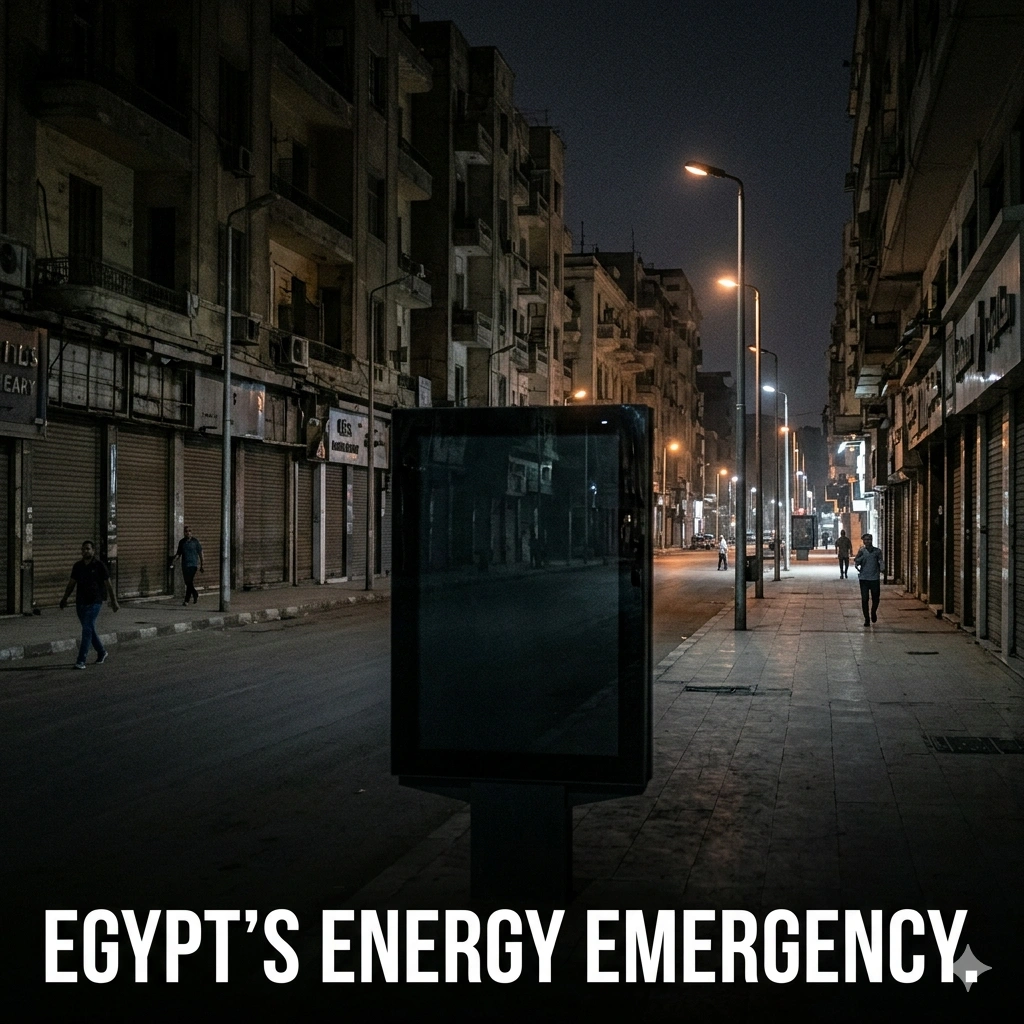
Egypt Energy Crisis and the Triple-Cost Import Shock
The Egypt Energy Crisis has been significantly worsened by a dramatic spike in the cost of securing external fuel sources. With the regional conflict disrupting traditional supply lines, Egypt has been forced to pay a premium to ensure its power plants remain operational. The jump from half a billion dollars to over 1.6 billion dollars per month has placed an immense strain on the national budget and foreign currency reserves.
This financial pressure is the primary driver behind the new austerity measures announced by the Prime Minister. By enforcing a 9 p.m. curfew for malls and restaurants, the state hopes to shave off a critical percentage of peak evening demand. The “exceptional” nature of these steps reflects a government that is running out of traditional economic options to manage its energy portfolio during a time of war.
Furthermore, the Egypt Energy Crisis is a stark reminder of the risks associated with regional energy interdependency. While a 2023 agreement with Israel was meant to provide long-term stability, the current geopolitical climate has turned that asset into a liability. Egypt is now forced to compete on the global spot market for liquefied natural gas (LNG), often at prices that are unsustainable for its developing economy.
Facts About the 2026 Egypt Energy Crisis
The current scale of the Egypt Energy Crisis is unprecedented in the country’s modern history. One of the most shocking statistics is the daily deficit of 2.2 billion cubic feet of gas, which represents nearly a third of the nation’s total requirement during peak periods. This gap is so large that simple conservation measures may not be enough to prevent localized load-shedding in various governorates.
Another surprising aspect is the total darkening of roadside advertisements and the reduction of street lighting across major cities like Cairo and Alexandria. This move is intended not just to save electricity, but to send a psychological message to the public about the severity of the situation. The Egypt Energy Crisis is now a visible part of daily life, changing the nighttime landscape of one of the world’s most vibrant urban centers.
Additionally, the government’s pivot back to “fuel oil” (mazut) marks a regressive step in Egypt’s environmental goals. To avoid total blackouts, the Ministry of Petroleum is importing massive quantities of this high-emission fuel as a temporary substitute for natural gas. This “survival mode” highlights how the Egypt Energy Crisis has forced the state to prioritize immediate electricity availability over long-term sustainability and air quality.
- The monthly energy bill has increased by nearly 200% in less than 90 days.
- Malls and restaurants must close by 9 p.m. to protect the national grid.
- Domestic gas production has hit its lowest level in five years.
- Private sector companies are being encouraged to shift to 100% remote work.
Egypt Energy Crisis
The central focus of the current administrative push is managing the Egypt Energy Crisis before it spirals into social unrest. This term is now used officially in government briefings to describe the intersection of high import costs and low domestic supply. By framing the situation as a national emergency, the Prime Minister is seeking public cooperation for measures that would otherwise be highly unpopular.
Implementing the new “grid stabilization” rules requires a massive coordination effort between the Ministry of Interior and local municipalities. The Egypt Energy Crisis has led to the creation of task forces that monitor commercial compliance with the new early-closing hours. Business owners who fail to dim their lights or close on time face heavy fines, as the state can no longer afford the luxury of wasted megawatts.
The Egypt Energy Crisis is also reshaping the country’s diplomatic priorities. Egyptian officials are currently in high-stakes talks with Gulf partners to secure subsidized fuel shipments or financial grants to cover the import gap. Without external help, the “exceptional” measures currently in place may have to be extended indefinitely, leading to a long-term cooling of the Egyptian economy and a potential rise in the cost of living for millions.
Impact of Israeli Gas Volatility on Cairo’s Power Grid
A major contributor to the Egypt Energy Crisis is the sudden unreliability of gas flows from the Tamar and Leviathan fields in Israel. Due to the regional conflict, these offshore platforms have faced security shutdowns, drastically reducing the amount of gas reaching Egyptian processing plants. This supply chain disruption has exposed Egypt’s “excessive complacency” in relying on a single major regional supplier for its energy security.
The Egypt Energy Crisis has revealed that the “energy hub” dreams of 2023 were built on fragile geopolitical foundations. Instead of re-exporting gas to Europe for a profit, Egypt is now struggling to keep its own turbines spinning. This reversal has forced a complete rethink of the national energy strategy, with a new emphasis on diversifying import sources and accelerating renewable energy projects like wind and solar.
Despite the supply drops, Egypt still owes significant payments for the infrastructure used to transport this gas. This creates a “double whammy” effect where the country pays for capacity it cannot fully use while simultaneously buying expensive spot-market LNG. The Egypt Energy Crisis is therefore a financial trap as much as a technical one, requiring a masterclass in economic maneuvering to escape without a total systemic collapse.
Exceptional Measures: Malls, Restaurants, and Street Lights
The “exceptional” measures enacted to fight the Egypt Energy Crisis are perhaps most visible in the retail and hospitality sectors. Starting March 28, the 9 p.m. curfew will fundamentally change the social habits of Egyptians, who traditionally shop and dine late into the night. This shift is expected to have a significant impact on the revenue of small businesses already struggling with inflation.
In addition to early closures, the Egypt Energy Crisis has led to the “darkening” of the nation’s highways. Street lighting is being reduced by up to 50% in non-essential areas, and roadside billboards are being turned off entirely. While these measures save a measurable amount of gas, their primary function is to reduce the overall “base load” of the national grid, providing a small margin of safety for hospitals and essential services.
The government is also considering a “Friday remote work” mandate for all non-essential civil servants. By keeping government buildings closed for an extra day, the state can significantly reduce the energy used for air conditioning and lighting. The Egypt Energy Crisis is thus driving a digital transformation of the Egyptian bureaucracy, forced by the necessity of saving every possible cubic foot of natural gas.
- Restaurants are prohibited from using outdoor heating or excessive decorative lighting.
- Shopping malls must set their central air conditioning to no lower than 25°C.
- Public parks and squares will have restricted lighting after sunset.
Domestic Gas Production Decline and Future Vulnerability
While the regional war is the immediate trigger, the underlying cause of the Egypt Energy Crisis is the steady decline in domestic gas production. Major fields like Zohr, which once promised energy independence, have seen faster-than-expected depletion rates. This has turned Egypt from a net exporter back into a net importer in record time, leaving the state at the mercy of global price fluctuations.
The Egypt Energy Crisis has highlighted a lack of recent investment in new exploration and production. Because the government struggled to pay arrears to international oil companies during the previous economic downturn, many firms slowed their drilling programs. Now, as the crisis peaks, the lack of new wells is being felt across the entire energy value chain, from heavy industry to residential cooking gas.
To address this, the Ministry of Petroleum is offering new incentives for deep-water exploration in the Mediterranean. However, these projects take years to come online, meaning they offer no immediate relief for the Egypt Energy Crisis of 2026. For the next several years, the country will remain dangerously dependent on expensive imports, making the current “exceptional” measures a potential preview of a “new normal” for Egyptian society.
The Financial Strain of the $1.65 Billion Monthly Gas Bill
The most daunting aspect of the Egypt Energy Crisis is the sheer volume of capital required to keep the country running. Spending $1.65 billion every month just on gas imports is a fiscal nightmare that threatens to crowd out spending on health, education, and infrastructure. This “import bill shock” has forced the central bank to prioritize fuel payments over almost all other budgetary requirements.
The Egypt Energy Crisis is also putting pressure on the Egyptian Pound, as the demand for US Dollars to pay for these shipments remains high. This creates a vicious cycle where energy costs drive inflation, which then makes energy even more expensive to import. The government is currently negotiating with the IMF and other international lenders to increase support specifically for “energy stabilization” efforts.
Economic analysts warn that if the Egypt Energy Crisis continues through the summer, the total cost could exceed $15 billion for the year. This is a sum that the Egyptian treasury simply does not have without significant external assistance. The “exceptional” measures are therefore a desperate attempt to lower this bill by even 5% or 10%, which would save hundreds of millions of dollars that could be used for other critical national needs.
- Daily monitoring of gas consumption by the Ministry of Electricity.
- New emergency taxes on luxury energy use to fund the import bill.
- Priority allocation of foreign currency for fuel oil and LNG purchases.
Impact on Egyptian Heavy Industry and Manufacturing
The Egypt Energy Crisis is not just a problem for households; it is a direct threat to the nation’s industrial base. Factories producing cement, fertilizers, and steel require massive amounts of natural gas to operate. Under the new emergency plan, some of these industries may face “scheduled downtime” to ensure that there is enough gas to power residential homes and hospitals.
This disruption to manufacturing could lead to a decrease in exports, further worsening the trade deficit. The Egypt Energy Crisis thus has a “domino effect” on the entire economy. If the steel mills stop, construction projects stall; if fertilizer production drops, food prices rise. The government is trying to balance these competing interests, but in a 2.2 billion cubic foot deficit, there are no easy winners.
Some industrial leaders are calling for the government to allow the private sector to import its own gas directly. However, the infrastructure is currently state-controlled, and the Egypt Energy Crisis makes such a transition complicated and slow. For now, the manufacturing sector remains at the mercy of the national grid, hoping that the “exceptional” measures will be enough to avoid the dreaded “total blackout” scenarios of years past.
Public Reaction and Social Stability Concerns
The Egyptian public is watching the Egypt Energy Crisis with a mixture of concern and frustration. After several years of relative energy stability, the return of curfews and darkened streets is a bitter pill to swallow. The government has been using state media to explain the link between the regional war and the gas bill, but the daily reality of a 9 p.m. closure is hard to ignore for the average citizen.
Social media has become a hub for discussions about the Egypt Energy Crisis, with many questioning why the nation’s domestic production fell so quickly. There is a high degree of “energy anxiety,” particularly among those who remember the frequent power cuts of the 2011-2014 era. The government knows that maintaining the power supply is a key metric for social stability, which is why the “exceptional” measures are being presented as a way to avoid the worst-case outcomes.
To mitigate public anger, the state has promised that residential areas will be the last to face any potential load-shedding. The Egypt Energy Crisis is being managed with a “people first” philosophy, prioritizing the comfort of citizens over the needs of commercial malls and non-essential businesses. Whether this strategy holds during the 40°C heat of a Cairo summer will be the ultimate test for the Madbouly administration.
- Regular government town halls to explain the energy situation.
- Subsidies for energy-efficient appliances to help households save.
- Increased police presence in darkened areas to ensure public safety.
Long-Term Solutions: Renewables and New Explorations
While the immediate focus is on surviving the Egypt Energy Crisis of 2026, the government is also looking at long-term fixes. The crisis has provided a massive impetus for the “Green Egypt” initiative, which aims to produce 42% of the country’s electricity from renewable sources by 2030. Large-scale solar parks in Benban and wind farms along the Red Sea are being fast-tracked to reduce the reliance on gas.
The Egypt Energy Crisis has also led to a renewed interest in nuclear power. The El Dabaa Nuclear Power Plant, currently under construction with Russian assistance, is seen as the ultimate solution to the country’s “base load” problems. However, the first reactor is not expected to be operational for several more years, meaning it provides no immediate relief for the current $1.65 billion monthly bill.
In the meantime, the Egypt Energy Crisis will require a sustained effort in “energy diplomacy.” Egypt is looking to sign long-term supply deals with producers like Qatar and the United States to ensure that it is never again dependent on a single regional source. This diversification is the only way to ensure that the “exceptional” measures of 2026 never have to be repeated in the future history of the nation.
The Role of the US-Israel-Iran Conflict in Egypt’s Energy Woes
It is impossible to discuss the Egypt Energy Crisis without looking at the broader regional war. The conflict between the US, Israel, and Iran has turned the Eastern Mediterranean into a high-risk zone for energy infrastructure. Every time a missile is fired or a maritime route is threatened, the price of gas for Egypt goes up. The country is effectively a “collateral victim” of a war it is not directly fighting.
The Egypt Energy Crisis is therefore tied to the timeline of the regional conflict. If a ceasefire is reached, gas flows from Israel could stabilize and global prices might drop. But if the war escalates, the $1.65 billion bill could climb even higher. This uncertainty makes it impossible for the Egyptian government to plan more than a few weeks in advance, leading to the “month-long” emergency cycles we are currently seeing.
Cairo has been active in calling for a de-escalation of the conflict, not just for humanitarian reasons, but for its own economic survival. The Egypt Energy Crisis is a powerful motivator for Egyptian diplomacy, as the state seeks to protect its national grid from the fallout of regional geopolitical ambitions. For now, the country remains in a “holding pattern,” using exceptional measures to bridge the gap until peace—and gas—returns to the region.
Conclusion: Navigating a Summer of Uncertainty
The Egypt Energy Crisis of 2026 is a defining challenge for the nation. By enacting “exceptional” energy measures, the government is attempting to navigate a perfect storm of tripling import costs, declining domestic production, and regional warfare. The success of the 9 p.m. curfews and the shift to alternative fuels will determine whether Egypt can survive the upcoming summer without widespread social and economic disruption.
As the March 28 start date for the emergency plan approaches, the eyes of the region are on Cairo. The Egypt Energy Crisis is a test case for how a developing nation can manage extreme energy shocks in an increasingly volatile world. While the measures are drastic, they are a necessary response to a $1.65 billion monthly bill that no nation can afford to ignore for long.
Ultimately, the resolution of the Egypt Energy Crisis will require a combination of domestic conservation, long-term technical investment, and regional stability. For the millions of Egyptians living through this period, the goal is simple: to keep the lights on and the economy moving, one “exceptional” measure at a time. The path forward is difficult, but the resilience of the Egyptian state is once again being put to the ultimate test.
For more details & sources visit: Alhurra
Read more about Egypt news on 360 News Orbit – Egypt.