
Gaza Municipal Election Record marks a historic shift in the Palestinian political landscape, representing the first time residents in the Gaza Strip have cast ballots in twenty years. This landmark event, saw voters in Deir el-Balah and the occupied West Bank participate in local elections designed to restore democratic processes. Deir el-Balah was specifically selected for this pilot municipal vote because its infrastructure remains relatively intact compared to other regions devastated by recent warfare. Approximately seventy thousand citizens in the enclave were eligible to participate in this localized exercise of democratic rights.
While the Gaza Municipal Election Record is a localized achievement, it coincided with a massive electoral effort in the occupied West Bank. Nearly one million registered voters in the West Bank cast their ballots to determine the composition of local councils across numerous municipalities. The Central Elections Commission stated that a primary goal of this synchronized effort was to politically link the two territories under a unified system. This push for administrative cohesion comes at a time when the Palestinian people have faced nearly two decades of political stagnation and a total lack of national-level elections.
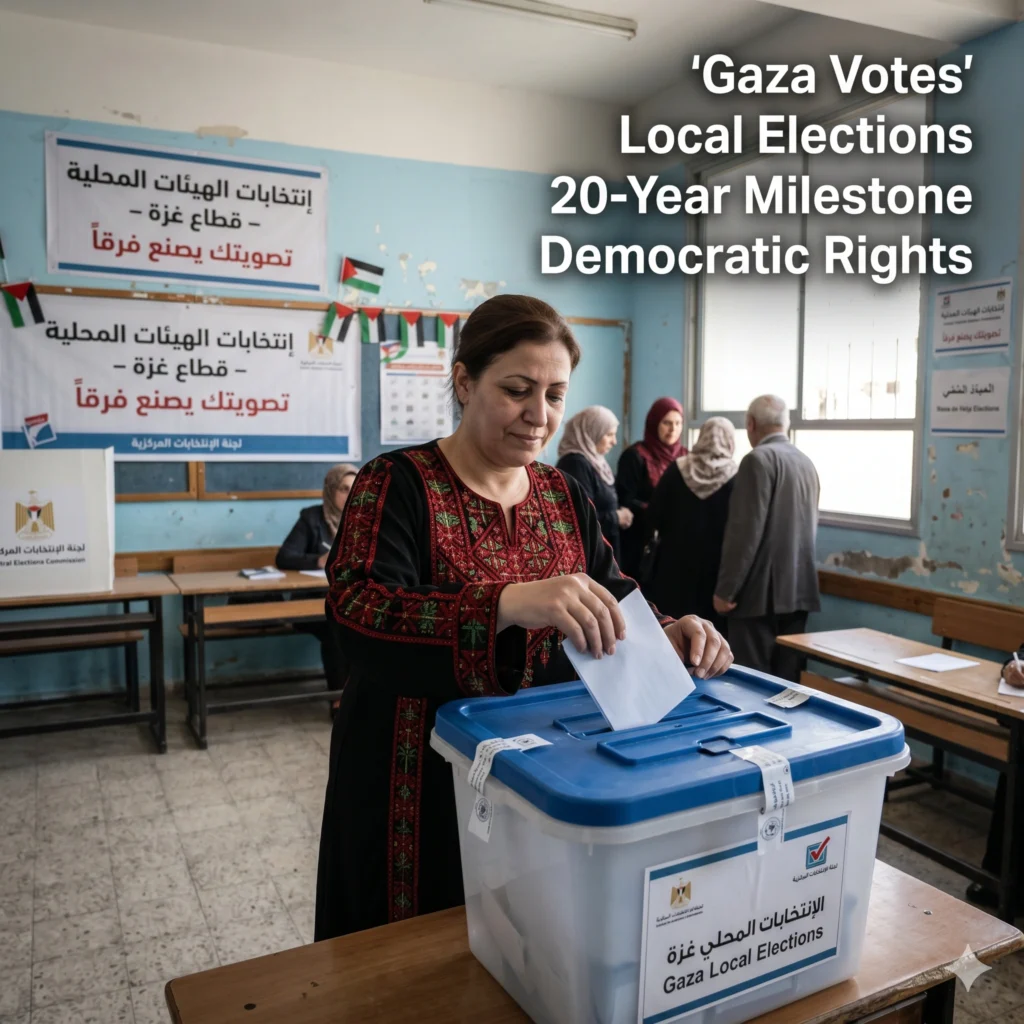
Gaza Municipal Election Record
The Gaza Municipal Election Record was set in motion at seven in the morning as polling stations opened across central Gaza. This pilot program is viewed as the first tangible step toward a broader twenty-point international plan for the region’s governance. This transitional structure involves a Board of Peace, which includes a mix of international envoys and a committee of Palestinian representatives. The Gaza Municipal Election Record serves as the foundational test for whether this new governing body can successfully manage civil administration.
Public disillusionment remains a significant challenge for election officials, as many citizens feel that local votes do not address the core issue of national leadership. Since 2006, the Palestinian territories have been divided by internal rivalry, leading to a freeze on legislative and presidential contests. The Gaza Municipal Election Record is intended to break this cycle by proving that electoral logistics can be managed even under extreme conditions. Success in Deir el-Balah could lead to the expansion of voting rights to other areas of the strip as reconstruction begins.
Economically and socially, the Gaza Municipal Election Record is seen as a way to provide local communities with a sense of agency over their own recovery. Municipal councils are responsible for critical services like waste management, water distribution, and road repairs, which are essential for daily life. By electing their own local representatives, residents hope to see a more transparent and efficient allocation of reconstruction funds. The Gaza Municipal Election Record is thus a record of resilience for a population seeking to rebuild their society from the ground up.
Logistical Hurdles and Innovative Solutions
The Gaza Municipal Election Record was nearly derailed by the severe shortage of traditional election materials within the enclave. Because standard ballot boxes and security ink could not be imported, local organizers had to utilize improvised containers and digital verification methods where possible. These constraints highlighted the ongoing isolation of the Gaza Strip, even during a period of international oversight. The Gaza Municipal Election Record stands as a testament to the ingenuity of the Central Elections Commission in the face of such restricted access.
In the West Bank, the logistical scale was much larger, involving hundreds of polling stations and thousands of volunteers. The goal of the Gaza Municipal Election Record was to ensure that the process in both regions mirrored one another as closely as possible to maintain legal legitimacy. Observers from various international organizations were present to monitor the fairness and transparency of the vote. This oversight is a record-breaking development, as it represents a high level of international involvement in Palestinian internal affairs.
- Deir el-Balah served as the primary site for the Gaza portion of the vote.
- Digital voter rolls were used to compensate for the lack of physical registration cards.
- International envoys from the Board of Peace provided security and logistical coordination.
- The pilot program aims to establish a blueprint for future elections in destroyed northern zones.
Political Dynamics and Candidate Lists
The absence of Hamas from the Gaza Municipal Election Record has led to criticism regarding the inclusivity of the vote. Most of the lists presented to voters were dominated by Fatah or independent candidates with ties to the Palestinian Authority. This political tilt has caused some residents to view the Gaza Municipal Election Record as a symbolic rather than a transformative event. However, supporters argue that any form of voting is a strong improvement over the total lack of representation seen since the mid-2000s.
The West Bank portion of the vote saw a more diverse array of local factions, though the overarching influence of the major political movements remained clear. The Gaza Municipal Election Record is part of a strategy to revitalize the Palestinian Authority’s image as a governing body capable of operating in both territories. By successfully holding elections in Gaza, the PA hopes to demonstrate its readiness to take on a larger role in the post-war transition. This growth in administrative reach is a central pillar of the international peace plan currently being implemented.
- Fatah-backed lists won a significant majority of seats in the pilot districts.
- Independent candidates focused on local infrastructure rather than national politics.
- Public discourse centered on the need for a “technocratic” approach to municipal management.
- The Gaza Municipal Election Record highlights the divide between local and national aspirations.
The Board of Peace and International Oversight
The Gaza Municipal Election Record is inextricably linked to the work of the Board of Peace, an international body tasked with overseeing Gaza’s transition. This board is responsible for ensuring that the local councils elected on Saturday operate within the guidelines of the twenty-point peace plan. The Gaza Municipal Election Record provides these international envoys with a clear set of local partners to work with on the ground. This partnership is expected to facilitate the flow of humanitarian aid and reconstruction materials more effectively than previous systems.
For many Palestinians, the presence of the Board of Peace is a record of a strong international commitment to their long-term stability. While some fear a loss of sovereignty, others see the board as a necessary buffer against the return of hostilities. The Gaza Municipal Election Record is the first major milestone for this new governance model, proving that it can mobilize the population for a peaceful civic activity. The board will now focus on certifying the results and seating the new council members in Deir el-Balah.
- International envoys include representatives from the UN, EU, and regional Arab states.
- The twenty-point plan prioritizes the restoration of civil law and order.
- The Gaza Municipal Election Record serves as a “stress test” for international-Palestinian cooperation.
- Local committees will act as the primary link between the Board of Peace and the citizenry.
Voter Turnout and Public Sentiment
Initial reports indicate that voter turnout for the Gaza Municipal Election Record was within the historical average of fifty to sixty percent. This level of participation is seen as a strong indicator that the population is still eager to engage in the democratic process despite the trauma of recent years. In Deir el-Balah, queues formed early in the morning, with many voters expressing a sense of duty toward their community. The Gaza Municipal Election Record is a reflection of the enduring Palestinian desire for self-determination and local growth.
However, the mood at the polling stations was often somber, with voters reminding journalists that they are still living in a state of crisis. The Gaza Municipal Election Record cannot solve the broader issues of occupation and displacement, but it does provide a small measure of local control. Public disillusionment was most visible among the youth, many of whom have never seen a national election in their lifetimes. For them, the Gaza Municipal Election Record is a record of what has been missing for two decades.
- High turnout in the West Bank reflected the competitive nature of local council seats.
- Gaza voters prioritized the restoration of water and electricity in their ballot choices.
- Sentiment remains divided between hope for the future and skepticism of the process.
- The Gaza Municipal Election Record is viewed as a “trial run” for a future national vote.
Implications for Palestinian Unity
The Central Elections Commission emphasized that the Gaza Municipal Election Record is a vital tool for national unity. By holding the vote on the same day in both regions, the commission sent a record-strong message that Gaza and the West Bank remain one political unit. This unity is a key requirement for the eventual establishment of a Palestinian state and for the continued support of the international community. The Gaza Municipal Election Record is a physical demonstration of the geographical and political ties that bind the Palestinian people.
This push for unity faces significant hurdles, including the physical separation of the territories and the differing security environments. The Gaza Municipal Election Record had to be managed under the watchful eye of international peacekeepers, while the West Bank vote took place under the jurisdiction of the Palestinian Authority. Reconciling these two systems into a single national government remains the ultimate goal of the current political transition. The success of the municipal vote provides a record of growth toward that difficult objective.
- Synchronized voting across the “Green Line” reinforces the concept of a single Palestinian entity.
- The commission hopes to use the same logistical model for future legislative elections.
- International support for the vote was contingent on its cross-territorial nature.
- The Gaza Municipal Election Record helps counter the narrative of a permanent political split.
Future Projections and National Elections
Looking ahead, the success of the Gaza Municipal Election Record has increased pressure on the Palestinian leadership to schedule national elections. If a local vote can be held successfully in a conflict-prone area like Gaza, many argue that a presidential contest should also be possible. The Gaza Municipal Election Record has effectively removed some of the logistical excuses used to delay national democracy. However, the political risks for the current leadership remain high, as a national vote could lead to a significant shift in the balance of power.
The international community is expected to use the Gaza Municipal Election Record as a benchmark for future aid. Continued funding for reconstruction will likely be tied to the performance of the newly elected local councils and the transparency of their operations. The Gaza Municipal Election Record is therefore not just a one-day event, but the start of a long-term assessment of Palestinian governance. As the twenty-point plan moves into its next phase, the focus will shift toward expanding these democratic records to the rest of the Gaza Strip.
- The pilot program in Deir el-Balah will be reviewed by the UN in late 2026.
- Plans for a second round of municipal elections in Khan Yunis are already being drafted.
- The Gaza Municipal Election Record has revitalized the call for a “New National Council.”
- International donors view the vote as a record of a strong return to civil administration.
Conclusion and the Legacy of the Vote
The Gaza Municipal Election Record of 2026 will be remembered as the moment the enclave began its long journey back to democratic normalcy. By casting their ballots for the first time in twenty years, the people of Gaza have set a record of courage and civic engagement. This vote provides a foundation for the Board of Peace to build upon as they work to restore the social fabric of the region. While the road to full political recovery is long, the Gaza Municipal Election Record is a significant and strong first step.
We celebrate the efforts of the election officials and the bravery of the voters who participated in this historic exercise. The Gaza Municipal Election Record is a beacon of hope for a future defined by the ballot rather than the bullet. As the results are tabulated and the new councils take office, the world will be watching to see how this experiment in local democracy transforms the Palestinian territories. The 2026 elections have written a new chapter in the history of the region, one that prioritizes growth, unity, and the voice of the people.
For more details & sources visit: Al Jazeera
Read more about Palestine news on 360 News Orbit – Palestine.