
Jordan Syrian trade tariffs represent a transformative shift in the economic relationship between Amman and Damascus, ending nearly seven years of stagnation. Jordan’s Ministry of Industry, Trade, and Supply issued Decision No. 34, officially repealing the 2019 import bans that had previously blocked Syrian textiles and food products from entering the Kingdom. This policy pivot is a direct response to a staggering 238% increase in bilateral trade volume, which skyrocketed from $97.5 million last year to over $330 million in the current period.
While the border is now technically open to a wider variety of goods, the introduction of Jordan Syrian trade tariffs serves as a critical protective shield for local manufacturers. This strategic balance aims to revitalize regional commerce while preventing a flood of cheaper Syrian imports from destabilizing Jordanian national industries. As the Middle East faces broader economic volatility, this agreement marks a rare moment of practical cooperation intended to reduce the cost of living for citizens in both nations.
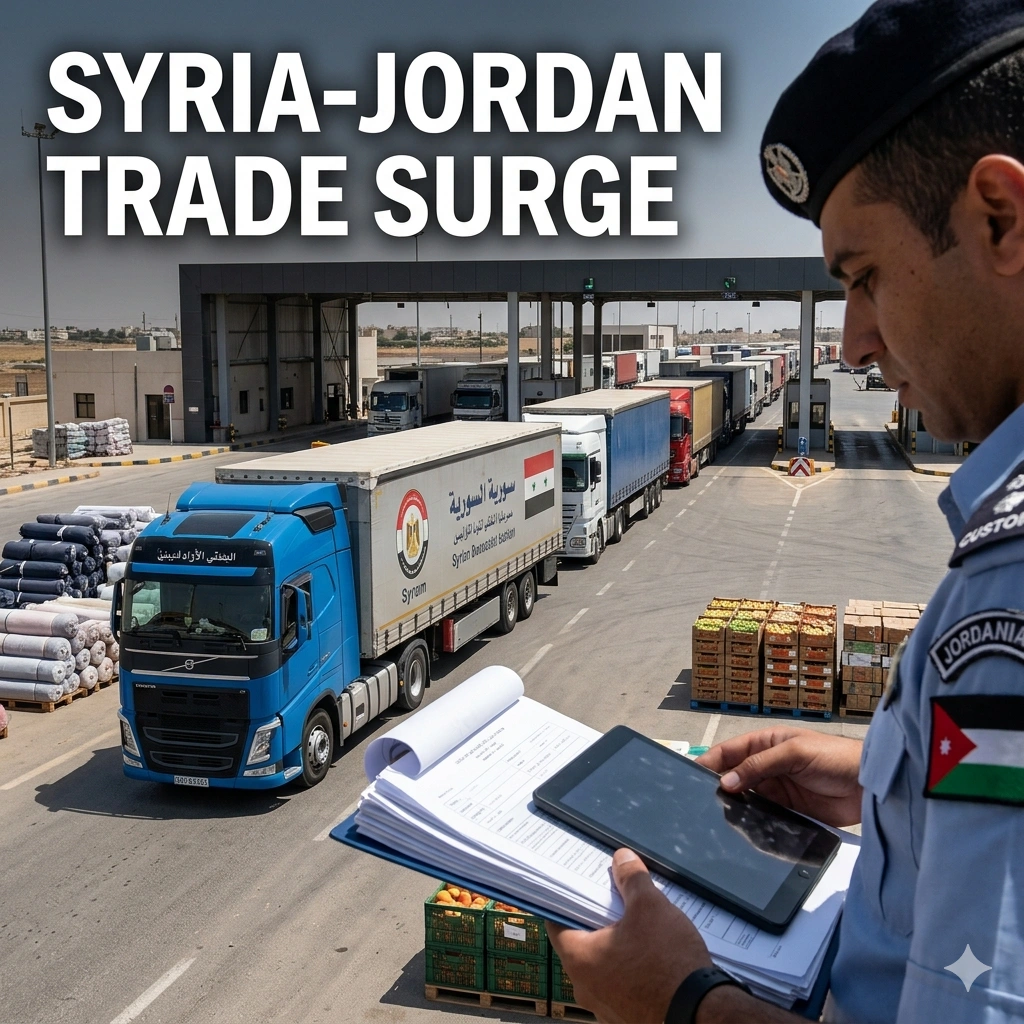
The Strategic Shift in Jordan Syrian trade tariffs
The decision to implement Jordan Syrian trade tariffs instead of outright bans marks a sophisticated evolution in Jordan’s regional trade policy. For years, the total prohibition of certain Syrian goods was necessary to protect a struggling domestic manufacturing sector during the height of regional instability. However, the current surge in demand for affordable raw materials and consumer goods made the old restrictions counterproductive to Jordan’s growth. By introducing Jordan Syrian trade tariffs, the government can now regulate the flow of goods while generating significant customs revenue that was previously lost to the informal economy.
This move toward tariffs over bans allows Jordanian businesses to access Syrian supply chains that have been inaccessible since 2019. The textile industry, in particular, stands to benefit from high-quality Syrian fabrics, provided they can navigate the newly established Jordan Syrian trade tariffs. Analysts suggest that this approach provides the Ministry with a “volume knob” to control market saturation. If local industries show signs of distress, the government can simply adjust the Jordan Syrian trade tariffs to restore competitive equilibrium without returning to a total trade freeze.
Impact on the Syrian Textile and Food Sectors
While the Damascus Chamber of Commerce has officially welcomed the end of the import ban, there is significant concern regarding the severity of the Jordan Syrian trade tariffs. Syrian exporters, particularly in the renowned textile and food processing industries, have long viewed the Jordanian market as a vital gateway to the wider Gulf region. However, many business leaders in Damascus have noted that the “very high” levels of the Jordan Syrian trade tariffs may still price their products out of the reach of the average Jordanian consumer.
The Syrian food sector, which produces a variety of agricultural staples and processed goods, is particularly sensitive to these new Jordan Syrian trade tariffs. Despite the high costs, Syrian producers are eager to regain their pre-2011 market share in Amman’s supermarkets. The hope among Damascus-based traders is that the quality and brand recognition of Syrian products will allow them to overcome the hurdle of the Jordan Syrian trade tariffs. Over time, they anticipate that successful trade volumes will lead to a gradual reduction of these protective levies through future diplomatic negotiations.
Boosting Bilateral Trade Volume to 330 Million
The primary driver behind the revision of Jordan Syrian trade tariffs is the undeniable momentum of current trade figures. Achieving a trade volume of $330 million in such a short period signals a deep-seated economic interdependence that politics could no longer ignore. By formalizing this relationship through Jordan Syrian trade tariffs, both nations are essentially admitting that their economies are stronger when they cooperate. This jump from under $100 million in the previous year is one of the largest percentage increases in trade ever recorded between the two neighbors.
This surge is not limited to just textiles and food; it also includes construction materials, chemicals, and transit services. The new Jordan Syrian trade tariffs are specifically designed to target the most competitive Syrian sectors, ensuring that the trade remains “complementary” rather than “predatory.” Government officials in Amman believe that by taxing these imports through Jordan Syrian trade tariffs, they can fund infrastructure projects that further facilitate regional logistics. The goal is to reach a bilateral trade target of $500 million by the end of 2026, assuming the tariff structure remains stable.
Eliminating the Custom Yard Unloading Rule
A critical component of the agreement accompanying the Jordan Syrian trade tariffs is the removal of the mandatory unloading of trucks at the border. Previously, trucks were required to offload their cargo in customs yards for inspection and transfer, a process that added up to $800 in extra costs per shipment. By allowing “door-to-door” transport, Jordan and Syria have effectively neutralized one of the biggest non-tariff barriers to trade. When combined with the new Jordan Syrian trade tariffs, this logistics reform makes legal trade significantly more attractive than smuggling.
The $800 saving per truck is expected to offset some of the costs imposed by the Jordan Syrian trade tariffs, making the final price of Syrian goods more competitive in Jordan. This reform is particularly beneficial for perishable food items that often suffered from spoilage during the lengthy unloading process. Logistics firms on both sides of the border have hailed this as a “common-sense victory” for the transport sector. It allows for a faster turnaround time for drivers, increasing the overall efficiency of the Jaber-Nassib border crossing.
Protecting Jordanian National Industries
The “protective” nature of the Jordan Syrian trade tariffs is a non-negotiable priority for the Ministry of Industry, Trade, and Supply. Jordanian manufacturers of garments, detergents, and packaged foods have voiced their fears that Syrian competition could lead to factory closures and job losses. To mitigate this, the Jordan Syrian trade tariffs have been calibrated to match the price gap between Syrian production costs and Jordanian retail prices. This ensures that the Syrian goods are available to consumers without undercutting the “Made in Jordan” brand.
Regular monitoring of market prices will dictate the future adjustments of these Jordan Syrian trade tariffs. If the Ministry detects a significant drop in domestic production in any specific category, it has the authority to increase the Jordan Syrian trade tariffs immediately. This protectionist stance is part of a broader “Self-Reliance” economic strategy that Jordan has pursued since the start of the 2026 regional energy crisis. The government is walking a tightrope between encouraging regional trade and maintaining its own industrial base.
- Textiles and clothing face the highest protective tariffs.
- Food staples like oil and grains have a tiered tariff structure.
- Industrial raw materials are subject to lower Jordan Syrian trade tariffs.
- Luxury Syrian goods carry a specific consumption tax in addition to tariffs.
The Role of the Damascus Chamber of Commerce
The Damascus Chamber of Commerce has been the lead negotiator on the Syrian side, pushing for the removal of the 2019 bans for over three years. Their leadership views the current Jordan Syrian trade tariffs as a “necessary evil” that must be endured to re-enter the Jordanian market. They have been active in educating Syrian manufacturers on the technical requirements for exporting under the new Jordan Syrian trade tariffs. This includes compliance with Jordanian quality standards and packaging regulations that are now strictly enforced.
The Chamber is also advocating for a “reciprocal tariff” system, where Jordanian goods entering Syria face similar Jordan Syrian trade tariffs. This would create a balanced playing field and provide the Syrian government with its own revenue stream from the trade surge. However, for now, the priority remains the successful delivery of Syrian textiles and agricultural products into the Kingdom. The Chamber believes that once the benefits of this trade are visible to Jordanian consumers, the pressure to lower the Jordan Syrian trade tariffs will grow naturally.
Addressing Transport and Logistical Challenges
Despite the removal of the unloading rule, the transport sector still faces challenges that the Jordan Syrian trade tariffs cannot solve alone. High fuel prices in 2026 and the ongoing regional war have made insurance for cross-border shipping more expensive. The Jordan Syrian trade tariffs are just one part of a complex cost equation that every trucking company must calculate. To alleviate this, Jordan is considering a “green corridor” for trucks that comply with certain safety and environmental standards.
Better coordination between the customs authorities at Jaber and Nassib is also essential for the success of the new Jordan Syrian trade tariffs. New digital scanning technology has been installed at the border to speed up inspections without compromising security. This technology allows customs agents to verify the contents of a truck against its manifest, ensuring that the correct Jordan Syrian trade tariffs are being applied. A more transparent customs process reduces the opportunity for corruption and ensures that the state receives its full share of tariff revenue.
The Economic Context of the 2026 Energy Crisis
The decision to adjust the Jordan Syrian trade tariffs did not happen in a vacuum; it is a direct result of the global energy and food crisis. With traditional supply chains disrupted by the Strait of Hormuz closure, Jordan has been forced to look closer to home for essential supplies. Syrian agriculture, which has shown remarkable resilience, offers a cheaper and more accessible alternative to imports from Europe or the Americas. The Jordan Syrian trade tariffs are the mechanism that allows this vital trade to happen in a controlled manner.
By sourcing more food and textiles from its neighbor, Jordan can reduce its reliance on long-haul shipping that is currently plagued by high insurance premiums. The Jordan Syrian trade tariffs are significantly lower than the cost of shipping a container from a distant port during the current regional war. This “near-shoring” of trade is a strategic response to the volatility of the 2026 global economy. It proves that regional integration is the best defense against global shocks, provided it is managed through smart policies like the Jordan Syrian trade tariffs.
- Regional food prices have risen by 15% due to shipping disruptions.
- Land-based trade through Syria is 40% cheaper than maritime routes.
- Strategic reserves of wheat and flour are being bolstered through Syrian imports.
- Local Jordanian factories are being incentivized to use Syrian raw materials.
Future Projections for Jordan-Syria Relations
The successful implementation of Jordan Syrian trade tariffs is expected to pave the way for deeper cooperation in other sectors, such as energy and water. If the trade in textiles and food remains stable, the two nations may look at joint industrial zones near the border where the Jordan Syrian trade tariffs could be waived. This would create a “mini-Schengen” for commerce that benefits both populations. The current decision is just the first step in a multi-year roadmap for regional economic reintegration.
Diplomatic observers suggest that the Jordan Syrian trade tariffs are a “pragmatic bridge” that allows for economic normalization without requiring a full political alignment. This “economy first” approach is being watched closely by other nations in the region as a potential model for post-conflict recovery. As long as the Jordan Syrian trade tariffs protect the interests of local workers, the political will to continue the opening will remain strong. The next twelve months will be a crucial trial period for this new trade architecture.
Consumer Impact and Price Stability in Jordan
For the average Jordanian consumer, the arrival of more Syrian products should theoretically lead to lower prices at the supermarket. Even with the Jordan Syrian trade tariffs, Syrian fruits, vegetables, and dairy products are often cheaper to produce than their Jordanian counterparts. This competition is expected to curb the inflation that has hit the Jordanian middle class particularly hard in 2026. The government is monitoring retail prices to ensure that the savings from lower transport costs are passed on to the public rather than being absorbed by middlemen.
The Jordan Syrian trade tariffs are also intended to prevent “dumping,” where Syrian goods are sold below cost to gain market share. This ensures that the prices stay at a level that is sustainable for both Syrian exporters and Jordanian producers. By maintaining a stable price floor through Jordan Syrian trade tariffs, the Ministry of Industry avoids the “boom and bust” cycles that often follow sudden trade openings. A predictable market is essential for long-term consumer confidence and business investment.
Conclusion: A New Era of Regional Commerce
The repeal of the 2019 import bans and the introduction of Jordan Syrian trade tariffs on April 3, 2026, marks the beginning of a new chapter in Levantine economics. By prioritizing bilateral trade that has already reached $330 million, Jordan is positioning itself as a central hub for regional recovery. The Jordan Syrian trade tariffs provide a necessary safety net for domestic industries while allowing the country to benefit from Syria’s agricultural and textile prowess. This balanced approach is a masterclass in economic pragmatism during a time of global crisis.
The elimination of transport bottlenecks, such as the customs yard unloading rule, further solidifies this agreement as a win-win for both nations. As the Jordan Syrian trade tariffs begin to generate revenue and stabilize markets, the benefits will be felt by truckers, manufacturers, and consumers alike. The road ahead requires constant coordination and a willingness to adapt the tariff structure as market conditions evolve. Ultimately, the Jordan Syrian trade tariffs are more than just a tax; they are a tool for regional stability and shared prosperity in 2026.
For more details & sources visit: Enab Baladi / Roya News / Petra
Read more about Syria news on 360 News Orbit – Syria.