
The Bahrain UN Security Council vote represents a critical diplomatic attempt to reopen the world’s most important energy chokepoint amid a month-long total maritime blockade. Bahrain’s Foreign Minister, Abdullatif bin Rashid Al Zayani, formally presented the fourth iteration of a draft resolution aimed at restoring safety to the Strait of Hormuz. This strategic waterway has been effectively paralyzed since late February following intense military exchanges involving the United States, Israel, and Iran.
The proposed Bahrain UN Security Council vote seeks international authorization for the use of “all necessary means” to protect commercial vessels from ongoing kinetic threats. As global oil prices skyrocket and supply chains crumble, the international community looks toward New York for a decisive mandate. This diplomatic maneuver is seen as the final straw to prevent a total global economic meltdown caused by the persistent closure of the strait.
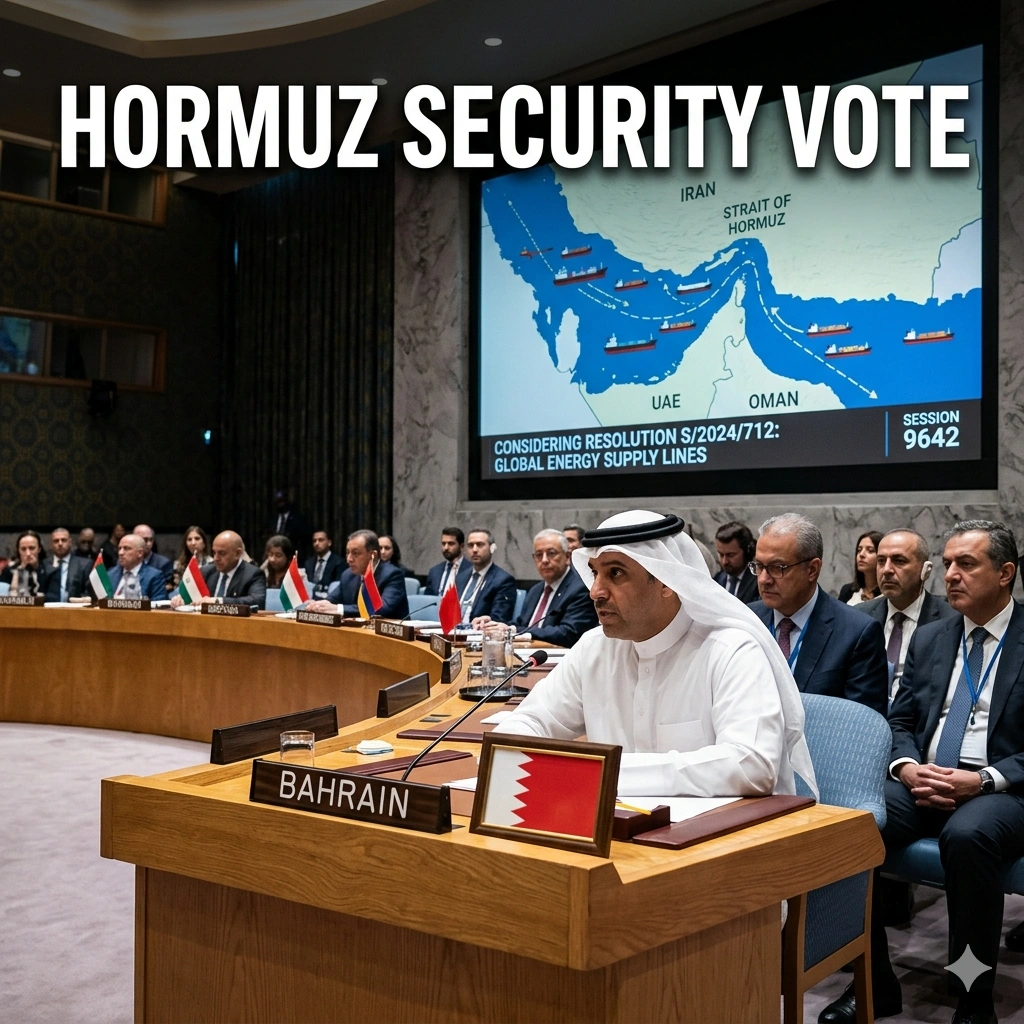
The Strategic Necessity of the Bahrain UN Security Council Vote
The urgency behind the Bahrain UN Security Council vote stems from the catastrophic impact the closure of the Strait of Hormuz has had on global energy security. For over thirty days, no commercial tankers have successfully navigated the passage, leading to a massive backlog of crude oil and liquefied natural gas (LNG). Foreign Minister Al Zayani emphasized that the resolution is not a call for war, but a plea for the restoration of international law. By securing a Bahrain UN Security Council vote, the kingdom hopes to establish a protected maritime corridor overseen by a multinational task force.
Military analysts suggest that without a clear legal mandate from the United Nations, individual nations are hesitant to escort merchant ships through the contested waters. The Bahrain UN Security Council vote is intended to provide the necessary legal cover for a coordinated naval response to neutralize sea mines and drone threats. The proposed resolution specifically targets the protection of civilian crews who have been caught in the crossfire of the regional war. Providing a safe passage is now considered a humanitarian necessity as much as an economic one.
Addressing the Global Energy Crisis of 2026
The month-long disruption has sent shockwaves through the global economy, making the Bahrain UN Security Council vote a matter of extreme financial priority. Oil prices have breached record highs, leading to fuel rationing in several Asian and European nations that rely on Gulf exports. Many developing countries are facing imminent blackouts as their strategic reserves dwindle to critical levels. The Bahrain UN Security Council vote is viewed by many economists as the only immediate solution to prevent a deep global recession.
During his address, Al Zayani pointed out that the closure of the strait affects every corner of the globe, not just the Middle East. The Bahrain UN Security Council vote is expected to receive support from major energy consumers like Japan, South Korea, and China, who are suffering most from the supply halt. Restoring the flow of 20 million barrels of oil per day is the primary objective of this diplomatic push. If the resolution passes, it could lead to an immediate de-escalation of insurance premiums for maritime shipping.
Technical Details of the Revised Resolution
The current draft being considered for the Bahrain UN Security Council vote is the most comprehensive version to date, incorporating feedback from all permanent members. It outlines specific “Rules of Engagement” for international naval assets tasked with protecting commercial traffic in the Persian Gulf. The Bahrain UN Security Council vote will determine if a “Maritime Safety Zone” can be established with the backing of international law. This zone would be strictly monitored to ensure that only non-military, commercial vessels are granted passage under escort.
Previous versions of the resolution were vetoed due to concerns over sovereignty and the potential for mission creep. However, the revised Bahrain UN Security Council vote includes strict sunset clauses and regular reporting requirements to the council. These safeguards are designed to ensure that the intervention remains focused solely on maritime safety rather than political regime change. The diplomatic efforts in the 24 hours leading up to the vote have been described as “intense and unprecedented.”
The Role of Bahraini Diplomacy in the Conflict
Bahrain has taken a leading role in the diplomatic arena, positioning itself as a bridge between Western powers and regional stakeholders. The Bahrain UN Security Council vote is a testament to the kingdom’s commitment to multilateralism and the peaceful resolution of conflicts. Foreign Minister Al Zayani has spent the last week in New York, meeting with representatives from the “P5” nations to secure their support. His efforts highlight Bahrain’s strategic importance as a hub for regional security and international maritime cooperation.
By championing the Bahrain UN Security Council vote, the kingdom is also protecting its own economic future, which is inextricably linked to the freedom of navigation. The Bahraini government has consistently advocated for a collective security architecture that prevents any single state from holding the world’s energy supply hostage. The outcome of the Bahrain UN Security Council vote will likely define the kingdom’s diplomatic legacy for the next decade. It serves as a reminder that smaller nations can play a pivotal role in resolving global crises through persistent diplomacy.
Assessing the Positions of the Permanent Members
The success of the Bahrain UN Security Council vote depends entirely on the stance of the five permanent members: the US, UK, France, Russia, and China. Early reports suggest that the United States and its European allies are strongly in favor of the resolution to protect their economic interests. However, the Bahrain UN Security Council vote still faces potential hurdles from members who may view the intervention as a threat to their strategic partners in the region. Negotiations have focused on language that avoids assigning direct blame for the initial strikes.
Russia and China have expressed cautious interest in the resolution, provided it does not lead to a permanent Western military buildup in the Gulf. The Bahrain UN Security Council vote will be a test of whether the great powers can set aside their geopolitical rivalries for the sake of global economic stability. A “yes” vote would signal a rare moment of unity in an otherwise fractured international landscape. Conversely, a veto could lead to a fragmented and much more dangerous “coalition of the willing” approach to the crisis.
Humanitarian Concerns for Merchant Crews
One of the most compelling arguments for the Bahrain UN Security Council vote is the plight of thousands of sailors currently stranded on vessels in the region. These merchant crews are living in constant fear of missile attacks or being taken as collateral in the naval skirmishes. The Bahrain UN Security Council vote seeks to provide these individuals with a guaranteed safe exit or entry through the strait. The resolution includes provisions for humanitarian aid and medical support for any crews affected by the ongoing hostilities.
International maritime unions have thrown their support behind the Bahrain UN Security Council vote, calling it a “necessary shield” for civilian workers. They have documented numerous instances of psychological trauma and physical danger faced by seafarers since the conflict began in late February. The Bahrain UN Security Council vote is not just about oil and gas; it is about the lives of the people who keep the global economy moving. Ensuring their safety is a moral imperative that transcends the political complexities of the Middle East.
- Over 200 commercial vessels are currently anchored outside the strait.
- Thousands of merchant sailors from 50 different countries are affected.
- The resolution includes a mandate for search and rescue operations.
- Emergency medical corridors are part of the proposed safety zone.
The Economic Impact of a Failed Resolution
If the Bahrain UN Security Council vote fails to pass, the economic consequences are predicted to be catastrophic and potentially irreversible. Global shipping firms have already warned that they will completely bypass the region for the foreseeable future, adding weeks to delivery times and billions to costs. A failed Bahrain UN Security Council vote would likely lead to a permanent shift in trade routes, bypassing the Middle East entirely. This would result in a long-term decline in the regional economy and a surge in inflation worldwide.
Central banks are closely monitoring the developments surrounding the Bahrain UN Security Council vote as they prepare for potential emergency interest rate hikes. The inability to secure the strait would mean that the “war risk” premium on energy would become a permanent feature of the market. This scenario would hit the manufacturing sectors in Germany and Japan particularly hard, potentially triggering a global industrial slowdown. The Bahrain UN Security Council vote is therefore seen as a “binary event” for the future of the 2026 global economy.
Military Readiness for the Post-Vote Scenario
Should the Bahrain UN Security Council vote result in a “yes,” the logistical challenge of implementing the resolution will begin immediately. A multinational naval fleet is reportedly already on standby in the Arabian Sea, awaiting the legal authority to begin minesweeping and escort duties. The Bahrain UN Security Council vote would trigger the largest maritime security operation since the 1980s “Tanker War.” The goal would be to have the first convoy of tankers moving through the strait within 72 hours of the resolution’s passing.
Military leaders from the participating nations are coordinating their communication protocols to ensure a seamless integration of their forces. The Bahrain UN Security Council vote provides the necessary framework for this cooperation, allowing different navies to share intelligence and defensive assets. This operation will require a high level of technical precision to avoid any accidental escalation with coastal defense batteries. The world is watching the Bahrain UN Security Council vote not just for the diplomacy, but for the massive military movement it will likely initiate.
The Status of the “Necessary Means” Clause
The inclusion of the “all necessary means” phrase in the Bahrain UN Security Council vote is the most contentious part of the entire document. This language traditionally authorizes the use of military force to achieve the stated objectives of a UN resolution. During the negotiations for the Bahrain UN Security Council vote, some members argued for more restrictive language to prevent offensive strikes against land-based targets. The final compromise limits the use of force strictly to the defense of commercial vessels within the designated safety zone.
Legal experts note that this clause is what gives the resolution its “teeth” and makes it an effective deterrent against future attacks. Without it, the Bahrain UN Security Council vote would be seen as a symbolic gesture rather than a practical security measure. The challenge for the council is to balance the need for effective protection with the desire to avoid a wider regional conflagration. The Bahrain UN Security Council vote will determine if the world is willing to back its diplomatic words with the threat of credible force.
Impact on Global Shipping Routes
The closure of the strait has forced ships to take the long route around the Cape of Good Hope, a journey that adds nearly 6,000 miles to a typical trip. The Bahrain UN Security Council vote is the only hope for these vessels to return to their normal, more efficient routes. For companies transporting perishable goods or time-sensitive electronics, every day the Bahrain UN Security Council vote is delayed represents a significant loss. The canal and port fees lost by regional economies are also reaching into the billions of dollars.
If the Bahrain UN Security Council vote succeeds, it will restore the Suez Canal’s status as a primary artery of world trade, which has also suffered due to the drop in traffic. The interconnected nature of these waterways means that a victory for Bahraini diplomacy is a victory for the entire global logistical network. The Bahrain UN Security Council vote is a chance to prove that the world can still manage its most critical infrastructure collectively. The alternative is a fragmented world of “regional silos” that would be far less efficient and more prone to conflict.
- Shipping costs from Asia to Europe have risen by 350% since February.
- Delivery times for consumer electronics have been pushed back by 4 weeks.
- Port authorities in the Gulf report a 90% drop in transshipment activity.
- Insurance companies have suspended “all-risk” coverage for the region.
Bahrain UN Security Council vote and Middle East Stability
The Bahrain UN Security Council vote is being framed as a crucial step toward de-escalating the wider conflict between the US, Israel, and Iran. By focusing on the narrow but vital issue of maritime safety, the council hopes to create a “diplomatic opening” for broader peace talks. The Bahrain UN Security Council vote could serve as a confidence-building measure, proving that the warring parties can agree on at least one shared interest: the free flow of energy. Bahraini officials believe that this “bottom-up” approach to peace is the most realistic path forward.
However, critics warn that if the Bahrain UN Security Council vote is perceived as a purely Western-led initiative, it could further alienate other regional actors. To avoid this, Bahrain has gone to great lengths to ensure the resolution has a “neutral and international” character. The Bahrain UN Security Council vote is designed to be a win-for-all scenario where no nation loses face while the world gains stability. The success of this strategy will be revealed in the coming hours as the council members cast their final ballots.
Future Implications for Maritime Law
Regardless of the outcome, the Bahrain UN Security Council vote will have a lasting impact on how the world views the protection of international waterways. It has raised fundamental questions about the responsibility of the international community to intervene when a “global common” is threatened by local conflict. The Bahrain UN Security Council vote may lead to the creation of a permanent UN Maritime Task Force to deal with similar crises in the future. This would be a significant evolution in the role of the United Nations in the 21st century.
Legal scholars are already analyzing the draft resolution as a potential blueprint for future interventions in other contested waters. The Bahrain UN Security Council vote highlights the need for a more robust legal framework that can respond quickly to the rapid technological changes in naval warfare, such as the use of autonomous drones. The lessons learned from this 2026 crisis will be taught in law and military academies for years to come. The Bahrain UN Security Council vote is not just a solution for today; it is a lesson for tomorrow.
Conclusion: A Turning Point for Global Trade
The Bahrain UN Security Council vote scheduled for Friday, April 3, 2026, is the most significant diplomatic event of the year. By seeking a mandate to protect the Strait of Hormuz, Bahrain is attempting to save the global economy from a catastrophic collapse. The Bahrain UN Security Council vote represents the intersection of high-stakes diplomacy, military strategy, and economic survival. As Foreign Minister Al Zayani has stated, the world cannot afford to wait any longer for a resolution to this month-long blockade.
The passage of this resolution would mark a triumph for multilateralism and a major step toward restoring peace in the Middle East. It would allow for the immediate deployment of a safety task force to reopen the vital energy veins of the world. The eyes of the international community are fixed on the council chamber, waiting for the Bahrain UN Security Council vote to decide the fate of global shipping. Whatever the result, the courage and persistence of Bahraini diplomacy in this crisis will be remembered as a defining moment of 2026.
For more details & sources visit: Business Recorder
Read more about Behrain news on 360 News Orbit-Behrain.