
The South Sudan prophetic war has reached a fever pitch as the nation moves closer to the 2026 electoral deadline. This conflict is not merely a political struggle for the presidency but a deeply spiritual battle centered on an ancient tamarind wood stick. For the Nuer people, this artifact represents the ultimate authority of their most revered historical figure, Prophet Ngundeng Bong. As the rivalry between President Salva Kiir and Riek Machar intensifies, the relic has become a symbol of divine right. Many believe that whoever possesses the stick holds the spiritual mandate to lead the entire region. Consequently, the South Sudan prophetic war has transformed from a typical civil dispute into a crusade fueled by mysticism and ancestral tradition.
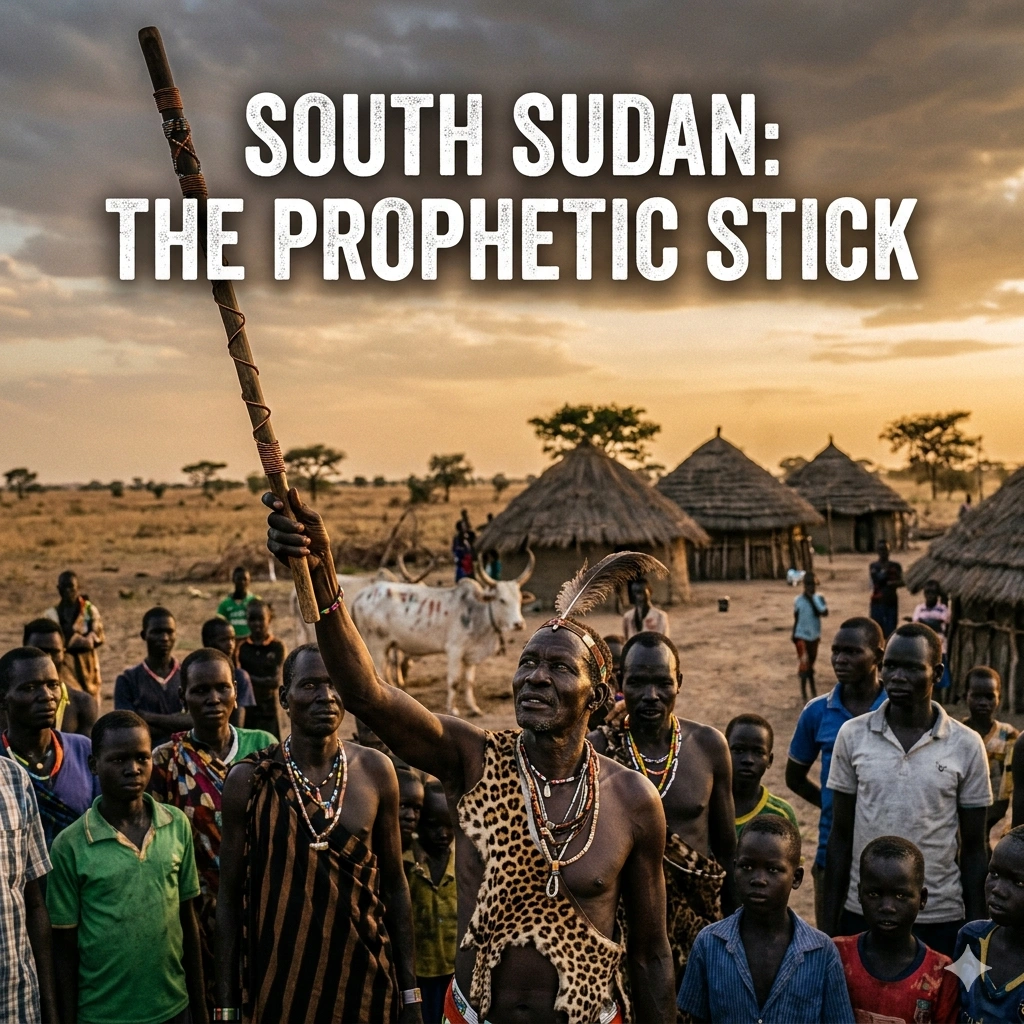
The Historical Roots of the South Sudan Prophetic War
To understand the current tension, one must look back at the 19th century when Prophet Ngundeng Bong first rose to prominence. He was a figure of immense spiritual power who famously resisted colonial expansion and unified the Nuer tribes. During his lifetime, he predicted a period of immense darkness followed by the rise of a specific leader. The South Sudan prophetic war is viewed by many as the literal manifestation of these century-old warnings. This historical context provides the ideological backbone for modern rebel groups who see themselves as soldiers of destiny.
The prophet’s influence was so great that even the British colonial administration feared his reach and eventually confiscated his sacred items. They believed that by removing the physical symbols of his power, they could quell the spirit of rebellion. However, the South Sudan prophetic war proves that the absence of the relic only strengthened its legend. Decades later, the return of these items sparked a renewed sense of ethnic pride and political ambition. This lingering influence continues to dictate the tactical decisions of both government and opposition forces today.
The Symbolism of the Sacred Dang Stick
The dang is a curved staff made from the wood of a tamarind tree, decorated with copper wire and ivory. It is not just an heirloom; it is considered a living entity with the power to summon lightning and ensure victory. In the context of the South Sudan prophetic war, the stick serves as a parliamentary mace for the Nuer people. Its presence at a political or military gathering lends immediate legitimacy to the proceedings. Without it, many elders believe any claim to leadership is spiritually hollow and destined to fail.
When the artifact was returned from the United Kingdom in 2009, it was handed directly to Riek Machar. This event was seen by thousands as a sign that the South Sudan prophetic war was entering its final stage of fulfillment. Machar, who fits several physical descriptions provided in the prophecy, used the moment to consolidate his base. The government in Juba viewed this not as a cultural celebration, but as a direct threat to national security. Since then, the physical location of the stick has been one of the country’s most protected secrets.
How Prophecy Influences Modern Military Strategy
The White Army, a formidable Nuer militia, operates almost entirely on the spiritual directives associated with Ngundeng. Their involvement in the South Sudan prophetic war is driven by the belief that they are protecting a divine legacy. They do not follow traditional military hierarchies but instead look to spiritual intermediaries for guidance. This makes them unpredictable and incredibly resilient in the face of government crackdowns. For these fighters, the South Sudan prophetic war is a holy obligation that transcends modern political borders.
President Salva Kiir has struggled to counter this spiritual narrative with conventional military force alone. He recognizes that as long as the prophecy is believed, his administration will be viewed as an obstacle to divine will. This has led to a dual strategy of military suppression and attempts to co-opt Nuer spiritual leaders. The South Sudan prophetic war has thus created a landscape where tactical maps and ancient oracles carry equal weight. Every major offensive is timed or justified through the lens of these traditional beliefs.
South Sudan Prophetic War
The South Sudan prophetic war remains the primary driver of displacement and humanitarian crisis in the Upper Nile region. International observers often miss the spiritual nuances, focusing instead on oil revenue or ethnic quotas. However, the local population views the conflict through the prism of the dang and the prophet’s words. Until the spiritual grievances are addressed, political peace treaties are likely to remain fragile and temporary. The South Sudan prophetic war is a reminder that in this part of the world, the past is never truly gone.
Efforts to mediate the South Sudan prophetic war have often failed because they ignore the symbolic weight of the relic. Diplomatic missions focus on power-sharing ratios between the Dinka and Nuer elites. Yet, for the average fighter on the ground, the South Sudan prophetic war cannot end until the prophetic timeline is satisfied. This disconnect between Western diplomacy and local spirituality is a major hurdle for lasting peace. Any successful resolution must account for the cultural significance of the Ngundeng legacy.
The Role of Riek Machar as the Prophesied Leader
Riek Machar has strategically positioned himself as the “left-handed, gap-toothed” leader described by Ngundeng. This alignment has given him a level of loyalty that a standard politician could never achieve. In the South Sudan prophetic war, his supporters see his survival through multiple assassination attempts as proof of divine protection. Even while under house arrest, his influence remains potent because of his association with the dang. The South Sudan prophetic war is essentially a struggle to prove whether he is the chosen one or a pretender.
Opponents argue that Machar is merely exploiting ancient superstitions to maintain his grip on the Nuer people. They point to the immense suffering caused by the South Sudan prophetic war as evidence that no true prophet would desire such bloodshed. Regardless of the truth, the perception of his destiny is a functional reality in South Sudanese politics. It shapes how soldiers fight and how civilians vote, making it a cornerstone of the nation’s instability. The South Sudan prophetic war is, at its core, a battle over who gets to define the national identity.
Ethnic Rivalry and the Dinka-Nuer Divide
While the South Sudan prophetic war is framed by spiritual symbols, it exacerbates deep-seated ethnic tensions. The Dinka, led by Salva Kiir, view the Nuer’s spiritual claims as a mechanism for ethnic dominance. They have their own traditions and historical heroes, which often clash with the Nuer worldview. This cultural friction provides the fuel for the South Sudan prophetic war to continue indefinitely. Both sides use their unique histories to justify the exclusion of the other from the highest levels of power.
The militarization of ethnic identity has led to horrific cycles of revenge killings and scorched-earth tactics. In the South Sudan prophetic war, villages are often targeted based on their perceived loyalty to either the prophet’s followers or the state. This has created a fractured nation where trust between communities is almost non-existent. International aid organizations struggle to navigate these ethnic minefields while providing life-saving support. The South Sudan prophetic war has turned neighbor against neighbor in a quest for spiritual and political supremacy.
- Over 400,000 lives have been lost since the conflict escalated in 2013.
- Millions of South Sudanese remain internally displaced or in refugee camps.
- The dang remains hidden to prevent it from falling into government hands.
- Spiritual leaders continue to play a central role in mobilizing young men for combat.
The Looming December Elections and the Relic
As the nation prepares for the high-stakes elections in December, the South Sudan prophetic war enters a critical phase. Both factions are looking for a decisive victory to either validate or debunk the prophecy. The government is expected to increase its presence in Nuer-dominated areas to prevent a spiritual uprising. Meanwhile, the opposition views the vote as the moment for the South Sudan prophetic war to finally conclude with the prophet’s leader in power. The tension in the capital is palpable as citizens fear a return to full-scale urban warfare.
Many analysts worry that the election results will not be accepted if they contradict the prophetic expectations. In the logic of the South Sudan prophetic war, a loss at the ballot box could be interpreted as a fraudulent act against God. This makes the democratic process incredibly dangerous in a society where spiritual mandates outweigh constitutional law. The South Sudan prophetic war is likely to influence voter turnout and the behavior of local militias. Stability hangs in the balance as the ghost of Ngundeng Bong continues to haunt the political arena.
Human Rights and the Crackdown on Spirituality
The government’s attempts to suppress the South Sudan prophetic war have often led to widespread human rights abuses. Security forces frequently target spiritual sites and traditional healers suspected of supporting the rebels. These actions are seen as an attempt to “de-spiritualize” the Nuer resistance and break their morale. However, in the South Sudan prophetic war, such aggression often has the opposite effect, reinforcing the narrative of martyrdom. Every shrine destroyed becomes a new rallying cry for the White Army and its allies.
Civilians caught in the crossfire of the South Sudan prophetic war face a grim reality of famine and violence. When the government blocks food aid to regions identified with the prophecy, it uses hunger as a weapon of war. The South Sudan prophetic war has thus evolved into a total conflict affecting every aspect of life. International courts are monitoring the situation for evidence of war crimes and ethnic cleansing. The tragedy of the South Sudan prophetic war is that the very artifact meant to bring unity is now a catalyst for destruction.
Global Perception vs Local Reality
The international community often views the South Sudan prophetic war as a simple resource conflict. While oil and cattle are certainly factors, they do not explain the fanaticism of the fighters. To truly understand the South Sudan prophetic war, one must accept that the metaphysical is as real to the participants as the physical. Ignoring the dang and the prophecy leads to ineffective policy and failed peace initiatives. The South Sudan prophetic war requires a unique diplomatic approach that respects traditional beliefs while promoting modern governance.
[Image showing the geographic distribution of Dinka and Nuer territories]
Media coverage of the South Sudan prophetic war has been sparse, often drowned out by other global crises. This lack of attention allows the actors in the South Sudan prophetic war to operate with relative impunity. Without external pressure, the cycle of prophetic violence is unlikely to break. The South Sudan prophetic war is a complex puzzle involving history, faith, and the raw pursuit of power. Understanding the role of the dang is the first step toward untangling this deadly web.
The Future of the Ngundeng Prophecy
What happens if the South Sudan prophetic war does not end in the way the followers expect? There is a growing concern that a failed prophecy could lead to a catastrophic collapse of social order. Alternatively, if the South Sudan prophetic war results in a Machar presidency, will the relic be brought back into the light? The long-term stability of the country depends on how the legacy of Ngundeng is integrated into a national identity. The South Sudan prophetic war has shown that ancient symbols cannot be ignored in the building of a new state.
- Traditional reconciliation ceremonies are being proposed as a way to bridge the gap.
- Cultural experts suggest that the dang should eventually be housed in a neutral national museum.
- Education programs aim to teach the youth a unified history that includes all ethnic groups.
- Religious leaders from Christian and traditional backgrounds are seeking a common ground for peace.
Conclusion: A Nation Caught Between Two Worlds
The South Sudan prophetic war is a testament to the enduring power of cultural memory and spiritual conviction. It reminds us that modern politics is often built upon the foundations of ancient myths. As the country moves toward its uncertain future, the shadow of the dang will continue to loom large. The South Sudan prophetic war is not just a chapter in a history book; it is a living, breathing struggle for the soul of a nation. Only time will tell if the prophecy brings the promised peace or continued suffering for the people of South Sudan.
The world must pay closer attention to the South Sudan prophetic war if it hopes to see a stable East Africa. The intersection of faith and fire in this conflict is a warning of how deeply identity can be tied to a single object. As long as the South Sudan prophetic war remains unresolved, the tamarind stick of Ngundeng will remain the most powerful weapon in the country. Let us hope that the next phase of the South Sudan prophetic war leads to dialogue rather than further bloodshed. The people have suffered enough in the name of a destiny they did not choose.
Final Thoughts on the Conflict
Addressing the South Sudan prophetic war requires a level of cultural humility from global leaders. It is easy to dismiss the conflict as irrational, but it follows a very specific logic for those involved. The South Sudan prophetic war is a cry for recognition and respect for Nuer traditions within the state framework. Until the government in Juba can accommodate these spiritual realities, the South Sudan prophetic war will persist. The path to peace must be paved with both political compromise and spiritual reconciliation.
The South Sudan prophetic war continues to evolve as new actors enter the scene. Younger generations are starting to question the costs of the South Sudan prophetic war, looking for a future beyond ethnic silos. However, the pull of the prophecy remains strong among the rural populations who form the bulk of the fighting forces. The South Sudan prophetic war is a crossroads where tradition meets modernity, and the result will define South Sudan for decades. We must watch closely as the final act of this prophetic drama unfolds on the world stage.
For more details & sources visit: Arab News
Read more on Sudan news: 360 News Orbit – Sudan.