
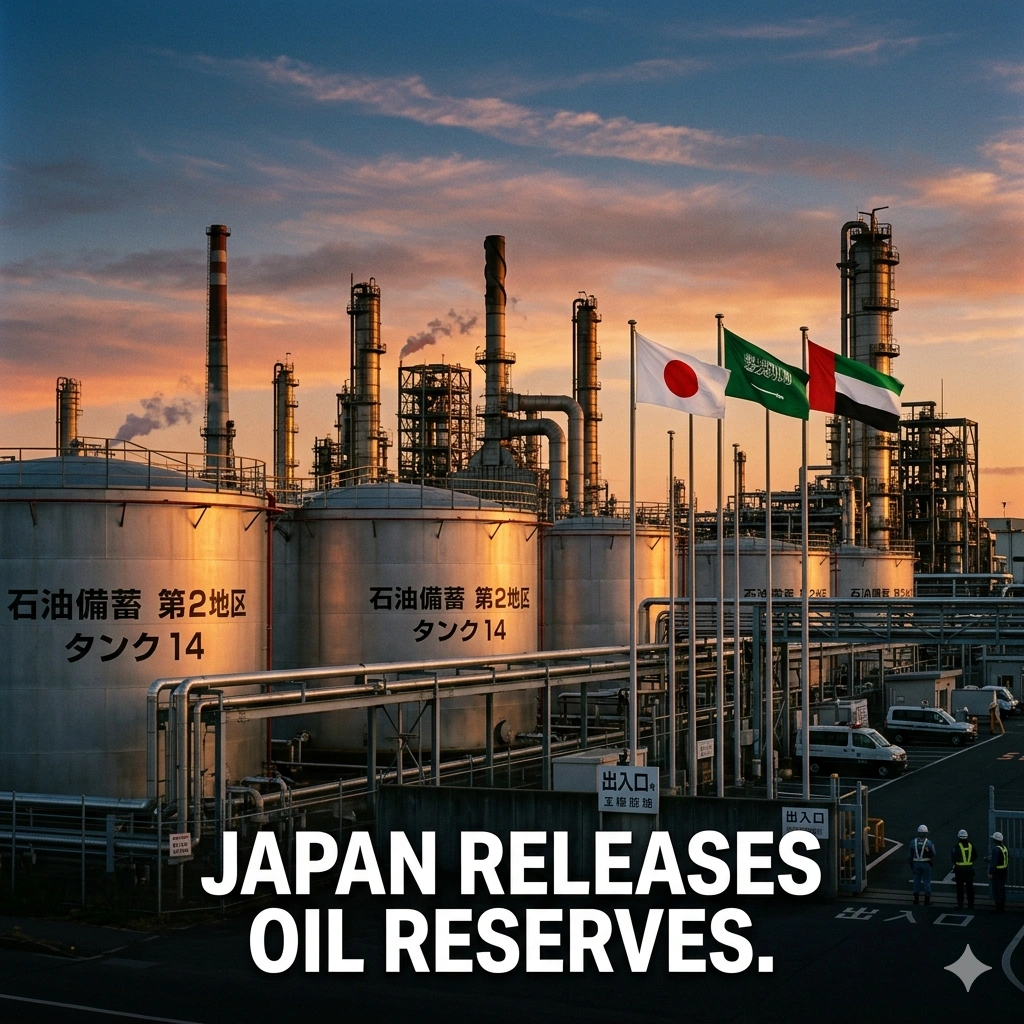
Japan Strategic Reserves are officially being mobilized as Prime Minister Sanae Takaichi takes decisive action to combat the 2026 global energy crisis. The Japanese government announced a historic plan to release millions of barrels of crude oil from joint stockpiles held with Middle Eastern producing nations. This emergency measure is a direct response to the skyrocketing fuel prices and supply disruptions caused by the closure of the Strait of Hormuz and escalating regional conflicts.
The move signals a major shift in Tokyo’s energy security strategy, as it seeks to insulate the world’s fourth-largest economy from a prolonged supply vacuum. By tapping into reserves shared with Saudi Arabia and the United Arab Emirates, Japan is utilizing every available tool to prevent an industrial slowdown. Industry Minister Ryosei Akazawa confirmed that this coordinated effort with the International Energy Agency (IEA) is essential to maintain domestic market stability during these volatile times.
As global oil prices hit four-year highs, the Japan Strategic Reserves release serves as a critical buffer for a nation that imports nearly all of its energy needs. The phased rollout, which began with private sector stocks earlier this month, is now expanding to national and joint reserves to ensure a steady flow of crude to refineries. This bold intervention highlights the severity of the current geopolitical situation and Japan’s commitment to protecting its citizens from the economic fallout of international warfare.
Japan Strategic Reserves and the Strait of Hormuz Crisis
The decision to tap into the Japan Strategic Reserves comes at a moment of extreme peril for international shipping and energy logistics. Following the late February missile strikes between Israel and Iran, the subsequent shutdown of the Strait of Hormuz has effectively cut off a significant portion of the world’s daily oil supply. For a maritime nation like Japan, which relies heavily on this specific corridor, the closure represented an immediate and existential threat to its energy infrastructure.
Prime Minister Takaichi’s administration has acted with unprecedented speed to address the resulting price surge. By coordinating with the IEA, Japan is not just acting alone but as part of a global “energy shield” designed to discourage speculative hoarding and stabilize the markets. The Japan Strategic Reserves are seen as the primary line of defense in this strategy, providing a tangible physical volume of oil that can be injected into the system to offset the missing Iranian and Gulf exports.
This strategic release is also a diplomatic signal to producing nations that Japan expects a reciprocal level of cooperation during times of crisis. The joint stockpiles, which are physically located on Japanese soil but partially owned by Saudi Arabia and the UAE, represent a unique security partnership. Tapping into these specific barrels under the Japan Strategic Reserves framework demonstrates the deep trust and integrated planning between Tokyo and its Middle Eastern energy partners.
Facts About the 2026 Japan Strategic Reserves Release
The scale of the current Japan Strategic Reserves mobilization is truly staggering when viewed in a historical context. One of the most shocking aspects is the total volume involved; the government is moving to release nearly 80 million barrels as part of the wider IEA effort. This represents one of the largest drawdowns in the history of the Strategic Petroleum Reserve (SPR) program, reflecting the sheer magnitude of the supply deficit currently facing the global market.
Another surprising detail is the speed at which the “joint reserves” are being utilized. Japan will tap five days’ worth of these shared supplies, totaling approximately 13 million barrels, starting on March 26. This specific segment of the Japan Strategic Reserves was originally designed as a “last resort” for extreme emergencies, and its activation now proves that the government views the current situation as a top-tier national security crisis that demands immediate and forceful action.
Furthermore, the economic impact of the surging prices has forced the government to accelerate its timeline for the release. While initial plans suggested a slower rollout, the rapid escalation of the Middle East conflict meant that private reserves alone were not enough to stem the tide. The expansion to national and joint Japan Strategic Reserves highlights the urgency of the situation and the government’s willingness to use all its “emergency fuel” to keep the lights on and the factories running.
- The release includes specialized light crude ideal for high-speed gasoline production.
- Nearly 13 million barrels are coming from joint-use tanks in Okinawa and Kagoshima.
- This is the first time since 2022 that Japan has triggered such a massive joint release.
- The IEA coordination involves over 30 countries releasing a combined 150 million barrels.
Japan Strategic Reserves
The activation of the Japan Strategic Reserves is the centerpiece of a multifaceted approach to energy survival in 2026. This term refers to the totality of the government-held, private, and joint-nation stockpiles that Japan maintains to ensure it can survive for several months without any imports. By officially “tapping the tanks,” the Takaichi administration is proving to the world that Japan is prepared for a long-term disruption of traditional energy routes.
Implementing the logistics of a Japan Strategic Reserves release is a massive technical undertaking. Moving millions of barrels from deep-storage facilities to commercial refineries requires precise coordination with the maritime industry and the national pipeline network. The Ministry of Economy, Trade, and Industry (METI) is overseeing this process 24/7 to ensure that there are no bottlenecks that could delay the arrival of fuel to the Japanese public and industrial sectors.
Moreover, the Japan Strategic Reserves serve as a psychological deterrent against market panic. When the public knows that there is a physical “cushion” of oil available, the likelihood of gas station runs and hoarding decreases. The government’s transparent communication regarding the March 26 start date for the joint reserve release is a calculated move to maintain social order and consumer confidence during what is undeniably the most difficult energy period of the decade.
The Role of Saudi Arabia and the UAE in Japan’s Energy Security
The Japan Strategic Reserves are uniquely bolstered by the presence of joint stockpiles held by Saudi Arabia and the United Arab Emirates. This arrangement, which has been in place for years, allows these producing nations to store their oil in Japan’s high-tech facilities in exchange for giving Japan “first right of refusal” during a global shortage. It is a win-win scenario that provides the producers with storage and Japan with an extra layer of guaranteed supply.
Under the current crisis, this partnership is being put to its most rigorous test. The release of 13 million barrels from these joint pools is a testament to the strength of the ties between Tokyo, Riyadh, and Abu Dhabi. As part of the Japan Strategic Reserves strategy, these barrels are being moved into the domestic market to replace the oil that is currently trapped behind the blockade of the Strait of Hormuz.
This cooperation also has a stabilizing effect on the international stage. By allowing Japan to tap into these reserves, Saudi Arabia and the UAE are demonstrating their commitment to being reliable energy providers, even when their own regional geography is under fire. The Japan Strategic Reserves framework effectively bridges the gap between the volatile Middle East and the energy-hungry markets of East Asia, creating a “security pipeline” that exists even when physical ships cannot pass through the Gulf.
Impact of the Global Supply Crisis on Japanese Industry
The global supply crisis has hit the Japanese manufacturing sector particularly hard, making the Japan Strategic Reserves release a vital lifeline. Industries such as automotive manufacturing, chemicals, and electronics are highly sensitive to energy costs. Without the intervention announced by Prime Minister Takaichi, many of these firms would have been forced to implement rolling shutdowns or massive price hikes, potentially triggering a domestic recession.
By injecting more oil into the market via the Japan Strategic Reserves, the government is helping to cap the rising costs of electricity and transportation. This is especially important for the small and medium-sized enterprises that form the backbone of the Japanese economy. These businesses often lack the hedging tools of larger corporations and are the first to suffer when oil prices remain at four-year highs for an extended period.
The logistics industry is also breathing a sigh of relief following the news of the March 26 release. Fuel surcharges were beginning to cripple the delivery networks that Japanese consumers rely on for everything from food to medical supplies. The Japan Strategic Reserves act as a shock absorber for these essential services, ensuring that the “last mile” of the economy continues to function despite the geopolitical chaos occurring thousands of miles away.
- Expected reduction in industrial fuel surcharges by mid-April.
- Stabilized electricity rates for heavy manufacturing zones in Nagoya and Osaka.
- Improved shipping schedules for tankers diverted around the Cape of Good Hope.
Why Prime Minister Takaichi Chose a Phased Release Strategy
Prime Minister Sanae Takaichi’s decision to use a phased approach for the Japan Strategic Reserves release was a tactical move designed to maximize market impact. By starting with private reserves on March 16 and transitioning to national and joint stocks on March 26, the government is creating a “ladder” of supply. This ensures that the market is not suddenly flooded, which could cause price volatility, but rather receives a steady and predictable flow of crude.
This phased strategy also allows the government to monitor the situation in the Middle East in real-time. If the conflict shows signs of de-escalating, the later phases of the Japan Strategic Reserves release can be adjusted or extended. However, given the current “hardened” stances of the regional powers, the Takaichi administration is preparing for the possibility that the release will need to continue well into the second quarter of 2026.
The Prime Minister’s announcement was also a clear political statement of competence and preparedness. By taking charge of the Japan Strategic Reserves situation personally, she is reassuring the electorate that her government is capable of navigating the complex intersection of global diplomacy and domestic economics. This leadership is crucial for maintaining public trust as the nation faces its most significant energy challenge since the 1970s oil shocks.
Comparing the 2026 Energy Crisis to Historical Oil Shocks
The current crisis is often being compared to the 1973 and 1979 oil shocks, but the Japan Strategic Reserves provide a level of protection that was absent in those decades. Back then, Japan was almost entirely at the mercy of sudden supply cuts. Today, the nation has built one of the world’s most sophisticated and well-funded reserve programs, designed specifically to prevent the kind of societal breakdown that occurred during the previous century’s energy crises.
Unlike the past, the current mobilization of the Japan Strategic Reserves is highly coordinated with international partners. The IEA framework ensures that Japan is not competing with its allies for limited barrels, but rather working in a synchronized manner to calm the global market. This collective action is a modern evolution of energy security, where the Japan Strategic Reserves act as one part of a global “firewall” against price manipulation and supply blackmail.
However, the 2026 crisis is unique because of the technological complexity of the modern world. Today’s “just-in-time” supply chains are much more fragile than those of the 70s, making even a small delay in oil delivery catastrophic. This is why the Japan Strategic Reserves are more important than ever; they provide the immediate physical liquidity needed to keep a hyper-connected, high-tech society functioning when the global “heart” of the oil trade stops beating.
The Technical Process of Releasing Joint Stockpiles
Releasing oil from the joint Japan Strategic Reserves involves a rigorous series of technical and legal steps. First, the government must issue a formal decree that an “emergency supply interruption” has occurred. Once this is done, the operators of the massive storage tanks in places like Shibushi and Tomakomai begin the process of heating and pumping the crude into the domestic pipeline network or onto coastal tankers.
The oil held in the Japan Strategic Reserves is meticulously maintained to ensure it hasn’t degraded over time. Special additives and constant monitoring are required to keep the crude at refinery-ready standards. When the “go” signal is given for the March 26 release, these high-tech facilities will shift into high gear, delivering millions of barrels with the precision of a Swiss watch. This technical excellence is what makes the Japanese reserve system the envy of the world.
Furthermore, there are complex financial arrangements to settle. Since some of the oil in the Japan Strategic Reserves is jointly owned by Saudi Arabia and the UAE, the Japanese government must account for every barrel used and arrange for future replenishment. This “energy accounting” is a vital part of the partnership, ensuring that the reserve levels are eventually restored to their pre-crisis levels once the Strait of Hormuz is reopened and global trade returns to normal.
- Use of ultra-large crude carriers (ULCCs) to move oil from offshore storage to mainland hubs.
- Specialized filtration processes to ensure “freshness” of the decades-old reserves.
- Real-time monitoring of refinery capacity to prevent “over-flooding” the domestic market.
Future Outlook: Replenishing the Japan Strategic Reserves
The most significant question following the current release is how and when the Japan Strategic Reserves will be replenished. Drawing down 80 million barrels is a major move that will leave the nation’s “energy bank account” significantly lower than it has been in years. The Takaichi government has already begun preliminary discussions with producers about long-term contracts to refill the tanks once the current conflict subsides.
Replenishing the Japan Strategic Reserves will likely be a multi-year process. The government will need to wait for oil prices to drop to a reasonable level to avoid overspending the national budget. This “buy low, release high” strategy is the ideal way to manage the reserves, but it requires a level of geopolitical stability that is currently in short supply. Tokyo is betting that its strong relationships with the Gulf states will allow it to secure priority for refilling its stocks.
In the long term, the 2026 crisis may lead to an even further expansion of the Japan Strategic Reserves program. There is already talk in the Diet about increasing the mandatory number of “days of supply” from 90 to 120 or even 150. As the world becomes more volatile, the value of having a massive, domestic physical supply of energy has never been clearer. The current release is a proof-of-concept for why these expensive “insurance policies” are worth every yen.
Global Market Reactions to Japan’s 80 Million Barrel Release
The international oil markets reacted with a slight “cool down” following the news of the Japan Strategic Reserves mobilization. While prices remain high, the knowledge that 80 million barrels are coming online has prevented a further spike toward the $150 per barrel mark. Analysts see Japan’s move as a “stabilizing force” that helps to offset the extreme fear and uncertainty currently gripping the commodities exchanges in London and New York.
Other IEA member nations are expected to follow Japan’s lead with their own announcements in the coming days. The Japan Strategic Reserves release is seen as the first major “domino” to fall in the global response to the Hormuz blockade. By going first and going big, Tokyo has set a standard for the rest of the developed world to follow, demonstrating that the international community will not be held hostage by regional conflicts.
However, some experts warn that the Japan Strategic Reserves are a finite resource. If the conflict lasts for six months or a year, even Japan’s massive stockpiles will eventually run dry. This realization is keeping a “floor” under oil prices, as traders understand that the current release is a temporary fix rather than a permanent solution to the loss of Gulf oil. The eyes of the world remain fixed on the Middle East, even as Japan does its part to manage the immediate crisis.
- Brent Crude futures stabilized at $118 per barrel following the Takaichi announcement.
- Increased demand for “non-Gulf” oil grades from West Africa and the North Sea.
- Renewed focus on renewable energy investment as a long-term alternative to oil.
Public Opinion and Political Support for the Release
Domestically, the release of the Japan Strategic Reserves has broad political and public support. Most Japanese citizens are acutely aware of the nation’s energy vulnerability and view the reserves as a common-sense necessity. The Takaichi administration has received praise from both sides of the aisle for its proactive stance, which is seen as a welcome departure from the “wait and see” approach of previous governments.
Public opinion polls show that a majority of Japanese people are worried about the “Strait of Hormuz shock” but feel more confident knowing that the Japan Strategic Reserves are being utilized. There is a sense of national solidarity as the country prepares for the higher energy costs that are inevitable despite the release. The government’s transparency about the 13 million barrels coming from joint stocks has helped to demystify the process and build trust.
For Prime Minister Takaichi, the successful management of this crisis could define her legacy. By effectively using the Japan Strategic Reserves to protect the economy, she is positioning herself as a “crisis-manager-in-chief.” This political capital will be essential as she moves forward with other difficult reforms, including the potential restart of more nuclear reactors to further reduce Japan’s long-term dependence on imported fossil fuels.
Conclusion: Japan’s Energy Resilience in an Uncertain World
The mobilization of the Japan Strategic Reserves in March 2026 is a landmark event in the history of global energy security. It represents the successful activation of a massive, multi-decade “insurance policy” designed to protect one of the world’s most advanced economies from the chaos of international conflict. As the phased release begins on March 26, the nation moves into a new phase of its energy survival strategy.
While the Japan Strategic Reserves cannot solve the underlying geopolitical problems in the Middle East, they provide the time and stability needed for diplomacy to work. By tapping into its joint stockpiles with Saudi Arabia and the UAE, Japan is leveraging its international partnerships to safeguard its domestic interests. It is a masterclass in modern statecraft, balancing technical logistics with high-stakes international relations.
Looking ahead, the lessons learned from the 2026 crisis will undoubtedly shape Japan’s energy policy for decades to come. The importance of the Japan Strategic Reserves has been reaffirmed, and the need for a diversified, resilient energy mix has never been more obvious. As the barrels begin to flow from the storage tanks to the refineries, Japan stands as a model of preparedness in a world that is increasingly defined by uncertainty and risk.
For more details & sources visit: Reuters
Read more about Japan news on 360 News Orbit – Japan.