
The World Happiness Report 2026, released to coincide with International Day of Happiness, highlights a complex global landscape defined by both remarkable resilience and emerging mental health challenges. Finland has secured the top position for a record ninth consecutive year, maintaining a significant lead over other nations. This year’s report specifically examines the intersection of digital life and well-being, focusing on how social media usage patterns are reshaping happiness across different age groups and regions. Despite ongoing regional instabilities, many nations in the Middle East and Central Europe have shown surprising upward mobility in their self-reported life evaluations.
As the 14th edition of this landmark study, the World Happiness Report 2026 continues to use a three-year average of Gallup World Poll data to rank 147 countries. The findings reveal a deepening “happiness gap” between generations in Western industrial nations, where youth happiness has seen a dramatic decline. Conversely, many developing regions are experiencing a convergence in well-being scores, driven by improvements in social support and personal freedom. The data provides a critical baseline for policymakers who are increasingly looking beyond GDP to measure the true progress and health of their societies during these turbulent times.
Nordic Dominance in World Happiness Report 2026
Nordic countries continue to dominate the highest tier of the World Happiness Report 2026, with Iceland, Denmark, Sweden, and Norway all featuring prominently in the top six. Researchers attribute this consistent success to a combination of high social trust, robust universal welfare systems, and a strong sense of community. Finland’s top score of 7.764 remains unmatched, illustrating the effectiveness of the “Nordic Model” in providing a stable and fulfilling life for its citizens. These nations serve as the global gold standard for balancing economic prosperity with personal and social well-being.
- Finland: Ranked 1st for the ninth year in a row.
- Iceland and Denmark: Follow closely in 2nd and 3rd place.
- Costa Rica: Reached a historic 4th place, the highest ever for a Latin American country.
- Sweden and Norway: Complete the top tier, ranking 5th and 6th respectively.
The rise of Costa Rica to the 4th spot is one of the most significant highlights of the World Happiness Report 2026. Experts believe the country’s high ranking is fueled by exceptional social capital and strong family bonds, which provide a buffer against global economic volatility. This shift suggests that cultural factors and social connectivity can sometimes outweigh pure financial wealth in determining a nation’s overall happiness levels. The “Costa Rican model” is now being studied by other middle-income countries as a blueprint for improving life satisfaction without massive industrial expansion.
World Happiness Report
The World Happiness Report 2026 identifies a growing crisis among young people in English-speaking countries, where happiness levels have plummeted over the last decade. In the United States, Canada, Australia, and New Zealand, life evaluations for those under 25 have dropped by nearly a full point on the 0–10 scale. This trend has pushed the U.S. to 23rd and the UK to 29th in the overall rankings, keeping them out of the top 20 for the second consecutive year. Analysts point to economic anxiety, the vanishing of traditional career paths, and digital stressors as the primary drivers of this decline.
In stark contrast, the World Happiness Report 2026 shows that youth in Central and Eastern Europe are becoming significantly happier. Countries like Kosovo, Slovenia, and Czechia have seen their rankings rise to 16th, 18th, and 20th, respectively. This “happiness convergence” indicates that the quality of life in Eastern Europe is rapidly catching up to Western European standards. The report suggests that the younger generation in these regions feels more optimistic about their future opportunities compared to their peers in more established, but currently stagnant, Western economies.
Social Media Impact in World Happiness Report 2026
A major focus of the World Happiness Report 2026 is the “population-level harm” caused by heavy social media use among adolescents. The report presents seven independent lines of evidence suggesting that platforms driven by algorithmically curated content are contributing to a global surge in anxiety and depression. Teenage girls in Western Europe and North America are identified as the most vulnerable group, with high usage linked to severe body-image issues and social isolation. The findings have sparked a renewed global debate on the need for stricter digital regulations to protect the mental health of the “smartphone generation.”
- Heavy use (5+ hours daily) is associated with a 20% higher risk of depressive symptoms.
- Passive scrolling through influencer content is more harmful than active messaging.
- Moderate use (under 1 hour) actually correlates with higher happiness than zero use.
- Platforms like TikTok and Instagram show stronger negative links to well-being than WhatsApp.
The World Happiness Report 2026 also notes regional differences in digital impact. In the Middle East and Africa, the correlation between social media and unhappiness is less pronounced, with many users reporting that digital platforms help them maintain vital social connections. This suggests that the “social” aspect of social media is key; when used for communication rather than comparison, the impact on well-being can be neutral or even positive. However, the report warns that as these regions adopt more algorithm-heavy habits, they may eventually face the same mental health challenges seen in the West.
Middle East Resilience in World Happiness Report 2026
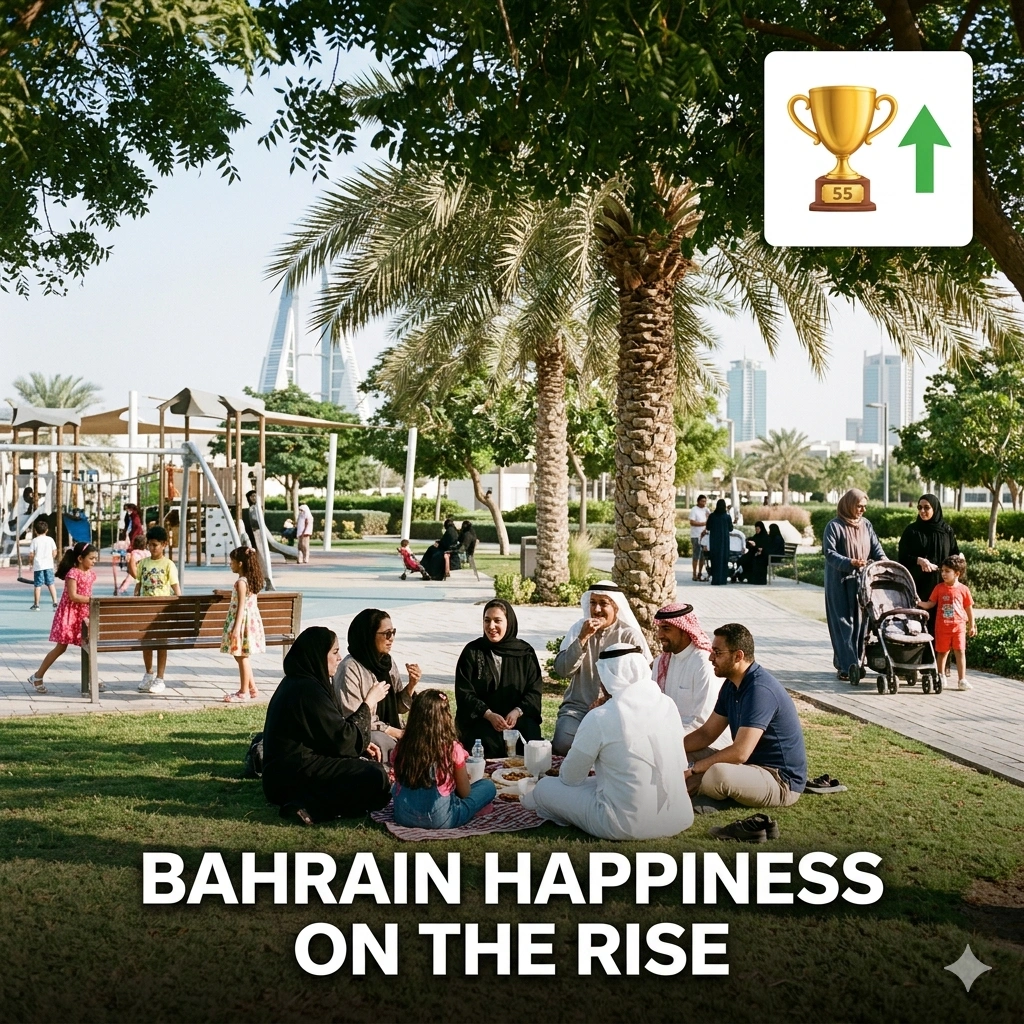
Despite the shadows of regional conflict, the World Happiness Report 2026 highlights the resilience of Gulf nations. The UAE remains the happiest country in the Arab world, ranking 21st globally, followed closely by Saudi Arabia at 22nd. Bahrain’s leap of four spots to 55th place is a testament to its strong community support and personal freedom scores. These countries have successfully maintained high life evaluations by investing heavily in public services and infrastructure, ensuring that residents feel supported even during times of geopolitical uncertainty and external pressure.
The report’s data on Saudi Arabia is particularly striking, showing a 15-place climb over recent years. This rise reflects the massive social and economic reforms under Vision 2030, which have expanded entertainment, employment, and personal freedoms for the Saudi youth. The World Happiness Report 2026 confirms that when people see tangible improvements in their daily lives and future prospects, their self-reported happiness increases rapidly. The Kingdom’s focus on “Quality of Life” as a national metric is proving to be a successful strategy for boosting long-term national well-being.
Measuring Global Benevolence in World Happiness Report 2026
Benevolence and generosity continue to be high-performing metrics in the World Happiness Report 2026, particularly in the wake of global crises. More than half of the respondents in several high-ranking nations reported donating to charity or helping a stranger in the previous month. This altruistic behavior is a key component of the “social support” pillar, which researchers find is a more stable predictor of happiness than individual income. Countries with high rates of benevolence tend to recover faster from economic shocks and natural disasters, as their social fabric remains intact.
- Over 56% of residents in top-tier GCC countries reported recent charitable activities.
- India showed a slight improvement to 116th place, driven by gains in the freedom parameter.
- Conflict zones like Afghanistan and Lebanon remain at the bottom of the index (147th and 141st).
- Social trust in institutions remains the single most important factor for long-term stability.
The World Happiness Report 2026 concludes that the “Goldilocks” approach to technology—not too much, not too little—is essential for modern happiness. By putting the “social” back into social media and prioritizing face-to-face community bonds, nations can protect the well-being of their citizens. As the world navigates the complexities of 2026, the report serves as a reminder that the most successful countries are those that place human happiness and social connection at the heart of their development goals. The path to a happier world lies in balancing technological progress with the fundamental human need for belonging.
Future Outlook for World Happiness Report 2026
The future outlook based on the World Happiness Report 2026 suggests that mental health will become the next major frontier for government regulation. With clear evidence that certain digital products are harming the population, many nations are considering bans or age-restrictions for social media, similar to the protocols currently being tested in Australia. The 2026 data will be instrumental in shaping these policies, providing the scientific backing needed to challenge the dominance of major tech platforms. Protecting the “digital well-being” of the youth is now seen as an essential component of national security.
For more details & sources visit: Gulf Daily News (GDN Online)
Read more about Behrain news on 360 News Orbit-Behrain.