
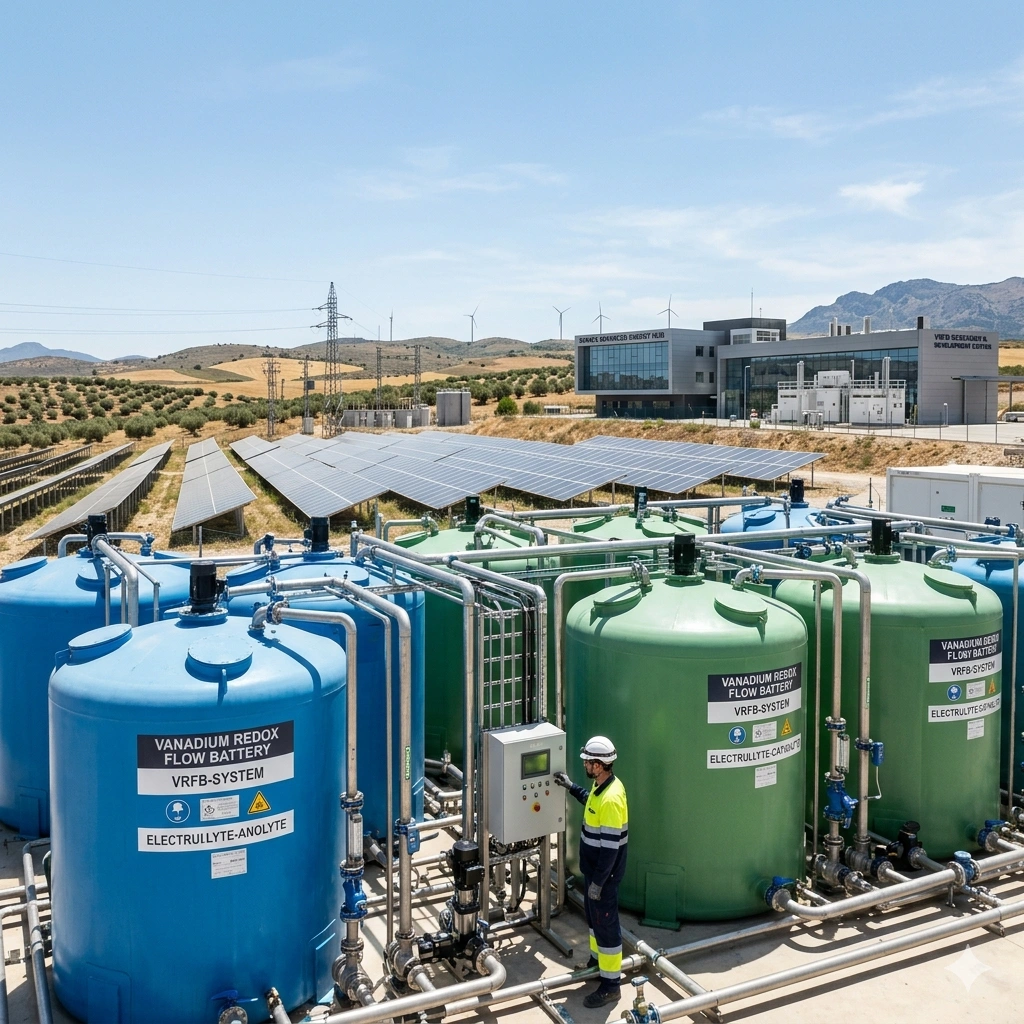
Spain has achieved a monumental milestone in the global energy transition by finalizing the most advanced Vanadium Storage Strategy 2026 at the Technology Development Center in Cubillos del Sil. The governmental agency Ciuden, operating under the Ministry for Ecological Transition, has successfully commissioned a massive 1 MW/8 MWh Vanadium Redox Flow Battery (VRFB). This project marks a significant shift in how European nations plan to manage long-duration energy storage as they phase out fossil fuels in favor of volatile renewable sources like wind and solar power.
The implementation of the Vanadium Storage Strategy 2026 is a direct response to the increasing need for grid stability and energy autonomy across the continent. By utilizing liquid electrolytes to store energy, this specific system provides over 15 hours of storage capacity, setting a new record for research and development infrastructure in Spain. This endurance is critical for balancing the electrical grid during extended periods without sunlight, ensuring that the green energy transition remains both reliable and economically viable for industrial consumers.
Industrial Impact of Vanadium Storage Strategy 2026
The technical success of the Vanadium Storage Strategy 2026 provides vital data for the future scalability of flow battery technology across the European Union. Unlike traditional lithium-ion systems that suffer from significant degradation over time, the vanadium-based liquid electrolyte allows for a service life exceeding 20 years with minimal capacity loss. This longevity makes it an ideal candidate for large-scale utility projects that require high initial capital investments but offer lower long-term operational costs compared to short-cycle battery chemistries.
Furthermore, the Vanadium Storage Strategy 2026 allows for the decoupling of power and energy ratings, providing a modular flexibility that is unique to flow batteries. Engineers can simply increase the volume of the electrolyte tanks to expand storage duration without needing to replace the entire power conversion system. This modularity is a game-changer for grid operators who need to adapt to changing energy demands over several decades, making the Cubillos del Sil facility a blueprint for future European energy hubs.
Vanadium Storage Strategy 2026
The core objective of the Vanadium Storage Strategy 2026 is to validate how different battery technologies can work in harmony within a single hybrid environment. The €6.4 million project, backed by NextGenerationEU funding, integrates the 8 MWh vanadium system with lithium-ion and sodium-sulfur batteries. This “singular experimental environment” allows researchers to test which chemistry performs best under specific load conditions, providing a comprehensive map for the next generation of renewable energy infrastructure.
By executing the Vanadium Storage Strategy 2026, Spain is positioning itself as a leader in the green hydrogen and storage sectors. The site also incorporates PEM and SOEC electrolyzers, which are powered by the energy stored in these massive battery arrays. This synergy between long-duration storage and hydrogen production is essential for decarbonizing heavy industries that cannot rely on direct electrification alone. The data gathered here will dictate the investment flow for European energy projects through the end of the decade.
Technological Synergy and Hybrid Energy Hubs
The integration of the Vanadium Storage Strategy 2026 within a 2.2 MWp solar plant demonstrates the potential for fully autonomous energy parks. By combining multiple storage types, the facility can handle rapid frequency fluctuations using lithium-ion while relying on the vanadium flow battery for long-term energy shifting. This hybrid approach ensures that no green energy is wasted, even during peak production times when the grid might otherwise be saturated.
Researchers at Ciuden are focusing on the efficiency and thermal management of the VRFB system during high-stress summer months. The Vanadium Storage Strategy 2026 involves monitoring the electrolyte’s chemical stability across thousands of cycles to ensure that the South Korean technology used in the project meets European industrial standards. These findings will be shared with various European partners to accelerate the deployment of flow batteries in regions with high solar penetration, such as Greece and Italy.
Economic Viability and NextGenerationEU Funding
The financial backing of the Vanadium Storage Strategy 2026 by the European Union highlights the strategic importance of energy independence. With a total investment of €6.4 million, this project serves as a pilot to prove that long-duration storage is no longer just a theoretical concept but a commercially ready solution. The success of the testing phase in Cubillos del Sil has already sparked interest from private investors looking to fund similar 100+ MWh projects across Spain’s northern provinces.
- Reducing reliance on rare-earth minerals found in traditional battery supply chains.
- Lowering the total cost of ownership (TCO) for municipal grid storage.
- Creating high-tech jobs in rural regions like Leon through green innovation.
- Establishing a domestic supply chain for vanadium processing and electrolyte production.
Environmental Benefits of Flow Battery Technology
A critical pillar of the Vanadium Storage Strategy 2026 is the sustainability of the materials used in the system. Unlike other battery types that rely on cobalt or nickel, vanadium is more abundant and the electrolyte can be fully recovered and reused at the end of the battery’s life. This circular economy potential aligns perfectly with the European Green Deal’s objectives, making the Vanadium Storage Strategy 2026 a model for environmentally conscious industrial development.
The environmental monitoring of the site in Cubillos del Sil has shown that the VRFB system has a minimal footprint compared to pumped hydro or other long-duration storage methods. The lack of fire risk associated with vanadium electrolytes—which are non-flammable—makes these systems much safer for deployment near residential areas or sensitive industrial zones. This safety profile is a key selling point for the widespread adoption of the Vanadium Storage Strategy 2026 in urban planning.
Vanadium Storage Strategy 2026
Under the Vanadium Storage Strategy 2026, the Technology Development Center is effectively acting as a “living lab” for the transition to a 100% renewable grid. The ability to test three distinct battery chemistries side-by-side provides an unbiased look at the strengths and weaknesses of each technology. While lithium remains king for mobility, the Vanadium Storage Strategy 2026 proves that flow batteries are the undisputed champions for stationary, long-duration applications.
The project also explores the role of AI-driven energy management systems in optimizing when to charge and discharge the VRFB. By integrating real-time weather data and market pricing, the Vanadium Storage Strategy 2026 aims to maximize the economic return of the stored energy. This intelligent layer is what transforms a simple battery into a sophisticated energy asset capable of supporting the entire Spanish electrical network during times of crisis.
Future Scaling and European Integration
The data produced by the Vanadium Storage Strategy 2026 will be instrumental in the drafting of new European energy regulations. As the EU looks to set mandatory storage targets for 2030, the results from the Ciuden facility will provide the empirical evidence needed to justify large-scale subsidies for flow battery technology. Spain is essentially performing the “heavy lifting” of R&D for the rest of the continent, ensuring that future projects are built on a foundation of proven performance.
- Testing interoperability between VRFB and green hydrogen electrolyzers.
- Evaluating the impact of extreme temperature variations on electrolyte density.
- Collaborating with South Korean tech partners to localize manufacturing in Iberia.
Long-Duration Storage as a Grid Necessity
As traditional coal and gas plants are decommissioned, the Vanadium Storage Strategy 2026 fills the critical gap in “firm” power capacity. Without long-duration storage, a grid powered by renewables would be vulnerable to the “dunkelflaute”—periods of low wind and sun. The 15-hour autonomy provided by the Ciuden system is exactly what is needed to ensure that hospitals, factories, and homes remain powered through the night and into the next morning.
The commitment to the Vanadium Storage Strategy 2026 signals to the global market that Spain is ready for the “post-lithium” era of energy storage. While the current 8 MWh system is impressive for research purposes, plans are already being drawn up for “gigafactories” of flow batteries. This industrial foresight is what will keep European energy prices competitive while achieving the ambitious carbon neutrality goals set for 2050.
Advancing Green Hydrogen Solutions
The synergy between the Vanadium Storage Strategy 2026 and the newly commissioned electrolyzers at the site cannot be overstated. By using the stored vanadium energy to run PEM and SOEC electrolyzers during off-peak hours, the facility creates a “dual-buffer” system. This ensures a constant, high-pressure flow of green hydrogen, which is notoriously difficult to produce using intermittent solar power alone.
The Vanadium Storage Strategy 2026 therefore supports not just the power grid, but also the emerging hydrogen economy. This multi-vector approach is the hallmark of modern energy planning, where electricity, heat, and gas are treated as part of a single, interconnected system. The Cubillos del Sil facility is currently the only place in Europe where this level of complex hybridization is being studied at an industrial scale.
Safety Standards and Operational Excellence
Operational safety is a top priority within the Vanadium Storage Strategy 2026 framework. The testing protocols developed by Ciuden include rigorous stress tests to simulate grid failures and extreme weather events. Because the vanadium electrolyte is water-based and non-flammable, the risk of thermal runaway—a common concern with lithium-ion batteries—is virtually eliminated. This inherent safety simplifies the permitting process and reduces insurance costs for future utility-scale deployments.
The Vanadium Storage Strategy 2026 also includes a dedicated training program for local technicians, ensuring that the workforce is prepared for the maintenance requirements of flow battery systems. This focus on human capital ensures that the transition to green energy also brings sustainable economic development to the Bierzo region. By investing in people as much as in hardware, Spain is creating a resilient ecosystem that can support the Vanadium Storage Strategy 2026 for decades to come.
Comparing VRFB to Sodium-Sulfur Performance
The side-by-side comparison of the Vanadium Storage Strategy 2026 with sodium-sulfur (NaS) technology is providing fascinating results for the scientific community. While NaS batteries offer high energy density, they operate at elevated temperatures and require specialized thermal management. In contrast, the vanadium flow battery operates at room temperature, which simplifies the balance-of-plant requirements and improves overall system reliability in the Mediterranean climate.
The Vanadium Storage Strategy 2026 data shows that for durations exceeding 8 hours, flow batteries become significantly more cost-effective than their solid-state counterparts. This finding is crucial for policy makers who are deciding where to allocate limited public funds. The results suggest a future where sodium-sulfur might handle mid-duration storage, while the Vanadium Storage Strategy 2026 becomes the standard for the longest storage durations required by the grid.
Conclusion: A New Era for European Energy
The finalization of the Vanadium Storage Strategy 2026 at Cubillos del Sil marks the beginning of a more mature phase in the renewable energy transition. No longer are we merely looking at how to generate green power; we are now perfecting the art of storing it for whenever it is needed. Spain’s leadership in this field, supported by the NextGenerationEU initiative, provides a clear roadmap for a decarbonized and energy-independent Europe.
As the Vanadium Storage Strategy 2026 moves from the testing phase to full industrial deployment, the lessons learned in Leon will echo across the global energy market. The modularity, safety, and longevity of the vanadium flow battery make it the ideal partner for the solar and wind farms of the future. With the completion of this 1 MW/8 MWh system, the world has one less excuse to delay the move away from fossil fuels, proving that the technology for a sustainable future is already here and operational.
For more details & sources visit: PV Magazine
Read more on Spain news: 360 News Orbit – Spain.