
UAE and Bahrain Swap Agreement is the focal point of a new era in Middle Eastern financial cooperation. The Central Bank of the United Arab Emirates and the Central Bank of Bahrain have officially executed a multi-billion dollar currency swap deal designed to facilitate smoother trade flows. By establishing a direct exchange mechanism for the Emirati dirham and the Bahraini dinar, both nations are actively reducing their historical dependency on third-party currencies for bilateral settlements. This strategic move, valued at approximately $5.44 billion, serves as a testament to the deepening economic ties within the Gulf Cooperation Council.
Furthermore, it highlights a broader regional shift toward monetary sovereignty and enhanced cross-border liquidity management. As global markets face ongoing volatility, this UAE and Bahrain Swap Agreement provides a robust buffer for financial stability, ensuring that both domestic banking sectors remain resilient and capable of supporting large-scale commercial activities across their shared borders.
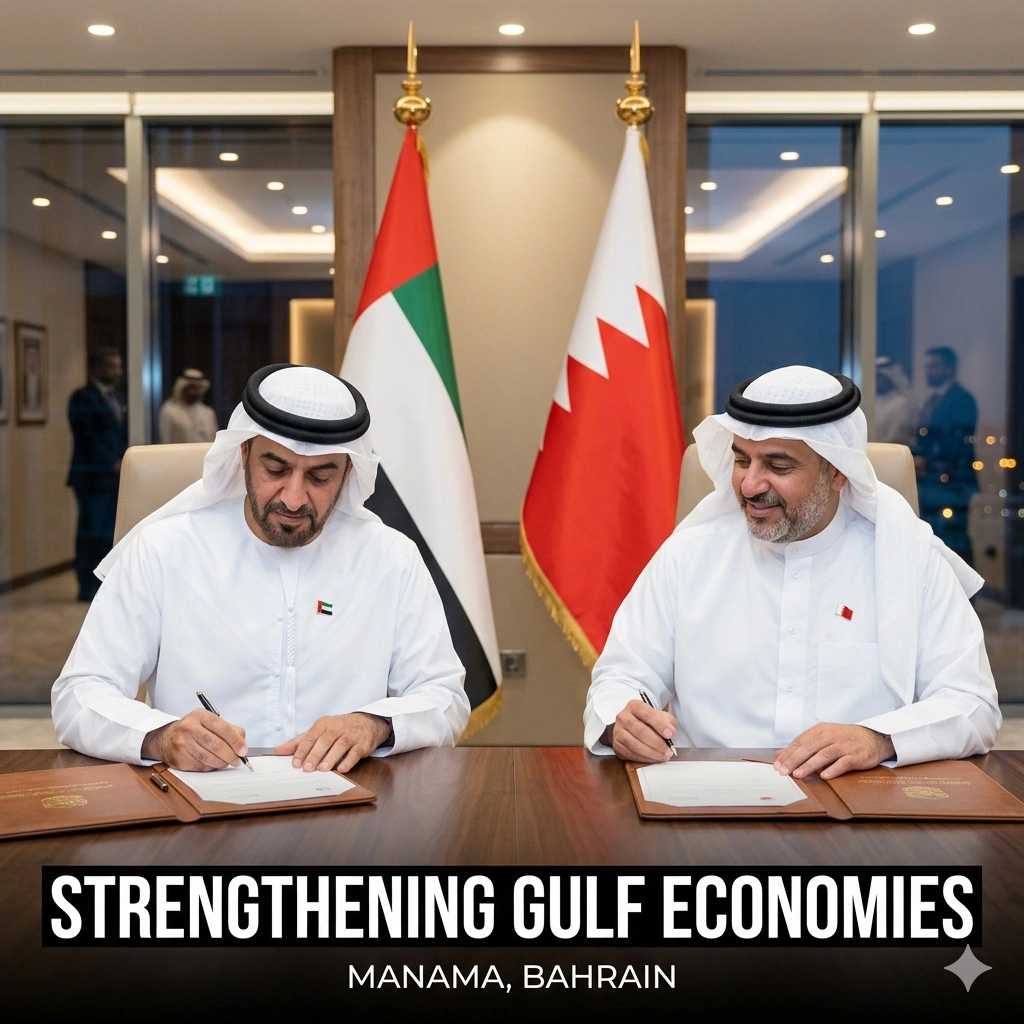
The Strategic Importance of the UAE and Bahrain Swap Agreement
The recent finalization of the UAE and Bahrain Swap Agreement represents a landmark moment for the financial sectors of both countries. Governors Khaled Mohamed Balama and Khalid Humaidan have signed a pact that effectively allows for the exchange of up to 20 billion Emirati dirhams. This massive liquidity injection is not merely about numbers; it is about creating a seamless financial bridge. By using local currencies, businesses can avoid the hidden costs associated with foreign exchange fluctuations and intermediary banking fees.
In addition to trade efficiency, the agreement strengthens the overall monetary framework of the GCC. It signals to international investors that the Gulf region is moving toward a more integrated and self-sustaining economic model. The ability to swap local currencies directly ensures that even during times of global dollar shortages, trade between Manama and Abu Dhabi can continue without interruption. Consequently, this initiative fosters a sense of long-term economic security and mutual trust between the two leading Arab economies.
Enhancing Regional Liquidity and Market Stability
One of the primary objectives of the UAE and Bahrain Swap Agreement is to maintain high levels of liquidity within the regional banking system. When commercial banks have access to local currency swap lines, they can offer more competitive financing rates to importers and exporters. This mechanism is crucial for maintaining the momentum of non-oil trade, which has become a priority for both nations under their respective economic diversification visions. Stability is the cornerstone of any successful financial market.
By stabilizing the supply of dirhams and dinars, the central banks are effectively dampening the impact of external economic shocks. This proactive approach to monetary policy shows a sophisticated understanding of modern global finance. Furthermore, the five-year duration of the deal provides a predictable environment for long-term project planning. Investors appreciate such consistency, as it allows for better risk assessment when committing capital to cross-border ventures in the renewable energy, technology, and manufacturing sectors.
UAE and Bahrain Swap Agreement
The specific terms of the UAE and Bahrain Swap Agreement allow for the exchange of local currencies for a period of five years. This duration is significant because it covers a critical window of economic transition for both countries as they move away from hydrocarbon reliance. The central banks have agreed on a ceiling of 20 billion dirhams, which translates to a substantial amount of Bahraini dinars. This high cap ensures that the agreement can accommodate even the most ambitious trade projections for the coming decade.
Technically, the swap functions as a mutual credit line that central banks can draw upon to meet the needs of their domestic markets. This is particularly useful for Bahrain, which seeks to bolster its financial services sector, and for the UAE, which is positioning itself as the primary global hub for trade and logistics. The UAE and Bahrain Swap Agreement is therefore a win-win scenario, providing the necessary tools for both central banks to intervene in their markets if liquidity ever becomes tight.
Driving Non-Oil Trade Through Local Currency Usage
The promotion of local currency usage is a central pillar of the UAE and Bahrain Swap Agreement. For decades, the US dollar has been the primary vehicle for trade in the Middle East, but this trend is slowly shifting. By utilizing the dirham and the dinar, the two nations are leading a movement toward de-dollarization in regional commerce. This shift is expected to lower the cost of doing business, making local products more competitive on the international stage while protecting small and medium enterprises.
Moreover, the agreement aligns perfectly with the UAE’s broader strategy of establishing similar swap lines with other major trading partners like China and Turkiye. By expanding this network to include Bahrain, the UAE is creating a web of financial interdependency that favors regional growth. The UAE and Bahrain Swap Agreement simplifies the accounting processes for multinational firms operating in both jurisdictions. This ease of operation is likely to attract more foreign direct investment into the Gulf, as the financial hurdles for cross-border expansion are significantly lowered.
Impact on the Banking Sectors of Abu Dhabi and Manama
Banks in both Abu Dhabi and Manama are set to benefit immensely from the UAE and Bahrain Swap Agreement. With better access to the neighboring country’s currency, banks can facilitate larger transactions without the need for complex hedging strategies. This efficiency naturally trickles down to the end consumer and the corporate client. Financial institutions can now manage their balance sheets with greater flexibility, knowing that a reliable swap mechanism exists at the central bank level.
Furthermore, this agreement encourages technical cooperation between the two regulatory bodies. As they manage the UAE and Bahrain Swap Agreement, officials will share data, best practices, and supervisory insights. This collaboration improves the overall health of the financial system by ensuring that both countries are aligned in their anti-money laundering and counter-terrorism financing efforts. The increased transparency resulting from this pact will likely lead to higher credit ratings for regional banks, further reducing their cost of borrowing on global markets.
Strengthening the Gulf Cooperation Council Framework
The UAE and Bahrain Swap Agreement serves as a blueprint for other GCC members to follow. While the idea of a single Gulf currency has been discussed for years, practical bilateral agreements like this one offer a more immediate and flexible solution. It demonstrates that financial integration can be achieved through strategic partnerships rather than just through a singular monetary union. This bottom-up approach to economic unity is proving to be highly effective in the current geopolitical climate.
As the UAE and Bahrain Swap Agreement enters its implementation phase, it will provide valuable data on the benefits of local currency swaps. Other nations in the region will be watching closely to see how this impacts inflation, trade volumes, and exchange rate stability. If successful, we could see a flurry of similar agreements across the Middle East, creating a more resilient and self-sufficient economic bloc. The leadership shown by the UAE and Bahrain in this regard is a clear indication of their commitment to a prosperous and integrated Arab world.
Future Outlook for UAE and Bahrain Economic Relations
Looking ahead, the UAE and Bahrain Swap Agreement is just the beginning of a deeper economic integration process. Both nations have expressed interest in expanding their cooperation to include digital currencies and fintech innovations. The infrastructure built to support this swap deal can eventually be adapted for a regional central bank digital currency (CBDC). Such a development would further revolutionize the way trade is conducted in the Gulf, making it even faster and more secure.
The UAE and Bahrain Swap Agreement also paves the way for joint investment funds and shared infrastructure projects. With the financial plumbing now firmly in place, the flow of capital between the two nations will naturally increase. We can expect to see more joint ventures in the tourism, real estate, and healthcare sectors. The commitment to a five-year term suggests that both governments are thinking long-term, ensuring that the UAE and Bahrain Swap Agreement remains a cornerstone of their bilateral relationship for years to come.
Conclusion and Financial Resilience
The successful signing of the UAE and Bahrain Swap Agreement marks a turning point in regional monetary policy. By prioritizing local currencies and liquidity, the two nations are building a fortress against global economic instability. The $5.44 billion deal is a significant investment in the future of the Gulf, proving that cooperation is the most effective tool for growth. As businesses start to utilize this new mechanism, the benefits of reduced costs and increased stability will become increasingly apparent.
Ultimately, the UAE and Bahrain Swap Agreement is a bold statement of economic confidence. It reflects the maturity of the financial markets in Abu Dhabi and Manama and their readiness to lead on the global stage. By providing a stable framework for trade and investment, this agreement ensures that the economic partnership between the UAE and Bahrain will continue to thrive. The UAE and Bahrain Swap Agreement stands as a shining example of how strategic financial planning can create a more prosperous and secure future for all stakeholders involved in the regional economy.
For more details & sources visit: Arab News
Read more about UAE news: 360 News Orbit – UAE.