
The Spain airspace closure has officially redefined the geopolitical landscape of Western Europe. This decisive move by the Spanish government effectively bars all United States military aircraft involved in “Operation Epic Fury” from utilizing Iberian skies or the strategic bases at Morón and Rota. Prime Minister Pedro Sánchez and Defense Minister Margarita Robles have taken a firm stand, labeling the ongoing U.S. strikes against Iran as “illegal” under international law.
This historic Spain airspace closure signals a dramatic rift within NATO, reflecting a level of diplomatic tension not seen since the 2003 Iraq War protests. By rejecting all flight plans related to U.S. operations in the Middle East, including essential aerial refueling missions, Madrid has forced the Pentagon to rethink its logistics. The White House has responded with sharp criticism, yet the Spanish administration remains steadfast in its commitment to a “no to war” policy that prioritizes national sovereignty over traditional allied expectations.
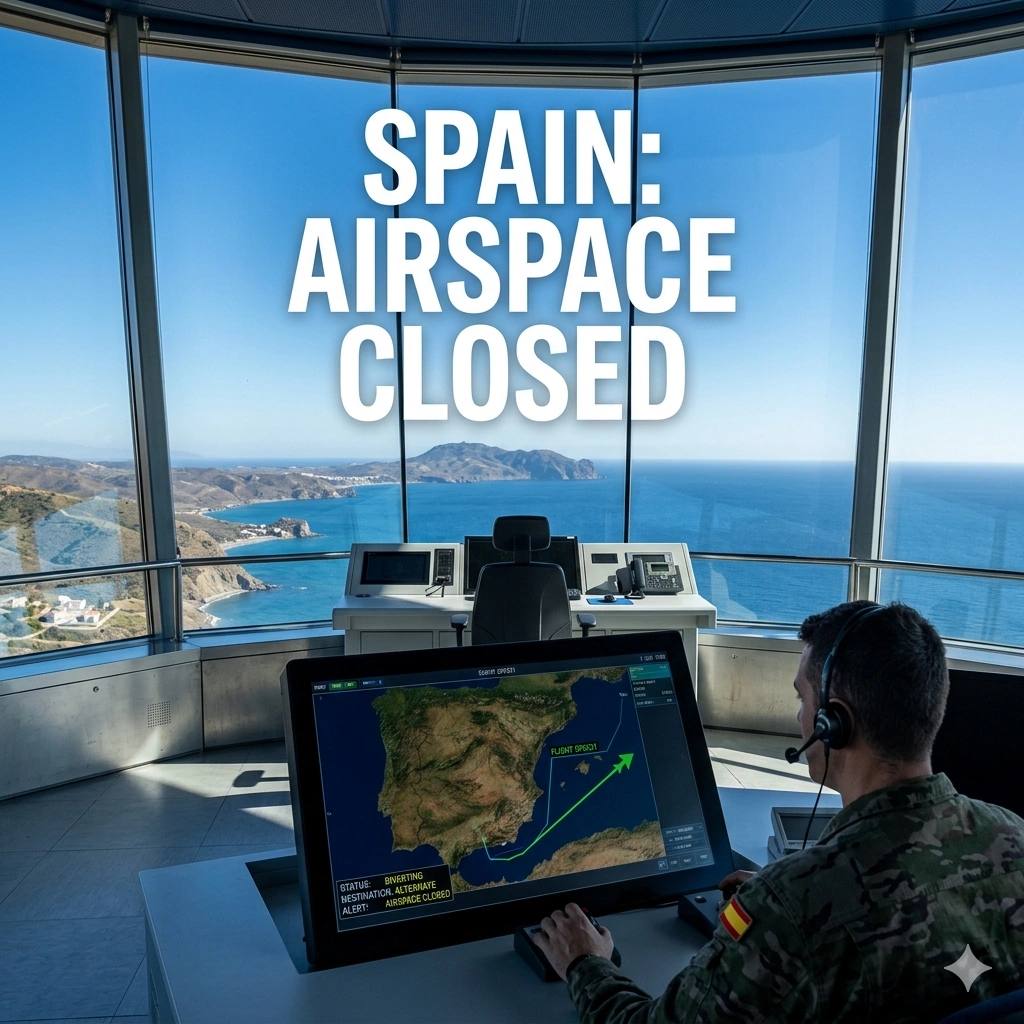
The Strategic Impact of the Spain Airspace Closure
The immediate consequence of the Spain airspace closure is the logistical nightmare it creates for U.S. bombers stationed at RAF Fairford in the United Kingdom. Without access to Spanish transit routes, these aircraft must now undertake significantly longer and more complex flight paths over the Atlantic Ocean or through French territory. This detour adds hours to mission times and increases the demand for specialized long-range refueling support, which Spain has also strictly prohibited within its sovereign borders.
Military analysts suggest that the Spain airspace closure demonstrates a significant vulnerability in the U.S. power projection capabilities within the Mediterranean. While the U.S. administration claims “Operation Epic Fury” is meeting its objectives without Spanish assistance, the increased operational costs and fuel consumption are undeniable. The refusal to allow even emergency refueling for combat-related missions underscores the severity of the diplomatic breakdown between Washington and Madrid during this escalating global crisis.
Spain Airspace Closure: A Sovereign Stand Against Escalation
Prime Minister Pedro Sánchez has invoked the spirit of historical anti-war sentiments to justify the Spain airspace closure to the public. He maintains that Spain will not be a silent partner in a conflict that lacks a clear United Nations mandate or a defensive justification. By implementing the Spain airspace closure, the government aims to prevent the country from being used as a “launchpad” for what it deems an unprovoked escalation of hostilities in the Middle East.
The decision has been met with widespread support within Spain’s domestic political sphere, though it remains a point of contention among conservative opposition groups. The Spain airspace closure is being framed by the Ministry of Defense as a necessary measure to protect Spanish interests and avoid becoming a target for retaliatory actions. Madrid has clarified that while it will allow emergency landings for aircraft in distress, it will provide no proactive support for the ongoing offensive against Iranian targets.
Economic Threats and the Trump Administration Response
The international reaction to the Spain airspace closure was swift, particularly from the White House. President Donald Trump has characterized the move as a betrayal by a key ally and has threatened a comprehensive trade embargo against Spanish goods. This potential economic retaliation casts a shadow over the Spain airspace closure, as industries ranging from olive oil to automotive manufacturing could face devastating tariffs or total bans in the American market.
Despite these looming threats, the Spanish cabinet appears prepared for the economic fallout of the Spain airspace closure. Minister Robles emphasized that “sovereignty cannot be bought,” suggesting that the moral and legal standing of the nation outweighs short-term financial pressure. The U.S. administration’s dismissal of the move as inconsequential contrasts sharply with the intensity of its diplomatic threats, indicating that the loss of Spanish bases is a more significant blow than the Pentagon is willing to admit publicly.
Unusual Geopolitical Alignments Following the Closure
An unexpected result of the Spain airspace closure has been a shift in relations between Madrid and Tehran. Following the announcement, Iranian officials signaled that they would be “receptive” to Spanish maritime transit through the Strait of Hormuz, which currently remains effectively closed to most Western shipping. This potential “reward” for Spain’s adherence to international law highlights the complex web of alliances being rewoven as a direct result of the Spain airspace closure.
However, critics warn that this alignment could further isolate Spain from its traditional partners in the European Union and NATO. The Spain airspace closure is viewed by some as a dangerous precedent that could weaken the collective security framework of the West. If more nations follow Spain’s lead, the U.S. military may find itself without the necessary European infrastructure to conduct large-scale operations, fundamentally altering the balance of power in the Atlantic and Mediterranean regions.
Historical Context: From 2003 to the 2026 Crisis
To understand the weight of the Spain airspace closure, one must look back at the 2003 protests against the Iraq War. The current administration has explicitly drawn parallels to that era, using the “no to war” slogan to unify the populace behind the decision. The Spain airspace closure is not merely a technical refusal of flight plans; it is a symbolic rejection of a specific style of unilateral military intervention that has long been unpopular with the Spanish electorate.
The 2026 crisis differs in its technological and economic landscape, making the Spain airspace closure even more impactful. With modern satellite tracking and advanced air defense systems, the enforcement of a closed airspace is more precise than ever before. Spain’s ability to monitor its borders ensures that the Spain airspace closure remains a physical reality rather than just a diplomatic statement. This level of control reinforces the government’s message that its territory will not be utilized for “Operation Epic Fury.”
The Future of the Rota and Morón Bases
The long-term status of the Rota and Morón bases is now in question due to the Spain airspace closure. These facilities have long been cornerstones of the U.S.-Spain defense relationship, hosting thousands of American personnel and sophisticated naval and aerial assets. If the Spain airspace closure persists, the utility of these bases for the U.S. Africa Command and European Command will be severely compromised, potentially leading to a permanent reduction in the American military footprint in Spain.
- The Rota Naval Base serves as a key port for U.S. Aegis destroyers.
- Morón Air Base is a vital hub for rapid response forces.
- The Spain airspace closure prevents these bases from supporting active combat missions.
- Future lease renewals for these facilities may be tied to stricter usage clauses.
The current standoff suggests that the Spain airspace closure could be the beginning of a larger renegotiation of defense treaties. As Madrid asserts its independence, the traditional “blank check” for base usage appears to be a thing of the past. The Spain airspace closure has set a new standard for how middle-tier powers might challenge the military objectives of superpowers when they conflict with national ethics and international law.
Global Reactions to the Spanish Decision
As the Spain airspace closure continues to dominate international headlines, other European nations are watching closely. While France has permitted some U.S. overflights, the public pressure in Paris and Berlin is mounting to follow the example set by the Spain airspace closure. If a “neutrality bloc” forms within Europe, the U.S. may find its “Operation Epic Fury” increasingly difficult to sustain from a logistical and political standpoint.
The United Nations has remained largely paralyzed by the conflict, but the Spain airspace closure has given a voice to those advocating for a diplomatic resolution. Supporters of the move argue that by withdrawing logistical support, Spain is actively working to de-escalate a potential third world war. The Spain airspace closure is seen by many as a courageous act of peace, even if it comes at the cost of a significant trade war with the world’s largest economy.
Technical Logistics of Bypassing Spanish Skies
For the U.S. Air Force, the Spain airspace closure requires a complete redesign of the Atlantic bridge. Pilots who previously relied on the predictable path over the Iberian Peninsula must now navigate the “Azores Gap” or seek permission from more distant African nations. These alternative routes are not only longer but often lack the sophisticated radar and emergency landing infrastructure that the Spain airspace closure has made unavailable.
The Spain airspace closure also impacts the deployment of unmanned aerial vehicles (UAVs). Many of the drones used for intelligence and surveillance in the Mediterranean were managed through Spanish infrastructure. Without this access, the operational range of these assets is halved, creating “blind spots” in the U.S. military’s theater awareness. The technical hurdles created by the Spain airspace closure demonstrate just how integrated the two nations’ defense systems were before this diplomatic break.
Conclusion: A New Era of Diplomatic Independence
The Spain airspace closure marks a definitive end to the era of unquestioned European cooperation in U.S.-led military campaigns. By prioritizing international law and sovereign principles, Madrid has signaled that its territory is not a tool for external foreign policy objectives. The Spain airspace closure will likely be remembered as the moment when a major European power chose to risk economic ruin to uphold its “no to war” convictions.
As the conflict in Iran continues, the Spain airspace closure remains a significant obstacle for “Operation Epic Fury.” Whether this lead to a peaceful resolution or a deeper isolation for Spain remains to be seen, but the message is clear. The Spain airspace closure has proved that even in an interconnected world, a single nation can still assert its will against the most powerful military force on Earth.
For more details & sources visit: BBC News
Read more on Spain news: 360 News Orbit – Spain.