
Sheinbaum Diplomatic Warning measures have officially reshaped the geopolitical relationship between Mexico and the United States. This formal protest follows a high-stakes incident in northern Mexico where unauthorized American officials were discovered during a domestic anti-narcotics mission. This move signals a firm stance by the Sheinbaum government on protecting national sovereignty against foreign intelligence overreach. The tension reached a breaking point after a tragic event revealed the secret cooperation between regional forces and foreign agents.
The controversy began in the state of Chihuahua, where a fatal car crash claimed the lives of four individuals on April 19. Among the deceased were two Mexican officials and two American personnel, identified by various sources as CIA officers. President Sheinbaum confirmed that her government was entirely unaware of the Americans’ involvement in the tactical operation. Consequently, the diplomatic note serves as a stern reminder that all foreign cooperation must be authorized at the highest federal levels to remain legal.
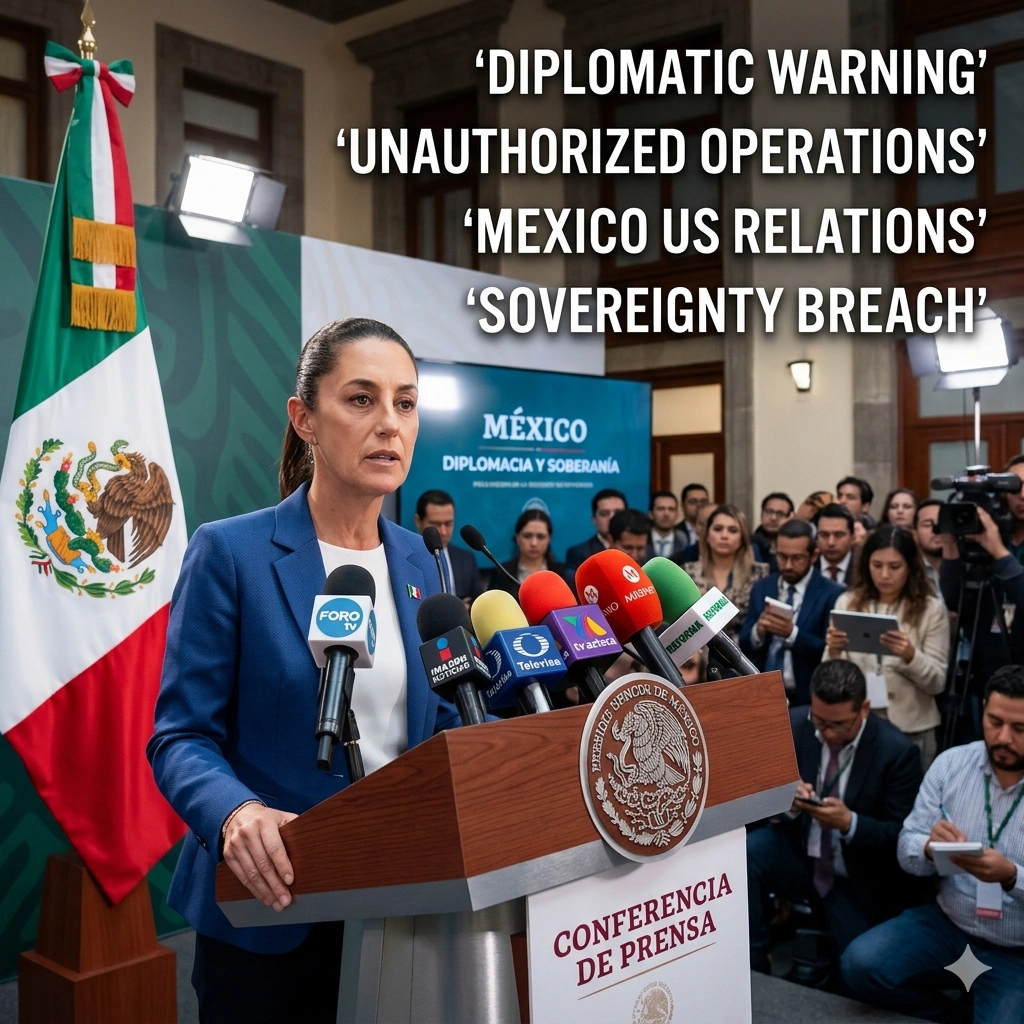
The Chihuahua Incident and the Sheinbaum Diplomatic Warning
The core of the Sheinbaum Diplomatic Warning stems from a total lack of transparency during a sensitive mission. Chihuahua has long been a focal point for high-stakes anti-drug efforts due to its proximity to the United States border. However, the discovery of foreign agents at a crash site, following a tactical mission, suggests a bypass of official protocols. The Mexican government is now investigating how these officials were integrated without proper clearance from the National Security Council.
Official reports indicate that the crash occurred shortly after the conclusion of the anti-narcotics activity in the region. The fact that American personnel were physically present and active in the field without the knowledge of the Mexican federal government is seen as a major breach. President Sheinbaum emphasized that Mexico maintains strict control over its internal security and law enforcement actions. This incident has forced a public confrontation over the “gray zone” of intelligence cooperation that has existed for decades.
The administrative response has been swift, with federal investigators descending on local police headquarters to audit communication logs. The Sheinbaum Diplomatic Warning is not just a letter; it is a mandate for a complete forensic review of how local-state pacts are formed. Many believe that without this intervention, the sovereignty of the Mexican state would continue to erode at the border. This investigation aims to restore a unified chain of command that starts and ends in Mexico City.
Sheinbaum Diplomatic Warning
The issuance of the Sheinbaum Diplomatic Warning is a calculated move to redefine the terms of engagement with the U.S. By delivering a formal note, Mexico is asserting that its territory is not a playground for foreign agencies. The administration’s stance is that cooperation is welcome, but only when it respects the legal framework of the host nation. This assertion of power is meant to deter future clandestine activities by foreign entities that bypass federal oversight.
Sheinbaum’s administration has been vocal about moving away from the secretive security arrangements of the past. The Sheinbaum Diplomatic Warning reflects a broader policy of “public diplomacy” where security breaches are handled openly rather than behind closed doors. This shift aims to build public trust in Mexican institutions while signaling to global powers that Mexico’s sovereignty is non-negotiable. The diplomatic note is the first step in a likely overhaul of regional security protocols.
By making this a public issue, the President has effectively forced the U.S. State Department to acknowledge the presence of its agents. This transparency prevents the “plausible deniability” that often accompanies covert intelligence work in foreign territories. The Sheinbaum Diplomatic Warning ensures that every foreign agent working on Mexican soil is known to the federal government. This level of accountability is unprecedented in the modern history of the two neighboring nations.
Evaluating the Impact on Intelligence Sharing
The Sheinbaum Diplomatic Warning could have long-term effects on how the two nations share critical data. If the United States feels that its agents are not welcome or that cooperation is too bureaucratic, the flow of intelligence might slow down. Conversely, Mexico argues that without oversight, foreign operations can lead to unintended casualties and political instability. Balancing these two needs is the primary challenge for diplomats throughout the remainder of 2026.
Mexican authorities are currently drafting a new framework for bilateral intelligence exchanges. This framework will likely include mandatory registration for all foreign technical advisors entering high-conflict zones like Chihuahua. While this may slow down immediate tactical responses, the government argues it will prevent catastrophic diplomatic failures. The Sheinbaum Diplomatic Warning is the catalyst for this much-needed structural reform in the security sector.
- Intelligence sharing must now be documented through official federal channels.
- Foreign officials are restricted from participating in active field operations without explicit permits.
- Mexican authorities will conduct a full audit of local security agreements in border states.
- Bilateral meetings will be required to establish new “rules of the road” for anti-drug missions.
Analyzing the Fatal Crash in Chihuahua
The tragic accident that triggered the Sheinbaum Diplomatic Warning remains under intense scrutiny. The death of two Mexican officials and two suspected CIA officers in a single vehicle is a rare and highly visible failure of operational security. It provides undeniable evidence of the deep-seated, yet unacknowledged, involvement of the U.S. in Mexican field operations. This physical proof made it impossible for either government to ignore the breach.
Investigations are focused on the “tactical operation” that preceded the crash. If the operation was successful in its anti-narcotics goals, the victory has been completely overshadowed by the diplomatic fallout. The Sheinbaum Diplomatic Warning highlights that the ends do not justify the means when it comes to national law. The loss of life has added a layer of human tragedy to an already complex geopolitical dispute between the neighbors.
Mechanical experts are also examining the vehicle involved in the crash to rule out foul play or external interference. Because the individuals involved were high-ranking officials and specialized agents, the stakes of the investigation are incredibly high. The Sheinbaum Diplomatic Warning has ensured that the findings of this investigation will be shared with the public. This commitment to truth is intended to prevent conspiracy theories from damaging the national interest.
Potential Consequences for US-Mexico Relations
The fallout from the Sheinbaum Diplomatic Warning may lead to a cooling of relations in other sectors. Security and trade are often interlinked in the North American relationship, and a dispute in one can bleed into the other. However, Sheinbaum has remained focused specifically on the issue of unauthorized personnel. This surgical approach to diplomacy aims to fix the security loophole without causing a total breakdown in communication.
Washington has yet to issue a public response to the specific allegations regarding the status of the deceased CIA personnel. Silence from the United States often indicates a period of internal review or a desire to handle the matter quietly. However, the Sheinbaum Diplomatic Warning has already set the tone for all future discussions. Any future collaboration will likely be subject to much more rigorous inspections and legal vetting by Mexican federal authorities.
There is also the question of how this affects the United States-Mexico-Canada Agreement (USMCA) frameworks. If security cooperation becomes a point of contention, it could theoretically impact cross-border logistics and supply chains. The Sheinbaum Diplomatic Warning serves as a reminder that economic partnerships cannot thrive without a foundation of mutual respect for legal boundaries. Traders and investors are watching the situation closely to gauge the stability of the region.
Sovereignty and the New Security Framework
A major theme of the Sheinbaum Diplomatic Warning is the restoration of dignity to Mexican law enforcement. For years, critics have argued that foreign agencies have had too much influence over domestic police and military units. By taking a stand, Sheinbaum is addressing these domestic concerns and consolidating her power. The warning is as much for a domestic audience as it is for the international community.
The administration plans to invest heavily in independent Mexican intelligence capabilities to reduce reliance on foreign hardware and data. This “technological sovereignty” is a key pillar of the post-warning strategy. By developing domestic tools for drug interdiction, the government hopes to eliminate the need for clandestine foreign assistance. The Sheinbaum Diplomatic Warning is the ideological starting point for this massive shift in national defense policy.
- Establishing a centralized database for all authorized foreign security advisors.
- Implementing stricter monitoring of border-state tactical missions by federal observers.
- Enhancing the training of Mexican officials to handle high-level intelligence independently.
- Reviewing the legal status of all private security firms operating near the border.
Historical Context of Unauthorized Operations
To understand the weight of the Sheinbaum Diplomatic Warning, one must look at the history of the “Merida Initiative” and subsequent agreements. These programs often allowed for close cooperation, but the lines of authority were sometimes blurred. The current incident in Chihuahua suggests that those blurred lines have become a liability. Sheinbaum is looking to draw a clear, sharp line that cannot be crossed without consequences.
In previous decades, such incidents might have been swept under the rug to maintain the appearance of a unified front against cartels. However, the Sheinbaum Diplomatic Warning indicates that the current administration values sovereignty over the appearance of unity. This shift is a response to years of public outcry over foreign intervention in Mexican affairs. It represents a “Mexico First” approach to internal security and regional law enforcement.
Historical records show that previous administrations often felt pressured to accept foreign “boots on the ground” in exchange for financial aid. The Sheinbaum Diplomatic Warning signals that Mexico’s current economic position allows it to say no to such conditions. The era of unconditional cooperation is over, replaced by a model of negotiated and transparent engagement. This evolution reflects Mexico’s growing confidence as a regional leader.
The Role of Chihuahua in Modern Drug Interdiction
The geographic importance of Chihuahua cannot be overstated in the context of the Sheinbaum Diplomatic Warning. As a massive border state, it is the primary corridor for both legal trade and illegal trafficking. This makes it a natural magnet for both Mexican and American intelligence activities. The problem arises when these activities are not synchronized with the central government’s strategic vision.
The Sheinbaum Diplomatic Warning specifically targets the “integration” of foreign officials into local operations. This suggests that local or state-level commanders in Chihuahua may have been working directly with U.S. agents. This “bottom-up” cooperation is exactly what the federal government wants to stop. By centralizing authority, Sheinbaum hopes to eliminate the rogue elements that lead to unauthorized foreign presence.
Local residents in Chihuahua have often reported seeing unmarked vehicles and foreign-speaking personnel in rural areas. The Sheinbaum Diplomatic Warning gives a voice to these concerns and promises a more visible federal presence. By reclaiming the streets from unauthorized actors, the government aims to reduce the violence associated with shadow operations. This is a vital step in pacifying one of Mexico’s most volatile regions.
Global Reactions to the Diplomatic Note
The Sheinbaum Diplomatic Warning has been noted by other nations that deal with U.S. security cooperation. Countries in Europe and Southeast Asia are watching to see if Mexico can successfully push back against the CIA’s operational methods. If Mexico succeeds in enforcing its rules, it could provide a blueprint for other middle powers to reassert their own sovereignty. This makes the dispute a matter of global significance in 2026.
Diplomatic sources suggest that the note was phrased in a way that is firm but leaves room for future dialogue. The Sheinbaum Diplomatic Warning is not an end to the relationship, but a demand for its evolution. It asks for a partnership based on mutual respect rather than one-sided intervention. This nuanced approach has earned Sheinbaum praise from international legal experts who value the principle of non-intervention.
Furthermore, the United Nations has been briefed on the incident as a matter of international protocol. While it remains a bilateral issue, the Sheinbaum Diplomatic Warning sets a precedent for how sovereign states should handle “mission creep” by foreign intelligence agencies. Other Latin American leaders have expressed solidarity with Mexico, viewing the move as a win for the entire region. The warning has effectively strengthened Mexico’s position as a diplomatic heavyweight.
Investigating the Local Chain of Command
A critical part of the aftermath of the Sheinbaum Diplomatic Warning is the internal investigation. Investigators are looking for the “paper trail”—or lack thereof—that allowed the American personnel into the mission. This involves questioning local police chiefs and military commanders in northern Mexico. The President has made it clear that any Mexican official who facilitated the unauthorized presence will also face consequences.
The Sheinbaum Diplomatic Warning serves as a deterrent to any local leader thinking of bypassing federal law for the sake of efficiency. It reinforces the idea that the federal government is the sole arbiter of international relations. This internal consolidation of power is essential for Sheinbaum’s broader reform agenda. By cleaning up the local chain of command, she aims to create a more disciplined and accountable security force across the entire nation.
Several high-ranking local officials have already been suspended pending the outcome of the Chihuahua inquiry. This demonstrates that the Sheinbaum Diplomatic Warning is backed by real action and political will. The message is clear: working with foreign entities without permission is a violation of the national oath. This purge of “independent” actors is expected to streamline federal anti-drug efforts in the long run.
The Future of the US-Mexico Security Alliance
Despite the Sheinbaum Diplomatic Warning, the two nations are destined to remain close partners due to geography. The sheer volume of shared interests in trade, migration, and energy ensures that the relationship cannot be discarded. However, the alliance is entering a more mature phase where “unauthorized operations” are no longer tolerated. This evolution is necessary for the long-term health of the North American security bloc.
The Sheinbaum Diplomatic Warning marks the beginning of a more transparent era of cooperation. Both sides will likely spend the coming months drafting new protocols that provide the U.S. with the intelligence it needs while respecting Mexico’s right to lead. If successful, this could lead to a more effective and legally sound strategy against organized crime. The tragedy in Chihuahua, while painful, may eventually be seen as the catalyst for a better security framework.
Future summits will likely focus on “shared responsibility” with a heavy emphasis on legal documentation. The Sheinbaum Diplomatic Warning has effectively removed the ambiguity from the relationship. Moving forward, both parties will have to be more explicit about their goals and their methods. This clarity will reduce the risk of accidents and ensure that both nations are moving in the same strategic direction.
Reasserting Federal Control Over Northern States
The Sheinbaum Diplomatic Warning is also a message to the northern states of Mexico. These regions often have a different political and economic dynamic than the capital. By asserting federal control over security missions in Chihuahua, Sheinbaum is reinforcing national unity. She is ensuring that the laws of Mexico City are the laws of the entire country, including the sensitive border regions.
This move helps to prevent the “fragmentation” of the security state, where different provinces have different relationships with foreign powers. The Sheinbaum Diplomatic Warning is a unifying force that brings the focus back to national law. It ensures that the sovereign state speaks with one voice on the international stage. This level of coordination is vital for a country facing complex internal and external challenges in the 21st century.
- Implementing regional oversight committees that report directly to the President.
- Standardizing tactical procedures for all joint-force operations.
- Increasing the federal budget for border patrol and state-level intelligence monitoring.
- Establishing a hotline for reporting unauthorized foreign military presence.
Conclusion: A New Chapter in North American Diplomacy
The Sheinbaum Diplomatic Warning is a landmark event in the 2026 political calendar. It showcases a leader who is unafraid to challenge a superpower to protect her nation’s legal principles. While the incident that sparked the warning was tragic, the resulting diplomatic stance is a bold step toward a more balanced relationship with the United States. Mexico has made its position clear: sovereignty is the foundation of any partnership.
As we move forward, the impact of the Sheinbaum Diplomatic Warning will be felt in every joint operation and high-level meeting. It serves as a permanent record of Mexico’s commitment to its own laws and its people. The world will continue to watch as Sheinbaum navigates these turbulent waters, balancing the need for security with the absolute requirement of national respect. This is a new chapter for Mexico, defined by strength, clarity, and a firm hand on the wheel of history.
Ultimately, the Sheinbaum Diplomatic Warning proves that diplomacy is the most effective tool for maintaining order. By standing firm, Mexico has not only protected its borders but also its dignity. The lessons learned from the Chihuahua crash will inform security policy for generations to come. In 2026, the message is unmistakable: cooperation is a choice made by equals, not a requirement imposed by others.
For more details & sources visit: The Nation
Read more on Mexico news: 360 News Orbit – Mexico