
Saker Falcon Restoration efforts reached a historic milestone, as Kazakhstan and Saudi Arabia joined forces to save one of the world’s most iconic birds of prey. In a high-tech conservation move, 34 endangered falcons were released into the vast Kazakh steppe, marking the first phase of a dedicated three-year recovery program. This initiative, led by the Saudi Falcons Club in partnership with Kazakh research institutes, seeks to reverse a devastating 90% decline in the local population. By combining traditional reverence with modern satellite tracking, both nations are working to ensure that this symbol of nomadic nobility does not vanish from the wild.
The Saker Falcon Restoration project is a direct response to the critical survival crisis facing the species due to habitat loss and environmental shifts. With plans to release up to 45 birds annually through 2028, the program represents one of the most ambitious avian conservation drives in Central Asian history. Kazakhstan remains the primary nesting ground for these majestic raptors, making the success of this Saudi-backed initiative vital for the entire regional ecosystem. As the first wave of falcons takes to the sky, the world watches a masterclass in cross-border environmental diplomacy and scientific innovation.
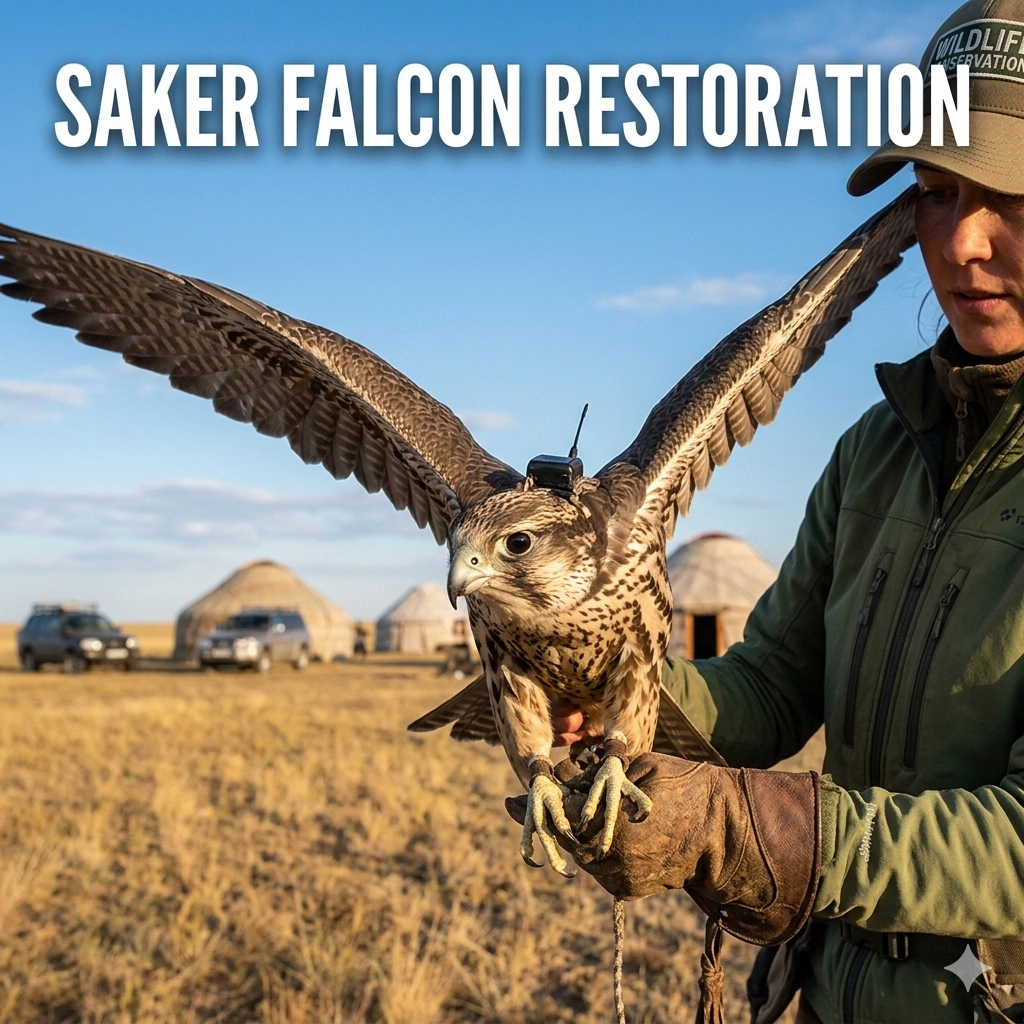
Saker Falcon Restoration
The Saker Falcon Restoration program is specifically designed to combat the staggering loss of biodiversity across the Eurasian landmass. For centuries, the Saker falcon has been a deeply revered symbol of status and nobility for the nomadic peoples of Central Asia and the Arabian Peninsula. However, the modern era has brought challenges such as illegal poaching and the destruction of natural nesting sites. This restoration drive aims to restore the natural balance by reintroducing healthy, captive-bred birds into their ancestral habitats under strict scientific supervision.
By targeting a “Red List” species, the Saker Falcon Restoration initiative highlights the urgency of protecting specialized predators at the top of the food chain. The decline of the falcon often signals broader environmental degradation that affects smaller mammals and local vegetation. Therefore, saving the falcon is about more than just one species; it is about preserving the health of the entire Kazakh steppe. The collaboration between the Saudi Falcons Club and Kazakh scientists provides the necessary resources and expertise to tackle these complex ecological issues head-on.
High-Tech Monitoring and GPS Tracking
A defining feature of the Saker Falcon Restoration drive is the integration of advanced technology to monitor the birds after their release. Every single falcon in the first wave of 34 birds has been equipped with a lightweight GPS tracker and a specialized microchip. These devices allow researchers to gather real-time data on migration patterns, hunting grounds, and eventual breeding behaviors across a range that stretches from China to Central Europe. This data is essential for identifying which areas of the steppe require the most protection from human interference.
The use of GPS technology in Saker Falcon Restoration allows scientists to intervene if a bird wanders into a high-risk zone, such as areas with dangerous power lines or active poaching sites. This level of granular detail was previously impossible and provides a much higher survival rate for reintroduced individuals. By analyzing the flight paths, the joint Saudi-Kazakh team can also determine the best locations for future releases. Technology is proving to be the ultimate ally in the fight to bring this endangered raptor back from the brink of extinction.
Cultural Significance and Nomadic Heritage
The Saker falcon occupies a unique place in the hearts of both Kazakh and Saudi citizens, serving as a living link to their shared nomadic heritage. In Kazakhstan, the bird is a national symbol of freedom and strength, often appearing in traditional art and folklore. In Saudi Arabia, falconry is an ancient sport and a respected cultural practice that has been passed down through generations. These shared values make the Saker Falcon Restoration project a natural point of cooperation between the two distant but culturally aligned nations.
- Falconry is recognized by UNESCO as an Intangible Cultural Heritage of Humanity, emphasizing the need for sustainable populations in the wild today.
- The Saker Falcon Restoration drive educates the local public on the importance of protecting wild nests rather than taking birds for private use.
- Cultural festivals in both Almaty and Riyadh now feature sections dedicated to the science of conservation and the progress of the restoration drive for the future.
- By honoring the bird’s history, the project gains widespread public support, which is crucial for the long-term success of environmental laws.
Addressing the 90% Population Decline
The statistics surrounding the species are grim, with some areas of Kazakhstan reporting a 90% drop in active breeding pairs over the last two decades. The Saker Falcon Restoration project is a localized response to this global trend, focusing on the areas where the impact has been most severe. Habitat loss due to expanding agriculture and industrial development has left the birds with fewer places to hunt and raise their young. The restoration drive aims to create “safe zones” where the birds can thrive without the threat of habitat fragmentation.
Researchers involved in the Saker Falcon Restoration efforts are also looking at the impact of climate change on the falcon’s prey species, such as ground squirrels and small birds. If the food source disappears, the falcons cannot survive, regardless of how many are released. Therefore, the program includes a component of habitat restoration to ensure the steppe remains a viable home for all native wildlife. Reversing a 90% decline is a monumental task, but the steady release of 35 to 45 birds per year provides a glimmer of hope for a full recovery.
Collaboration with the Saudi Falcons Club
The Saudi Falcons Club has emerged as a global leader in avian conservation, providing the funding and logistical support for this Saker Falcon Restoration drive. Their expertise in breeding and handling falcons is world-class, ensuring that the birds released into the wild are in peak physical condition. This partnership demonstrates how private organizations can work effectively with government research institutes to achieve significant environmental goals. The club’s commitment to the project extends through 2028, promising a sustained effort rather than a one-time publicity event.
The Saker Falcon Restoration initiative also involves training Kazakh biologists in the latest falconry-based conservation techniques. This knowledge exchange strengthens the local capacity for wildlife management and ensures the project’s sustainability long after the Saudi funding concludes. By building a network of experts across the Middle East and Central Asia, the Saudi Falcons Club is creating a unified front against the illegal wildlife trade. Their work is a testament to the power of passion-driven conservation in the modern world.
Future Projections for the Species in 2028
If the Saker Falcon Restoration project continues at its current pace, experts predict a significant stabilization of the population by the end of 2028. The goal is to establish at least 150 new breeding pairs across the protected regions of the Kazakh steppe. This would provide a sufficient genetic cushion to protect the species from localized disasters or disease outbreaks. The success of this project could serve as a template for other endangered raptors, such as the Peregrine or the Gyrfalcon, in other parts of the world.
- Annual releases of 45 birds will continue to bolster the wild population, creating a self-sustaining community of raptors in the long term.
- Data from the GPS trackers will be published in international journals to help other conservationists improve their own restoration techniques.
- The Saker Falcon Restoration drive may expand to include neighboring countries like Uzbekistan and Kyrgyzstan if the initial results are positive.
- By 2028, the project aims to have mapped the entire migration corridor of the Central Asian Saker falcon for the first time in history.
Environmental Challenges and Human Impact
Despite the progress of the Saker Falcon Restoration drive, human-made obstacles continue to pose a threat to the birds’ survival. Illegal trapping for the black market remains a lucrative but destructive trade that targets the healthiest and most beautiful specimens. The Kazakh government has increased penalties for poaching as part of the restoration agreement, but enforcement in the vast, remote steppe remains difficult. This is why the microchipping process is so important, as it allows authorities to identify and recover stolen birds.
Another major challenge to Saker Falcon Restoration is the prevalence of non-insulated power lines, which can electrocute large birds when they attempt to perch. Collaborative efforts are underway to encourage energy companies to install “bird-safe” equipment in key migratory paths. This requires a significant investment in infrastructure but is a necessary step for the long-term safety of all large birds of prey. Addressing these human impacts is just as important as the physical release of the birds into the wild.
The Role of the Kazakh Research Institute
The Kazakh Research Institute of Zoology is the local scientific anchor for the Saker Falcon Restoration project. Their scientists possess intimate knowledge of the steppe’s geography and the specific subspecies of falcons that inhabit the region. They are responsible for selecting the release sites and monitoring the health of the local ecosystems to ensure they can support the new arrivals. Their dedication to the Saker Falcon Restoration drive is fueled by a desire to protect a vital part of their national identity.
The institute also manages the database for the GPS tracking information, providing the analytical backbone for the entire project. By studying the survival rates of the released birds versus wild-born ones, they can refine the captive-breeding process to produce more resilient falcons. This scientific approach ensures that the Saker Falcon Restoration drive is based on hard evidence rather than just optimism. The partnership between the institute and the Saudi Falcons Club is a model of successful international scientific cooperation.
Strategies for a Successful Reintroduction
- Soft-release techniques where the birds are kept in large aviaries at the release site for several weeks to acclimate to the local environment and weather.
- Supplemental feeding during the first few weeks after release to ensure the falcons do not starve while they are learning to hunt in the wild steppe.
- Strict veterinary screening before release to prevent the introduction of domestic avian diseases into the wild population of the Central Asian region.
- Continuous community engagement to turn local farmers and herders into “falcon guardians” who report any sightings or threats to the authorities.
Balancing Tradition and Conservation
The Saker Falcon Restoration project is a unique example of how traditional practices can be adapted to serve modern conservation goals. While falconry was once purely a method of hunting, it has now become a powerful tool for preserving the species. The skills required to train and care for a falcon are the same skills needed to successfully reintroduce them into the wild. This evolution of tradition shows that heritage and environmentalism can go hand-in-hand to create a better future.
By involving traditional falconers in the Saker Falcon Restoration drive, the project gains access to centuries of practical knowledge about bird behavior and health. These experts can often spot subtle changes in a bird’s condition that might be missed by laboratory equipment alone. This blend of “citizen science” and high-level biology is what makes the project so effective and culturally resonant. The Saker falcon is more than just a biological specimen; it is a living bridge between the past and the future of two great cultures.
Conclusion on the Saudi-Kazakh Partnership
The launch of the Saker Falcon Restoration drive on April 4, 2026, marks the beginning of a new chapter for wildlife conservation in Eurasia. The release of 34 birds is a small but significant step toward reclaiming the steppe for this endangered species. Through the combined efforts of Kazakhstan and Saudi Arabia, the Saker falcon has a fighting chance to thrive once again. This project proves that when nations work together for a common environmental goal, the results can be truly transformative for the planet.
As the program progresses toward its 2028 goals, the data gathered will undoubtedly change our understanding of avian migration and survival. The Saker Falcon Restoration drive is a testament to what can be achieved with vision, technology, and a deep respect for nature. We must continue to support these international efforts to protect our shared natural heritage. The flight of the Saker falcon is a reminder that even in a rapidly changing world, some things are worth the effort to save and protect for the generations to come.
For more details & sources visit: Dawn
Read more about Saudi Arabia news on 360 News Orbit – Saudi Arabia.