
The Quantum 101 Saudi Renewable Energy project is a visionary leap into the future of global power management and sustainable infrastructure. Researchers at King Abdullah University of Science and Technology (KAUST) are currently exploring how quantum computing can stabilize the Kingdom’s rapidly expanding green grid. As Saudi Arabia targets a massive fifty percent electricity generation from renewable sources by 2030, the need for advanced computational power has never been more urgent. This initiative represents a fusion of high-tech innovation and environmental stewardship, ensuring that the nation’s energy transition is both smooth and economically viable.
The Quantum 101 Saudi Renewable Energy initiative is specifically designed to address the inherent volatility of solar and wind power. Traditional supercomputers often struggle with the sheer number of variables involved in predicting cloud cover, wind speeds, and fluctuating energy demand across a vast desert landscape. Quantum processors, however, handle these complex environmental challenges by processing massive datasets in parallel, offering insights that were previously considered unsolvable. This shift toward quantum-enhanced grid management is a cornerstone of the Kingdom’s Vision 2030, marking a departure from fossil fuel reliance toward a tech-driven future.
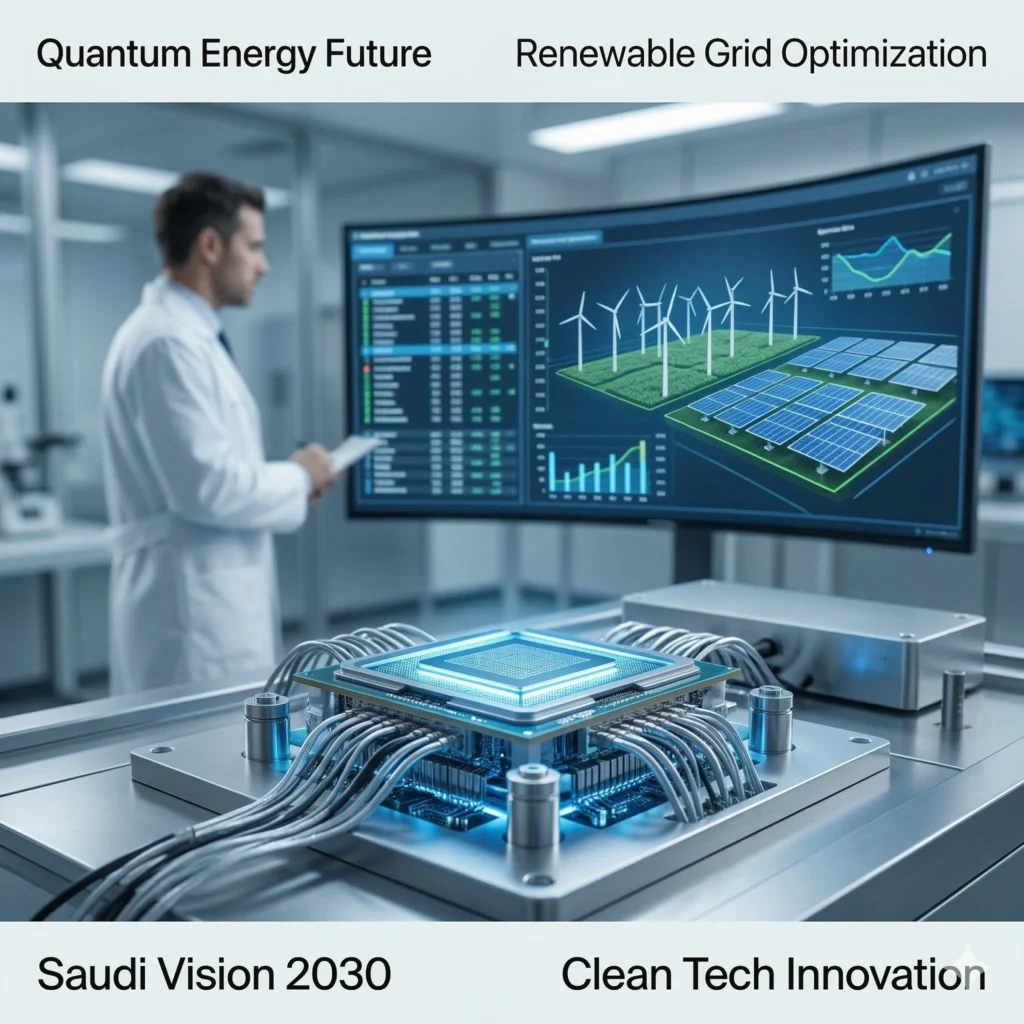
Analyzing the Quantum 101 Saudi Renewable Energy Grid Stability
Grid stability is the primary focus of the Quantum 101 Saudi Renewable Energy project, as the intermittent nature of renewables can cause significant disruptions. When a cloud passes over a massive solar farm, the sudden drop in voltage must be compensated for instantly by other energy sources. Quantum algorithms can predict these fluctuations with unprecedented accuracy, allowing the national grid to adjust its load-balancing protocols in real-time. This level of precision is essential for maintaining the reliability of the Kingdom’s electricity supply as more wind and solar farms come online.
The Quantum 101 Saudi Renewable Energy framework also utilizes quantum simulations to optimize the placement of new energy infrastructure. By analyzing decades of meteorological data alongside geographic features, researchers can determine the most efficient locations for wind turbines and solar panels. This data-driven approach ensures that every riyal invested in the renewable sector yields the maximum possible energy output. Such strategic planning is vital for meeting the ambitious 2030 targets set by the Saudi Ministry of Energy and KAUST partners.
Moreover, the Quantum 101 Saudi Renewable Energy initiative explores the integration of “smart” energy storage systems that communicate through quantum-encrypted networks. This ensures that the energy grid is not only efficient but also secure from potential cyber threats or systemic failures. As the complexity of the grid increases, the need for a robust, quantum-ready defense mechanism becomes a top priority for national security. Through these efforts, Saudi Arabia is building a resilient energy backbone that can support the needs of a growing population and a diversifying economy.
Quantum 101 Saudi Renewable Energy
The Quantum 101 Saudi Renewable Energy project is currently being spearheaded by experts like Osman Bakr at KAUST, who views the technology as a specialized accelerator for the energy sector. Unlike classical bits that represent either a zero or a one, quantum bits, or qubits, can exist in multiple states simultaneously. This allows the Quantum 101 Saudi Renewable Energy systems to perform calculations that would take traditional computers thousands of years to complete. This “quantum advantage” is what will allow the Kingdom to manage a grid that is fifty percent renewable.
In the context of the Quantum 101 Saudi Renewable Energy initiative, these processors are used to model the complex molecular chemistry of next-generation batteries. Current lithium-ion technology has limitations in terms of capacity and charging speed, but quantum modeling could reveal entirely new chemical compositions. By simulating these molecules at the atomic level, Saudi researchers are uncovering the secrets to longer-lasting and more efficient energy storage. This research is critical for storing solar energy generated during the day for use throughout the night across the Kingdom.
Additionally, the Quantum 101 Saudi Renewable Energy project plays a vital role in carbon capture and storage (CCS) technology. Quantum models allow scientists to design specialized materials that can “scrub” carbon dioxide from the atmosphere more effectively than existing filters. This is a key part of Saudi Arabia’s commitment to reaching net-zero emissions while maintaining its industrial output. By combining quantum physics with environmental engineering, the project offers a comprehensive solution to the most pressing challenges of the modern era.
Strategic Planning within the Quantum 101 Saudi Renewable Energy Vision
Strategic planning is a fundamental pillar of the Quantum 101 Saudi Renewable Energy project, ensuring that technological breakthroughs translate into national policy. The Saudi government is working closely with academic institutions to create a roadmap for quantum integration across all utility sectors. This involves training a new generation of Saudi scientists and engineers who are fluent in both quantum mechanics and energy systems management. This human capital development is essential for the long-term sustainability of the Kingdom’s high-tech energy goals.
The Quantum 101 Saudi Renewable Energy initiative also encourages international collaboration with leading tech firms from around the world. By hosting international workshops and joint research projects, KAUST is positioning itself at the center of the global quantum community. These partnerships facilitate the exchange of knowledge and resources, accelerating the development of hardware that can withstand the harsh environmental conditions of the Arabian Peninsula. Such global connectivity ensures that Saudi Arabia remains at the forefront of the clean energy revolution.
Furthermore, the Quantum 101 Saudi Renewable Energy project is influencing how the Kingdom manages its water resources through desalination. Since desalination is an energy-intensive process, optimizing the energy grid directly improves water security for the nation’s citizens. Quantum algorithms can manage the timing and power consumption of desalination plants to coincide with peak renewable energy production. This holistic view of resource management demonstrates the far-reaching impact of quantum computing on the daily lives of people living in Saudi Arabia.
Accelerating Innovation via Quantum 101 Saudi Renewable Energy
The acceleration of the innovation cycle is perhaps the most visible benefit of the Quantum 101 Saudi Renewable Energy project. In traditional materials science, developing a new solar cell can take a decade of trial-and-error testing in a physical lab. However, the Quantum 101 Saudi Renewable Energy approach reduces this timeline to just a few months through high-fidelity virtual simulations. This allows the Kingdom to deploy the latest technologies much faster than its regional competitors, securing a dominant position in the green energy market.
Within the Quantum 101 Saudi Renewable Energy framework, researchers are also focusing on the development of high-temperature superconductors. These materials could potentially transport electricity across the Kingdom with zero energy loss, a feat that would revolutionize the power industry. While these materials are difficult to discover using classical methods, quantum computing provides the specific computational “shortcuts” needed to find them. This pursuit of “lossless” energy transmission is a major objective for the researchers at King Abdullah University.
- Quantum simulations reduce the time required for material discovery from years to months.
- Virtual labs allow for thousands of simultaneous experiments without the cost of physical materials.
- The project focuses on improving solar cell efficiency and battery storage capacity.
- High-temperature superconductors are being modeled to eliminate energy waste during transmission.
The Economic Impact of the Quantum 101 Saudi Renewable Energy Project
The economic implications of the Quantum 101 Saudi Renewable Energy project are profound, as it directly supports the diversification of the Saudi economy. By reducing the cost of renewable energy production, the Kingdom can offer more competitive electricity rates to domestic industries and international investors. This makes Saudi Arabia an attractive destination for energy-intensive businesses, such as data centers and green hydrogen production. The project is a catalyst for job creation in the high-tech and renewable sectors.
The Quantum 101 Saudi Renewable Energy initiative also creates a new market for quantum-as-a-service (QaaS) within the Middle East. As other countries in the region look to modernize their energy grids, Saudi Arabia can export its quantum expertise and software solutions. This positions the Kingdom not just as an energy exporter, but as a provider of advanced technological services. The revenue generated from these high-value exports will contribute significantly to the national GDP as part of the Vision 2030 economic transformation.
- Lower energy costs attract global manufacturers and technology companies to the Kingdom.
- The project fosters a domestic startup ecosystem focused on quantum software and green tech.
- Saudi Arabia is positioned to become a regional leader in quantum-based energy consulting.
- The transition to renewables reduces the domestic consumption of oil, leaving more for export.
Overcoming Technical Hurdles in the Quantum 101 Saudi Renewable Energy Lab
Despite the excitement, the Quantum 101 Saudi Renewable Energy project faces significant technical challenges, primarily related to quantum “noise” and decoherence. Quantum computers are extremely sensitive to their environment, and even minor temperature changes can cause errors in their calculations. Researchers at KAUST are working on sophisticated error-correction codes to ensure that the results of their energy simulations are accurate. This requires a deep understanding of both physics and computer science.
Another challenge for the Quantum 101 Saudi Renewable Energy team is the integration of quantum systems with existing classical infrastructure. Most of the Kingdom’s current energy grid relies on 20th-century technology that was never designed for quantum communication. Bridging this “digital divide” involves developing hybrid systems that allow quantum and classical computers to work together seamlessly. This transitional phase is critical for ensuring that the grid remains functional while it is being upgraded to more advanced standards.
The Quantum 101 Saudi Renewable Energy project also must address the high energy consumption of the quantum computers themselves. While they solve energy problems, the cryogenics required to keep quantum processors cold can be power-intensive. Scientists are exploring ways to power these quantum labs using onsite renewable energy, creating a truly sustainable loop of innovation. By solving these internal technical hurdles, the KAUST team is paving the way for the widespread adoption of quantum technologies across the entire Middle East.
Future Projections for the Quantum 101 Saudi Renewable Energy Ecosystem
As we look toward the year 2030, the Quantum 101 Saudi Renewable Energy ecosystem is expected to become the standard for national energy management. By this time, the Kingdom will likely have a fully integrated quantum-classical grid that can self-heal and optimize its own performance. This “autonomous grid” would be capable of rerouting power during emergencies and predicting equipment failures before they happen. Such a system would represent the pinnacle of modern engineering and environmental science.
The Quantum 101 Saudi Renewable Energy project will also likely expand into the realm of green hydrogen production. Quantum simulations can help design more efficient catalysts for splitting water into hydrogen and oxygen, a process that is currently expensive and energy-intensive. If Saudi Arabia can produce green hydrogen at a low cost, it could become the world’s leading supplier of this clean fuel. The potential for quantum computing to unlock the “hydrogen economy” is one of the most exciting prospects of the current research.
- By 2030, quantum-controlled grids will manage 50% of Saudi Arabia’s total electricity.
- Green hydrogen production will be optimized through quantum-designed chemical catalysts.
- The project will have trained hundreds of local experts in quantum information science.
- Saudi Arabia will host one of the world’s most advanced quantum-renewable research hubs.
Environmental Benefits of the Quantum 101 Saudi Renewable Energy Plan
The primary beneficiary of the Quantum 101 Saudi Renewable Energy project is the environment, as it directly leads to a massive reduction in carbon emissions. By making renewable energy more reliable and affordable, the Kingdom can phase out older, dirtier oil-fired power plants. This will lead to cleaner air and a reduction in the national carbon footprint, contributing to global efforts to combat climate change. The project is a tangible demonstration of how technology can be used to protect the planet.
The Quantum 101 Saudi Renewable Energy initiative also helps preserve the Kingdom’s unique desert ecosystems by optimizing land use. By identifying the most productive sites for solar and wind farms, the project minimizes the physical footprint of energy infrastructure. This ensures that large swaths of the desert remain undisturbed, protecting the native flora and fauna that call the region home. Balancing the need for energy with the need for conservation is a core value of the KAUST research team.
- Significant reduction in national CO2 emissions through the replacement of fossil fuels.
- Optimized land use protects sensitive desert habitats from over-development.
- Enhanced carbon capture technology helps mitigate the impact of remaining industrial sites.
- The project supports the “Middle East Green Initiative” led by the Saudi government.
Concluding Thoughts on the Quantum 101 Saudi Renewable Energy Project
The Quantum 101 Saudi Renewable Energy project is more than just a scientific experiment; it is a blueprint for the future of the nation. By harnessing the power of the subatomic world, Saudi Arabia is solving the most complex problems of the macro world. The collaboration between the Ministry of Energy, KAUST, and international partners ensures that this initiative has the support and expertise needed to succeed. As the Kingdom moves toward its 2030 goals, quantum computing will remain the engine of its renewable transformation.
For more details & sources visit: Arab News
For the latest updates from Saudi Arabia, visit our Saudi Arabia page.