
The State of Qatar intercepts drones that were launched toward the country from Iranian territory. This targeted attack marks a significant escalation in the ongoing regional conflict that has gripped the Gulf since early 2026. According to an official statement from the Ministry of Defence, released through the Qatar News Agency (QNA), the nation’s advanced air defense systems were immediately activated to counter the incoming swarm. The successful operation ensured that the sovereign territory of Qatar remained protected from direct impact during the late-afternoon strike.
As the situation unfolded, the Qatari Armed Forces were able to track and neutralize every drone involved in the attempted strike. While the ministry confirmed the total success of the defense operation, investigations are currently ongoing to determine the specific scale of the provocation. This latest incident follows a series of regional escalations that have drawn international attention to the security of the Gulf state’s airspace. Military analysts suggest that the interception demonstrates Qatar’s high state of readiness amid a rapidly deteriorating security environment in the Middle East.
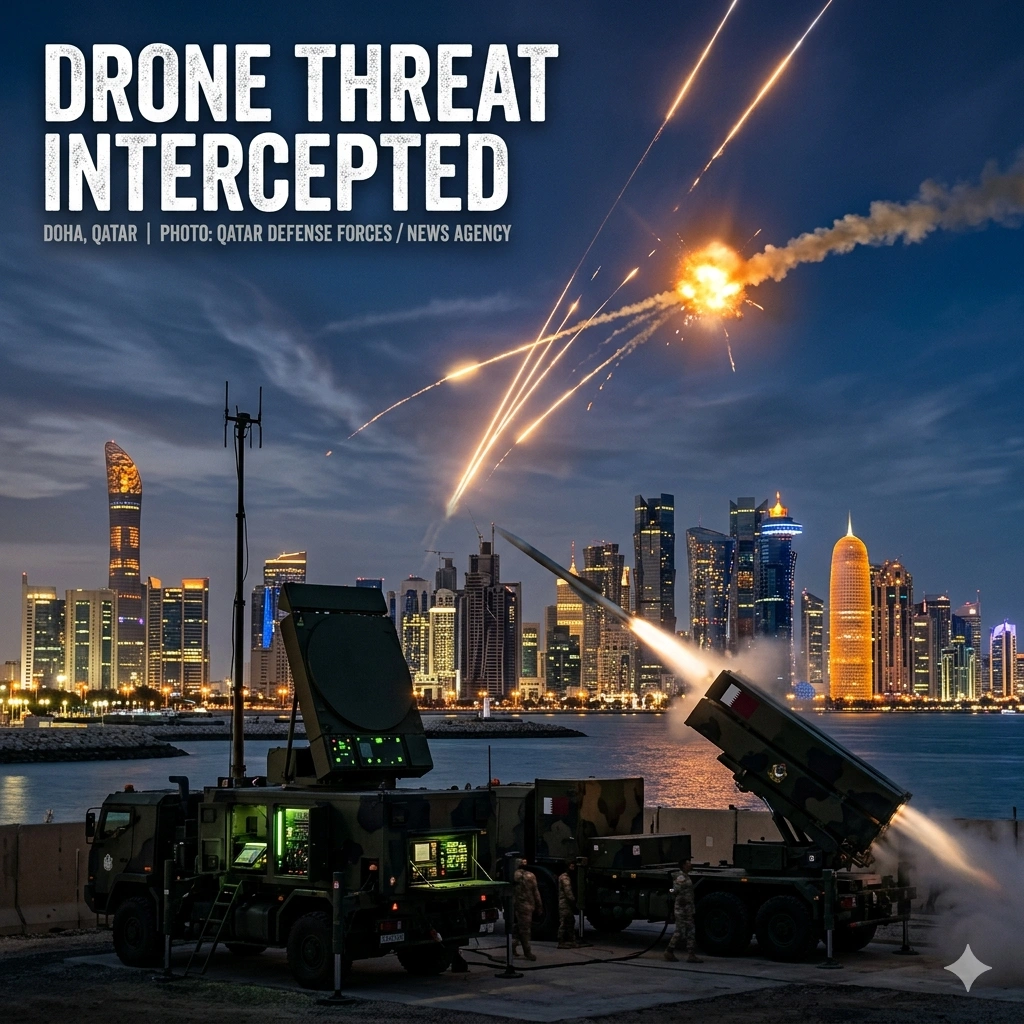
Qatar Intercepts Drones
The Qatari Ministry of Defence announced that the country was targeted on Thursday, April 2, by a wave of drones originating from Iran. In a decisive military response, the Qatar intercepts drones operation utilized multi-layered defense shields to protect critical infrastructure and residential areas. Official reports indicate that the interception took place well before the hostile craft could reach their intended targets near Doha and other strategic locations. This successful defense has provided a temporary sense of relief to the local population during a period of heightened anxiety.
The technical precision required for the Qatar intercepts drones mission highlights the significant investment the nation has made in its military hardware over the last decade. Command centers were reportedly in constant communication with regional allies to monitor the flight paths of the unmanned aerial vehicles (UAVs) as they crossed international waters. By neutralizing the threat in its entirety, the Qatari Armed Forces have sent a clear message regarding their capability to defend national sovereignty. Government officials have praised the rapid response of the air defense units involved in the mission.
Escalation in the Gulf Conflict
The drone attack on Qatar is part of a broader “Long War” scenario that has seen Iran and its proxies target multiple Gulf Cooperation Council (GCC) states. Since late February 2026, the region has been on high alert following a series of coordinated strikes that have disrupted global energy markets. This latest attempt to strike Qatari soil follows similar patterns of aggression seen in Bahrain, Kuwait, and the United Arab Emirates. The persistence of these attacks suggests a deliberate strategy to destabilize the world’s primary energy export corridor.
International observers note that the frequency of these drone incursions has forced regional governments to shift toward a permanent “war footing.” While Qatar has historically maintained a unique diplomatic role in the region, the direct targeting of its territory by Iranian assets complicates future mediation efforts. The International Civil Aviation Organization (ICAO) has already condemned these strikes as a direct threat to civil aviation safety. As the conflict enters its second month, the risk of a miscalculation leading to a full-scale regional war remains dangerously high.
Impact on Global Energy Security
Qatar’s role as a leading exporter of Liquefied Natural Gas (LNG) makes any threat to its security a global economic concern. The targeted drone wave aimed at Qatari territory sent immediate ripples through the energy sector, with oil and gas futures spiking on international exchanges. Although the Qatar intercepts drones success prevented any physical damage to the North Field or Ras Laffan Industrial City, the psychological impact on investors is substantial. Analysts warn that persistent instability could lead to long-term supply chain disruptions across Europe and Asia.
The security of the Strait of Hormuz remains the central pillar of global energy stability, and recent events have put this narrow waterway under intense pressure. Qatar participated in a ministerial meeting this week to discuss the safety of international supply chains in light of the Iranian provocations. The consensus among Gulf leaders is that a comprehensive security framework is needed to ensure the freedom of navigation. Without such a framework, the constant threat of drone and missile strikes will continue to haunt global markets and drive up fuel prices worldwide.
International Diplomatic Response
The international community has reacted with alarm to the news that Qatar was forced to defend its airspace against an Iranian drone wave. The United States and other Western allies have reaffirmed their commitment to the security of their partners in the Gulf. In a joint paper submitted to the UN Security Council, several nations condemned the “unlawful attacks” and called for an immediate cessation of hostilities. This diplomatic pressure is intended to isolate the aggressors while bolstering the defensive capabilities of the targeted states.
Despite the military successes, Qatari diplomats are emphasizing the need for strategic restraint to avoid a broader conflagration. The State of Qatar has sent its tenth formal letter to the United Nations regarding the violations of its territory, seeking a peaceful resolution through international law. However, the recurring nature of these strikes makes it difficult to maintain a purely diplomatic posture. Regional neighbors, including Saudi Arabia and the UAE, have also issued strong statements of support for Doha, signaling a unified GCC front against external threats.
Defense Systems and Technological Superiority
The ability of the Qatari military to achieve a 100% interception rate during the Thursday attack is a testament to their technological edge. The defense network includes a mix of high-altitude missile batteries and short-range electronic warfare systems designed specifically to counter drone swarms. During the Qatar intercepts drones event, these systems worked in tandem to jam the control signals of the UAVs while kinetic interceptors destroyed any craft that remained on a terminal trajectory. This sophisticated “shield” is a critical component of the nation’s 2026 security strategy.
Security experts believe that the drones used in the attack were designed for precision strikes on industrial targets rather than broad area damage. This makes the successful interception even more vital, as a single hit on an LNG facility could have catastrophic environmental and economic consequences. The military’s ability to track these small, low-flying targets over the Gulf is a significant achievement in radar and sensor integration. Future upgrades to the defense system are already being planned to counter more advanced “stealth” drone models currently being developed in the region.
Regional Airspace and Aviation Safety
The safety of civil aviation has become a major concern as the “drone war” expands across the Middle East. Qatar’s Hamad International Airport, one of the busiest hubs in the world, has had to implement emergency protocols multiple times since February to protect passengers. The ICAO’s recent resolution highlights that Iranian drone and missile attacks have forced numerous flight diversions and temporary airspace closures. These disruptions carry a heavy cost for airlines and have caused significant travel delays for thousands of international passengers.
Authorities in Doha have recently issued warnings to the public against the misuse of national emergency alert tones, which can cause panic during actual interception events. Maintaining public order and tranquility is as much a part of the defense strategy as the military hardware itself. The “normalcy” of air travel in the Gulf is currently a fragile state, dependent entirely on the continued success of air defense units. Passengers traveling through the region are advised to stay informed about the latest security updates and potential changes to flight paths.
The Humanitarian and Domestic Cost
While the military reports focus on interceptions and hardware, the domestic toll of the ongoing conflict is becoming more apparent. The Qatari population has lived under the constant threat of siren alerts and falling shrapnel for several weeks. Following the Qatar intercepts drones operation, reports emerged of debris falling in uninhabited areas, though no injuries were reported this time. The psychological stress of “sleepwalking into war” is a recurring theme in local discussions and on social media platforms across the country.
The government has stepped up its public communication efforts to ensure that citizens know how to react during an aerial threat. From animal shelters being rebuilt after related incidents to community-led safety workshops, the Qatari society is showing remarkable resilience. However, the economic fallout is also being felt at the local level, with fuel price hikes reported in neighboring countries as a direct result of the regional turmoil. The domestic stability of Qatar is currently anchored by the public’s confidence in their armed forces’ ability to maintain a total defense.
Future Outlook: A Narrow Path to Peace
As we look toward the middle of 2026, the path to a peaceful resolution in the Gulf appears increasingly narrow. The cycle of attack and interception creates a dangerous status quo where a single defensive failure could trigger a massive retaliatory strike. The Qatar intercepts drones success provides a window for diplomacy, but it also underscores the reality that the region is currently an active combat zone. Strategic patience remains the official policy of the GCC, but the pressure to respond more forcefully is growing among the military leadership.
The involvement of global powers, including the United States and Russia, further complicates the regional dynamic. While the U.S. has increased its troop presence to over 50,000 in the region, the goal remains containment rather than engagement. Qatar’s ability to navigate this complex web of alliances while under direct attack is a testament to its strategic depth. The world will be watching closely to see if the recent drone interceptions lead to a renewed push for a ceasefire or a further slide into a regional “Great War.”
Conclusion: A Total Defense
The successful defense of Qatari airspace on April 2, 2026, marks a pivotal moment in the current regional conflict. By neutralizing the drone threat from Iran, the Qatari Armed Forces have demonstrated that their “total defense” strategy is effective against modern asymmetric threats. The world owes a debt of gratitude to the precision of these units, as their success prevented a global economic shock that would have followed any damage to Qatar’s energy infrastructure.
Addressing the root causes of the “drone war” must now be the priority for the international community. The Qatar intercepts drones event should serve as a wake-up call that the security of the Gulf is not just a regional issue, but a cornerstone of global stability. As investigations continue into the intent behind the April 2 attack, the State of Qatar remains vigilant, ready to protect its people and its resources from any future aggression. The era of aerial insecurity in the Middle East requires a new, unified approach to ensure a peaceful future for all.
For more details & sources visit: UrduPoint / WAM
Read more about Qatar news on 360 News Orbit – Qatar.