
The Qatar Helicopter Crash has sent shockwaves through the regional military community after a technical failure led to a tragic loss of life. Seven dedicated personnel, including high-ranking military officers and expert civilian technicians, were martyred when their aircraft went down in territorial waters during a routine training mission. This incident highlights the inherent risks faced by armed forces even during non-combat operations and has prompted an immediate investigation into the mechanical integrity of the fleet. As the nation mourns, the focus remains on honoring the fallen while ensuring such a catastrophe never repeats itself.
This heartbreaking Qatar Helicopter Crash took place at dawn on Sunday while the aircraft was operating under the specialized Qatar-Turkey Joint Combined Force Command. Early reports from the Ministry of Defence suggest that the crew was performing a standard “routine duty” when a sudden and catastrophic technical malfunction occurred. Despite the skill of the pilots, the aircraft could not be recovered, leading to a fatal impact with the sea. This event serves as a somber reminder of the sacrifices made by those who serve in the defense sector, both in uniform and in supporting technical roles.
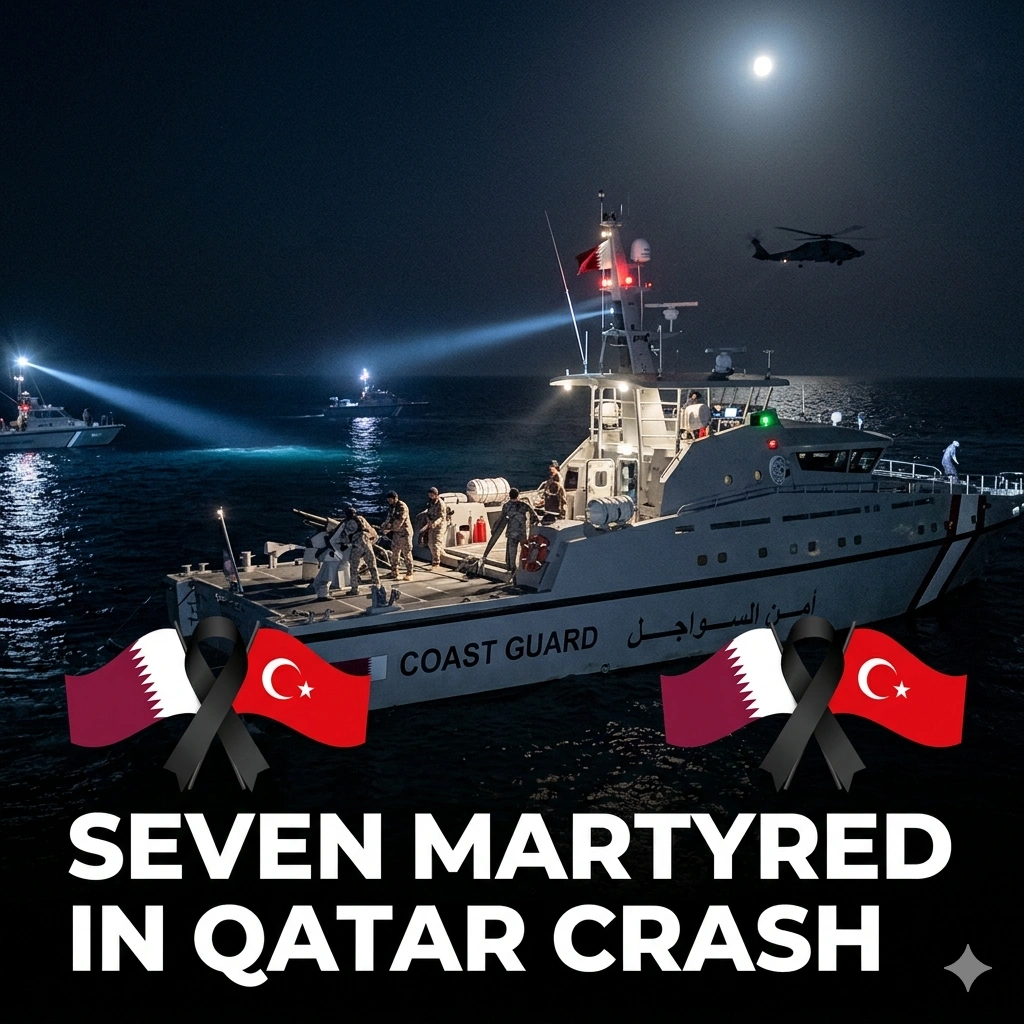
Official Details of the Qatar Helicopter Crash
The official investigation into the Qatar Helicopter Crash has confirmed that all seven individuals on board perished in the accident. Search and rescue teams were deployed immediately to the crash site in the Arabian Gulf, successfully recovering the wreckage and the bodies of the martyrs shortly after the incident. Qatari and Turkish defense officials have been working in close coordination to process the scene and provide support to the grieving families. The swift recovery operation underscores the efficiency of the regional coast guard and naval units despite the difficult circumstances surrounding the mission.
Among those lost in the Qatar Helicopter Crash were four esteemed members of the Qatari Armed Forces who served their country with distinction. The martyrs include Captain Mubarak Salem Daway Al-Marri, Captain Saeed Nasser Samekh, Sergeant Fahad Hadi Ghanem Al-Khayarin, and Corporal Mohammed Maher Mohammed. Their loss is deeply felt across the military hierarchy, as these individuals were integral to the operational readiness of the joint command. The Qatari government has expressed its deepest condolences, hailing these men as heroes who died while preparing to defend the sovereignty of their beloved nation.
International Personnel in Qatar Helicopter Crash
The Qatar Helicopter Crash also claimed the life of Major Sinan Taştekin, a prominent officer within the Turkish Armed Forces stationed in Doha. His presence on the flight was part of the ongoing bilateral security agreement that sees Turkish and Qatari forces training side-by-side to enhance regional stability. Major Taştekin was known for his tactical expertise and his role in fostering the strong military bond between the two allied nations. His martyrdom has been met with significant grief in Ankara, where he was regarded as a rising star within the Turkish military establishment.
In addition to the military officers, the Qatar Helicopter Crash resulted in the deaths of two civilian technicians from the renowned Turkish defense firm ASELSAN. Suleiman Cemra Kahraman and Ismail Anas Can were on board to provide technical oversight and ensure the sophisticated systems of the helicopter were functioning at peak performance. Their inclusion in this mission highlights the critical role that civilian contractors play in modern military logistics and maintenance. ASELSAN has released a statement mourning their colleagues, noting their dedication to the advancement of defense technology and bilateral cooperation.
Qatar Helicopter Crash
The Qatar Helicopter Crash has led to a comprehensive review of maintenance protocols for all aircraft operating under the joint command. While the Ministry of Defence ruled out hostile action or external interference early in the investigation, the “sudden technical failure” remains a point of intense scrutiny. Engineering teams are currently analyzing the flight data recorders to determine if the fault was a manufacturing defect or a localized mechanical issue. Ensuring the safety of the remaining fleet is the top priority for both Qatari and Turkish aeronautical experts as they move forward.
- The crash occurred during a routine training mission under the Joint Combined Force Command.
- Technical failure was identified as the primary cause by both Qatari and Turkish defense ministries.
- Recovery teams successfully retrieved the wreckage from Qatari territorial waters within hours.
- Military cooperation between Qatar and Turkey remains unaffected by this tragic operational accident.
The aftermath of the Qatar Helicopter Crash has seen a massive outpouring of support from neighboring countries and international allies. Letters of condolence have arrived from across the globe, acknowledging the vital role the Qatar-Turkey Joint Combined Force plays in maintaining peace in a volatile region. This tragedy has, in many ways, strengthened the resolve of the partner nations to continue their shared mission. The commitment to regional security remains unwavering, with officials confirming that joint exercises will proceed as scheduled once the initial period of mourning has concluded.
Impact of Qatar Helicopter Crash on Military Strategy
The strategic impact of the Qatar Helicopter Crash is being evaluated by senior commanders to ensure that operational capabilities are not diminished. While the loss of experienced pilots and technicians is a blow, the structural foundations of the Qatar-Turkey military alliance remain robust. Training programs are expected to incorporate new safety modules based on the findings of the crash investigation to prevent future technical mishaps. This proactive approach to safety is essential for maintaining the high standards of the joint forces during a period of heightened regional tension.
Maintaining public trust following the Qatar Helicopter Crash is a key objective for the Ministry of Defence, which has maintained a policy of total transparency. By quickly identifying the cause as a technical failure rather than a security breach, the government has mitigated potential rumors during the ongoing regional crisis. The clear communication regarding the identities of the martyrs has also allowed the public to join in the national mourning process. This level of openness is seen as vital for maintaining morale within the armed forces and the wider civilian population during difficult times.
Technical Analysis of Qatar Helicopter Crash Factors
A deep dive into the Qatar Helicopter Crash factors reveals that the aircraft was a modern model equipped with the latest navigational and safety systems. This makes the “technical malfunction” even more perplexing to investigators who are looking into the maintenance logs of the specific unit involved. Analysts are considering environmental factors, such as humidity and salt-air corrosion, which are common challenges for maritime aviation in the Gulf region. The final report is expected to provide a detailed breakdown of the sequence of events that led to the loss of power or control.
- Captain Mubarak Salem Daway Al-Marri: A veteran pilot with extensive hours in maritime patrols.
- Captain Saeed Nasser Samekh: Recognized for his leadership during joint regional exercises.
- Sergeant Fahad Hadi Ghanem Al-Khayarin: A dedicated specialist in aerial reconnaissance.
- Corporal Mohammed Maher Mohammed: Known for his exceptional service record and technical skill.
The technical expertise lost in the Qatar Helicopter Crash extends to the two ASELSAN employees who were experts in electronic warfare and communication systems. Their work was essential for the interoperability of Turkish and Qatari military hardware, a cornerstone of the joint defense strategy. The loss of such specialized knowledge requires a temporary recalibration of technical support teams on the ground in Doha. However, ASELSAN has already committed to sending a new team of specialists to ensure that technical support for the Qatari Armed Forces continues without any significant interruption.
Qatar Helicopter Crash and Regional Defense Ties
The Qatar Helicopter Crash has underscored the depth of the “Strategic Dialogue” between Qatar and Turkey, which extends far beyond simple hardware sales. The fact that personnel from both nations were working and dying together in the line of duty highlights a deep level of integration. This bond is particularly important as the U.S.-Israel war on Iran continues to create a complex security environment in the Middle East. The joint command provides a localized security architecture that is capable of responding to threats while maintaining national sovereignty for the involved parties.
Despite the tragedy of the Qatar Helicopter Crash, the Turkish Ministry of National Defense has emphasized that military cooperation will continue “uninterrupted.” This statement is a clear signal to the region that the alliance remains functional and focused on its long-term goals. The martyrs of the crash are being viewed as symbols of this enduring partnership, having sacrificed their lives for a shared vision of security. Memorial services are planned in both Doha and Istanbul to honor the seven individuals who represented the best of their respective nations’ defense sectors.
Mourning the Victims of the Qatar Helicopter Crash
The psychological toll of the Qatar Helicopter Crash on the remaining members of the joint force is being addressed through military counseling and support services. Losing comrades in a non-combat accident can often be more difficult to process than losses in battle, as it feels more preventable. Commanders are emphasizing the importance of resilience and continued focus on the mission to honor the memory of the fallen. The sense of duty remains high, and the aircrews are returning to their posts with a renewed commitment to safety and excellence in their daily operations.
As the investigation into the Qatar Helicopter Crash continues, the wreckage is being analyzed at a secure facility to look for signs of fatigue or systemic errors. This forensic approach is standard for military aviation accidents but is being handled with extra care due to the international nature of the flight. The findings will likely be shared with other nations that operate similar helicopter models to ensure global aviation safety. This collaborative spirit in the wake of tragedy is a hallmark of the international military community’s response to such devastating events.
Future Safety Upgrades Post-Qatar Helicopter Crash
The Qatar Helicopter Crash will likely lead to the implementation of new real-time monitoring technology on all joint-force aircraft. By using advanced telemetry, ground crews can potentially identify a technical failure before it becomes a life-threatening emergency. This investment in “predictive maintenance” is part of a larger trend in military aviation to reduce the human cost of technical errors. While no technology can eliminate risk entirely, the lessons learned from this crash will undoubtedly save lives in the future by providing pilots with better warning systems.
- Implementation of enhanced telemetry systems for real-time engine monitoring.
- Increased frequency of “deep-cycle” maintenance checks for maritime-based aircraft.
- Joint safety workshops between Qatari and Turkish aviation technicians.
The families of those lost in the Qatar Helicopter Crash are receiving full military honors and comprehensive support from their respective governments. The state-led funerals served as a moment of national unity, with high-ranking officials and citizens alike paying their respects. For the civilian technicians, their families are being supported by both ASELSAN and the Qatari government, recognizing their vital contribution to national defense. These gestures of gratitude are essential for the healing process and for maintaining the social contract between the state and those who serve it.
Qatar Helicopter Crash Resilience and Recovery
The resilience shown in the wake of the Qatar Helicopter Crash is a testament to the strength of the Qatari and Turkish military institutions. Within days of the accident, the joint command was back to its operational baseline, demonstrating that while individuals are lost, the mission continues. This operational continuity is a critical component of deterrence in a region where any sign of weakness can be exploited. The martyrs of March 22 will be remembered as the foundation upon which even stronger safety and security protocols were built for the future of the Gulf.
The Qatar Helicopter Crash remains a focal point for military analysts who study the challenges of joint task force operations. The ability of two different nations to respond so cohesively to a shared tragedy is being praised as a model for international cooperation. As the technical investigation nears its conclusion, the focus will shift from “what happened” to “how we grow.” This forward-looking mindset ensures that the sacrifice of the seven martyrs leads to a safer and more secure environment for all personnel serving under the Qatar-Turkey Joint Combined Force Command.
Conclusion of the Qatar Helicopter Crash Report
In conclusion, the Qatar Helicopter Crash was a devastating event that claimed seven lives due to an unforeseen technical failure during a routine mission. The loss of Qatari and Turkish military and civilian personnel is a tragedy that has resonated across the international defense community. However, the response to the crash has demonstrated the unbreakable bond between the two nations and their shared commitment to regional stability. Through transparent investigation and a renewed focus on safety, the legacy of the martyrs will be one of improved protection for those who serve in the skies.
The Ministry of Defence has assured the public that the Qatar Helicopter Crash will result in meaningful changes to aviation safety standards. By honoring the fallen and learning from the mechanical failures, the UAE and its allies are ensuring that their forces remain the most capable and safe in the world. As the region navigates the complexities of 2026, the strength of the Qatari-Turkish alliance stands as a pillar of hope and resilience. The memory of the seven personnel martyred on March 22 will forever be etched in the history of the nation’s defense.
For more details & sources visit: Al Jazeera (via Kashmir Life)
Read more about Qatar news on 360 News Orbit – Qatar.