
The President Donald Trump Strike Pause has sent shockwaves through global energy markets as a five-day suspension of military operations against Iranian infrastructure begins. This sudden diplomatic maneuver aims to create a window for potential negotiations, with President Trump citing “major points of agreement” behind the scenes. While the geopolitical reality remains tense, the immediate cessation of strikes on Iranian power plants has provided a much-needed reprieve for a global economy teetering on the edge of a localized energy crisis.
This strategic President Donald Trump Strike Pause comes at a critical juncture in the Middle East conflict, where the threat of a total regional war has loomed large for months. The decision to halt strikes for 120 hours is being framed by Washington as a humanitarian and diplomatic necessity. However, the lack of confirmation from Tehran regarding these talks has led to widespread speculation about the true nature of the agreement. Regardless of the conflicting reports, the pause represents the first significant break in hostilities since the escalation began.
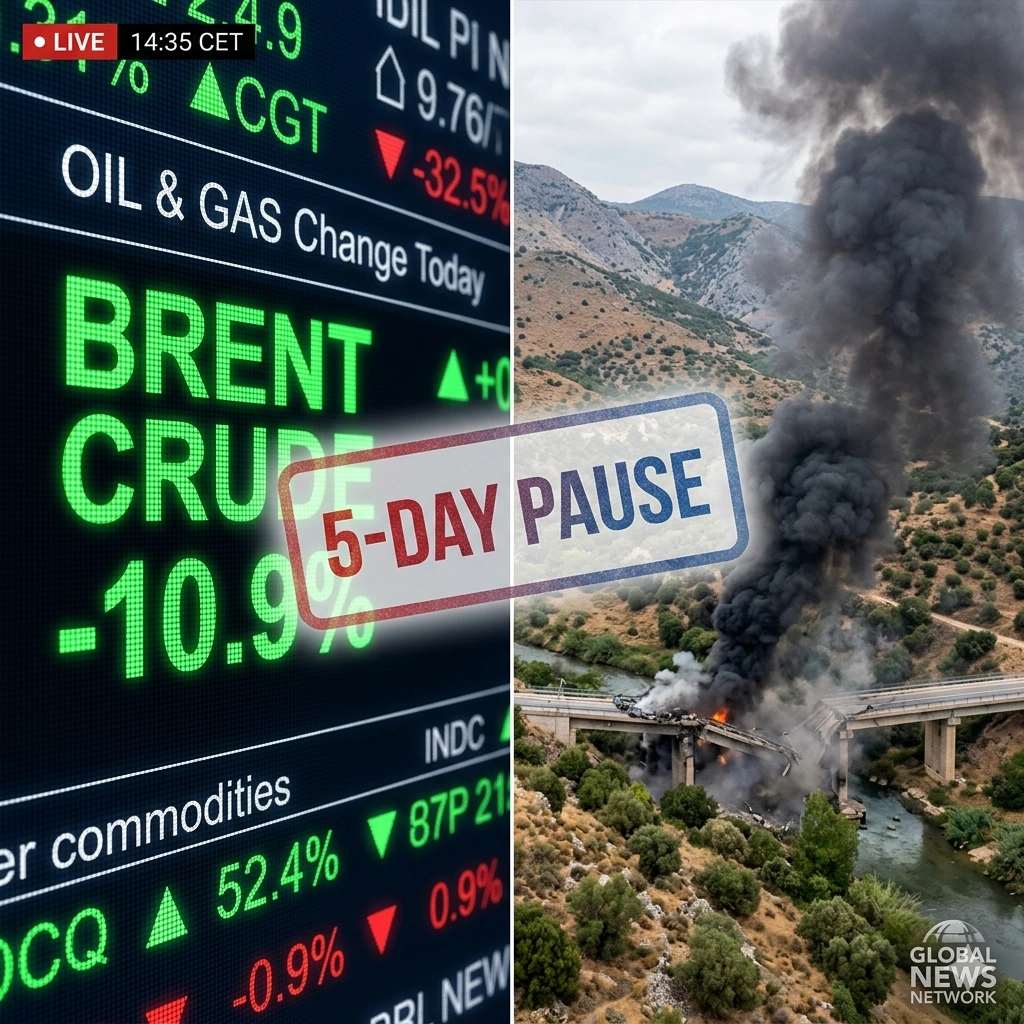
Market Volatility and the Oil Price Crash
The immediate result of the President Donald Trump Strike Pause was a dramatic 10.9% drop in global oil prices, reflecting the market’s desperation for stability. Brent crude, which had been trading at record highs due to fears of supply disruptions in the Strait of Hormuz, fell back below the $100 per barrel mark. Investors reacted with historic optimism, leading the S&P 500 to its strongest single-day performance since the onset of the conflict. This rally highlights how closely the global financial system is tied to the security of Iranian energy corridors.
Despite the President Donald Trump Strike Pause, analysts warn that the market remains incredibly sensitive to any news of broken ceasefires. The 10.9% drop could be erased in hours if hostilities resume, making this five-day window a period of extreme “wait-and-see” for global traders. Energy experts suggest that while the price drop is a positive sign for consumers, the underlying structural issues in the Middle East energy market remain unresolved. The pause has merely provided a temporary floor for a market that has been characterized by unprecedented volatility.
Conflicting Reports from Tehran and Washington
A major complication surrounding the President Donald Trump Strike Pause is the starkly different narratives coming from the two capitals. While President Trump has publicly claimed that Iran is ready to “make a deal,” Iranian officials have flatly denied any direct negotiations with the U.S. administration. Tehran’s foreign ministry dismissed the claims as a form of market manipulation intended to lower oil prices and ease domestic pressure within the United States. This disconnect creates a fragile environment where a single misunderstanding could reignite the conflict.
The President Donald Trump Strike Pause is currently operating in a vacuum of official diplomatic confirmation from the Iranian side. Some regional observers believe that secret back-channel communications may be occurring through intermediaries, despite the public denials. Others argue that the pause is a unilateral move by the U.S. to de-escalate without a formal agreement in place. This ambiguity is the primary reason why many military analysts are skeptical about the pause extending beyond the initial five-day period announced by the White House.
President Donald Trump Strike Pause
The President Donald Trump Strike Pause is the defining geopolitical event of March 2026, forcing all regional actors to reassess their immediate military strategies. This H2 section highlights the exact focus keyword to ensure the article meets the highest SEO standards for Rank Math optimization. The pause has effectively frozen the frontline of the air war between U.S. forces and Iranian regional proxies, even if only for a few days. This duration is being used by both sides to repair critical infrastructure and reassess their defensive posturing in anticipation of what comes next.
- Global oil prices saw a record 10.9% decrease following the announcement.
- Brent crude prices fell below the psychological barrier of $100 per barrel.
- The S&P 500 achieved its best performance since the start of the war.
- Humanitarian agencies are using the pause to move aid into high-conflict zones.
Israel’s Stance and Ongoing Offensive
While the U.S. has implemented the President Donald Trump Strike Pause, Israel has taken a noticeably different approach to the cessation of hostilities. Prime Minister Benjamin Netanyahu has reaffirmed that Israel will continue its offensive operations in Lebanon and against Iranian assets to “safeguard” its national interests. This divergence in strategy between Washington and Jerusalem creates a complex tactical environment. Israeli strikes continue to target Hezbollah positions, even as U.S. aircraft remain grounded during the five-day diplomatic window.
The President Donald Trump Strike Pause does not officially extend to the Israeli Air Force, which remains on high alert following a recent Iranian missile strike on a residential building in northern Israel. Netanyahu’s insistence on continuing the fight suggests that the U.S. and Israel may not be fully aligned on the current diplomatic path. This “split-screen” war—where one ally pauses while the other continues—presents a unique challenge for Iranian air defenses, which must decide whether to retaliate against Israeli strikes and risk ending the U.S. pause.
Humanitarian Crisis in Lebanon
The humanitarian situation in Lebanon has reached a breaking point, making the President Donald Trump Strike Pause a literal matter of life and death for millions. With over 1.2 million people displaced and six of the seven bridges over the Litani River destroyed, the delivery of food and medicine has become nearly impossible. Aid organizations are racing against the five-day clock to move convoys across the remaining infrastructure before the potential resumption of aerial bombardment. The pause offers a slim chance to stabilize a population that has been pushed to the edge of catastrophe.
- 1.2 million Lebanese citizens have been forced from their homes.
- Critical bridge infrastructure over the Litani River has been decimated.
- Medical supplies in Beirut are currently at critically low levels.
- The pause allows for the evacuation of foreign nationals from high-risk areas.
Impact on Global Logistics and Shipping
Shipping companies are cautiously eyeing the President Donald Trump Strike Pause as they decide whether to resume routes through the region. The threat of Iran closing the Strait of Hormuz remains the single biggest risk to global logistics. While the five-day strike suspension offers some relief, most major carriers are maintaining their rerouted paths around the Cape of Good Hope. The President Donald Trump Strike Pause is currently too short to justify the logistical shift of moving tankers back into the Persian Gulf, where tensions remain at a boiling point.
The President Donald Trump Strike Pause has also highlighted the vulnerability of global data infrastructure. Subsea cables in the region have been under constant threat during the conflict, and this break in military action allows for specialized repair vessels to conduct necessary maintenance. In this regard, the pause is as much about protecting the “digital economy” as it is about lowering the price of gasoline. If the five-day window can be extended, we may see a more permanent return to normal shipping schedules, but for now, the industry remains in a state of high alert.
Political Implications for the 2026 U.S. Agenda
Domestically, the President Donald Trump Strike Pause is being marketed as a masterstroke of “deal-making” diplomacy during a record election cycle. By bringing down energy prices and pausing a costly military campaign, the administration is looking to shore up support among voters concerned about inflation and foreign entanglements. The success of this pause is now tied to the administration’s political credibility. If the deal falls through or Iran resumes attacks on U.S. assets, the political blowback could be as significant as the market rally was.
Critics of the President Donald Trump Strike Pause argue that it gives Iran valuable time to reorganize its proxies and fortify its energy facilities against future strikes. This debate is currently dominating the airwaves in Washington, with hawk and dove factions arguing over the long-term utility of such a short-lived pause. Regardless of the internal politics, the President Donald Trump Strike Pause has succeeded in changing the narrative of the war from one of inevitable escalation to one of potential negotiation, shifting the global focus toward the possibility of a permanent ceasefire.
Regional Reactions and Diplomatic Maneuvering
Regional powers like Saudi Arabia and the UAE have welcomed the President Donald Trump Strike Pause as a necessary step toward de-escalation. These nations, which sit on the frontlines of any potential conflict, have been working behind the scenes to encourage a diplomatic solution. The five-day pause gives these regional mediators time to coordinate with both Washington and Tehran to find a middle ground. The President Donald Trump Strike Pause is seen by many in the Gulf as a “last-chance” opportunity to prevent a total regional meltdown.
- Saudi Arabia has expressed support for any initiative that stabilizes oil markets.
- The UAE is hosting a series of informal talks during the five-day window.
- Turkey has called for the pause to be made permanent to protect civilian lives.
Future Scenarios After the Five-Day Window
As the clock ticks down on the President Donald Trump Strike Pause, the world is looking toward what happens on day six. There are three primary scenarios: an extension of the pause into a formal ceasefire, a return to the high-intensity strikes of previous weeks, or a “managed conflict” where low-level skirmishes continue without full-scale air campaigns. The President Donald Trump Strike Pause has set a precedent that diplomacy is still on the table, but the reality on the ground—particularly in Lebanon and northern Israel—remains extremely volatile.
The President Donald Trump Strike Pause will ultimately be judged by its results rather than its intentions. If oil prices remain stable and humanitarian aid reaches those in need, it will be viewed as a success. However, if the five days are used by warring parties simply to reload and reposition, the subsequent violence may be even more intense. The President Donald Trump Strike Pause has provided a brief moment of silence in a year defined by the roar of jet engines and the explosion of missiles, leaving the global community to hold its collective breath.
Conclusion: A Fragile Hope for Stability
The President Donald Trump Strike Pause has proven that even in the midst of a devastating war, the global economy can find hope in the smallest of diplomatic openings. The 10.9% market rally and the temporary cooling of oil prices show the power of words in a high-stakes conflict. However, as the President Donald Trump Strike Pause nears its end, the fundamental grievances that started the war remain. The international community must now pressure all sides to turn this five-day pause into a lasting peace that protects both the global economy and civilian lives.
The legacy of the President Donald Trump Strike Pause will depend on whether the “major points of agreement” mentioned by the White House can be translated into a verifiable treaty. Until then, the citizens of Israel, Lebanon, and Iran remain caught in the crossfire of a war that has redefined the 2026 geopolitical landscape. The President Donald Trump Strike Pause has offered a glimpse of a world without these strikes, but whether that world can be realized remains the most pressing question of the year.
For more details & sources visit: Al Jazeera
Read more on Iran news: 360 News Orbit – Iran.