
Post-regime trade between Türkiye and Syria has entered a transformative era following the collapse of the previous administration in 2024. This week’s high-level meetings in Ankara and Damascus signal a definitive shift toward long-term regional stabilization and mutual commercial prosperity. Spearheaded by the inaugural Joint Economic and Trade Committee (JETCO), both nations are working to solidify a partnership that was once unthinkable.
The focus has moved from emergency aid to sustainable economic development, with billions of dollars in potential investments now on the table. As the geopolitical dust settles, the restoration of these historic trade routes is proving to be the cornerstone of a new Middle Eastern economic order. This strategic alignment is designed to benefit both Turkish manufacturers and a Syrian population eager for reconstruction.
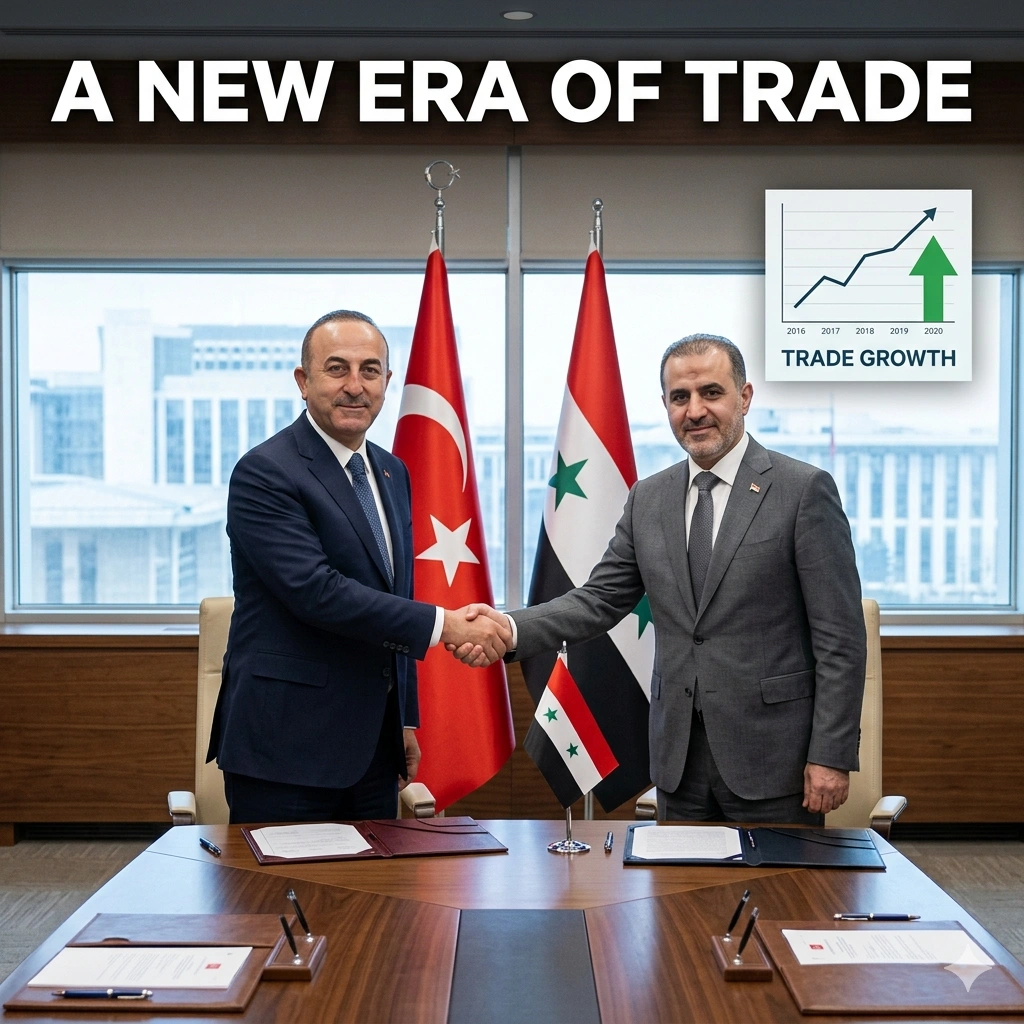
The Inaugural JETCO Session and Business Forum
The launch of the Joint Economic and Trade Committee (JETCO) represents a formal institutionalization of the burgeoning economic ties between the two neighbors. Co-chaired by Turkish Trade Minister Ömer Bolat and Syrian counterpart Nidal al-Shaar, this committee is tasked with removing bureaucratic hurdles that have historically hindered post-regime trade. Alongside the JETCO session, a comprehensive Business and Investment Forum has gathered hundreds of industry leaders from both nations to explore joint ventures.
These platforms are essential for establishing a legal framework that protects cross-border investments and encourages private sector participation. By creating a structured dialogue, both governments are ensuring that the current trade momentum is not just a temporary surge but a permanent pillar of regional growth.
Surge in Turkish Exports to Syria
The statistical growth of Turkish shipments to Syria over the past year has been nothing short of extraordinary. In 2025, exports surged by a staggering 60%, reaching a total valuation of $3.5 billion, a record high for the post-regime trade era. This momentum has carried into the first quarter of 2026, with the initial two months recording $666.7 million in trade volume.
These figures are driven primarily by the high demand for motor vehicles, industrial machinery, and construction materials needed for the rebuilding process. Türkiye has officially recognized this potential by adding Syria to its “target export markets” list for the first time in over a decade. This official designation provides Turkish exporters with government-backed incentives and insurance, further fueling the shipment of essential goods across the border.
Post-Regime Trade
Post-regime trade is the primary engine driving the rapid reconstruction of Syrian cities and industrial zones. The current economic strategy focuses on a multi-layered approach that prioritizes immediate infrastructure needs while planning for long-term industrial self-sufficiency. Turkish firms have already taken the lead in restoring power grids and water treatment facilities, which are vital for bringing life back to urban centers.
This post-regime trade is also facilitating the transfer of technical expertise, allowing Syrian workers to learn modern construction and engineering techniques. As the border crossings become more efficient, the flow of raw materials and finished products is creating thousands of jobs on both sides. The success of this economic integration is a testament to the resilience of regional commerce in the face of political change.
Rebuilding Syria’s Critical Infrastructure
The most urgent sector within the current trade talks is the comprehensive rebuilding of Syria’s decimated infrastructure. Post-regime trade in the construction sector is expected to account for a significant portion of the total bilateral exchange over the next five years. Turkish construction giants, renowned globally for their speed and quality, are already bidding on projects ranging from highway repairs to the construction of new residential complexes.
The focus is not just on rebuilding what was lost but on creating a modern, sustainable infrastructure that can support a 21st-century economy. This includes the implementation of smart city technologies and renewable energy solutions in major hubs like Aleppo and Damascus. The synergy between Turkish engineering and Syrian labor is proving to be a winning formula for national recovery.
Diversification into Healthcare and Agriculture
While construction dominates the initial phase of post-regime trade, both nations are actively diversifying into other critical sectors. Healthcare cooperation has become a top priority, with Turkish medical firms supplying pharmaceuticals and state-of-the-art medical equipment to newly reopened Syrian hospitals. In the agricultural sector, joint projects are underway to restore the fertility of Syrian farmlands and modernize irrigation systems.
Türkiye is exporting high-quality seeds and industrial fertilizers, helping Syria regain its status as a regional food producer. This diversification ensures that the economic partnership remains balanced and resilient against fluctuations in any single industry. By supporting these foundational sectors, the trade agreement is directly improving the quality of life for millions of Syrian citizens.
Logistics and the “Middle Corridor” Connectivity
A major theme of the JETCO meetings is the restoration of Syria’s role as a vital logistics hub connecting Türkiye with the broader Arab world. The post-regime trade strategy includes the modernization of border gates and the rehabilitation of rail networks that have been out of service for years. These logistics improvements are essential for reducing the time and cost of transporting goods through the Levant. Syria’s strategic location makes it a natural extension of the “Middle Corridor” trade route, which Türkiye has been promoting on the global stage.
By integrating Syrian transport networks into this broader framework, both countries can capture a larger share of international trade flowing between Europe and Asia. This connectivity is a record-breaking development for regional trade logistics.
- Implementation of a 24/7 digital customs processing system at major border crossings.
- Restoration of the historic Hijaz railway segments for industrial freight.
- Development of “Free Trade Zones” along the Türkiye-Syria border.
- Joint security protocols to ensure the safety of transit corridors.
Industrial Growth and the Textile Sector
Syria has a rich history in the textile industry, and post-regime trade is playing a crucial role in reviving this traditional powerhouse. Turkish textile manufacturers are partnering with Syrian factories to establish integrated supply chains that benefit from both countries’ strengths. Türkiye provides high-tech fabrics and fashion design expertise, while Syria offers competitive production costs and a skilled workforce.
This collaboration is already resulting in a surge of “Made in Syria” products entering the Turkish and international markets. The revival of the textile sector is particularly important for providing employment opportunities to women and youth, helping to stabilize the social fabric of the country. This industrial resurgence is a key indicator of a healthy post-regime transition.
Energy Cooperation and Power Stability
Reliable energy is the backbone of any economic recovery, and post-regime trade in the energy sector is a highlight of the 2026 talks. Türkiye has begun exporting electricity directly to Northern Syrian grids, providing a much-needed lifeline to hospitals and schools. Simultaneously, joint ventures are being formed to repair Syrian oil and gas fields, ensuring that the country can eventually meet its own energy needs.
There is also a strong push toward solar and wind energy, with Turkish green-tech firms looking to invest in Syrian renewable projects. This energy partnership is essential for powering the new factories and residential areas that are popping up across the country. Ensuring energy security is a prerequisite for the success of all other economic initiatives.
Foreign Minister Hakan Fidan’s Diplomatic Push
The current economic momentum was made possible by the intense diplomatic groundwork laid by Turkish Foreign Minister Hakan Fidan. His recent high-level meetings with Syrian President Ahmed al-Sharaa marked the official end of a decade of frozen relations and the beginning of a “commercial-first” policy. Fidan’s approach emphasizes that economic prosperity is the most effective deterrent against future regional conflict.
By focusing on the tangible benefits of post-regime trade, he has managed to build consensus among various stakeholders who were previously at odds. This diplomatic breakthrough has provided the necessary political cover for Trade Minister Ömer Bolat to proceed with the ambitious JETCO agenda. The “Fidan Doctrine” of economic diplomacy is now being studied as a model for regional conflict resolution.
Post-Regime Financial and Banking Frameworks
To support the massive volume of post-regime trade, both nations are working to establish reliable banking and financial corridors. This includes the opening of Turkish bank branches in major Syrian cities and the creation of a joint clearinghouse for trade in local currencies. These financial institutional frameworks are necessary to provide credit to Syrian small businesses and to facilitate secure payments for Turkish exporters.
Without a functioning banking system, the scale of trade would be limited by cash transactions and high-risk informal networks. The 2026 talks have prioritized the creation of a secure financial ecosystem that can handle billions of dollars in annual transactions. This financial integration is a record step toward a unified regional market.
- Establishing credit lines for Syrian entrepreneurs through Turkish Eximbank.
- Implementing a unified digital payment system for cross-border retailers.
- Training Syrian bank officials on international anti-money laundering standards.
- Facilitating the use of the Turkish Lira and Syrian Pound in bilateral contracts.
Targeting “Target Export Markets” Status
Türkiye’s decision to officially classify Syria as a “target export market” for 2026 is a significant policy shift. This status means that the Turkish government will prioritize Syria in its global trade strategy, offering specialized support to firms that choose to operate there. This includes subsidies for participating in trade fairs, market research grants, and enhanced insurance coverage through state agencies. For post-regime trade, this status acts as a signal to the international community that Syria is “open for business” and that the risks of investment are being actively managed. This move is expected to attract third-party investors from the Gulf and Europe, who may use Türkiye as a gateway into the Syrian market.
Rebuilding the Social Fabric through Trade
The impact of post-regime trade goes beyond balance sheets and industrial output; it is a vital tool for social reconstruction. By creating jobs and restoring essential services, the trade partnership is giving displaced Syrians a reason to return home and participate in their country’s future. The revitalization of local markets and the availability of affordable Turkish goods have already brought a sense of normalcy back to many communities.
Trade creates a network of mutual dependency that makes renewed conflict less likely, as both sides have a vested interest in maintaining the peace. The “peace dividend” of these economic talks is perhaps the most valuable outcome for the millions of people affected by years of instability.
Motor Vehicles and Industrial Parts Leading the Way
Early 2026 data shows that the automotive and industrial sectors are the most active areas of post-regime trade. Turkish-made trucks, buses, and spare parts are flooding across the border to replace the aging and damaged fleets in Syria. This is essential for the logistics sector, as a modern transportation fleet is needed to move both people and goods efficiently.
Additionally, Turkish industrial parts are being used to repair Syrian factories that have been idle for a decade. The ability to source high-quality components from a neighboring country has significantly reduced the cost and time required for industrial rehabilitation. This surge in heavy machinery shipments is a clear record of the nation’s move toward industrialization.
Joint Ventures in the Agriculture Sector
The Syrian steppe and coastal regions are once again becoming productive thanks to Turkish-Syrian agricultural joint ventures. Post-regime trade has facilitated the import of modern tractors and automated harvesting equipment, which are replacing traditional, labor-intensive methods. These partnerships are also focusing on sustainable water management, utilizing Turkish expertise in drip irrigation to maximize crop yields.
The goal is to make Syria not only self-sufficient in food production but also an exporter of high-value crops like olives, cotton, and citrus fruits. By stabilizing the agricultural heartland, the trade agreement is ensuring food security and rural economic stability, which are critical for national peace.
Textiles and the Fashion Renaissance
Syria’s legendary textile craftsmen are finding a new audience through post-regime trade agreements with Turkish fashion houses. This collaboration is creating a unique “Levantine style” that combines traditional Syrian patterns with modern Turkish tailoring. These products are being marketed as high-end goods in Istanbul and beyond, bringing much-needed foreign currency into the Syrian economy.
The restoration of the textile supply chain, from raw cotton to finished garments, is a primary focus of the 2026 JETCO session. This sector represents the successful blending of cultural heritage with modern commerce, proving that post-regime trade can be as much about culture as it is about profit.
- Reviving traditional silk and brocade industries for the luxury market.
- Establishing joint training centers for fashion design in Aleppo.
- Streamlining the export of finished Syrian garments to the European Union.
- Sponsoring an annual “Ankara-Damascus Fashion Week” to showcase regional talent.
Overcoming the Logistics of a Broken Nation
Restoring the physical links between the two countries remains one of the most difficult challenges of post-regime trade. Years of conflict have left many roads and bridges in disrepair, requiring a massive logistical effort to ensure that goods can move safely. The 2026 talks have resulted in the creation of a “Logistics Task Force” composed of military and civilian engineers from both sides.
This group is responsible for demining trade routes and overseeing the rapid repair of critical transit infrastructure. The success of these efforts is already visible at the main border crossings, where wait times for cargo trucks have been reduced by 40% in just six months. This logistical record is a prerequisite for reaching the $5 billion trade goal.
Promoting Regional Commercial Growth
The broader aim of the Türkiye-Syria economic talks is to spark a wave of commercial growth throughout the Levant. Post-regime trade acts as a catalyst for other neighboring countries to reconsider their economic relations with the new Syrian administration. As the region becomes more stable and prosperous, the potential for a “Levantine Economic Zone” becomes more realistic.
This would involve the free movement of goods, services, and labor among Türkiye, Syria, Jordan, and Lebanon. The current JETCO session is the first step toward this ambitious vision, setting the standards and protocols that will define the future of regional commerce. The world is watching as these two historic nations build a record-breaking future together.
The Role of Trade Minister Ömer Bolat
Trade Minister Ömer Bolat has been the driving force behind the practical implementation of the post-regime trade strategy. His vision is one where economic integration serves as the ultimate guarantee of national security. During the JETCO session, Bolat emphasized that Türkiye is not just looking to sell goods to Syria but to build a lasting partnership based on mutual respect and shared growth. His background in international business has allowed him to speak the language of the private sector, encouraging Turkish CEOs to take calculated risks in the Syrian market. Bolat’s leadership has been instrumental in turning a diplomatic opening into a concrete record of economic achievement.
Conclusion on the 2026 Economic Outlook
As we look toward the remainder of 2026, the outlook for post-regime trade between Türkiye and Syria is overwhelmingly positive. The establishment of JETCO, the surge in export volumes, and the diversification into new sectors all point to a relationship that is rapidly maturing. While challenges remain, particularly in the areas of security and financial integration, the political will to succeed is stronger than ever. The restoration of this economic axis is a record development that will shape the Middle East for decades to come. By choosing commerce over conflict, Ankara and Damascus are providing their people with a future defined by opportunity rather than despair.
Final Thoughts on a New Trade Era
The transformation of the Türkiye-Syria border from a zone of conflict to a corridor of commerce is one of the most significant stories of the decade. Post-regime trade is the vehicle through which this transformation is occurring, proving that even the deepest wounds can be healed through the pursuit of shared prosperity. As the first-ever JETCO session concludes, the foundation for a billion-dollar partnership has been laid. The record growth in shipments, the commitment to infrastructure, and the diplomatic courage of leaders on both sides are all indicators that a new era has truly begun. The “Post-Regime Trade” era will be remembered as the moment when the Levant finally turned the page toward peace.
For more details & sources visit: Daily Sabah
Read more about Syria news on 360 News Orbit – Syria.