
Japan Economy Coincident Index has faced a significant setback as the latest government data reveals a 1.6-point drop, bringing the metric down to 116.3. This decline represents the first contraction in two months, signaling a potential cooling period for the world’s fourth-largest economy. The industrial heartland of Japan is struggling to maintain its momentum amidst a perfect storm of slowing global tech demand and domestic logistical hurdles.
The drop in the Japan Economy Coincident Index is primarily attributed to a sharp faltering in the shipment of semiconductor chips and a noticeable reduction in automotive output. These two sectors have traditionally been the twin engines of Japanese export growth. However, a cooling international market for electronics and supply chain bottlenecks have forced manufacturers to scale back production levels, directly impacting the national economic health indicator.
Furthermore, the Japan Economy Coincident Index reflects the growing strain on small and medium-sized enterprises (SMEs). While large conglomerates are feeling the pinch in exports, local service sectors—such as construction and house painting—are facing a surge in bankruptcies. These businesses are being caught between a severe labor shortage and skyrocketing operational costs driven by the ongoing geopolitical instability in the Middle East.
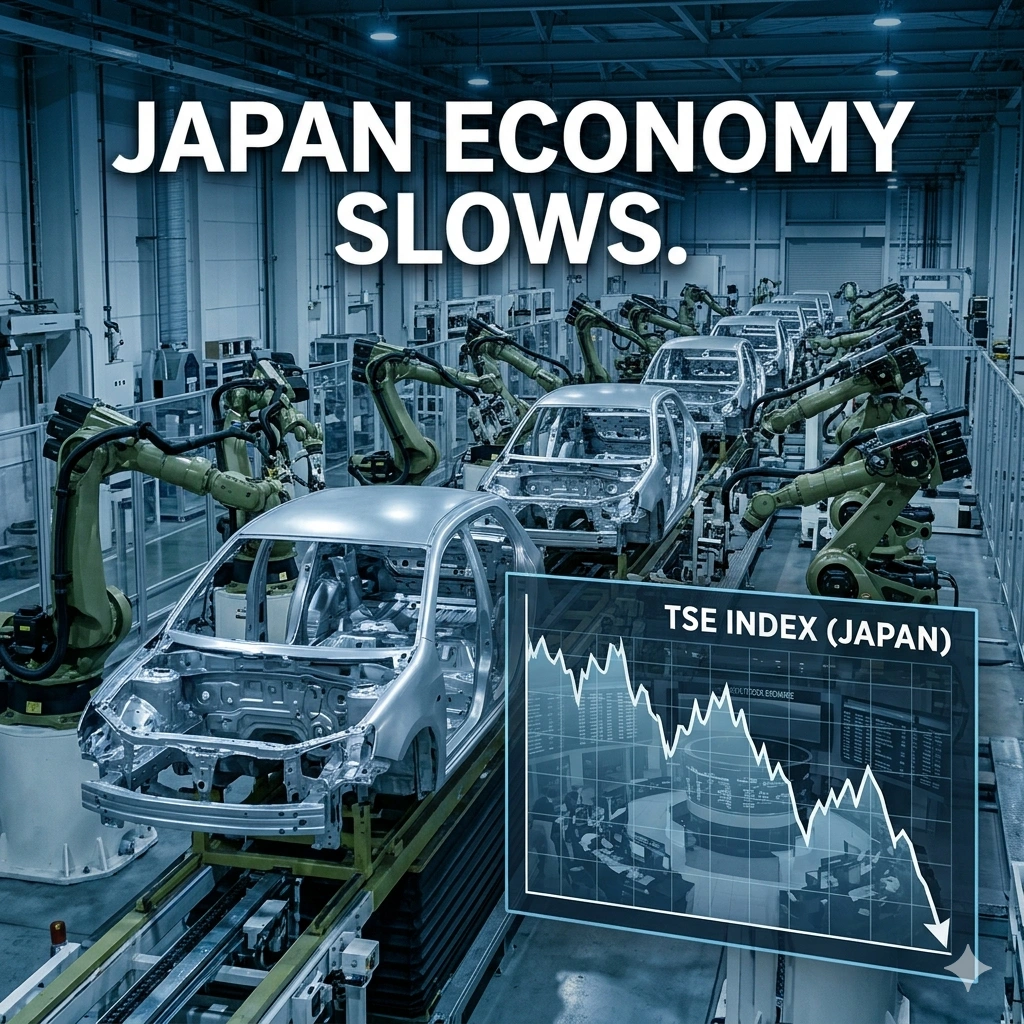
Japan Economy Coincident Index
The recent 1.6-point decline in the Japan Economy Coincident Index serves as a stark warning for policymakers at the Bank of Japan. For months, the central bank has maintained an optimistic outlook, banking on the idea that global demand would remain a stable pillar for the country’s recovery. This latest data suggests that the external environment is becoming increasingly hostile, necessitating a possible reassessment of current monetary strategies.
Under the weight of the Japan Economy Coincident Index drop, industrial production has seen a measurable slowdown. The automotive industry, which accounts for a massive portion of the nation’s GDP, has been hit by a lack of essential components. This is not just a localized issue but part of a broader trend where Japanese manufacturers are finding it harder to compete in an environment defined by high energy costs and restricted trade routes.
The Japan Economy Coincident Index also captures the deteriorating sentiment within the domestic service sector. As fuel prices climb due to the Iran war, small businesses that rely on transportation and energy-intensive processes are seeing their profit margins disappear. The rise in bankruptcies among local service providers indicates that the economic pain is moving from the factories into the streets of Tokyo and Osaka.
Semiconductor Shipments and Global Demand
A major factor dragging down the Japan Economy Coincident Index is the slump in semiconductor shipments. Japan remains a critical supplier of specialized chips and manufacturing equipment, but the global appetite for high-end tech has softened in early 2026. This cyclical downturn in the electronics market has left Japanese warehouses with excess inventory and forced a reduction in factory operating hours across the country.
The Japan Economy Coincident Index reflects this tech-sector cooling with high accuracy. Analysts suggest that the shift toward more localized chip production in the US and Europe is starting to erode Japan’s traditional market share. Without a rapid rebound in global gadget sales, the semiconductor industry may continue to be a drag on the coincident index for several more months.
- Chip manufacturing equipment orders fell by nearly 12% in the last quarter.
- Export volumes to major Asian markets have stagnated since the start of the year.
- Energy-intensive silicon wafer production is facing higher utility costs.
- Domestic tech investment is shifting toward artificial intelligence software over hardware production.
Automotive Output Challenges
The automotive sector’s role in the Japan Economy Coincident Index cannot be overstated. When Toyota, Honda, and Nissan face production delays, the entire national index feels the impact. The current decline is largely a result of parts shortages exacerbated by the Middle East conflict. Because Japan imports a vast array of chemical precursors and plastics derived from naphtha, any disruption in the Gulf region hits the car factories hard.
Japan Economy Coincident Index data shows that automotive output fell by 4.2% month-on-month in February. This reduction is not due to a lack of orders but an inability to complete vehicles on the assembly line. The “just-in-time” manufacturing model, which Japan perfected, is proving to be a vulnerability in an era of unpredictable global shipping and regional wars.
- Logistics costs for shipping finished vehicles have increased by 25%.
- Labor shortages in the trucking industry are delaying the delivery of parts.
- High steel prices are putting pressure on the manufacturing cost of entry-level vehicles.
- The transition to electric vehicles (EVs) is requiring expensive re-tooling of existing factories.
Energy Supply and the Iran War
Japan’s heavy reliance on Middle Eastern oil is a recurring theme in the Japan Economy Coincident Index analysis. As the Iran war threatens to prolong energy supply constraints, Japan’s operational costs are rising across the board. The nation imports nearly 90% of its crude oil from the region, making its industrial base extremely sensitive to any price shocks or maritime blockades in the Strait of Hormuz.
The Japan Economy Coincident Index is highly correlated with energy prices because Japan has limited domestic natural resources. Higher oil and naphtha prices filter through the economy almost instantly, affecting everything from plastic production to home heating. This “imported inflation” is squeezing both consumers and producers, leading to the first index decline in several months.
- Fuel surcharges for domestic shipping have reached record highs in April.
- The cost of naphtha, a key ingredient for the chemical industry, has spiked 15%.
- Power companies are passing higher liquid natural gas (LNG) costs to industrial users.
- Strategic oil reserves are being utilized, but long-term supply remains a concern.
Bankruptcies in the Service Sector
One of the most concerning aspects of the Japan Economy Coincident Index report is the rise in bankruptcies within the service sector. Small businesses, particularly in house painting and maintenance, are closing their doors at an alarming rate. These firms are unable to pass on the rising costs of paint and fuel to their customers, who are already tightening their belts due to general inflation.
The Japan Economy Coincident Index highlights that these SMEs are the backbone of domestic employment. When they fail, it leads to a gradual increase in the unemployment rate and a reduction in consumer spending. The labor shortage is making the situation even worse, as the few available workers are demanding higher wages that small companies simply cannot afford to pay.
- Small painting firms are seeing raw material costs increase by 30% annually.
- Fuel for specialized machinery has become a major line-item expense.
- Older business owners are choosing to close rather than navigate the current crisis.
- Regional economies outside of Tokyo are seeing the highest rates of business failure.
Bank of Japan and Monetary Policy
The Japan Economy Coincident Index drop complicates the Bank of Japan’s (BoJ) plans for interest rate normalization. For months, the BoJ has hinted at moving away from its ultra-loose monetary policy, provided that the economy remains strong. However, a falling coincident index suggests that the economy may not be resilient enough to handle higher borrowing costs at this time.
Managing the Japan Economy Coincident Index requires a delicate balancing act. If the BoJ raises rates to fight inflation, it might further stifle the already struggling automotive and tech sectors. Conversely, if they keep rates too low, the yen could weaken further, making energy imports even more expensive. This “policy trap” is a major topic of discussion among financial analysts in the spring of 2026.
- The yen’s value remains a key variable for import-dependent industries.
- Real wages have yet to catch up with the rising cost of living.
- Corporate bond yields are beginning to rise, increasing the cost of debt for manufacturers.
- The BoJ is expected to maintain its cautious stance until the coincident index stabilizes.
Labor Shortages and Demographic Strain
The underlying issue affecting the Japan Economy Coincident Index is the country’s shrinking and aging population. The labor shortage is no longer just a future threat; it is a current reality that is limiting the country’s industrial capacity. Factories are unable to run at full speed not just because of a lack of parts, but because they cannot find enough workers to staff the assembly lines.
Under the Japan Economy Coincident Index framework, labor input is a vital component. As the workforce diminishes, the “potential growth” of the economy is being lowered. Automation and robotics are being deployed as solutions, but the transition is slow and capital-intensive. This demographic strain ensures that even a small external shock, like the Middle East conflict, has a magnified impact on the national index.
- The number of open job positions per applicant remains at historically high levels.
- Rural areas are experiencing a “hollowing out” of their industrial bases.
- Foreign worker programs are being expanded but face cultural and logistical hurdles.
- Retirement of skilled engineers is leading to a “knowledge gap” in high-tech manufacturing.
Strategic Economic Outlook for 2026
Looking at the Japan Economy Coincident Index through a long-term lens, the outlook remains precarious but not entirely bleak. Japan’s high level of technological sophistication provides a cushion that many other nations lack. If the automotive sector can successfully transition to hydrogen or advanced EV platforms, and the chip industry finds its footing in the AI era, the index could see a sharp recovery.
However, the Japan Economy Coincident Index will likely remain volatile as long as the Iran war continues to disrupt energy markets. The government is currently looking into fresh stimulus packages for SMEs to prevent a total collapse of the local service sector. Whether these measures will be enough to offset the global supply chain disruptions remains to be seen as the second quarter of 2026 begins.
- Government subsidies for energy-efficient renovations are supporting some construction firms.
- New trade deals with Latin America are being explored to diversify raw material sources.
- The focus on “economic security” is leading to more reshoring of critical industries.
- Public-private partnerships in green energy are seen as the long-term solution to oil dependence.
Industrial Policy and Future Growth
The Japan Economy Coincident Index emphasizes the need for a revised industrial policy. The reliance on traditional sectors like internal combustion engines is clearly becoming a liability. The Ministry of Economy, Trade and Industry (METI) is aggressively pushing for a “Green Transformation” (GX) to decouple the Japan Economy Coincident Index from the volatility of Middle Eastern energy supplies.
Through the Japan Economy Coincident Index, we can see that the transition is painful. The shift from old industrial models to new ones requires massive amounts of capital and a complete re-skilling of the workforce. While the current index drop is discouraging, it may serve as the necessary “shock” to accelerate these long-overdue structural reforms in the Japanese economy.
- Investments in offshore wind and geothermal energy are being fast-tracked.
- The semiconductor industry is receiving billions in subsidies to build next-gen foundries.
- Digital transformation (DX) in the service sector is aimed at reducing labor dependency.
- Regional “innovation hubs” are being created to revitalize stagnant local economies.
Conclusion: Navigating a Global Crisis
In conclusion, the 1.6-point drop in the Japan Economy Coincident Index is a clear indicator of the multifaceted challenges facing the nation in 2026. From the cooling of global semiconductor demand to the rising operational costs caused by regional wars, Japan is currently in a defensive posture. The resilience of its automotive sector and the stability of its small businesses will be the key factors to watch in the coming months.
The Japan Economy Coincident Index will continue to be the most important metric for gauging how well the country adapts to these external shocks. While the current data is a disappointment, it also provides a clear roadmap of where intervention is needed most. For Japan to return to a path of growth, it must overcome its energy vulnerabilities and address the structural issues within its labor market and industrial base.
For more details & sources visit: Investing.com
Read more about Japan news on 360 News Orbit – Japan.