
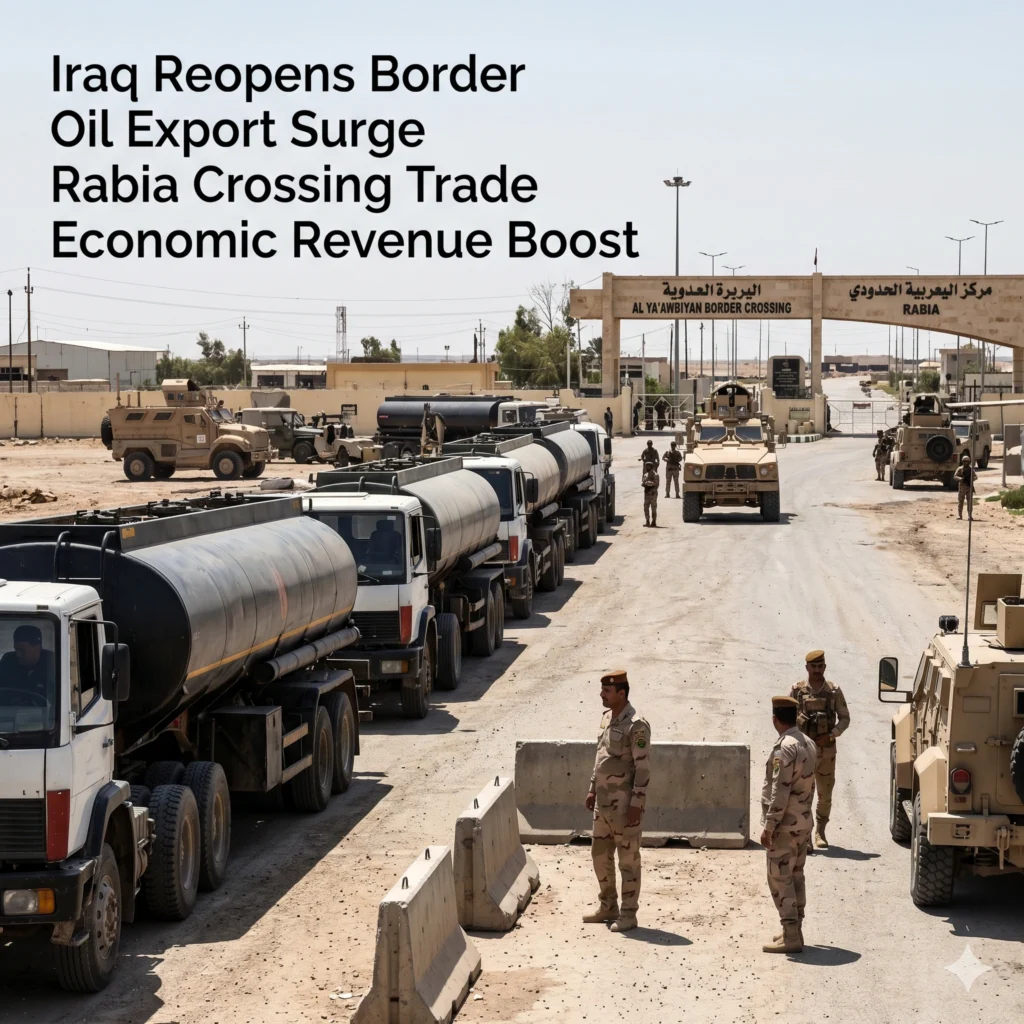
The Iraqi government officially reopened the Rabia border crossing on Monday to maximize Northern Iraqi Trade revenues and streamline the flow of critical energy resources. This strategic move is specifically designed to alleviate massive logistical congestion at existing checkpoints and redistribute crude oil export quotas heading into Syria. Iraqi officials, led by the Head of the Border Ports Authority Omar Al-Waeli, gathered at the customs center to mark the formal resumption of operations.
Consequently, the activation of this crossing is expected to enhance the movement of commercial goods and provide a vital secondary artery for the nation’s industrial output. Security remains a top priority, with military armored vehicles stationed at the entrance to ensure a smooth transition during this period of economic expansion.
Strategic Objectives of Expanding Northern Iraqi Trade in 2026
The primary objective of reopening the Rabia facility is to facilitate a more efficient Northern Iraqi Trade network that can handle the current surge in oil production. Before this reopening, massive congestion plagued existing routes, with tankers stretching for several kilometers at checkpoints like Al-Waleed. By activating Rabia, the government is effectively distributing the export load across multiple high-capacity crossings to reduce bottlenecks. This redistribution is essential for maintaining the pace of crude oil exports toward Syrian territory and beyond. Iraqi and Syrian guards are now coordinating closely at the Al-Yaarubiyah border center to ensure that transit remains uninterrupted and secure.
Maximizing state revenues through increased trade tariffs is another critical component of the Northern Iraqi Trade strategy for the current fiscal year. Omar Al-Waeli emphasized that every vehicle crossing the border represents a contribution to the national budget through customs duties and service fees. As the level of exchange increases, the site will become instrumental in funding regional infrastructure projects and public services. Furthermore, the crossing is intended to facilitate the import of essential goods, such as food and medicine, for the Iraqi consumer market. This dual-purpose role as both an export hub and an import gateway makes Rabia a cornerstone of the nation’s 2026 economic roadmap.
Logistical Improvements and Tanker Traffic Management
The logistical hurdles previously faced by energy exporters are expected to diminish significantly as Northern Iraqi Trade flows are redirected through Rabia. Managing the surge in commercial and industrial traffic requires a sophisticated coordination effort between the Border Ports Authority and the Ministry of Oil. Authorities expect that the secondary vital artery provided by Rabia will cut delivery times for crude oil shipments by nearly thirty percent. This efficiency gain is vital for meeting international export contracts and ensuring that northern refineries can operate at peak capacity. Numerous trucks and transport vehicles have already begun gathering on the Iraqi side, signaling a rapid return to full commercial activity.
To maintain order, security personnel remain on high alert at the complex to manage the anticipated surge in vehicle volume. The presence of military armored vehicles at the Syrian border entrance serves as both a deterrent against smuggling and a guarantee of safe passage for legitimate traders. Ensuring the safety of the Northern Iraqi Trade route is paramount for attracting private sector investment and logistics partners. As the facility scales up its operations, the government plans to implement automated customs tracking systems to further speed up the inspection process. These technological upgrades will help prevent future bottlenecks and ensure that Rabia remains a world-class transit hub for decades to come.
Northern Iraqi Trade
The successful reopening of the Rabia crossing is a testament to the strengthening of Northern Iraqi Trade relations with neighboring Syria. This diplomatic and economic alignment is crucial for the stability of the regional energy market and the recovery of local industries. By reopening this specific crossing, Iraq is leveraging its geographical position to become a central player in the Levantine trade corridor. The synergy between the Al-Waleed and Rabia ports creates a robust network that can adapt to changing market demands and geopolitical shifts. This flexibility is a key advantage for northern exporters looking to secure reliable access to Mediterranean ports through Syrian territory.
Moreover, the Northern Iraqi Trade expansion at Rabia is expected to create thousands of local jobs in the logistics, hospitality, and maintenance sectors. Towns located along the transit route will benefit from increased economic activity as drivers and security personnel require local services. The government is encouraging local entrepreneurs to set up support facilities near the customs center to cater to the growing number of transport workers. This localized economic growth is a vital part of the broader plan to diversify the national economy away from a pure reliance on oil extraction. Reopening the border is thus an investment in the people of the region as much as it is an investment in industrial infrastructure.
Regional Coordination and Border Security Measures
- Military armored vehicles are currently providing 24-hour surveillance at the entrance to the Rabia facility.
- Coordination meetings between Iraqi and Syrian border guards are held daily to manage the flow of tankers at Al-Yaarubiyah.
- Specialized scanners have been installed at the Rabia customs center to detect illicit materials without slowing down legitimate trade.
- High-alert status remains in effect for all security personnel at the complex to prevent any disruption to the crude oil export schedule.
Effective regional coordination is the backbone of the current Northern Iraqi Trade initiative. Without the cooperation of the Syrian authorities at Al-Yaarubiyah, the reopening of Rabia would not be possible or effective. Both nations have a shared interest in maximizing trade and ensuring that their shared border is a zone of economic prosperity rather than conflict. This partnership extends to intelligence sharing regarding border security and the prevention of unauthorized commercial activities. As the security environment continues to stabilize, officials hope to further streamline the visa and permit process for international logistics companies operating in the area.
Enhancing Fuel Oil and Crude Export Efficiency
The redistribution of fuel oil and crude quotas is a technical necessity that the Northern Iraqi Trade plan addresses directly. By providing a dedicated path for northern crude, the government ensures that the southern ports do not become overwhelmed by the nation’s total output. This geographic separation of export routes is a strategic decision to minimize the risk of a single point of failure in the national energy supply chain. The Rabia crossing specifically caters to the unique logistical needs of the northern oil fields, which are located closer to the Syrian border. This proximity reduces transportation costs and increases the overall profitability of the northern extraction operations for the Iraqi state.
Increasing the level of trade exchange at Rabia will also allow for the export of refined petroleum products, which carry a higher market value than raw crude. As Iraqi refineries modernize, the ability to ship gasoline and diesel through Northern Iraqi Trade routes will become increasingly important. The Rabia customs center is being outfitted with the necessary equipment to handle these varied energy products safely and efficiently. Al-Waeli noted that the facility is designed to be scalable, meaning it can expand its capacity as the northern industrial sector grows. This forward-thinking approach ensures that the border infrastructure will not become a bottleneck in the future as production levels continue to rise.
Impact on the National Economy and State Revenue
The financial benefits of the Northern Iraqi Trade expansion are already being calculated by the Ministry of Finance in Baghdad. With the resumption of transit at Rabia, the government expects a steady increase in non-oil revenue through trade tariffs and administrative fees. These funds are critical for reducing the national deficit and providing the capital needed for long-term development goals. Every tanker that passes through the gate contributes to the economic sovereignty of the Iraqi state. This revenue is particularly important as the country navigates the challenges of post-conflict reconstruction and the transition toward a more diversified economic base in 2026.
Beyond the direct tariffs, the Northern Iraqi Trade through Rabia stimulates the domestic manufacturing sector by providing easier access to raw materials from Syria. Iraqi factories that rely on imported industrial inputs can now receive their shipments more quickly and at a lower logistical cost. This improvement in the supply chain helps lower the production costs for local goods, making them more competitive in the regional market. The government’s goal is to create a virtuous cycle of trade, where increased exports lead to higher revenues, which are then reinvested into further trade-enhancing infrastructure. The reopening of the Rabia crossing is a vital first step in this ambitious national economic cycle.
Future Prospects for the Al-Yaarubiyah Corridor
The long-term vision for Northern Iraqi Trade involves turning the Al-Yaarubiyah corridor into a major international logistics hub. Future plans include the construction of a dedicated rail link that would parallel the existing road network to handle even larger volumes of cargo. Such a project would drastically increase the capacity of the border and further cement Iraq’s role as a regional trade leader. While these plans are still in the early stages, the successful reopening of the road crossing provides the necessary foundation for future investment. The international community is watching closely, as a stable and productive Iraqi-Syrian border is a key indicator of regional recovery.
Expanding the Northern Iraqi Trade network also paves the way for deeper cultural and social exchanges between the people of Iraq and Syria. Trade routes have historically served as conduits for ideas and innovation, and the Rabia crossing is no exception. As merchants and travelers move between the two nations, they strengthen the fraternal ties that have existed for centuries. The government remains committed to ensuring that the border remains a place of peaceful and productive interaction for all. The success of the Rabia reopening will be measured not just in barrels of oil, but in the enduring prosperity and stability of the northern provinces.
Common Signs of Growing Commercial Activity at Rabia
- A steady increase in the number of logistics and transport companies registering for permits to use the Rabia crossing.
- The development of new commercial warehouses and storage facilities on the outskirts of the border complex.
- An uptick in the volume of non-oil commercial goods, such as textiles and construction materials, passing through the customs center.
- Increased demand for local services, including fueling stations and repair shops, along the primary highway leading to the border.
The rise in Northern Iraqi Trade activity is becoming visible to the naked eye as more trucks gather at the facility each morning. This visible growth provides a sense of hope and momentum for the local population who have lived through years of border closures. The “steady increase” predicted by Al-Waeli is already becoming a reality, with the facility operating at near-peak capacity during its first week of reopening. Security personnel are working efficiently to keep the lines moving while maintaining the strict oversight required for national safety. The balance between security and commerce is being handled with a high degree of professional excellence at the Rabia gate.
Final Summary of the Iraqi Border Reopening in 2026
The official reopening of the Rabia border crossing is a defining moment for Northern Iraqi Trade and the national energy export strategy. By alleviating congestion and providing a dedicated route for northern crude, the government has taken a major step toward economic stability. The coordination with Syrian authorities and the high alert of security forces ensure that this transition is as safe as it is productive. As trade volumes continue to increase, the Rabia facility will play an increasingly important role in maximizing state revenues and supporting the local economy. The future of Iraq’s trade landscape looks more resilient and diverse than ever before.
Ultimately, the success of the Northern Iraqi Trade expansion depends on the continued stability of the regional security environment and the efficiency of the customs process. The government’s proactive approach to border management in 2026 serves as a model for how a nation can leverage its resources to overcome logistical challenges. As the Al-Yaarubiyah corridor flourishes, it will provide a path for the sustained growth and prosperity of the entire region. The reopening of Rabia is not just a tactical fix for congestion, but a strategic investment in the sovereign future of Iraq. We look forward to seeing the continued positive impact of this vital trade link on the lives of all Iraqi citizens.
For more details & sources visit: Reuters
Read more about Iraq news on 360 News Orbit – Iraq.