
Iranian Satellite Precision Strike technology has fundamentally altered the strategic landscape of the Middle East. This rapid advancement in guidance systems allows Tehran to bypass traditional electronic warfare measures that previously neutralized long-range threats. By integrating sophisticated components, the military apparatus has moved beyond the era of “carpet-fire” tactics into a surgical strike capability. This transition is not merely a local upgrade but a significant geopolitical pivot.
The integration of foreign navigational networks has provided the Iranian Revolutionary Guard Corps with unprecedented situational awareness. Consequently, military planners in the West are now forced to re-evaluate the survivability of fixed assets across the region. As the accuracy of these systems increases, the psychological deterrent effect of Iranian Satellite Precision Strike capabilities grows proportionally. Every modern defense installation must now account for high-precision atmospheric threats that were once considered inaccurate.
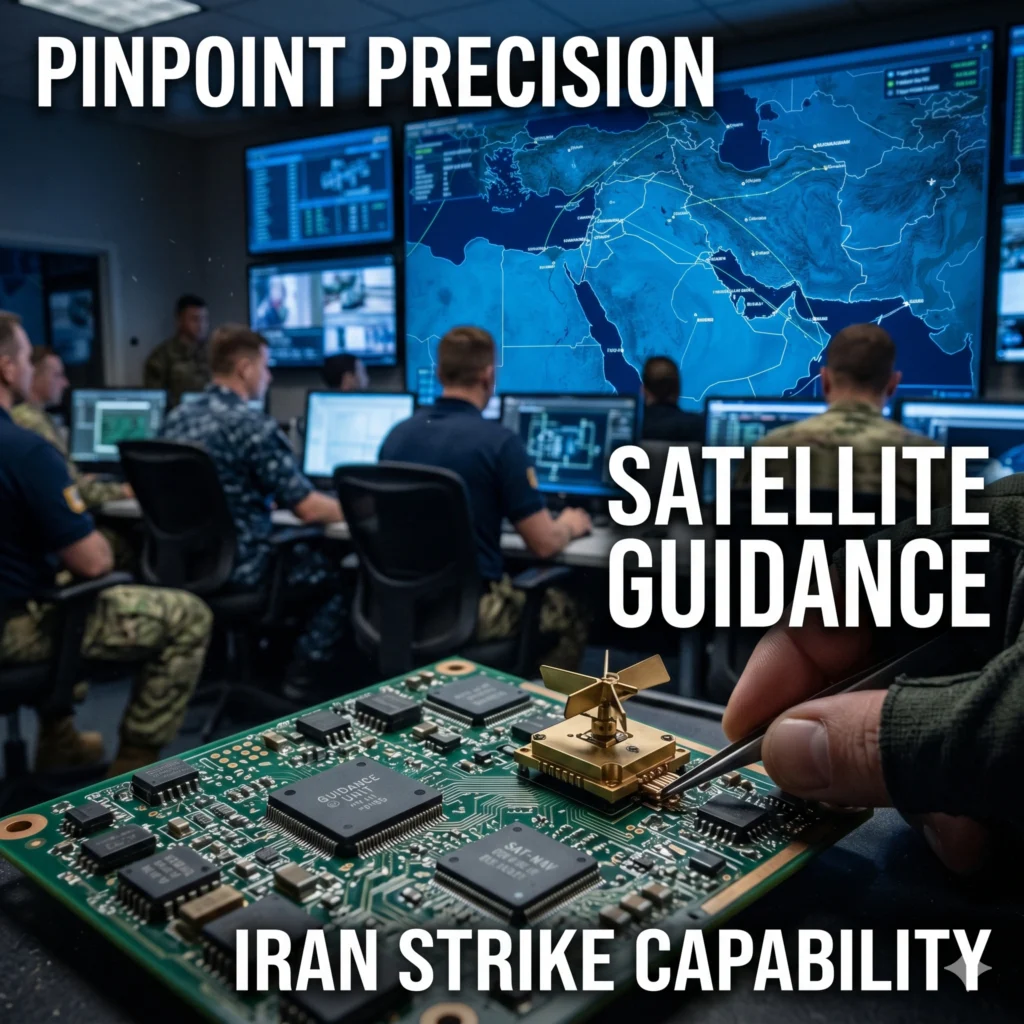
The Technological Foundation of Iranian Satellite Precision Strike
The core of the Iranian Satellite Precision Strike capability lies in the seamless integration of the Chinese BeiDou and Russian GLONASS constellations. Unlike the American GPS, which can be restricted or spoofed in specific combat zones, these alternative networks provide Iran with redundant layers of positioning data. This multi-constellation approach ensures that even if one signal is compromised, the weapon remains on its intended flight path with high fidelity.
Engineers in Tehran have successfully miniaturized the receiver modules required to process these diverse satellite signals simultaneously. This technical feat allows for real-time trajectory corrections during the terminal phase of a missile or drone flight. Furthermore, the reliance on non-Western infrastructure makes it incredibly difficult for NATO forces to “darken” the skies electronically without risking direct confrontation with other superpowers.
Iranian Satellite Precision Strike
The most terrifying aspect of the Iranian Satellite Precision Strike is the use of Controlled Reception Pattern Antenna (CRPA) technology. This hardware allows a drone or missile to ignore interference from “jammers” by focusing only on legitimate satellite signals from specific angles. As a result, the electronic bubbles typically used to protect airbases are no longer the impenetrable shields they once were during previous decades.
The deployment of CRPA systems marks a transformative moment for Iran’s paramilitary-industrial complex, according to various defense observers. By filtering out noise and malicious signals, Iranian weapons maintain a steady lock on their targets regardless of the complexity of the electromagnetic environment. This level of resilience is typically reserved for the most expensive munitions in the arsenals of major world powers, yet Iran is producing it at scale.
Collaborative Intelligence and Ground Station Synergies
Experts believe that the Iranian Satellite Precision Strike success is heavily bolstered by shared ground station access provided by Moscow. These stations offer the refined atmospheric correction data needed to achieve sub-meter accuracy over thousands of kilometers. By utilizing these nodes, Iranian targeting experts can account for weather patterns and ionospheric disturbances that would otherwise throw a long-range strike off course.
This tripartite collaboration between Tehran, Moscow, and Beijing has facilitated a shift from symbolic strikes to operationally decisive ones. Each partner gains something from this exchange, whether it is real-world testing of guidance algorithms or geopolitical leverage against common rivals. The sharing of satellite telemetry represents a deep level of trust and a shared vision for a multipolar military reality.
Assessing the Impact on Regional Airbase Security
The recent operation involving an Iranian Satellite Precision Strike on the Prince Sultan air base serves as a chilling case study. Reports indicate that a surveillance aircraft was struck precisely on its rotating radar dish, a target measuring only a few meters in diameter. This level of precision suggests that Iranian drones are no longer just “flying bombs” but are now sophisticated guided platforms.
During the same high-precision operation, five refuelling tankers were heavily damaged, and twelve United States personnel sustained injuries. The ability to distinguish between a hangar and a specific high-value asset on the tarmac demonstrates a mature targeting cycle. Military sources expressed deep concern that this increased precision will force a total recalculation of regional air defense strategies and personnel placement.
Operational Scale and Mass Drone Saturation
While precision is critical, the sheer volume of the Iranian Satellite Precision Strike capability is what truly overwhelms modern defenses. During the most recent phase of regional conflict, Iran launched more than 4,550 Shahed-136 kamikaze drones equipped with these new guidance chips. When high accuracy is paired with mass saturation, even the most advanced interceptors like the Patriot system eventually run out of ammunition or become overwhelmed.
This “quantity has a quality of its own” philosophy, when upgraded with satellite guidance, creates a nightmare scenario for defense planners. Each drone is now capable of striking a specific building, meaning a swarm can dismantle an entire industrial complex in a single afternoon. The economic disparity between a cheap drone and a multi-million dollar interceptor missile remains a core advantage for the Iranian military.
Electronic Warfare Resistance and Future Trajectories
The evolution of the Iranian Satellite Precision Strike does not stop at current satellite integration. Future iterations are expected to include optical terrain mapping, which would allow drones to navigate even if all satellite signals are completely lost. This layered approach to guidance ensures that Iranian influence remains a persistent factor in any regional dispute or full-scale military engagement.
Western security sources suggest that Iranian targeting experts are likely operating from Russian satellite ground stations to further refine these capabilities. This integration allows for a rapid feedback loop where battle damage assessments are fed back into guidance algorithms in real-time. Such a system allows for “follow-up” strikes that can hit the exact same hole created by a previous missile, maximizing structural damage.
Strategic Recalculation for Global Defense Networks
The Iranian Satellite Precision Strike has effectively ended the era where regional powers could rely on simple electronic jamming for protection. Nations across the globe are now looking toward directed energy weapons and lasers as the only viable way to counter these high-precision swarms. However, the deployment of such technology is years away from being widespread, leaving a significant vulnerability in current defense postures.
Strategic analysts argue that the shift toward satellite-linked guidance allows Iranian weapons to maintain accuracy in almost any electronically contested environment. This means that the “soft kill” methods of the past must be replaced by “hard kill” kinetic interceptions, which are significantly more expensive. The fiscal pressure of defending against these strikes is becoming a primary concern for finance ministries and defense departments alike.
Global Implications of High-Accuracy Paramilitary Systems
The success of the Iranian Satellite Precision Strike program is likely to inspire other non-state actors and smaller nations to seek similar upgrades. If a mid-tier power can achieve pinpoint accuracy using off-the-shelf satellite technology, the monopoly on “smart” warfare held by the West is officially over. This democratization of precision weaponry introduces a new level of volatility to global flashpoints.
We are currently witnessing a transformative moment for Iran’s paramilitary-industrial capabilities that will resonate for decades. The ability to strike specific windows or radar arrays from over a thousand miles away changes the definition of deterrence. As the technology continues to mature, the international community must find new ways to manage the risks associated with a world where everyone has a precision strike capability.
Redefining Naval Security in Contested Waters
The Iranian Satellite Precision Strike also poses a lethal threat to naval vessels operating in the Persian Gulf and beyond. Large warships, once thought to be safe due to their mobility and electronic defense suites, are now vulnerable to high-accuracy drones. A single strike on a carrier’s flight deck or a destroyer’s bridge could mission-kill a billion-dollar asset using a drone that costs less than a luxury car.
This maritime threat forces a change in how freedom of navigation operations are conducted in sensitive straits. Escort patterns and sensor ranges must be extended, and crews must remain on high alert for small, low-flying targets that blend into the radar clutter. The Iranian Satellite Precision Strike capability effectively extends Iran’s “anti-access/area denial” (A2/AD) umbrella far into the Indian Ocean.
The Psychological Dimension of Precision Warfare
There is a profound psychological impact associated with the Iranian Satellite Precision Strike that cannot be ignored. Knowing that a drone can be programmed to hit a specific office rather than just a general city block creates a different kind of fear. This targeted pressure is often used as a tool of coercive diplomacy, where the threat of a surgical strike is used to extract political concessions.
As Iranian Satellite Precision Strike technology becomes more visible through successful operations, the perception of Iranian power grows. This helps the nation maintain its influence among its proxies and allies, who see Tehran as a provider of high-tech solutions to low-tech conflicts. The prestige of achieving this level of accuracy, despite years of heavy international sanctions, is a point of national pride for the Iranian leadership.
Future Countermeasures and Technical Evolution
To combat the Iranian Satellite Precision Strike, new investments are being funneled into artificial intelligence-driven radar systems. These systems are designed to identify the unique flight signatures of satellite-guided drones at much greater distances. However, as defenses evolve, so do the Iranian guidance packages, leading to a continuous arms race in the digital and physical realms.
The integration of Iranian Satellite Precision Strike components into smaller, more clandestine platforms is the next logical step. We may soon see “loitering munitions” that can wait for hours over a target area, receiving satellite updates, before picking the perfect moment to strike. This persistence, combined with pinpoint accuracy, represents the ultimate evolution of modern asymmetric warfare.
Strengthening the Multipolar Alliance
The reliance on Russian and Chinese infrastructure for the Iranian Satellite Precision Strike has solidified a new axis of technological cooperation. This partnership is built on the mutual desire to challenge the hegemony of Western military standards. By providing the “eyes in the sky,” Moscow and Beijing ensure that Tehran remains a potent and capable actor on the global stage.
The Iranian Satellite Precision Strike is a symptom of a larger shift toward a world where technology transfers happen outside of Western-controlled channels. This development makes it nearly impossible to use traditional sanctions to stop the flow of critical knowledge. As long as the satellite networks remain operational, the precision of Iranian weapons will continue to improve, regardless of trade embargoes or diplomatic pressure.
Global Consequences of Iranian Satellite Precision Strike
In conclusion, the rise of the Iranian Satellite Precision Strike represents a fundamental change in the cost and accessibility of modern warfare. The days of safe havens for high-value assets in the Middle East are over. Military planners must now operate under the assumption that any fixed or slow-moving target is within the crosshairs of a precision-guided Iranian weapon.
The world must adapt to this new reality by investing in resilient infrastructure and more cost-effective defense systems. The Iranian Satellite Precision Strike has proven that innovation can bypass even the most stringent obstacles. As we move further into 2026, the lessons learned from this technological leap will dictate the future of global conflict and the pursuit of international peace.
For more details & sources visit: The National
Read more on Iran news: 360 News Orbit – Iran.