
The geopolitical landscape of the Middle East has shifted into a period of unprecedented volatility as the confrontation between the United States, Israel, and Iran enters its twenty-second day. Authorities in Tehran confirmed that the Iran Conflict Death Toll has officially surpassed 1,444 fatalities, marking one of the bloodiest periods in recent regional history.
This grim milestone arrives amidst a rare and sacred alignment of the Persian New Year, Nowruz, and the Islamic holiday of Eid al-Fitr. Instead of traditional celebrations, the atmosphere across the nation is defined by mourning and a sharp escalation in military engagement. The conflict has now moved beyond localized skirmishes, evolving into a multi-theater war that spans the Persian Gulf to the remote Indian Ocean.
The Humanitarian Crisis and Rising Fatality Counts
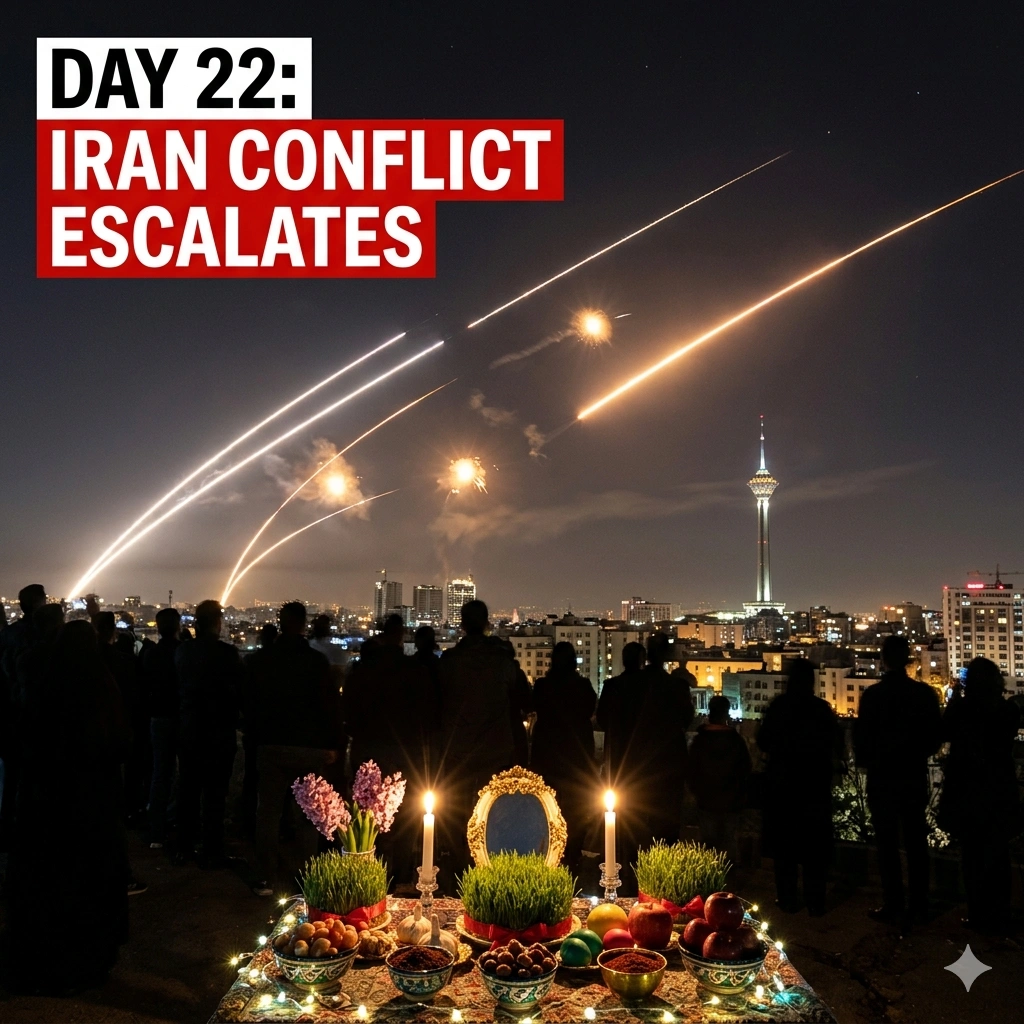
The human cost of this three-week engagement is becoming increasingly difficult to quantify as medical facilities struggle under the weight of the Iran Conflict Death Toll. Reports from the Iranian Ministry of Health indicate that over 200 children are among the deceased, highlighting the devastating impact of urban aerial campaigns. In Tehran, air defense sirens have become a constant backdrop to daily life, as citizens seek refuge in makeshift bunkers while missiles intercept incoming threats overhead.
The psychological toll on the civilian population is immense, with many displaced from their homes in major industrial hubs. International humanitarian organizations have raised alarms regarding the scarcity of medical supplies and the difficulty of providing aid during such high-intensity warfare.
Despite the heavy Iran Conflict Death Toll, the ideological resolve of the Iranian leadership appears to be stiffening. The traditional festivities at the Imam Reza Shrine, usually a time of prayer and family gatherings, have been repurposed into massive anti-Western demonstrations. Pilgrims and locals alike have gathered not just for religious observance, but to voice their defiance against the ongoing strikes. The juxtaposition of sacred holidays and high-tech warfare has created a unique and dangerous cultural flashpoint.
The government has had to implement strict rationing of food and fuel, further straining a population already reeling from years of economic pressure. As the fourth week of the conflict begins, the focus remains on the mounting loss of life and the inability of international mediators to establish a viable corridor for humanitarian relief or a temporary cessation of hostilities.
Iran Conflict Death Toll
The military dimension of this crisis reached a new peak with the launch of the 70th wave of drone and missile attacks directed at Israeli and American assets. This specific escalation was framed by Tehran as a direct response to the bombardment of the South Pars gas field, a cornerstone of the Iranian energy economy. The Iran Conflict Death Toll includes many specialized technicians and workers who were caught in the crossfire during these infrastructure strikes. The 70th wave of attacks utilized a mix of “suicide” drones and precision-guided cruise missiles, designed to overwhelm the sophisticated Iron Dome and Aegis defense systems. The sheer volume of these continuous waves suggests a deep stockpile of domestic weaponry that has not yet been exhausted.
Targeting energy infrastructure in the Gulf states represents a significant broadening of the war’s scope. By striking at the economic lifelines of the region, Iran is attempting to create a global energy crisis that would force Western powers to reconsider their military posture. The Iran Conflict Death Toll now includes personnel from various nationalities involved in the regional energy sector.
These attacks have caused a massive spike in global oil prices, leading to economic tremors in markets from New York to Tokyo. The strategy appears to be one of “maximum cost,” where Iran seeks to demonstrate that it can inflict significant financial and human damage if its own sovereignty is threatened.
Furthermore, the 70th wave of attacks has targeted U.S. naval assets stationed in the Persian Gulf, leading to heightened tensions in the Strait of Hormuz. The Iran Conflict Death Toll is expected to rise as search and rescue operations continue in the wake of these maritime strikes. Military experts note that the technical sophistication of the 70th wave shows a high level of coordination between different branches of the Iranian armed forces. This persistent offensive capability has forced the U.S. and its allies to maintain a state of constant high alert, exhausting crews and depleting interceptor missile inventories at a rapid pace.
Strategic Escalation at Diego Garcia
In perhaps the most stunning development of the fourth week, Iran launched long-range ballistic missiles at the joint US-UK military base on Diego Garcia. This remote atoll in the Indian Ocean is a critical hub for long-range bomber operations and maritime surveillance, making it a high-value strategic target. The strike follows the United Kingdom’s decision to permit its bases to be used for offensive sorties against Iranian territory. This move has effectively expanded the geographic boundaries of the war, proving that no Western asset in the Eastern Hemisphere is entirely safe. The Iran Conflict Death Toll is likely to see further increases as damage assessments from the base are processed and released.
The attack on Diego Garcia is a clear message to the international community that Iran possesses the “reach” to strike distant targets. This escalation was intended to punish the UK for its active role in the coalition and to signal to other nations that providing logistical support to the U.S. carries extreme risks. The Iran Conflict Death Toll reflects the high stakes of this “outer ring” strategy, where the war moves away from the Iranian border and into the global commons. Military analysts are now re-evaluating the safety of other overseas bases that were previously thought to be outside the effective range of Iranian conventional weaponry.
- The strike on Diego Garcia involved several medium-to-long-range ballistic missiles.
- US-UK logistical networks have been forced to reroute supplies following the attack.
- Satellite imagery confirms significant damage to hangar facilities and fuel depots.
- The Iran Conflict Death Toll continues to be the primary metric for the war’s intensity.
The Role of Diplomacy and Ceasefire Rejection
Despite the staggering Iran Conflict Death Toll, the prospects for a formal ceasefire remain bleak as the U.S. government has explicitly ruled out such an agreement. While Washington has signaled an interest in “winding down” the intensity of the conflict, it refuses to enter a legal framework that would limit its ability to respond to Iranian provocations. This “managed escalation” approach aims to degrade Iranian military capabilities without getting bogged down in a permanent occupation or a formal peace treaty. However, the high Iran Conflict Death Toll makes it politically difficult for any side to back down without achieving a decisive victory or a significant concession.
International mediators from the European Union and the United Nations have attempted to facilitate back-channel communications, but these efforts have been largely unsuccessful. The Iran Conflict Death Toll serves as a persistent reminder of the failure of modern diplomacy to prevent the slide into large-scale warfare. Iran has maintained that no talks can occur until the “unprovoked aggression” against its energy sector and civilian centers ceases. Meanwhile, the U.S. insists that Iran must first halt its 70th wave of drone strikes and its support for regional proxies. This deadlock suggests that the fourth week of the conflict may only be the beginning of a much longer and more destructive phase of the war.
The domestic political pressure in both the U.S. and Israel is also a major factor in the rejection of a ceasefire. Leaders are wary of appearing weak in the face of the 70th wave of drone attacks, while the Iranian leadership uses the Iran Conflict Death Toll to fuel nationalistic fervor. This cycle of violence is self-perpetuating, as each new strike provides the justification for the next. The “winding down” strategy mentioned by U.S. officials may simply be a tactical pause to resupply munitions rather than a genuine shift toward peace. Consequently, the civilian populations on all sides remain in a state of constant peril as the war of attrition grinds on.
Impact on Regional Stability and Energy
The economic ramifications of the Iran Conflict Death Toll are felt far beyond the borders of the Middle East. With the South Pars gas field and other regional energy hubs under constant threat, the global supply chain for liquefied natural gas (LNG) has been severely disrupted. This comes at a time when many nations are still recovering from previous global economic shocks. The Iran Conflict Death Toll in the industrial sector has led to a mass exodus of foreign contractors and experts, leaving the region’s infrastructure vulnerable to long-term decay. The instability has also caused a flight of capital from regional markets, as investors seek safer havens for their assets.
In the Gulf states, the 70th wave of drone attacks has forced a radical rethinking of national security strategies. Countries that were previously seen as neutral or peripheral to the U.S.-Iran rivalry are now finding themselves in the line of fire. The Iran Conflict Death Toll includes casualties from these neighboring states, drawing them deeper into the conflict. This regional contagion is exactly what many diplomats feared, as the war threatens to undo years of delicate regional integration and economic cooperation. The focus on military spending is now draining budgets that were originally earmarked for social and technological development.
The environmental impact of the strikes on energy facilities is another burgeoning crisis. Oil spills and atmospheric pollution from burning gas wells are creating an ecological disaster in the Persian Gulf. These “secondary” effects of the war will likely persist long after the Iran Conflict Death Toll has stabilized. The destruction of these resources not only affects the current economy but also the future habitability of the region. As the conflict continues, the total cost—human, economic, and environmental—is reaching levels that will take decades to recover from, making the quest for a resolution even more urgent.
Military Tactics and the 70th Wave
The tactical evolution seen in the 70th wave of drone attacks highlights a significant shift in modern warfare. Iran has effectively used low-cost, mass-produced technology to counter high-cost, high-tech defense systems. By saturating the airspace with drones, they are able to find gaps in the defense or simply wait until the interceptors run out. The Iran Conflict Death Toll during these waves often includes the crews of the defense batteries who are targeted by secondary strikes. This “swarming” tactic has proven to be an effective equalizer against a more technologically advanced adversary, forcing the U.S. and Israel to rethink their defensive doctrines.
The use of ballistic missiles in conjunction with drones adds another layer of complexity to the 70th wave. While the drones distract the radar and defense systems, the faster missiles strike the primary targets. This synchronized approach was evident in the attack on Diego Garcia and the Gulf energy sites. The Iran Conflict Death Toll is a direct result of this tactical efficiency, which maximizes the lethality of each engagement. The intelligence required to coordinate such large-scale attacks suggests that Iran’s command and control structures remain intact despite three weeks of heavy bombardment.
- Integration of artificial intelligence in drone navigation for the 70th wave.
- Use of decoys to exhaust the ammunition of the Iron Dome and Patriot systems.
- Targeting of logistical hubs to slow down the resupply of interceptor missiles.
- Continuous updates on the Iran Conflict Death Toll through state-run media outlets.
The 70th wave also demonstrates the importance of domestic manufacturing in modern conflict. Unlike some of its neighbors, Iran has developed a self-sufficient military industry that allows it to maintain a high operational tempo despite international sanctions. The Iran Conflict Death Toll is a tragic testament to the destructive power of this homegrown arsenal. As the war enters its second month, the ability of Iran to continue launching these waves will be a decisive factor in the ultimate outcome of the conflict.
The Role of Social Media and Information War
The battle for the narrative is just as intense as the physical fighting, with both sides using the Iran Conflict Death Toll to garner international sympathy and support. Images of the destruction in Tehran and the aftermath of the 70th wave are shared instantly across global social media platforms. Iran uses these visuals to frame itself as a victim of imperialist aggression, while the U.S. and Israel emphasize the need to dismantle a regime that sponsors regional instability. The Iran Conflict Death Toll is often the centerpiece of these digital campaigns, with each side accusing the other of inflating or deflating the numbers for political gain.
Information warfare has also played a role in the 70th wave, with cyber-attacks targeting the communication networks of the opposing forces. Hackers have attempted to disrupt the control signals of the drones and the early warning systems of the defense batteries. The Iran Conflict Death Toll could have been even higher if not for the successful interception of some of these digital threats. This “fifth domain” of warfare adds a layer of uncertainty to the conflict, as it is often difficult to attribute specific actions to a particular actor. The psychological impact of these cyber operations on the civilian population is significant, creating a sense of total vulnerability.
Journalists on the ground face immense risks as they attempt to document the Iran Conflict Death Toll and the reality of the 70th wave. Several media members have been killed or injured since the start of the conflict, leading to a “darkening” of the information landscape in certain areas. Without independent verification, the world is often left to choose between competing propaganda narratives. The Iran Conflict Death Toll remains the most reliable, albeit tragic, indicator of the war’s true scale, even as the details of individual battles remain shrouded in the fog of war.
Future Outlook and Escalation Risks
As the conflict moves into its fourth week, the risk of even further escalation remains high. There are concerns that if the 70th wave continues to inflict significant damage, the U.S. or Israel might resort to even more drastic measures, including strikes on leadership centers or nuclear-related facilities. The Iran Conflict Death Toll would inevitably skyrocket in such a scenario, potentially drawing other global powers like Russia or China into the fray. The current “high-intensity” stalemate is unsustainable, and many fear that the war is on the verge of a tipping point that could lead to a broader global conflagration.
The alignment of Nowruz and Eid al-Fitr in 2026 was meant to be a time of renewal and peace, but it has instead become a period of profound tragedy. The Iran Conflict Death Toll is a somber reminder of how quickly regional tensions can spiral out of control. The 70th wave of drone attacks has shown that traditional methods of deterrence are failing in the face of asymmetric warfare. Unless a diplomatic breakthrough is achieved soon, the fourth week of the Iran conflict may be remembered as the moment when the Middle East entered a new and much darker era of perpetual war.
In the final analysis, the Iran Conflict Death Toll is not just a statistic; it represents a generation of lost potential and shattered lives. The 70th wave of attacks and the strikes on Diego Garcia have fundamentally changed the security architecture of the world. Whether the conflict “winds down” or escalates further, the impact will be felt for decades. The international community must now decide if it will continue to watch from the sidelines or if it will take the necessary risks to stop the bloodshed and find a path toward a lasting, albeit difficult, peace.
Conclusion: A Crisis Without a Clear End
The twenty-second day of the conflict has left the world in a state of shock, as the Iran Conflict Death Toll continues its steady climb. The resilience of the Iranian military, evidenced by the 70th wave of drone strikes, has surprised many who expected a swift conclusion to the hostilities. The expansion of the war to Diego Garcia signifies that this is no longer a localized issue but a global security crisis. As the holidays of Nowruz and Eid al-Fitr come to a close, the hope for a peaceful resolution seems more distant than ever, replaced by the harsh reality of a protracted war of attrition.
The humanitarian tragedy reflected in the Iran Conflict Death Toll is a call to action for the global community. The 70th wave has proven that technology can be a double-edged sword, providing new ways to kill as well as to defend. The lack of a formal ceasefire means that the coming weeks will likely bring more destruction and more loss of life. The Iran Conflict Death Toll is a mark of shame on the international system’s inability to prevent such a massive failure of diplomacy.
Ultimately, the resolution of this conflict will require more than just military might; it will require a fundamental shift in how the U.S., Israel, and Iran interact on the world stage. The 70th wave and the rising Iran Conflict Death Toll should serve as a powerful incentive to find that new path. Until then, the people of the region remain trapped in a cycle of violence that shows no signs of abating, waiting for a peace that remains frustratingly out of reach in this turbulent spring of 2026.
A Summary of the Current Conflict Status
As we evaluate the state of the war on March 22, 2026, the complexity of the situation cannot be overstated. The Iran Conflict Death Toll is a testament to the high-intensity nature of the combat, while the 70th wave demonstrates the ongoing operational capacity of the Iranian forces. The strike on Diego Garcia has forced a strategic re-evaluation among Western military planners, and the rejection of a ceasefire by the U.S. ensures that the fighting will continue for the foreseeable future. The world remains on edge as it watches to see what the fourth week of this historic conflict will bring.
The 70th wave of drone attacks has redefined the expectations of modern air defense, while the Iran Conflict Death Toll has redefined the human cost of geopolitical rivalry. As the international community grapples with the fallout, the focus must remain on the protection of civilians and the search for a diplomatic opening. The Iran Conflict Death Toll is a high price to pay for a conflict that many believe could have been avoided with better communication and mutual respect between the involved nations.
For more details & sources visit: Al Jazeera
Read more on Iran news: 360 News Orbit – Iran.