
Germany Naval Security Mission represents a critical shift in European defense policy as Berlin prepares to address the growing crisis in the Middle East. German Defense Minister Boris Pistorius announced the early deployment of naval assets to the Mediterranean Sea to ensure a rapid response to maritime threats. This strategic movement involves the transfer of a specialized minesweeper and a command and supply ship to the region. The primary objective is to prepare for the reopening of the Strait of Hormuz, which has been significantly impacted by the current conflict. By positioning these units early, the German government aims to bypass potential delays once a formal parliamentary mandate is granted.
The Germany Naval Security Mission is a direct response to the blockade of one of the world’s most vital waterways. Following military hostilities involving the United States, Israel, and Iran on February 28, the passage was closed and rigged with naval mines. These developments have created a high-risk environment for international commercial shipping and energy transport. Germany, possessing one of the largest armed forces in Europe, feels a profound responsibility to contribute to the restoration of global maritime safety. This mission highlights the nation’s specialized capabilities in mine detection and clearing, which are essential for securing the Persian Gulf.
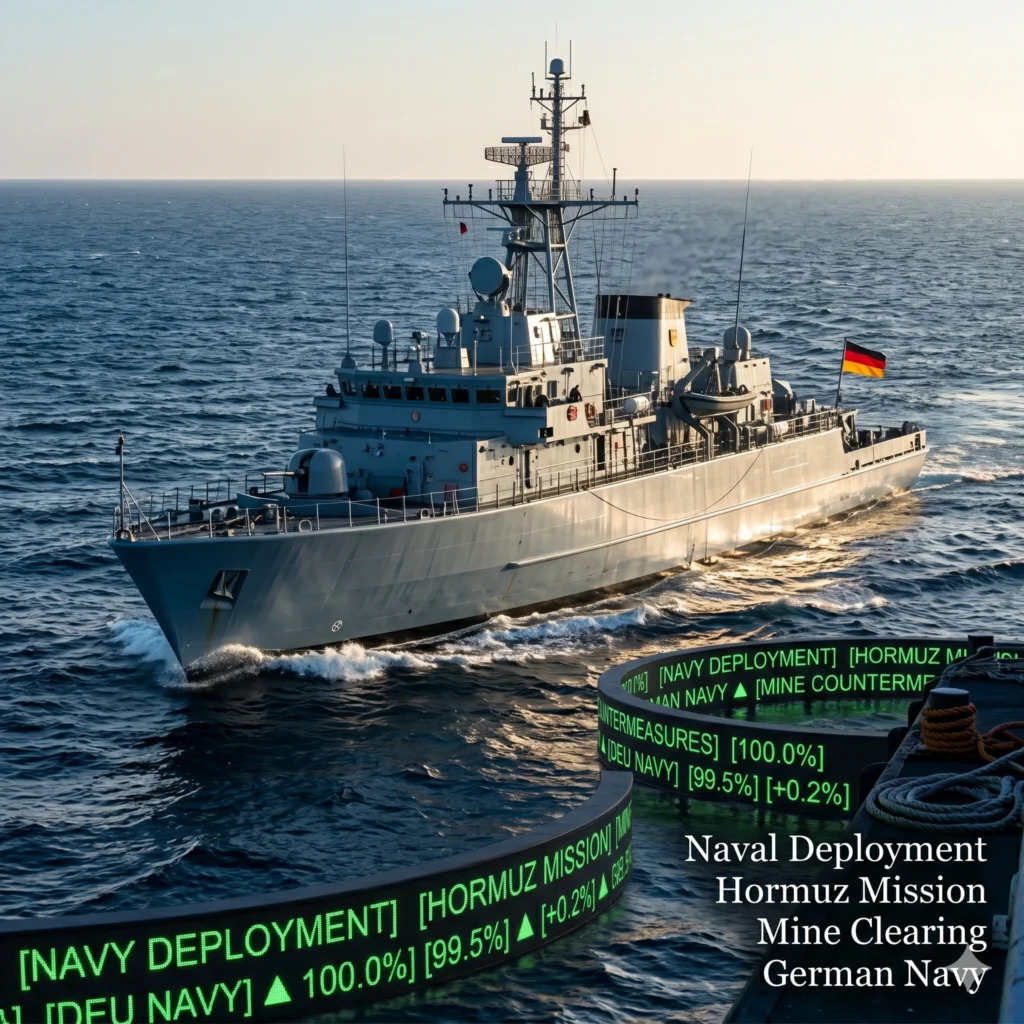
Germany Naval Security Mission
The Germany Naval Security Mission was officially detailed by Boris Pistorius as a measure to save valuable time in a volatile security landscape. Typically, a foreign deployment of the Bundeswehr requires a lengthy approval process within the German parliament. By moving the ships to the Mediterranean now, the navy can be ready to transit toward the Persian Gulf the moment legal hurdles are cleared. This foresight is a hallmark of the Germany Naval Security Mission and reflects a more assertive German defense posture in 2026. The move is designed to reassure allies that Europe is ready to protect shared economic interests.
The specific ships chosen for the Germany Naval Security Mission include a minesweeper, which is the “scalpel” of naval warfare. These vessels use advanced sonar and remote-controlled submersibles to identify and neutralize underwater explosives without risking the crew. In an environment like the Strait of Hormuz, where Iranian forces have deployed numerous mines, this expertise is indispensable. The command and supply ship provides the necessary logistical backbone to sustain operations far from home ports. Together, they form the vanguard of the Germany Naval Security Mission in the Middle East.
Military experts are particularly concerned about the density of the minefields laid after the February attacks. Clearing these hazards is a slow and dangerous process that requires absolute precision and technical mastery. The Germany Naval Security Mission is being watched by global shipping giants who are desperate for a return to normalcy. If the mission is successful, it would signify a major victory for international maritime security and a blow to those using blockades as a weapon. Germany’s commitment to this task reinforces its role as a stabilizer in the international community.
Maritime Blockades and Global Energy Stability
The closure of the Strait of Hormuz is not just a regional issue; it is a shock to the global energy market. With one-fifth of the world’s petroleum passing through this narrow corridor, any disruption leads to immediate price spikes at the pump. The Germany Naval Security Mission is fundamentally an effort to prevent a total collapse of global economic stability. By securing the lanes, the German navy helps ensure that energy continues to reach markets in Europe, Asia, and the Americas. This economic angle is a driving force behind the urgency of the Germany Naval Security Mission.
The negative consequences of the current blockade have already started to manifest in rising inflation and supply chain delays. Many tankers are currently anchored in safe waters, waiting for a signal that the mines have been cleared. The Germany Naval Security Mission provides the technical hope that these ships can soon resume their journeys safely. Minister Pistorius emphasized that the protection of free trade is a core interest for a manufacturing nation like Germany. Consequently, the Germany Naval Security Mission is seen as an investment in both security and economic prosperity.
- German naval assets are moving to the Mediterranean to minimize response times.
- The mission focuses on the Strait of Hormuz following the February 28 hostilities.
- Minesweepers are essential for clearing the naval mines deployed by Iranian forces.
- A parliamentary mandate is still required before the ships enter the combat zone.
Tactical Challenges in the Persian Gulf
Operating in the Persian Gulf presents unique tactical challenges for the Germany Naval Security Mission due to the narrow geography of the region. The Strait of Hormuz is a tight chokepoint where ships are vulnerable to both mines and shore-based missile batteries. The German navy must coordinate closely with international partners to ensure air cover and surface protection during demining operations. The Germany Naval Security Mission will likely be part of a larger multi-national task force aimed at regional stabilization. This collaborative approach is vital for the safety of the crews involved in the mission.
The technical proficiency of German sailors is highly regarded within NATO and among other maritime powers. Their training involves rigorous simulations of the exact types of mine warfare currently seen in the Middle East. The Germany Naval Security Mission allows these sailors to apply their skills in a real-world scenario with global implications. Every mine cleared is a potential disaster averted for a commercial vessel or a naval asset. The success of the Germany Naval Security Mission will depend on the continued reliability of German sensor technology and drone systems.
Beyond the physical clearing of mines, the Germany Naval Security Mission serves as a psychological deterrent to further escalation. The presence of a sophisticated naval force signals to all parties that the international community will not accept a permanent closure of the waterway. This diplomatic function of the Germany Naval Security Mission is just as important as the physical work done on the water. It reinforces the principle that international waters must remain open to all nations regardless of regional conflicts. Berlin is sending a clear message through this early deployment.
Parliamentary Mandate and Legal Framework
In Germany, the use of armed forces abroad is strictly regulated by the parliament, making the Germany Naval Security Mission a sensitive political topic. The government must convince lawmakers that the deployment is necessary for national security and international law. By starting the movement of ships now, Pistorius is demonstrating the urgency of the situation to his colleagues in the Bundestag. The Germany Naval Security Mission will only proceed to the final stage once the legal framework is firmly in place. This ensures that the mission has the democratic backing required for long-term operations.
Public opinion in Germany is often divided on foreign military engagements, but the protection of shipping lanes usually finds broader support. The economic impact of the blockade makes the Germany Naval Security Mission a matter of domestic concern for German voters. High energy prices are a powerful motivator for supporting a mission that promises to restore the flow of oil and gas. The Germany Naval Security Mission is being framed as a defensive and humanitarian effort to protect global commerce. This narrative is essential for securing the necessary political consensus in Berlin.
- Strategic positioning in the Mediterranean provides a platform for rapid deployment.
- The German navy specializes in high-tech mine countermeasures and underwater drones.
- Boris Pistorius highlighted the need for German responsibility in European defense.
- The blockade has already caused significant disruption to the global oil supply.
International Cooperation and Allied Support
The Germany Naval Security Mission is not happening in a vacuum; it is part of a broader network of allied security efforts. The United States and other European nations are also increasing their presence in the region to counter the Iranian blockade. The Germany Naval Security Mission adds a specific and highly valued capability to this collective force. Working together, these nations can create a “safe corridor” for shipping even if the broader conflict continues. This synergy is a key reason why the Germany Naval Security Mission is viewed so favorably by NATO leadership.
Coordination between the different naval forces requires standardized communication and shared intelligence on mine locations. German command and supply ships are equipped to facilitate this type of inter-agency cooperation. The Germany Naval Security Mission will benefit from the data gathered by allied satellites and reconnaissance aircraft. This “big picture” view allows the minesweepers to target the most critical areas of the blockade first. The efficiency of the Germany Naval Security Mission is greatly enhanced by this deep integration with international partners.
- Regional instability in the Middle East has necessitated a proactive naval stance.
- The Strait of Hormuz handles roughly 20% of the world’s total petroleum.
- German ships are currently awaiting the final signal from the federal parliament.
- Deployed naval mines represent a significant threat to international merchant fleets.
The Role of Boris Pistorius in Defense Reform
Defense Minister Boris Pistorius has been a central figure in the modernization of the German military and the Germany Naval Security Mission. Since taking office, he has pushed for a more “combat-ready” force that can respond to 21st-century threats. The early deployment for the Germany Naval Security Mission is a perfect example of his proactive leadership style. He has consistently argued that Germany must lead from the front when it comes to European security. This mission is a tangible result of his efforts to transform the Bundeswehr into a more agile organization.
His interview with the Rheinische Post was a strategic move to prepare the public for a potentially long-term commitment. By explaining the technical and economic reasons behind the Germany Naval Security Mission, he is building a case for continued defense spending. Pistorius understands that the Germany Naval Security Mission is a test of the country’s new defense doctrine. If the navy performs well, it will solidify Germany’s reputation as a reliable and capable security partner. The stakes for the minister and the nation are incredibly high as the ships move south.
Future Outlook for Maritime Security
The long-term outlook for maritime security in the Middle East remains uncertain, making the Germany Naval Security Mission more important than ever. Even if the current conflict reaches a ceasefire, the threat of unexploded mines will persist for months or even years. The Germany Naval Security Mission may transition into a long-term monitoring and clearing operation to ensure the lanes stay safe. This enduring presence would be a significant shift for a navy that has traditionally focused on the North and Baltic Seas. The Germany Naval Security Mission marks the beginning of a new chapter in German naval history.
As technology evolves, the Germany Naval Security Mission will likely incorporate more autonomous systems and artificial intelligence. These tools can map minefields faster and with less risk to human divers. The lessons learned during the Germany Naval Security Mission will be used to refine these technologies for future conflicts. The world is entering an era where maritime chokepoints are increasingly weaponized, and the Germany Naval Security Mission is the first line of defense. Berlin is committed to staying at the forefront of this critical security domain.
- The German navy is one of the few with deep-water mine clearing expertise.
- International oil markets are highly sensitive to the success of the mission.
- German officials insist on a cessation of hostilities before final entry.
- The deployment serves as a deterrent against further mine warfare escalation.
Impact on the European Security Architecture
The Germany Naval Security Mission is also a statement about the future of European security independence. By taking the lead on a major maritime security issue, Germany is showing that it can act outside of the traditional NATO framework if necessary. This strengthens the European “pillar” of global security and provides more options for crisis management. The Germany Naval Security Mission is a clear indication that Europe is willing to protect its own interests in the Middle East. This newfound assertiveness will have lasting effects on how the continent interacts with other global powers.
Allies have largely welcomed the Germany Naval Security Mission as a sign of a more balanced sharing of the security burden. For too long, the United States has been the primary provider of maritime security in the Persian Gulf. The Germany Naval Security Mission represents a maturing of the European defense contribution. This shift is essential for maintaining a stable and rules-based international order. The Germany Naval Security Mission is the latest piece of a complex puzzle aimed at global peace and economic continuity.
Technical Details of Mine Countermeasures
To understand the Germany Naval Security Mission, one must look at the technology used to find mines. German ships use a combination of hull-mounted sonar and towed sensors to “see” underwater. Once a potential mine is identified, the Germany Naval Security Mission utilizes a SeaFox drone to get a closer look. This drone can then place a small charge to destroy the mine safely from a distance. This “remote” approach is what makes the German navy so effective and safe during these dangerous missions.
The command ship in the Germany Naval Security Mission acts as the brain of the operation, processing vast amounts of data. It coordinates the movements of the minesweepers and provides a landing pad for helicopters. This logistical hub is what allows the Germany Naval Security Mission to operate for extended periods without returning to port. The technical superiority of these vessels is a major reason why the German contribution is so highly sought after. Each meter of the Strait of Hormuz will be checked with the highest levels of German engineering precision.
- The SeaFox drone is a primary tool for the Germany Naval Security Mission.
- Advanced sonar allows for the detection of mines even in silted water.
- The command ship provides essential medical and logistical support to the fleet.
- Constant data sharing with allies ensures a comprehensive map of the seafloor.
Conclusion and Strategic Importance
The Germany Naval Security Mission is a landmark operation that combines humanitarian, economic, and military goals. By preparing to clear the Strait of Hormuz, Germany is defending the very foundation of global trade. The Germany Naval Security Mission is a testament to the nation’s technical skill and its growing willingness to take on international responsibilities. As the ships wait in the Mediterranean, the world hopes for a peaceful resolution that will allow them to complete their work. The Germany Naval Security Mission is more than just a deployment; it is a promise to keep the world’s oceans open and safe.
The coming months will be a test of German resolve and diplomatic skill. The Germany Naval Security Mission will require a delicate balance of military force and political negotiation. We celebrate the bravery of the sailors who are preparing to enter these dangerous waters for the benefit of all. The Germany Naval Security Mission is a shining example of proactive defense in an era of uncertainty. We wish the fleet a safe and successful journey as they work to restore the lifeblood of the global economy.
For more details & sources visit: Al Arabiya English
Read more about Germany news on 360 News Orbit – Germany.