
A Paris Assizes Court delivered a historic verdict on Friday, marking a significant milestone in the international pursuit of justice for the Yazidi people. The French Jihadist Sentence handed down to Sabri Essid represents the first time a French judiciary has officially recognized and punished the genocide committed by the Islamic State against this religious minority. Essid, a high-ranking member of the terrorist organization, was sentenced to life in prison for crimes against humanity and his role in the systematic enslavement of Yazidi women.
The French Jihadist Sentence serves as a powerful legal acknowledgment of the atrocities that began in 2014 when IS militants invaded the Sinjar region of northern Iraq. While Essid is widely believed to have been killed in 2018, the court proceeded with the trial in absentia due to a lack of formal proof of his death. This decision allowed the legal system to document the horrors faced by survivors and ensure that the perpetrators of these specific religious persecutions do not escape a formal record of their crimes.
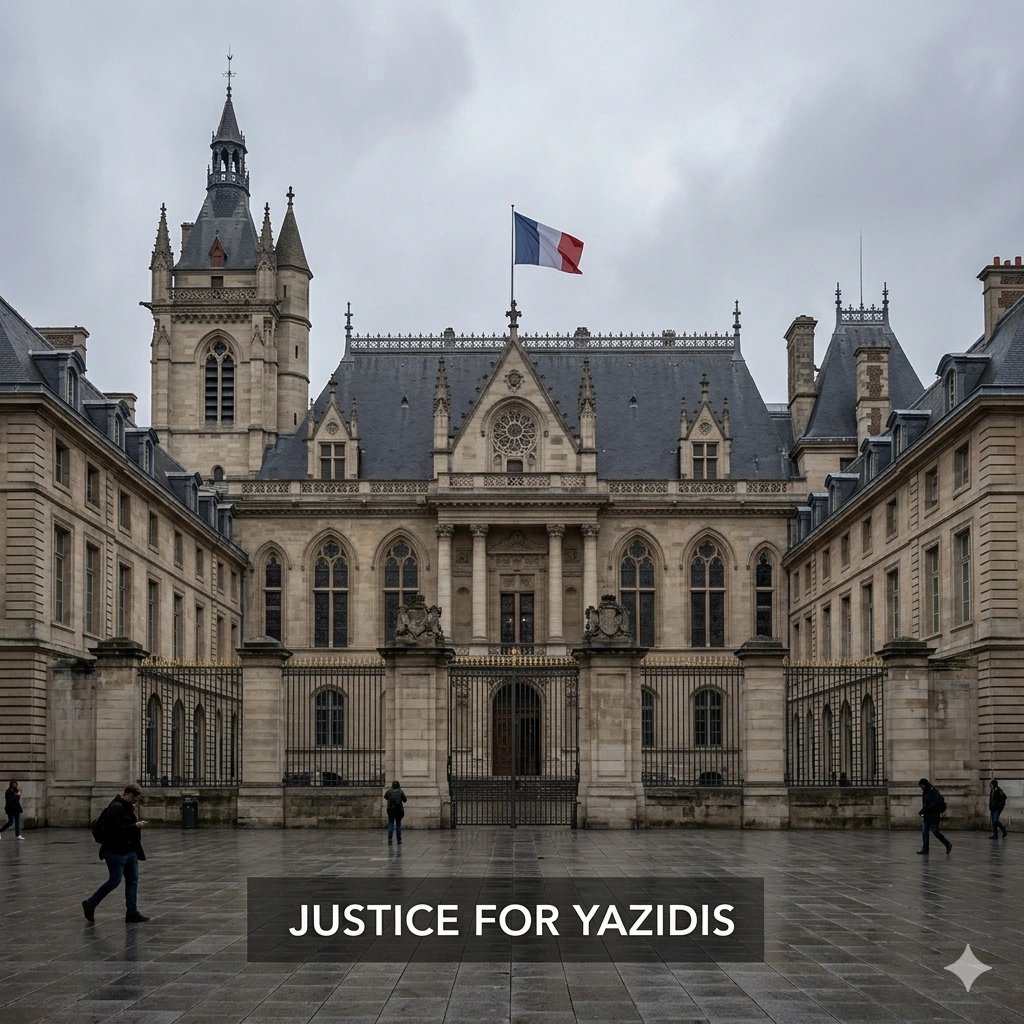
The Legal Significance of the French Jihadist Sentence
The French Jihadist Sentence is a 1-of-a-kind ruling that moves beyond standard terrorism charges to address the specific intent of destroying a religious group. By convicting Essid of genocide, the Paris court has validated the testimonies of numerous survivors who described a calculated effort to wipe out the Yazidi identity. This legal distinction is crucial because it classifies the actions of the Islamic State not just as war crimes, but as a coordinated attempt at total ethnic and religious cleansing.
For years, human rights organizations have pushed for foreign fighters to be tried for these specific crimes rather than just “terrorist association.” The French Jihadist Sentence sets a precedent that will likely influence how other European nations handle returning or deceased militants who participated in the Sinjar massacres. It sends a clear message that the international community will not overlook the targeted sexual enslavement and mass murder of the Yazidi community, regardless of the defendant’s current status.
Human Markets and the French Jihadist Sentence
Details emerging during the trial highlighted the brutal nature of the crimes that led to the French Jihadist Sentence. Sabri Essid was found guilty of participating in a criminal network that treated Yazidi women as property to be bought and sold in “human markets” across Iraq and Syria. These markets were a central part of the Islamic State’s economy, where women were subjected to horrific physical and psychological trauma as part of a state-sanctioned system of sex slavery.
- Essid was accused of purchasing several women specifically for sexual exploitation.
- Survivors testified that victims were deprived of basic necessities like food and water.
- The court heard accounts of repeated sexual violence used as a tool of religious degradation.
- The “market” system was used to reward militants and fund the organization’s operations.
French Jihadist Sentence
The presiding judge, Marc Sommerer, emphasized that the French Jihadist Sentence was a direct response to the “specific targeting” of the Yazidi people for their faith. The Islamic State viewed the Yazidis as “devil worshippers,” a designation they used to justify the murder of men and the enslavement of women. The court’s findings confirm that Essid was not a passive bystander but an active participant in the administrative and physical machinery of this genocide between 2014 and 2016.
This conviction for the French Jihadist Sentence provides a sense of closure for the victims, even if the defendant may never physically serve the time. The legal record now reflects that the systematic abuse of Yazidi women was a core component of Essid’s service to the caliphate. By focusing on the victims’ religious identity, the court has ensured that the specific motivations of the Islamic State are preserved in the annals of French and international law.
The Sinjar Massacre and French Jihadist Sentence
To understand the weight of the French Jihadist Sentence, one must look back at the devastating events of August 2014. The invasion of Sinjar led to the displacement of hundreds of thousands of Yazidis, many of whom fled to the mountains where they faced starvation. Thousands of men were executed and buried in mass graves, while approximately 7,000 women and children were abducted into a life of misery and forced labor under militants like Sabri Essid.
The French Jihadist Sentence addresses a small but vital portion of this larger tragedy by holding a French citizen accountable for his role in the Syrian end of the trafficking pipeline. Many of the women sold in Iraq were eventually moved to Raqqa, Syria, where Essid operated. The ability of the French court to link a domestic citizen to these specific international atrocities is a testament to the growing reach of universal jurisdiction in cases involving genocide and crimes against humanity.
Sabri Essid’s Role in the French Jihadist Sentence
Sabri Essid was no ordinary recruit, and his history contributed heavily to the severity of the French Jihadist Sentence. He was a veteran of jihadist circles in Toulouse and was the stepbrother of Mohamed Merah, the gunman who carried out the 2012 attacks in southwest France. Essid appeared in several IS propaganda videos, including one where a young boy—believed to be his stepson—was encouraged to execute a prisoner, showcasing his deep immersion in the group’s violent ideology.
The court found that Essid utilized his position of authority within the IS hierarchy to facilitate the trade of Yazidi women. His involvement in the internal “administration” of slaves made him a key figure in the suffering of those under his control. The French Jihadist Sentence recognizes that his leadership role amplified the impact of his crimes, as he helped maintain the logistical infrastructure required to keep thousands of women in a state of permanent captivity and abuse.
Impact on Survivors Following French Jihadist Sentence
The French Jihadist Sentence has been welcomed by Yazidi advocacy groups, including those led by Nobel Peace Prize laureate Nadia Murad. For many survivors, the trial was an opportunity to have their stories heard in a formal, respected legal setting. The conviction provides a degree of moral repair, acknowledging that the world has not forgotten the “black days” of 2014 and that the individuals responsible are viewed as criminals of the highest order.
- The ruling helps destigmatize survivors by placing the blame solely on the perpetrators.
- It encourages other survivors to come forward and share their accounts for future trials.
- The life sentence confirms the gravity of the psychological harm inflicted on the victims.
- Legal recognition of genocide is seen as a prerequisite for long-term healing in the Yazidi community.
Proof of Death and the French Jihadist Sentence
One of the more unusual aspects of the French Jihadist Sentence was the defendant’s presumed death. Intelligence reports from 2018 suggested that Essid was killed in an explosion in Syria, but without a body or DNA evidence, French law allows for a trial to proceed. This ensures that a “legal death” (the life sentence) occurs even if a physical death is suspected, preventing a situation where a militant could secretly return to society without facing justice.
This approach used in the French Jihadist Sentence reflects a “zero tolerance” policy for genocide. If Essid were to be found alive, the life sentence would be immediately enforceable. By conducting the trial now, authorities preserved witness testimony and evidence that might have been lost over time. This proactive judicial stance is designed to prevent the “disappearance” of high-level terrorists from serving as a shield against their historical responsibilities for crimes against humanity.
International Cooperation and French Jihadist Sentence
The investigation leading to the French Jihadist Sentence involved a high degree of international cooperation between French, Iraqi, and Syrian sources. Special units dedicated to the prosecution of war crimes worked with NGOs to identify victims who could testify against Essid. This collaborative effort highlights the complexity of prosecuting modern genocide, where the evidence is often scattered across multiple war zones and different jurisdictions.
The success of the French Jihadist Sentence is expected to bolster the work of UNITAD, the UN team investigating IS crimes. By proving that a domestic court can successfully navigate the complexities of a genocide trial involving foreign territory, France has provided a roadmap for other nations. The case demonstrates that with sufficient political will and legal resources, the perpetrators of the Sinjar massacre can be brought to justice regardless of where they were born or where they committed their crimes.
French Jihadist Sentence and the Paris Assizes Court
The Paris Assizes Court is specifically equipped to handle cases of this magnitude, and the French Jihadist Sentence is perhaps its most significant ruling regarding the Middle Eastern conflict. The court’s ability to process crimes of genocide requires a deep understanding of international law and a sensitive approach to witness protection. Throughout the proceedings, the court maintained a focus on the dignity of the victims, ensuring that the focus remained on the human cost of Essid’s actions.
The life term delivered in the French Jihadist Sentence is the maximum penalty available under French law for such offenses. By imposing this sentence, the judges signaled that there is no greater crime than the systematic destruction of a people based on their religion. The verdict stands as a testament to the resilience of the French judicial system and its commitment to upholding the principles of the Genocide Convention, even when the crimes occur thousands of miles away.
Public Reaction to the French Jihadist Sentence
The French Jihadist Sentence has drawn widespread attention from the public and media outlets across Europe. Many see it as a long-overdue accounting for the “French connection” to the Islamic State’s atrocities. As one of the largest exporters of foreign fighters to the region, France has a unique responsibility to ensure its citizens are held accountable for their actions abroad. The verdict has been seen by many as a necessary step in addressing the domestic radicalization crisis.
- Human rights activists have praised the court for the “genocide” designation.
- Some legal scholars questioned the trial of a “ghost,” but most agreed on its symbolic value.
- Media coverage has refocused public attention on the ongoing plight of Yazidi refugees.
- The sentence has been framed as a victory for the “universal conscience” of humanity.
Future Trials After the French Jihadist Sentence
The French Jihadist Sentence is unlikely to be the last of its kind, as several other French and European citizens are currently under investigation for similar crimes. The success of this prosecution provides a blueprint for how to use survivor testimony and captured IS documents to build a case for genocide. Legal teams are already looking at other “returnees” and detainees in Syrian camps who may have been involved in the slave trade.
Because the French Jihadist Sentence successfully linked Essid to the slave markets, it paves the way for a broader “market-focused” investigation. Authorities are interested in identifying the buyers and sellers who operated this network, treating it like a transnational organized crime syndicate. This shift in strategy could lead to a wave of new indictments in the coming years, ensuring that the legacy of the Sinjar genocide is fully addressed in courts across the globe.
Universal Jurisdiction and French Jihadist Sentence
The concept of universal jurisdiction was vital to the French Jihadist Sentence. This legal principle allows a country to prosecute individuals for particularly heinous crimes, like genocide, even if they were not committed on that country’s soil and did not involve its citizens as victims. While Essid is a French citizen, the victims were Iraqi and the crimes occurred in Syria, making the trial a pure application of this international legal doctrine.
The use of universal jurisdiction for the French Jihadist Sentence reinforces the idea that some crimes are so offensive to humanity that every state has an interest in punishing them. This prevents “safe havens” for war criminals and ensures that the global legal network is tight enough to catch those who cross borders to commit atrocities. The Paris ruling is a strong endorsement of this principle, showing that it can produce tangible results and meaningful justice for marginalized groups like the Yazidis.
Documenting Atrocities for the French Jihadist Sentence
The evidence gathered for the French Jihadist Sentence includes a haunting collection of digital footprints and physical documents. Prosecutors used IS “ownership certificates” for slaves and internal communications that detailed the prices and conditions of the women held by Essid. This documentation was essential for proving the “systematic” nature of the crimes, a requirement for a genocide conviction under the French Jihadist Sentence guidelines.
By archiving this evidence through a public trial, the French court has created a permanent historical record of the Islamic State’s depravity. This record serves as a counter-narrative to extremist propaganda and ensures that the truth of the Yazidi experience cannot be erased or denied by future generations. The French Jihadist Sentence is thus as much an act of history-keeping as it is an act of judicial punishment.
Conclusion of the French Jihadist Sentence Case
The French Jihadist Sentence against Sabri Essid marks the end of a long legal journey for the survivors of his abuse. By delivering a life sentence for genocide and crimes against humanity, the Paris Assizes Court has affirmed that the life of every Yazidi woman and man has infinite value in the eyes of the law. This ruling is a landmark for French justice and a beacon of hope for those still seeking their missing loved ones in the aftermath of the caliphate.
As the international community continues to grapple with the fallout of the Islamic State’s reign of terror, the French Jihadist Sentence will be remembered as the moment the legal tide turned. It moved the conversation from simple “terrorism” to the much weightier and more accurate charge of “genocide.” The verdict ensures that while Sabri Essid may be gone, his crimes will never be forgotten, and the justice served in a Paris courtroom will resonate throughout the Sinjar mountains.
Final Thoughts on the French Jihadist Sentence
The French Jihadist Sentence is a victory for the rule of law over the rule of fear. It demonstrates that the mechanisms of justice, while sometimes slow, are persistent and capable of addressing even the most complex and distant atrocities. For the Yazidi people, this is one more step on the long road to global recognition and protection, proving that their suffering was seen and that their oppressors will be named and shamed by the world.
Looking forward, the French Jihadist Sentence will serve as a standard for future prosecutions. It reminds us that genocide is not a relic of the past but a present danger that requires an active and courageous legal response. By standing with the Yazidi victims, the French court has upheld the highest ideals of justice, ensuring that the French Jihadist Sentence remains a permanent obstacle to those who would seek to destroy a people for their faith.
For more details & sources visit: France 24
For the latest updates from France, visit our France news page.