
The strategic meeting between King Abdullah II and President Sheikh Mohamed bin Zayed Al-Nahyan serves to officially condemn Iranian aggression and establish a new security doctrine for the Arab world. The two leaders met in the UAE to address the alarming military escalations that have targeted sovereign territories over the past month. This high-level summit was designed to coordinate a defensive posture that can withstand the physical and economic pressures of a broader regional war.
Both heads of state agreed that the international community must condemn Iranian aggression to prevent a total collapse of the current security architecture in the Middle East. By aligning their diplomatic and military resources, Jordan and the UAE are leading a movement to protect the sanctity of Arab borders. This collaboration is viewed as a necessary step to ensure that the region’s future is shaped by its own leaders rather than external actors.
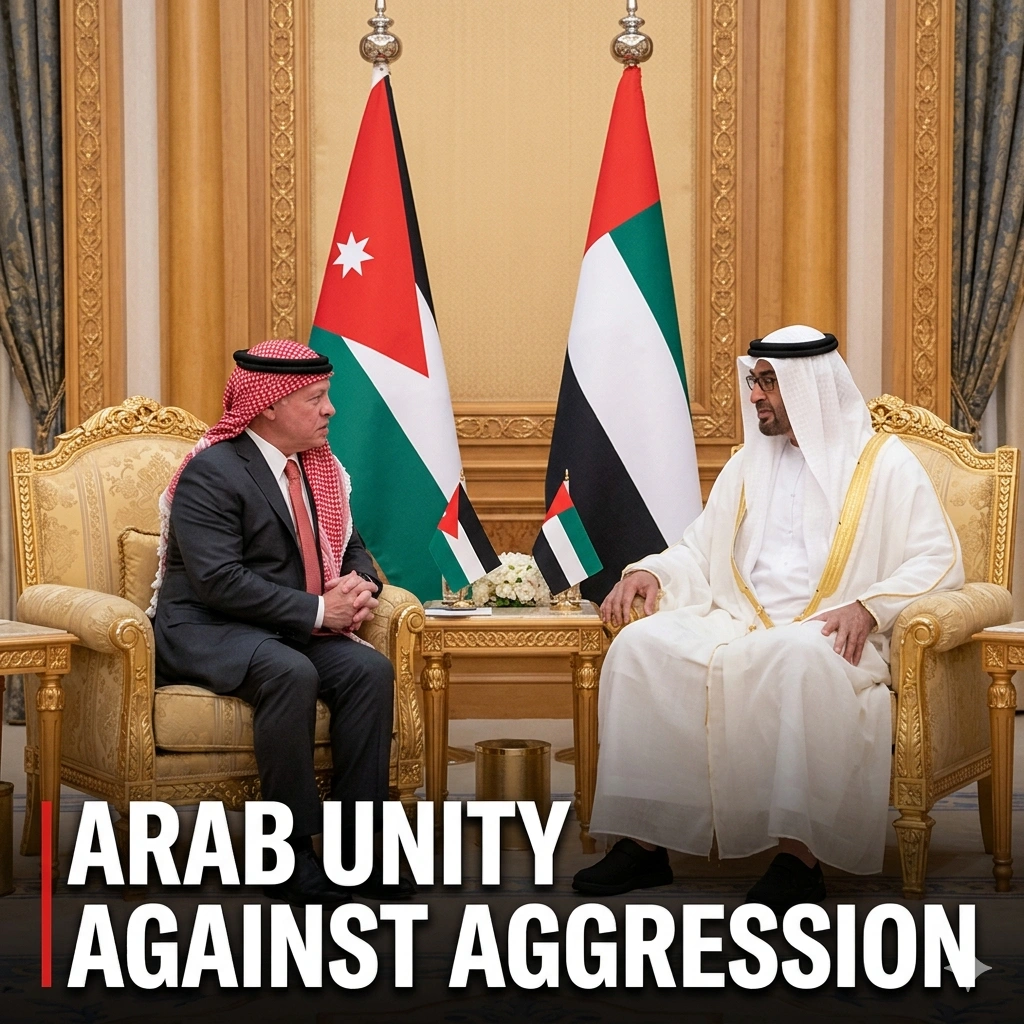
Addressing the Source of Condemn Iranian Aggression
The primary focus of the summit was the necessity for the international community to formally condemn Iranian aggression and take immediate steps to halt the ongoing military provocations. King Abdullah II stated that the repeated violations of national airspace and territory constitute a flagrant disregard for international law and the UN Charter. The UAE leadership echoed these sentiments, noting that the stability of global energy markets and trade routes is at stake if these hostilities continue unchecked. Both nations have recently been forced to activate advanced missile defense systems to protect civilian populations from incoming threats.
This diplomatic push is designed to move beyond rhetoric and toward a tangible framework for regional protection. The leaders are calling for a formal investigation into the origins of the attacks to ensure accountability on the global stage. By working in tandem, Jordan and the UAE hope to leverage their combined diplomatic weight to influence the United Nations Security Council. They believe that failing to condemn Iranian aggression now will only embolden further destabilizing actions in the months to come. The goal is to establish a clear “red line” that protects the territorial integrity of all Arab states.
The Call for a Unified Arab Response
A central theme of the discussions was the urgent requirement for a mobilized and unified Arab response to counteract external military pressures. King Abdullah II argued that the current fragmented approach to regional security is no longer sufficient in the face of sophisticated modern warfare. He proposed a more integrated intelligence-sharing network and a coordinated economic strategy to absorb the shocks caused by the conflict. This unified front would serve as a deterrent against any state seeking to exploit temporary vulnerabilities within the Middle East.
President Sheikh Mohamed bin Zayed Al-Nahyan supported this vision, suggesting that Arab unity is the most effective tool for de-escalating the broader regional war. The leaders are reaching out to other neighboring capitals to form a coalition that prioritizes Arab interests above external geopolitical agendas. Such a response would involve not only military coordination but also a unified diplomatic voice in international forums. They believe that a strong, collective stance is the only way to ensure that the region’s future is determined by its own people rather than outside powers.
Impact of the Regional Conflict on Jordan
Jordan has found itself in an increasingly precarious position as it attempts to manage the spillover effects of the ongoing hostilities. The kingdom has faced significant pressure on its borders, necessitating a massive mobilization of the Jordanian Armed Forces to maintain order. Beyond the immediate military threats, the economic burden of hosting displaced populations and securing trade routes has put a strain on national resources. King Abdullah II noted that his country remains a pillar of stability, but that stability requires active support from regional partners.
The King’s decision to condemn Iranian aggression is a reflection of the direct impact these actions have had on Jordanian internal security. The disruption of traditional supply chains has led to rising costs for essential goods, impacting the daily lives of millions of citizens. Despite these challenges, the Jordanian leadership remains committed to its role as a mediator and a guardian of regional peace. The summit in the UAE provided an opportunity for Jordan to secure necessary financial and strategic commitments to bolster its domestic resilience during this crisis.
UAE Leadership and Strategic Defense Measures
The United Arab Emirates has also been a target of the recent escalations, prompting a swift and comprehensive upgrade of its national defense protocols. President Sheikh Mohamed bin Zayed Al-Nahyan has overseen the deployment of cutting-edge technology to intercept aerial threats and protect the country’s high-value infrastructure. The UAE’s military readiness has been praised by international observers as a model for modern defensive operations. However, the President emphasized that technology alone is not enough; strategic alliances are the true foundation of long-term security.
By joining Jordan to condemn Iranian aggression, the UAE is demonstrating its leadership in the quest for a more stable Middle East. The country is utilizing its significant diplomatic influence to bridge gaps between various regional actors who share common security concerns. The UAE’s approach combines hard military power with “soft power” diplomacy to create a comprehensive shield against external interference. This dual strategy is intended to protect the nation’s economic achievements while contributing to the overall safety of the Arabian Peninsula and the Levant.
Protecting the Status Quo in Palestine
Amidst the broader regional turmoil, both leaders issued a stern warning against any attempts to alter the “status quo” in the Palestinian territories. They expressed deep concern that the current volatility is being used as a cover to impose new realities on the ground in Jerusalem, the West Bank, and Gaza. King Abdullah II, as the custodian of the holy sites in Jerusalem, reiterated that the Palestinian cause remains the central issue for the Arab world. Any shift in the administration or demographics of these areas would be met with fierce opposition from the unified Arab front.
The leaders argued that the global focus on the Iranian conflict must not result in the marginalization of Palestinian rights or the abandonment of the two-state solution. They called for a cessation of all Israeli military operations in Lebanon and a return to the negotiating table. By linking the current regional crisis to the Palestinian situation, they are highlighting the interconnected nature of Middle Eastern security. They believe that true stability can only be achieved through a comprehensive peace that addresses the legitimate aspirations of the Palestinian people.
Economic Resilience Amidst the Shocks of War
The month-long conflict has sent ripples through the regional economy, leading to what the leaders described as “significant economic shocks.” Oil prices have seen increased volatility, and international shipping insurance rates have skyrocketed due to the perceived risks in the Gulf and Red Sea. Jordan and the UAE are working on a joint economic task force to stabilize local markets and ensure the continued flow of essential commodities. This cooperation is vital for preventing the security crisis from turning into a full-scale humanitarian or financial disaster.
To combat these shocks, the leaders are advocating for increased intra-Arab investment and the diversification of trade routes. They are also looking at long-term energy security projects that can withstand the physical disruptions of war. The ability to condemn Iranian aggression effectively depends on the internal economic strength of the Arab nations. By shoring up their financial systems, Jordan and the UAE are ensuring they have the resources necessary to sustain a prolonged period of high alert and defense spending.
- The leaders agreed on a joint financial stability fund for regional partners.
- Trade agreements were signed to prioritize the movement of medical supplies.
- Energy ministers will meet next week to coordinate fuel reserves.
- Tourism sectors are receiving government subsidies to offset regional travel declines.
International Intervention and Diplomatic Pressure
The summit concluded with a direct appeal for immediate international intervention to prevent the conflict from expanding into a total regional war. King Abdullah II and President Mohamed bin Zayed called on the “Great Powers” to fulfill their responsibilities under international law to protect sovereign states from unprovoked attacks. They believe that a passive international stance will only lead to more chaos and a potential global economic meltdown. Diplomatic pressure must be applied to all parties to return to established norms of state behavior.
Specifically, they are looking for the implementation of stricter sanctions against entities that provide the technological or financial means for regional aggression. The leaders are also calling for an international peace conference that addresses the root causes of the current tensions rather than just the symptoms. They stressed that the Arab world is ready to be a constructive partner in this process, provided its sovereignty and interests are respected. The call to condemn Iranian aggression is a prerequisite for any meaningful dialogue or de-escalation effort moving forward.
Ending Military Operations in Lebanon
A significant portion of the discussion was dedicated to the deteriorating situation in Lebanon, which has become a secondary front in the regional struggle. The leaders emphasized the necessity of ending all external military operations on Lebanese soil to prevent the total collapse of the state. They expressed solidarity with the Lebanese people, who are caught in the crossfire of larger geopolitical rivalries. Restoring Lebanese sovereignty is seen as a key component of the broader plan to stabilize the Levant and reduce the influence of non-state actors.
Jordan and the UAE have pledged to provide humanitarian aid to Lebanon while also supporting its official military institutions. They believe that a strong Lebanese state is the best defense against the encroachment of external powers. The leaders argued that the international community must provide the Lebanese government with the resources it needs to assert control over its entire territory. This effort is directly linked to the broader goal of a unified Arab response that protects all member states from foreign interference and military aggression.
The Role of the Arab League in 2026
With the regional crisis reaching a fever pitch, the role of the Arab League has once again become a subject of intense debate and reform. King Abdullah II and President Mohamed bin Zayed are pushing for a more empowered Arab League that can take decisive action during security emergencies. They envision an organization that can go beyond symbolic resolutions to provide actual military and economic support to its members. The 2026 crisis has shown that the existing mechanisms for Arab cooperation must be modernized to meet the challenges of the 21st century.
This vision includes the creation of a permanent security council within the Arab League that can meet on short notice to condemn Iranian aggression or other threats. It would also involve the establishment of a joint defense fund and shared military training standards. By strengthening the central institutions of the Arab world, the leaders hope to create a self-reliant security architecture. This would reduce the region’s historical dependence on external security guarantees, which have often proven unreliable during times of extreme crisis.
Guarding the Holy Sites and Jerusalem
King Abdullah II used the summit to remind the world of Jordan’s historical and religious responsibility toward the Islamic and Christian holy sites in Jerusalem. He warned that any attempt by Israel or other regional actors to change the legal and historical status quo would be a “red line” for the entire Muslim world. The protection of these sites is seen as a matter of national security for Jordan and a point of honor for the UAE. They believe that religious tensions must not be allowed to further inflame an already volatile military situation.
The leaders called for an immediate halt to any provocative actions in the Old City and the surrounding areas of the West Bank. They emphasized that the dignity of the Palestinian people and their access to holy sites must be guaranteed even during times of war. By keeping the focus on Jerusalem, they are ensuring that the fundamental drivers of regional identity are not lost in the fog of modern military conflict. Their commitment to these sites remains unwavering, serving as a unifying force for the Arab response they are currently building.
Condemn Iranian Aggression
The leaders recognized that the battle for public opinion is as important as the physical defense of their borders. They discussed the need to counteract disinformation campaigns that seek to divide Arab nations and justify external military interference. To effectively condemn Iranian aggression, a clear and truthful narrative must be presented to the global public through every available diplomatic and media channel. Both nations are investing in strategic communication units that can quickly debunk false claims and present the Arab perspective to the world.
This effort involves working with international media outlets to ensure that the impact of the attacks on civilian populations is accurately reported. The leaders believe that transparency is their greatest weapon against those who operate in the shadows of proxy warfare. By providing a consistent and unified message, Jordan and the UAE are building international empathy and support for their defensive measures. The success of their diplomatic mission depends on their ability to win the “war of ideas” alongside the physical defense of their borders.
Future Outlook for Regional Stability
The coming months will serve as a test for the commitments made by King Abdullah II and Sheikh Mohamed bin Zayed. If the international community fails to condemn Iranian aggression, the risk of a miscalculation leading to a larger conflict remains high. However, the formation of a unified Arab front provides a much-needed layer of protection for the region’s people and economies. The leaders concluded the summit with a renewed sense of purpose, vowing to remain in constant contact as the situation evolves.
For the people of Jordan and the UAE, this summit represents a proactive step toward a more secure and prosperous future. The focus now shifts to implementing the financial stability funds and the joint defense initiatives discussed during the meeting. While the regional volatility is expected to continue throughout 2026, the partnership between Amman and Abu Dhabi serves as a beacon of stability. The world now watches as these two influential nations work to condemn Iranian aggression and restore peace to the Middle East.
- The leaders will host a follow-up summit in Amman next month.
- Strategic reserve centers for essential food items are being established.
- Cyber-defense cooperation will be prioritized to prevent infrastructure hacking.
Examining the Geopolitical Shifts
The decision to condemn Iranian aggression reflects a broader geopolitical shift where middle powers are taking more control over their own security destinies. Jordan and the UAE are no longer waiting for external guarantees but are instead building indigenous capabilities to counter emerging threats. This shift is likely to influence other nations in the region to follow suit, potentially leading to a more self-sufficient Middle East. The long-term impact of this summit could be the creation of a new regional order based on mutual defense and economic integration.
Experts suggest that the coordination seen between Jordan and the UAE will serve as a blueprint for other Arab states facing similar pressures. By combining Jordanian military expertise with the UAE’s technological and financial resources, they have created a formidable partnership. To condemn Iranian aggression successfully, they must maintain this level of synergy over a prolonged period. This alliance is not just about the present crisis but about defining the rules of engagement for the next decade of Middle Eastern politics.
Conclusion: A High-Level Strategic Front
The historic meeting on April 3, 2026, has set a clear path forward for the defense of Arab sovereignty against external military pressure. By moving to condemn Iranian aggression, King Abdullah II and President Mohamed bin Zayed have prioritized the safety and stability of their citizens above all else. The unified Arab response they are building will serve as the primary deterrent against future incursions into sovereign airspace and territory. As the regional war continues to test the resolve of all nations, the partnership between Jordan and the UAE remains a critical pillar of strength.
The world must take note of this collective stance and act to support the de-escalation of hostilities. The leaders have provided a framework for peace, but it requires the cooperation of the international community to be fully realized. The commitment to condemn Iranian aggression remains the central theme of their diplomatic strategy as they navigate the complexities of 2026. Ultimately, the success of this summit will be measured by the security and prosperity of the Arab people in the years to come.
For more details & sources visit: Arab News / WAM / Petra
Read more about Jordan news on 360 News Orbit – Jordan.